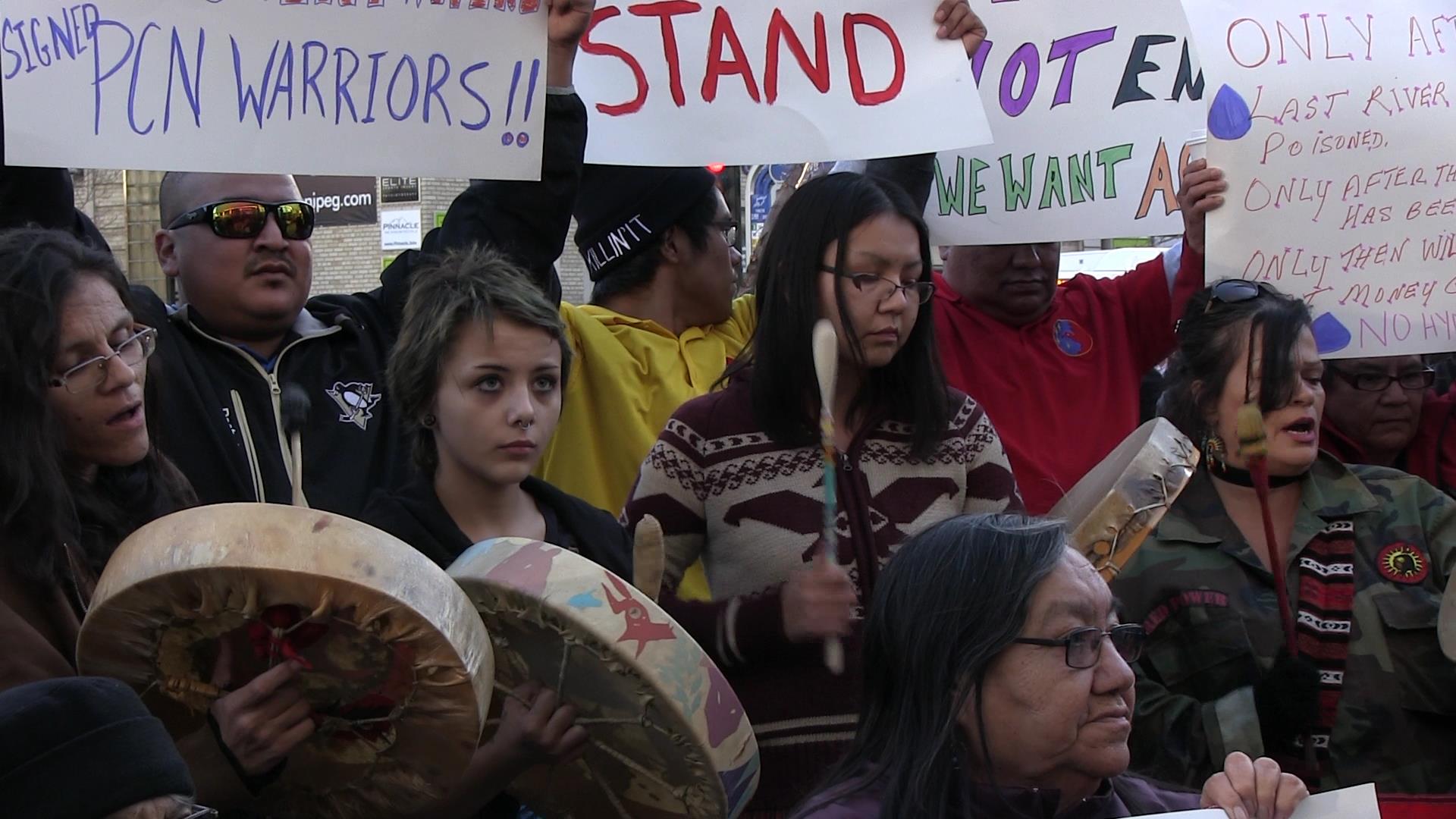
Oct. 23, 2014: Members and supporters of Pimicikamak Cree Nation rallied at Manitoba Hydro’s Winnipeg Headquarters to explain the reasons for their occupation of the Jenpeg Generating Station. Photo: Paul S. Graham
Yesterday, after a week-long occupation of the Jenpeg Generating Station, representatives of the Pimicikamak Cree of Cross Lake brought their protest to Winnipeg. Community members and local supporters rallied at Manitoba Hydro’s downtown headquarters to pray, sing and tell their story to Winnipeg media.
They began with a prayer and followed with a moment of silence and an honour song for Cpl. Nathan Cirillo, the young reservist murdered in the recent attack on Parliament Hill. Then representatives explained what led the community to evict Hydro staff from the Jenpeg housing complex and to occupy the generating station.
In a statement circulated on her behalf, Chief Cathy Merrick invites Winnipeggers to empathize.
“Imagine if the once pristine waters in the lake by your cottage became murky and the shoreline continually washed away. Imagine your favourite childhood camping sites eroded right off the map, your industries undercut, your favourite golf course denuded, your ancestors’ graves dug up, and your place of worship defiled. Imagine if you had to constantly fight for compensation and mitigation, while paying monthly bills to the victimizer.”
According to Merrick, the Pimicikamak are asking for “a public apology, a revenue sharing arrangement, environmental cleanup, a say in how water levels are managed, and aggressive Power Smart programs to reduce our bills.”
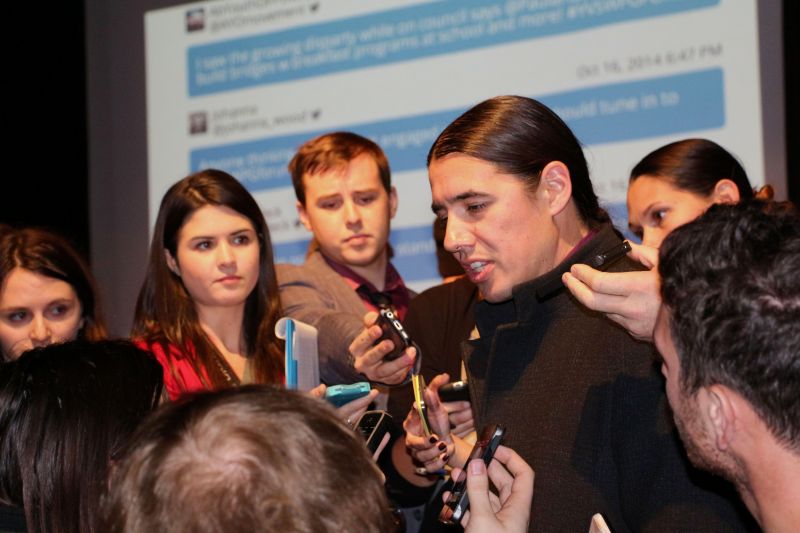
Winnipeg, Oct. 16, 2014: Robert-Falcon Ouellette speaks with students following a forum on youth issues at the Winnipeg Art Gallery. Photo: Paul S. Graham
This Wednesday, I’m voting for Robert-Falcon Ouellette. I believe he offers the best combination of progressive ideas and personal characteristics of all the candidates. Having voted in every Winnipeg civic, provincial and federal election since the 1970s I’ll go even further – Robert is the most promising candidate for mayor (or any other office) we have seen in a generation.
Robert proposes sensible ideas for fixing Winnipeg’s infrastructure and knows how we’ll pay for them. His plan to renew Winnipeg Transit is both practical and visionary. His proposals for standing up for indigenous women and girls will save lives. He’s serious about cleaning up City Hall and he walks the talk: unlike his competitors, he lists his contributors on his web site, in real time. As a grandfather, I’m pleased with his many creative ideas for a child friendly city and for a city our grandchildren will thank us for when they are old enough to vote.
There’s much more I could say about Robert’s platform. Visit his web site (links below) and judge for yourself. While I have your attention, I’d prefer to talk about Robert the man.
Born on Red Pheasant Cree Nation in Saskatchewan, Robert grew up poor. His father suffered from alcoholism. He’s been hungry and homeless and knows what it is like to live on next to nothing. Statistically speaking, he should be dead, in jail or poor.
Instead, Robert has defied the statistics that come with being born aboriginal and poor in Canada. At 37, he directs Aboriginal Focus Programs at the University of Manitoba. He, his wife Catherine, and their five children live in a comfortable home. During 18 years in the Canadian Forces he earned a Bachelor of Education degree, two Masters degrees (music and education) and a PhD in educational anthropology.
Robert credits his success to his mother’s sacrifices and the support he received from a high school teacher. However, without his own considerable intelligence, hard work and self discipline he would not have come this far.
Robert is youthful and energetic, but thoughtful and mature. He’s self confident, yet modest. He’s self-aware but not self-absorbed; without exception, he treats everyone with genuine interest, respect and warmth. He communicates fluently in English, French and Cree. He likes to laugh, dances a pretty good Red River jig, sings on key and plays a mean piano.
Robert says he wants to be “a mayor for everyone.” Not content with cleaning up City Hall, he aspires to unite a city that is divided along racial, ethnic and class lines. This is a tall order, but if anyone can, it’s Robert-Falcon Ouellette.
A poll came out this morning that puts Robert in third place with the support of 14% of decided voters. This is a remarkable achievement for a candidate who was completely unknown when he declared his candidacy in late May.
The two front-runners, Brian Bowman and Judy Wasylycia-Leis, are in a statistical dead heat with 38 and 36 percent of the decided vote respectively. With 29% of those polled in the undecided category, this race is too close to call.
I expect Robert’s supporters will feel considerable pressure to abandon him. “Vote strategically. Don’t waste your vote,” we will be advised. We’ll be warned that “it’s the only way to stop ___________ (pick your favourite ‘villain’).”
I don’t accept these arguments. For starters, a careful analysis of the front-runners’ programs reveals no significant differences. Neither candidate promises the break with the past we need for Winnipeggers to meet the many challenges we face. Neither candidate has demonstrated the skills or attitudes needed to unite a divided city. One is as good or as bad as the other.
My philosophy is simple: You get what you vote for. The only sensible thing to do is to vote for what you really want. For me that means voting for Robert-Falcon Ouellette.
If Robert wins, great! If he doesn’t, his ideas will have to be taken seriously, especially if he attracts a significant share of the ballots cast on Wednesday. These votes will provide the foundation, not only for future campaigns, but for the movement for real change that must be built and sustained far into the future.
In April 2014, the government that had come into power two months earlier in Ukraine launched what it termed an “anti-terrorist operation” against the people of Eastern Ukraine.
The easterners were opposed to the government’s plans for economic association with Western Europe and were demanding a greater voice in central government decisions.
That political conflict, NATO’s backing of Kyiv against Moscow, and the large-scale humanitarian crisis created by the war have shaken the political foundations of Europe and ushered in a new Cold War.
Roger Annis is a Vancouver-based writer who attended an antiwar conference in Yalta, Crimea on July 6th and 7th. Conference delegates included Ukrainians, Russians and antiwar activists from Europe and North America.
Roger talks in depth about the origins of the conflict, the anti-Russian propaganda offensive in the West, the rise of neo-fascism and other recent developments in Ukraine, and what must be done to bring peace to this part of the world.
Winnipeg, Sept. 23, 2014: CBC News reporter (and panel moderator) Sean Kavanagh snaps a selfie with mayoral candidates at North Centennial Community Centre, proving some journalists will bend over backwards to get the story. Photo: Paul S. Graham
On October 22, 2014, we Winnipeggers will elect a new mayor. With seven in the running, and the avalanche of announcements continuing to grow, it is difficult knowing who said what.
Mainstream media outlets tend to be selective in what they cover and often oversimplify what candidates have to say. It’s difficult to get a complete picture.
To help you deepen and broaden your knowledge of the candidates, what they say and how they present themselves, I’ve been recording mayoral debates. So far, I’ve recorded four debates where candidates present their views and one very interesting forum where citizens talk and the candidates listen.
I’ve stitched them into a YouTube playlist where you can see the candidates in action, unedited and unfiltered. This is unbiased coverage you will find nowhere else. The only spin you get is that which the candidates choose to offer.
I know – information overload. But the stakes are high and it’s worth investing the time. We’ve had ten years of lousy government at City Hall and with this election, we have a chance to do better
Make an informed choice. Click on the link below to watch these debates:
Winnipeg, July 19, 2014: Winnipeggers march in solidarity with the people of Gaza. Photo: Paul S. Graham
July 19, 2014: Several hundred Winnipeggers rallied in front of the Canadian Human Rights Museum in solidarity with the people of Gaza who are enduring yet another murderous invasion by Israeli forces. The rally, the second in a week, was part of an international day of action.
Here’s my video report, featuring:
• Krishna Lalbiharie, Canada-Palestine Support Network (Winnipeg)
• Rana Abdulla, Canadian Palestinian Association of Manitoba
• Terrance Nelson, Grand Chief, Southern Chiefs Organization
• Daniel Thau-Eleff, Independent Jewish Voices (Winnipeg)
• Bassam Hozaima, Canada-Palestine Support Network (Winnipeg)
• Glenn Michalchuk, Peace Alliance Winnipeg
The demonstration was sponsored by
• Canadian Palestinian Association of Manitoba
• Canada-Palestine Support Network (Winnipeg)
• Independent Jewish Voices (Winnipeg)
• Peace Alliance Winnipeg
• Winnipeg Coalition Against Israeli Apartheid (WCAIA)
Winnipeg, Feb. 17, 2014: Suzanne Patles of the Mi’kmaq Warriors Society, speaking at Thunderbird House. Photo: Paul S. Graham
It is time to “warrior up” according to Suzanne Patles of the Mi’kmaq Warriors Society. She spoke at Thunderbird House in Winnipeg on Feb. 17, 2014 as part of a national tour to raise awareness about the struggle at Elsipogtog First Nation against shale gas fracking and police repression, as well as their ongoing assertion of nationhood.
Their blockade in opposition to shale gas fracking at Elsipogtog First Nation (located in Kent County, New Brunswick) came to national attention on October 17, 2013 when the it was attacked by dozens of RCMP officers armed with assault rifles, pepper spray and dogs.
Forty members of the blockade were arrested, and a number of members of the Mi’kmaq Warriors Society face charges.
Seen at the opening of the video is the Keewatin Otchitchak Traditional Women’s Drum Group, which performed at various times during the evening.
Winnipeg, Jan. 21, 2014: Niigaan James Sinclair, speaking at the “Gift of Treaties” teach-in organized by Idle No More Manitoba. Photo: Paul S. Graham
A standard dictionary definition of the word “treaty” will describe it, rather drily, as a formal agreement between two or more states – an instrument of international relations commonly used to make peace, cement alliances, enable commerce, and so on.
For Anishinaabe scholar and activist Niigaanwewidam James Sinclair, treaties are gifts which oblige the signatories to accept and value each as equals. Treaties, says Sinclair, are as old as creation and inextricably embedded in the spiritual beliefs and traditions of aboriginal people.
Sinclair is an assistant professor at the University of Manitoba and a regular commentator on indigenous issues on CTV, CBC, and APTN.
He spoke at a teach-in organized by Idle No More Manitoba on Jan. 28, 2014 at the Circle of Life Thunderbird House in downtown Winnipeg.
Several hundred members and supporters of Idle No More gathered at the centre court of the Polo Park Mall in Winnipeg Friday evening to sing and to dance. Some are calling it Idle No More 2.0. Idle No More Manitoba spokesperson Michael Kannon explains why in this video report.
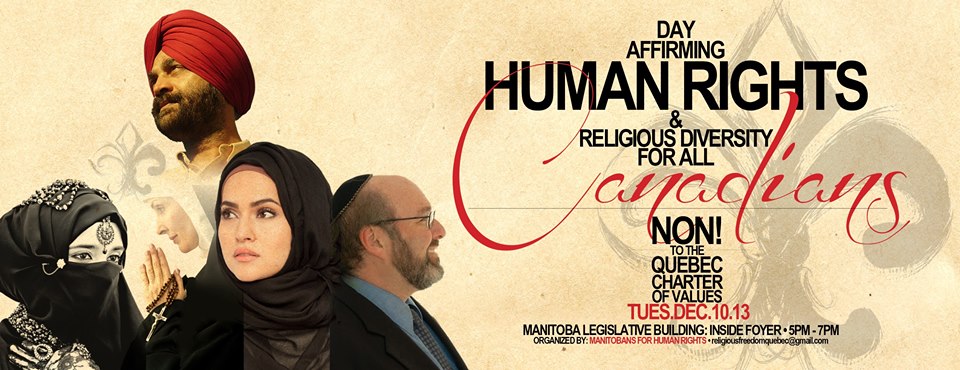
Because the assumptions that underpin Quebec’s Bill 60 occupy the same racist mindset that drove the Canadian government’s decision in the 19th Century to set up the Indian Residential School system, it was fitting that local Idle No More activists capped Winnipeg’s “Day Affirming Human Rights and Religious Diversity for All Canadians” with a round dance.
The bill is controversial across Canada because of a provision to prohibit public employees from wearing “objects such as headgear, clothing, jewelry or other adornments which, by their conspicuous nature, overtly indicate a religious affiliation” while at work.
About 200 people crowded into the foyer of the Legislative Building to listen to speakers address Bill 60 from a variety of perspectives. Shahina Siddiqui, executive director of the Islamic Social Services Association, welcomed the audience, thanking them for coming out “to stand in solidarity with all other Canadians across the country, affirming our human rights for all Canadians, and our religious diversity.”
Art Miki, former president of the National Association of Japanese Canadians, questioned the sincerity of Bill 60′s framers. “The Quebec government [says] that their goal is to defend equality between men and women and to encourage equality and harmonious relations amongst all people . . . the National Association of Japanese Canadians sees the values expressed in the proposed [Quebec] charter to be contrary to the values expressed in the Canadian Charter of Rights and Freedoms . . . We want guarantees to the right of freedom of expression, freedom of religion, and freedom to manifest one’s religion.”
John Harvard, a former journalist, Member of Parliament and Lieutenant Governor of Manitoba said that “This invidious piece of legislation has been moved in the name of secularism in a further attempt to exclude religious considerations from the area of government. Well, ladies and gentlemen, I am a secularist and I say ‘Thanks, but no thanks.’ ”
Rabbi Alan Green, senior rabbi at Congregation Shaary Zedek described the terminology of the bill as “Orwellian in effect if not in intent.” He continued: “Maintaining religious, ethnic and cultural traditions has always been respected and promoted in Canada. . . [The Quebec charter] represents nothing short of an attack on the open, inclusive, pluralistic Canada we have all known and loved these past many years.”
Bernice Cyr, executive director of the Native Women’s Transition Centre questioned the right of a government to restrict human rights, saying “Human rights are a foundational component of every person’s value in our country. The fact that other people are voting on them – it doesn’t even make sense . . . Rights are not not meant to be voted on. They are meant to [be upheld].”
Marie Lands, a social worker and advocate for aboriginal rights, said Bill 60 seemed all too familiar. “When I started paying attention to this particular bill, I find it quite appalling . . . because our aboriginal people know very well what that means. What it means is that it takes away everything of your identity, of your culture and of who you are and assimilates you into something that you don’t know who you are anymore. We have a whole nation that is struggling to try and reconnect to who they are and what they have lost in their whole lives.”
Dr. James Christie, director of the Ridd Institute for Religion & Global Policy at the University of Winnipeg, said that the bill is being driven by the political ambitions of Premier Pauline Marois. “She would be delighted if it failed before the Supreme Court of Canada in a challenge around the Canadian Bill of Human Rights or Charter of Human Rights and Freedoms. Why? Because Madame Marois doesn’t care about religion, yours or mine. Madame Marois cares about Madame Marois’ political agenda for Quebec. . . People of her own political stripe think that this is a wicked and intolerable thing. But Madame Marois doesn’t care because Madame Marois wants to drive a wedge between the people of Quebec and . . . the rest of Canada.”
The evening ended on an uplifting note, with short speeches by two members of Idle No More Winnipeg, and a round dance.
Holding a wreath of braided grasses, Michael Kannon asked the audience: “How long are you really going to be here?” and answered: “A long, long, long time. Canada is young. We’ve assembled this brief cross-section of who we really are as human beings in this place. For the next couple of hundred years this building is going to be alright but we’re going to be around to build it again. That’s how long we’re going to be here, all of us. I want each and every one of you to remember that. Such a long time we will be together in the future. So now, in this day and in this moment in 2013, we should start really looking at how do we treat each other. How do we share? How do we weave ourselves into that rhythm and braid that is Canada? . . . Our families and our children – how are they going to weave together in a nice balance? . . . That is what First Nations have been working for for thousands of years.”
Raising her hand drum high, Ko’ona Cochrane invited the audience to participate in a traditional round dance. “Behind this drum you see the four directions and you see all nations represented in the centre of this drum. No matter who you are, no matter what your belief, no matter where you are on the globe, you are represented on this drum. You are here on my ancestral lands; welcome to Treaty One. . . These are our homelands. We invite you here to share and to participate with us. We honour this round dance and we want to offer it to you and ask you to join us. The round dance is a spiritual dance. It’s a dance of reciprocity. We’re holding hands; your right hand is connected to the left hand of the person beside you. In our teachings we receive with our right and we give with our left. In order for you to be a whole and balanced human being you have to be always receiving and giving.”
The round dance, the singing and the speeches can be found in my video report.
TransCanada Pipelines’ proposed “Energy East” pipeline project, which is intended to transport Alberta tar sands crude to eastern Canada, is meeting growing opposition from First Nations, environmentalists and citizens who live along the planned route.
The Winnipeg chapter of the Council of Canadians, along with Idle No More and the Boreal Forest Network held a public forum on the issue on October 22, 2013. Speakers included Maryam Adrangi, the Council of Canadians’ Energy and Climate Campaigner, and Crystal Green, Michael Kannon and Nina Was’te of Idle No More. The forum was moderated by Susan McCrea of the Boreal Forest Network and held at the Mondragon Book Store and Coffee House.
Ken Harasym recorded and I edited this video report.