Adopted by the UN General Assembly in 2007, the declaration was initially opposed by the Harper government but eventually endorsed by Canada in 2010. Bill C-262 is essentially the same as a bill Saganash introduced during the Harper government. While the Conservatives were unwilling to support it, the (then) Opposition Liberals did promise to vote for it. Saganash says the Trudeau government has so far been noncommittal with regard to this bill.
Saganash played a key role in the development of the UN Declaration on the Rights of Indigenous Peoples, a process that took 23 years. He was in Winnipeg recently and spoke with students at the University of Winnipeg about the benefits this legislation will provide indigenous peoples in Canada, if it is passed by Parliament. Passage is by no means assured and Saganash is calling on Canadians to lobby their Members of Parliament to support the bill.
Manitoba’s Progressive Conservatives won a majority government last week, leaving many left-of-centre citizens feeling somewhat shell-shocked and adrift on a sea of uncertainty after 17 years of predictable but increasingly unsatisfactory NDP government. Even though the outcome had been foreseen for many months by all but the most optimistic Dippers, many professed shock that the same people who had voted last fall to oust the federal Harper Conservatives would turn around and vote in their provincial kissing cousins. (Many of the same folks have expressed surprise that Sunny Ways Trudeau is beginning to break their hearts, but I digress.)
For over a year now, it’s been clear that the election was Brian Pallister’s to lose. There are many reasons for this, but Pallister’s charisma and charm were never factors. Even though Pallister runs behind his party in terms of popularity, Manitobans so disliked Greg Selinger and/or the NDP that they were even willing to vote Progressive Conservative if that is what it would take to get rid of them. And vote Tory they did, giving the Pallister PCs 53.4% of the vote and 40 seats in a 57-seat legislature. While the NDP were reduced to 14 seats, the Liberals overcame the many rookie gaffes of the feckless Rana Bokhari to win three seats. Even the Greens saw an improvement in electoral fortunes, very nearly winning the riding of Wolseley, long an NDP stronghold.
Not surprisingly, anxiety stalks the land — at least that portion of it occupied by folks who believe in a major role for the public sector and/or those who depend upon it for programs, services and employment. That fear is probably justified. Tory times typically have been tough times and Pallister’s promises to protect the jobs of front-line government workers have not been particularly convincing. Still, as challenging as this situation is, I think it offers some exciting possibilities for Manitoba’s Left, broadly defined.
For progressive thinkers within the NDP, the party’s electoral humiliation offers the opportunity for critical reflection and the possibility for renewal. This will not be easy in a party that is as divided and beaten up as this one has been. It will take years and a willingness to confront some ugly truths about what the party has allowed government to do in its name. I hear distant rumblings that this process is beginning.
Unaffiliated Lefties are faced with choosing between involvement in party politics (and not just within the NDP) and perhaps escalating their involvement in movement politics (labour, indigenous rights, environmentalism, human rights, peace, feminism, LGBTQ, etc., etc.) A new player is emerging on the scene called Solidarity Winnipeg which seeks to unite progressive elements to oppose the anticipated Tory austerity project and promote the Leap Manifesto. It is early days for Solidarity Winnipeg, but I’m reminded of CHOICES!, a loose association of lefties that did some very creative and productive political work in the 1990s but dissolved as soon as the NDP regained power.
Another choice for progressive Manitobans lies with the Green Party of Manitoba. While it is fashionable in some Left circles to dismiss the Greens as “conservatives who compost,” this criticism is usually made by people who have not taken the time to read, much less understand, the party’s platform. (Full disclosure: I’ve been a Green for a few years now.) If they had, they would easily conclude that federally and provincially the Greens are to the left of the NDP on most issues.
In Wolseley, the provincial riding where I live, we doubled the Green vote and very nearly toppled the NDP incumbent. Greens made gains in numerous other constituencies as well. Our growth was based, I would argue, on a platform that was fundamentally more progressive than anything on offer from the other parties. These gains show that there is a growing appetite for a politics that promises to care for the earth while caring for each other.
What’s a Lefty to do in Manitoba? You’ve read my take. I’d love to read yours.
Green Party of Manitoba candidate in Wolseley, David Nickarz. Photo: Paul S. Graham
Next April, Manitobans will elect a new government. Based on recent polling, if that election were held today, the winners would likely be the Progressive Conservatives. A September 2015 poll of 1000 Manitobans by Probe Research indicates 45 per cent of decided voters province-wide would vote PC; the governing NDP was tied for second place with the Liberals, at 20 per cent.
Of course, having the most votes doesn’t guarantee one the election in our antiquated first-past-the-post electoral system. Support for the PCs is overwhelming outside of Winnipeg (where the Tories have 59 per cent of decided voters and NDP holds third place with 16 per cent). But in Winnipeg, where a slim majority of the seats are, the situation is more competitive; the Tories and Dippers are in a statistical tie (35 and 32 per cent respectively) and the Liberals are beginning to challenge at 27 per cent.
Despite being almost invisible, the Liberals have shown steady growth among decided voters both outside and inside of Winnipeg. NDP support has declined in lock step with Liberal advances while Tory vote in and outside Winnipeg has remained fairly stable. If the Tories do win next year it will likely be because the NDP hemorrhaged crucial support to the Liberal Party.
Given that the Liberal Party has not done anything to date to distinguish itself, the NDP could still win this one if it can convince soft supporters that a Liberal vote is not only a wasted vote, but a dangerous vote because it will lead to victory for the dreaded Tories. At this point, it’s anybody’s guess.
Whether the next government is formed by Dippers or Tories, the outcome will be the same in at least one very important respect – it will be business as usual. Neither party has shown real interest in or capacity for discussing the major issues of the day, much less offering solutions. (The same goes for the third party in the Legislature, with its promise to allow Uber to compete with taxi companies, but I digress.)
As serious as these are, they pale in comparison to the existential challenge posed by climate change. Whether or not Manitoba matters in the overall scheme of things, the province has consistently failed to meet its own carbon emissions targets and, recent announcements notwithstanding, shows no sign that anything is about to change.
As well, the province has shown no interest in stopping the TransCanada Energy East Pipeline – a project that is will enable the expansion of the Alberta tar sands. Not only is tar sands expansion a driver of global climate change, the pipeline itself is an environmental menace that should have no place in Manitoba.
So, as you may have guessed, I’m not at all optimistic about the outcome of the next election. I do, however, have reason to hope that we will see the beginning of change in my little part of the province.
I reside in the provincial constituency of Wolseley – a neighbourhood in central Winnipeg where the Green Party of Manitoba has placed second in each of the last three elections.
This time around, the Green candidate is David Nickarz. I like him and think he’d make a great MLA. He’s youthful, mature, energetic, intelligent and a seasoned environmental campaigner. You can read his bio, here.
I’ve decided to support his bid for office because we need to have at least one Green voice in the Legislature. Neither of the likely winners will provide this. The NDP has had more than a decade to deliver on the environment and in some regards we have moved backwards. As for the Tories, the environment is not even on their radar.
And so Dave Nickarz will have my vote and my volunteer time. If the Greens will make a breakthrough anywhere in Manitoba, it will be in Wolseley. As shop-worn as the phrase is, it really is time for a change.
Winnipeg, June, 5, 2015: At the Manitoba Legislative Building, Maeengan Linklater answers journalists’ questions about his proposed Manitoba Indian Residential Schools Genocide and Reconciliation Memorial Day Act. Photo: Paul S. Graham
I’m rather taken with a draft Act that was made public yesterday on the steps of the Manitoba Legislature that would set aside one day a year, called Manitoba Indian Residential School Genocide and Reconciliation Memorial Day, to reflect on and reaffirm our commitment to truth and reconciliation.
According to Maeengan Linklater, the proponent of this resolution, adopting the Act would help achieve the following:
Continue the healing for those survivors, families and communities;
Reaffirm the safety and protection of Aboriginal children from emotional, physical, and sexual abuse;
Reaffirm, recognize and acknowledge Aboriginal people and governments as self-governing and nation-to-nation in their relationships with the Government of Canada and the Province of Manitoba; and,
Educate all Canadians about the Indian Residential School experience.
The use of the word “genocide” makes this is a provocative name for a provincial holiday. It is precisely the provocative nature of the word that makes it so valuable. Most Canadians are in a state of denial regarding the injustices perpetrated against indigenous peoples and badly in need of some straight talk.
I recorded Maeengan’s launch of the Act, following him through the halls of the Manitoba Legislature to capture the responses of representatives of four political parties. I’ve also (see below), published the draft Act. I hope the Manitobans reading this post will get behind it and get in contact with their Members of the Manitoba Legislature.
Wouldn’t it be cool if Canadians in other parts of the country tried to beat us to the punch and get similar laws enacted in their provinces?
Manitoba Indian Residential School Genocide and Reconciliation Memorial Day Act
WHEREAS between the years 1870 and 1996, 150,000 Indian, Metis, and Inuit children in Canada were removed from their families and communities to attend residential schools.
WHEREAS, the ‘Prevention and Punishment of the Crime of Genocide’ (adopted by Resolution 260 (III) A of the United Nations General Assembly on 9 December 1948, includes “Forcibly transferring children of the group to another group,” and the actions taken to remove children from families and communities and to put them in residential schools meets this definition of a “genocide”.
WHEREAS the goals of the Indian Residential School system were to “remove and isolate children from the influence of their home, families, traditions, and cultures, and to assimilate them into the dominate culture”.
WHEREAS the Government of Canada recognized that many of the children experienced emotional, physical, and sexual abuse, lived in conditions of neglect, and were forbidden to learn, or practice, their culture, and to speak their language.
WHEREAS on June 11, 2008, the Government of Canada made a Statement of Apology – to former students of Indian Residential Schools to initiate healing and reconciliation between the Aboriginal community and Canada.
WHEREAS efforts have been launched nationally to lead to reconciliation including the Indian Residential Schools Settlement Agreement and the Truth and Reconciliation Commission of Canada.
WHEREAS on June 2, 2015, the Truth and Reconciliation Commission of Canada recognized the establishment and operation of residential schools was a central element of assimilative policies that can be best described as cultural genocide.
WHEREAS the Truth and Reconciliation Commission recommended that the United Nations Declaration on the Rights of Indigenous Peoples be the framework for reconciliation at all levels and across all sectors of Canadian society.
WHEREAS setting aside one day a year for such a day will provide an opportunity to focus on understanding and reconciliation including to:
a. Continue the healing for those survivors of residential schools, their families, and communities;
b. Reaffirm the safety and protection of Aboriginal children from emotional, physical, and sexual abuse;
c. Reaffirm, recognize, and acknowledge, Aboriginal peoples and governments as self-governing, sovereign, and nation-to-nation, in its relationship with the Government of Canada and the Province of Manitoba; and,
d. To educate all Manitobans about the lessons of the Indian Residential School system, and its continuing impacts in today’s society.
WHEREAS the Legislative Assembly of Manitoba is committed through legislation and education, to support the revitalization of Aboriginal communities that enable Aboriginal people to reach their full potential, and to bridge efforts of reconciliation of Aboriginal people and the people of Manitoba.
WHEREAS on June 2, we will remember, for we must never forget.
THEREFOR HER MAJESTY, by and with the advice and consent of the Legislative of Manitoba, enacts as follows:
Manitoba Indian Residential School Genocide and Reconciliation Memorial Day
In each year, June 2, to be known as Manitoba Day for Understanding and Reconciliation in Relations to the Indian Residential Schools.
Who, aside from the occasional professional grump, has not taken delight from the sound of children’s laughter and marveled at their ingenuity as they play at being pirates and princesses, artists and acrobats, witches and warriors? Child’s play is fun to watch and fun to join in (even with the aches and pains my grandfatherly body suffers from after a visit with the grandkids).
There is a serious side to play, though, one I had never considered until I met with some remarkable women who are in the midst of an ambitious project in the heart of Winnipeg’s North End.
For the past seven years, they have been running a program called North End Stay and Play, the objective of which is to provide children and their families a place to play together and together to learn the benefits that play provides.
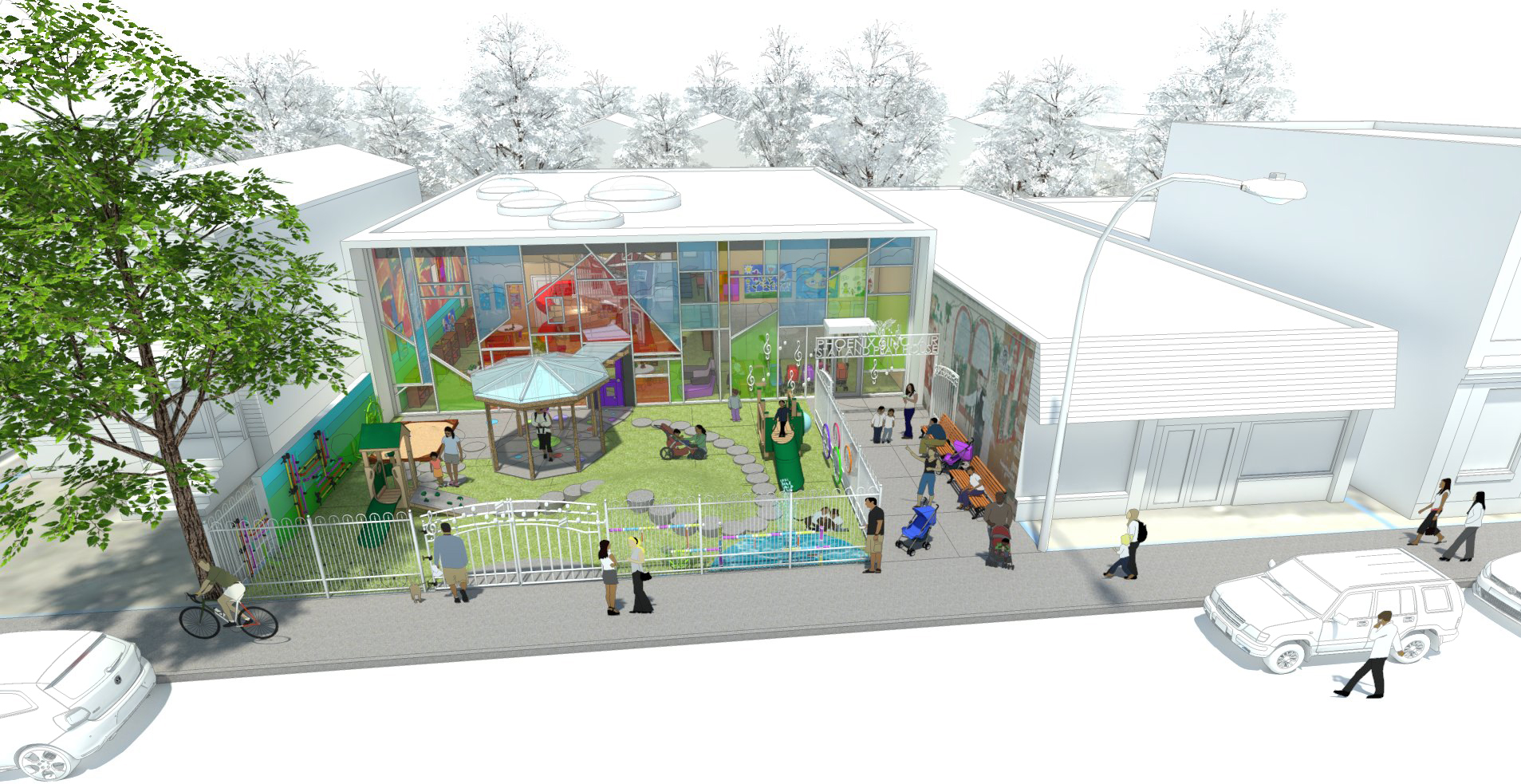
NESP has been running on a modest budget and has only been able to operate one afternoon a week, usually out of a donated church basement, but they have a dream that they are working very hard to fulfill – a new, custom-built play house on Selkirk Avenue that will operate five or six days a week. It will be called the Phoenix Sinclair Little Stars Playhouse.
The facility’s name commemorates the life of Phoenix Sinclair, a little girl who was murdered in 2005 under circumstances that demonstrate the need for building strong, healthy families. You can read the report of the Hughes Inquiry into the circumstances surrounding her murder here.
I made this little video to introduce the concept and to help them raise the money they need to build it. Please watch the video, share it with your friends and consider making a donation.
To make a donation:
Either make your cheque payable to “Woman Healing for Change Inc.” and send to Assiniboine Credit Union, 655 Henderson Hwy, Winnipeg, MB, R2K 2J6, Account no. 100101102192. WHFC,a registered nonprofit charity, will provide a receipt for all donations over $20, or
Make your cheque payable to United Way Winnipeg and note on the cheque that your United Way donation is for “Woman Healing For Change, Charitable no. 891621864RR0001 for Phoenix Sinclair Playhouse.”
March 14, 2015: About a thousand people rallied at Winnipeg City Hall and marched through Winnipeg to share their opposition to Bill C-51, a federal Conservative omnibus bill that will, in the guise of fighting terrorism, undermine constitutionally protected civil liberties in Canada. Similar events took place in more than 40 communities across Canada.
Introduced into Parliament on Jan. 30, 2015, Bill C-51 is an omnibus bill that will undermine constitutionally protected rights and freedoms of Canadians in the guise of combating terrorism. Prime Minister Stephen Harper’s bombastic, saber-rattling YouTube video, published 2 days before the bill was tabled, set the tone. Essentially, Canada is under attack and the government will do whatever it takes to protect Canadians.
Critics of C-51 argue that it will criminalize speech, make it easier to arrest people who police think might commit an offence, share citizen’s private information between government departments without oversight, and allow the Canadian Security Intelligence Service to have police-like powers and disrupt the organizations they are spying on, all under a veil of secrecy.
The Anti-Terrorism Act has come under expert legal scrutiny. Craig Forcese is a law professor teaching national security law at the University of Ottawa and a participant in the Canadian Network for Research on Terrorism, Security and Society. Kent Roach teaches at the University of Toronto law faculty and worked with both the Arar and Air India commissions. They have set up a website to present their analysis. This is well worth reading.
Bill C-51 passed second reading in the House of Commons on Monday evening, with 176 Liberals, Bloc Quebecois, and Conservative members voting in favour. Only the the NDP, Greens, and an independent conservative, Brent Rathgeber, opposed the legislation.
Does this mean the jig is up? Not by a long shot. There is still time to let your MP know there will be a political price to pay for supporting this police state bill. Contact your Member of Parliament and tell him/her to vote against Bill C-51. If you don’t know how to make contact, follow this link.
Map of Proposed Energy East Pipeline route. Source: National Energy Board
Energy East Pipelines, Ltd., a wholly owned subsidiary of TransCanada Oil Pipelines (Canada), has applied to build the Energy East Pipeline, a project that will use aging natural gas pipelines along most of its route to move explosive, toxic diluted bitumen from the Alberta oil sands to refining facilities on Canada’s east coast.
The plan is fraught with risks to human health and the natural environment, but the National Energy Board, the federal regulatory body charged with assessing the suitability of this project, seems determined to turn a blind eye to the most serious ones.
The elephant in the room that the NEB is most anxious to ignore is the climate change that will be unleashed by the continued development of the Alberta oils sands, a northern Alberta mega project that will strip-mine an area the size of Nova Scotia and in so doing, will unleash enough carbon to push the world to the edge of uncontrolled climate change. Without pipelines, oil sands development will shrivel, and with it, the potential for further environmental damage.
In Winnipeg, a citizens’ coalition has challenged the National Energy Board to “consider the full scope of the proposed project’s environmental and human impacts, including upstream and downstream effects.”
Here’s video I recorded at its December 8, 2014 news conference in Winnipeg. Below is the text of the coalition’s open letter to the NEB.
An Open Letter to the National Energy Board on TransCanada’s Energy East Pipeline
Dear Mr. Watson,
We, the undersigned, are writing to urge the National Energy Board to amend its review of TransCanada’s proposed Energy East pipeline. We believe that the review process must consider the full scope of the proposed project’s environmental and human impacts, including upstream and downstream effects. Any regulatory review should include not only the impact of the pipeline itself, but also the cumulative impacts of producing, refining, and burning the oil that would flow through it, if the project were approved.
If the NEB continues to refuse to assess upstream and downstream impacts you are leaving essential questions unanswered:
What are the global climate impacts of burning the oil this pipeline carries?
Understanding that this project would enable tar sands expansion, what consequences would Energy East have on the world’s ability to keep global average temperatures below a 2 degree Celsius temperature rise?
What would be the economic and health effects of increased tar sands production on communities, including First Nations communities, near the tar sands and along the pipeline?
What are the projected economic costs of the national and global climate impacts associated with any project which increases tar sand production? Who would be most likely to bear these costs?
What kinds of climate adaptation plans would be required based on the climate impacts of this proposed project? Who would develop them? Who would pay for them, and how?
Without a full and transparent accounting of the global climate impacts and associated economic and health costs of this project, we cannot in good conscience consider the National Energy Board to be acting in the best interest of Canadian families. Without including these critical questions, how can we believe the NEB to be undertaking a legitimate review of the proposal?
It is in your power to add these areas of concern to the “list of issues” for consideration. If it is currently outside the scope of the regulatory powers of the NEB to address these questions, we urge you to exercise exemplary moral leadership and refuse to review this pipeline and petition Parliament to grant you the legal authority to do so.
It has been said of Stephen Harper that he never saw a war he didn’t like. So it should be no surprise that he has been unabashedly at war with the environment since gaining power in 2006.
Whether it has involved shutting down world class environmental research, muzzling scientists, gutting environmental protection laws or attempting to demonize environmental activists as terrorists, Harper’s strategic objective has been to facilitate the corporate rape of our natural resources. He has pursued this objective with no regard for the health of our land, air and water, our people or the generations to come.
Despite Harper’s best efforts, Canadians are fighting back and opposition, in the form of demonstrations, occupations, road blocks and court battles, grows daily. Following are three recent presentations I have recorded of people who are making significant contributions to this fightback.
Dennis LeNeveu: Stop the Energy East Pipeline
Dennis LeNeveu is a retired scientist who worked for many years in the field of nuclear fuel waste management and radiation and industrial safety. In this presentation he discusses the many reasons Canadians show oppose the proposed TransCanada Pipeline Energy East Project, a proposal that he says risks the health and safety of the environment and the many people who live along its route. His presentation is available here.
Chris Turner: Stephen Harper’s War on Science
Chris Turner is the author of The War On Science: Muzzled Scientists and Wilful Blindness in Stephen Harper’s Canada. He spoke about Stephen Harper’s campaign to suppress Canadian science at the Fort Garry Hotel in Winnipeg on November 6, 2014. His presentation was sponsored by the Boreal Action Project. His presentation is available here.
Diane Orihel: Big Dreams, Big Science: Saving Canada’s Experimental Lakes Area
On November 6, 2014, Dr. Diane Orihel spoke on the struggle to save Canada’s Experimental Lakes Area from destruction by the Conservative federal government of Stephen Harper and the important role that this scientific institution has played in protecting the world’s environment. Her talk, also at the Fort Garry Hotel in Winnipeg, was sponsored by the Boreal Action Project and can be viewed here.
Some Useful Links
There are dozens of organizations that are fighting Harper’s agenda. I you haven’t already done so, join one. Here are some of my favorites. Please feel free to add your faves in the comments section.
Canada’s position on the world stage continues to embarrass and disturb.
On Nov. 4, Canada, along with Ukraine and United States, voted against a draft resolution entitled “Combating glorification of Nazism and other practices that contribute to fuelling contemporary forms of racism, racial discrimination, xenophobia and related intolerance.”
It’s a lengthy document, but worth the time it takes to read. As you read through the resolution, ask yourself why any decent human being would oppose it. Surely, only racists, bigots and nazis could find this resolution offensive.
Not surprisingly (also on Nov. 4th), Canada was one of a handful of nations to vote against a draft text on the right of the Palestinian people to self-determination. The resolution was supported by a record vote of 170 in favour. Seven were opposed (Israel, Canada, Marshall Islands, Micronesia, Palau, United States, Nauru), and six abstained (Cameroon, Central African Republic, Kiribati, Paraguay, Rwanda, South Sudan).
The Harper government’s stance on these two resolutions will not surprise anyone who has been paying attention. The next federal election cannot come soon enough.
From the video “Dancing Tragedies and Dreams.” Photo: Paul S. Graham
Art, culture, dance and politics blended seamlessly in Winnipeg on September 21, 2014, with the performance of Dancing Tragedies and Dreams, a production of the Canadian Palestinian Association of Manitoba, at Prairie Theatre Exchange.
Dancing Tragedies and Dreams featured dances from Palestine, Lebanon, Syria and Egypt as well as an exciting performance of Poi dance from New Zealand, propelled by the music of El Funon Popular Dance Troupe of Palestine. Talk about fusion!
Eleven months in the making, Dancing Tragedies and Dreams was the brain child of Rana Abdulla and involved dozens of volunteers working evenings and weekends to bring it to fruition. In preparing this event, Rana’s dream was to bridge the divide between Western and Arabic worlds and to amplify the cry of Palestinians for peace, human rights and social justice.
Sixty-six years ago, the people of Palestine were forcibly driven from their homeland. Confined to parcels of land that are a fraction of their traditional territory and vilified by the the people who drove them out, their history shows some similarity to that of the indigenous people of this country. Unlike the government of Israel, the government of Canada does not bomb indigenous people (in this country, anyway), but for decades in Canada, indigenous people needed permission from the local Indian Agent to leave their reserves, a parallel that would be immediately familiar to any resident of Gaza or the West Bank. And hence, at Dancing Tragedies and Dreams, Said Hamad, Palestine’s representative in Canada, referred to their “solidarity with the aboriginal people in Canada.”
Like the aboriginal people of Canada, Palestinians have been “ethnically cleansed” and negatively stereotyped by their oppressors. Like Canada’s aboriginal peoples, Palestinians continue to assert their rights and make visible their humanity and their rich culture.
Dancing Tragedies and Dreams makes a stunning contribution to this effort. It’s too bad that the performance was limited to one evening. Fortunately, my friend Ken Harasym and I recorded the evening. So, get comfortable for the next 90 minutes. Enjoy, and share widely, please.