I’ve recently changed computer operating systems, moving from Windows 10 to a version of Linux called Mint. I was motivated primarily by concerns about privacy and had grown weary of a computing environment that was constantly trying to sell me stuff I didn’t need.

I won’t bore you with what is wrong with Windows. Others have done so in some depth. If your Inner Geek is up to it, here is one of the better anti-Windows rants I’ve come across.

Changing operating systems is not easy. Different OS’s “think” differently. Habits of mind have to be overcome. Muscle memory needs to be reoriented. As well, one needs assurance that one can do all the things in the new system that one did in the old one – in my case, finding decent video editing software was the biggest challenge. Finally, one needs to ensure the new system will work with one’s existing hardware.

I did a lot of research before installing Linux Mint. In the course of that research, in which I looked at a bewildering array of Linux versions (called “distros) and software, I discovered a philosophy of technology development that makes me optimistic about the potential for the transition from capitalism to a more liberated state of political economy.

The philosophy I’m referring to is encapsulated in something called the Free and Open Source Software movement. FOSS is not an organized entity in the sense that a political party, trade union or professional association is. It is decentralized. There are no dues to pay, no flags to salute. Rather, it is a principle that software should be “free to use, modify and distribute.”

“Free” doesn’t necessarily mean “free of charge” although most Linux distros are available for free as are thousands of Linux-based software applications. The “free” in FOSS is freedom from capitalist property rights. One is free to use and modify the software to meet one’s needs and to share the modified and in many cases improved product with others who can, in turn, improve and share their version. And the beat goes on.

This freedom is facilitated by the “Open Source” part of the formulation. Simply, the code that used to run the application is readable by anyone who knows how to program. Unlike proprietary software (think Microsoft Office), programmers can look at open source code, see how it works, change it and use it without having to pay licensing fees (think Libre Office, the FOSS equivalent of Microsoft Office).

The FOSS philosophy encourages and facilitates cooperation in the development of technology and has even begun to influence other forms of cooperative endeavor. A prime example of open source thinking is Wikipedia.

Values associated with FOSS are the polar opposite of those common to capitalism: cooperation as opposed to competition, sharing as opposed to selling, openness as opposed to secrecy and social benefit as opposed to private profit.

I very much doubt that typical FOSS enthusiasts (and their numbers are legion) think of themselves as socialists. However, in practice they embody the core values of the socialist movement – a belief in sharing, openness, cooperation and the public good. This makes me optimistic about prospects for changing the system.

Have you ever noticed that the people who are the most vociferous proponents of radical social change are often the least competent in providing for the everyday needs of the people around them? By everyday needs, I’m talking about the goods and services that glue a society together, like building a house, growing food, fixing a car, or delivering babies. While they are usually well read and hip to the latest political trends, if left to themselves, most social justice activists would starve to death in a few short weeks.

I call this condition “revolutionary fecklessness” and (regretfully) consider myself to be an older member of this hapless social layer. We are the products of the middle class that grew out of the post World War Two economic boom and which has persisted until relatively recently. This economic growth enabled the expansion of post-secondary education which in turn allowed growing numbers of young radicals to leave the working class and join the ranks of corporate and government bureaucracies. In doing so they never properly developed the practical skills that society needs to function.

Now Marxists argue that unless one owns the means of production one is a worker. In that sense, educated bureaucrats are members of the working class. However, I think one can argue that there are workers and there are WORKERS. Some do the work and produce the goods and services that people need (WORKERS) and others move paper and pixels around in nonproductive endeavors (workers). The ranks of the revolutionary feckless are swollen by the latter.

Now in the process of becoming nonproductive workers we lost more than practical skills. We lost a sense of ourselves as workers and our connection to that social class. In a very real sense, we failed to develop necessary social skills.

This could explain why most radicals are incapable of talking with, much less leading the rest of the working class; so much of radical politics resembles the practices of bizarre cults whose rituals and vocabularies guarantee their irrelevance to the vast majority of working people. I’m often left with the impression that we don’t even understand each other. How, therefore, can we expect to inspire and motivate others outside of our little groups?

In one sense, none of this matters because revolutions are never caused by revolutionaries, however dedicated and fierce. Nonetheless, if you want to be taken seriously when the revolutionary shit hits the fan of history, learn to be useful. Regardless of your professional or academic choices, develop skills and attitudes that enable you to meet the concrete needs of people in your community. If you do, when the opportunity arises, your fellow workers will be more likely to listen to you. And perhaps, what you have to say will be more useful as well.

Seventy-two years ago this Sunday, a United States Air Force bomber dropped an atomic bomb, code-named “Little Boy,” on Hiroshima; an estimated 130,000 people perished. Three days later, on August 9, 1945, 70,000 citizens of Nagasaki were vaporized when the atomic bomb code-named “Fat Man” was unleashed. Over the years that followed, many thousands more were disabled or killed by a bewildering array of radiation burns, cancers and birth defects. The psychological impact on the survivors, their families and their communities was profound.

The dying days of World War Two seem impossibly far off. For those born after the postwar baby boom, we might as well be recalling the Peloponnesian War. However, for Boomers whose mental faculties are more or less intact, “The Bomb” is not ancient history. Those of us who grew up in the fifties and sixties have vivid memories of the Cold War and the arms race: the duck and cover drills at school, the Cuban Missile Crisis, strontium 90 raining down and contaminating our food, and so on. We had a healthy, rational fear of nuclear weapons and the actual experience of nuclear weapons being tested and used within living memory propelled a large and lively anti-nuke movement.

Today’s anti-nuclear movement is a shadow of its former self and that is perhaps one of the reasons why members of NATO (excluding Holland) felt they could refuse to participate in the development of the nuclear weapons ban treaty that was passed by the United Nations General Assembly on July 7, 2017. Perhaps that is why the United States feels confident that it can threaten to strike North Korea, even though this would likely precipitate a nuclear conflict.

We cannot afford to be complacent. Nine countries that we know of (United States, Russia, United Kingdom, France, China, India, Pakistan, North Korea and Israel) have nuclear arsenals and the slightest miscalculation by any of them could plunge the world into the darkness of a nuclear winter. 

What to do? We need to rebuild the movement. We need to start by talking to our families and our neighbours. We must educate, inform and remind. This will not be easy, but we need to cut through the clutter of contemporary life. We need to sweep away an array of political distractions and help focus attention on a truly existential threat. (It’s not that many or these issues aren’t important, it’s just that they will be totally irrelevant to the millions of dead that will result from a nuclear war.)

As I have done for many years, I will be participating in the Winnipeg’s Lanterns for Peace Ceremony. I hope you will join me.


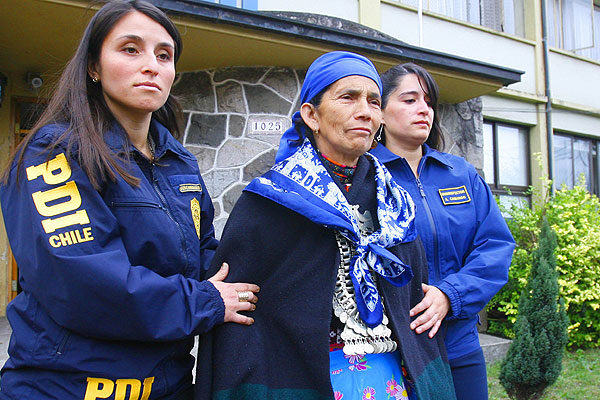
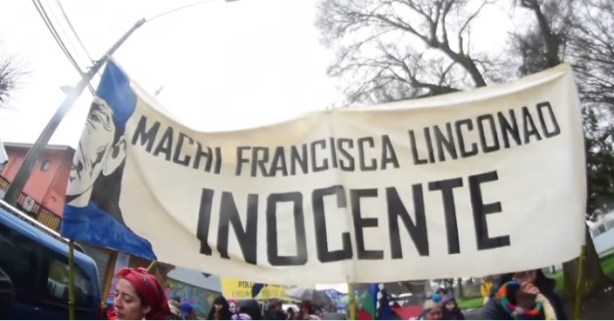
Francisca Linconao is a healer and a spiritual leader of the Mapuche, the largest of the indigenous peoples of Chile. On March 30, 2016 she was arrested along with ten others in connection with the killing of an elderly couple that had occurred January 4, 2013 in the midst of a demonstration on the couple’s farm. Those arrested were charged with murder, arson and terrorism and detained under Chile’s draconian Counter-Terrorist Act.

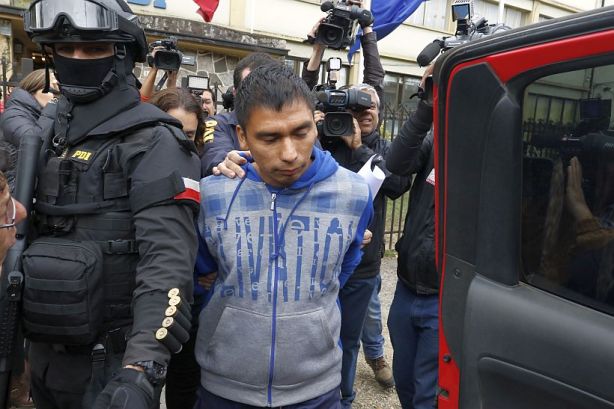
The only evidence linking the eleven accused to the killings was the testimony of one Jose Peralino (above, centre), who claimed he had participated in the attack and knew everyone involved. Peralino has since recanted, alleging police torture and coercion. His allegations are reportedly under investigation, but the eleven accused remain in custody, either in prison or – as is the case with Linconao, under house arrest.

The eleven maintain their innocence and are demanding a trial in order to prove it. Supporters have launched an international solidarity campaign and organizations such as Amnesty International have spoken out in their defence.

On June 24, 2017, Winnipeg supporters of Francisca Linconao held an evening of Solidarity at Broadway Disciples United Church. Here are some of the highlights.

L. B. Foote / Winnipeg Free Press Archives 1919 Strike Crowd gathers at Victoria Park

L. B. Foote / Winnipeg Free Press Archives
1919 Strike
Crowd gathers at Victoria Park

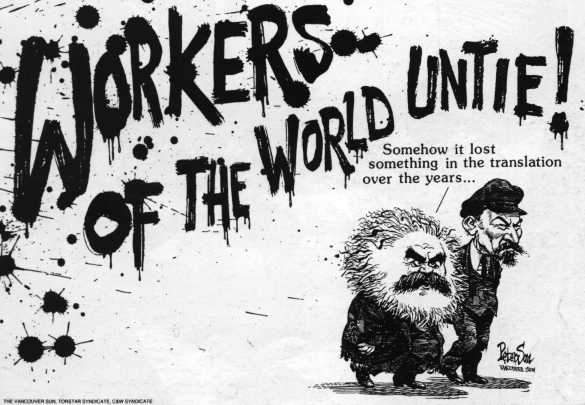
Sometime in the 1990s, it became fashionable for many socialists to refer to themselves as “anti-capitalists.” I’m not sure why this was the case, but I suspect it involved a large measure of opportunism; socialism (at least that variant represented by recently imploded Soviet Union) had become discredited but the dominant capitalist system still refused to deliver the goods, hence the “anti.” Anti-capitalism also worked nicely with the “anti-sexist, anti-racist, anti-homophobic, anti-imperialist” patter that Leftists liked to rattle off whenever ask to describe themselves. Unfortunately, upping the ANTI made it difficult for the uninitiated (and for younger comrades who lacked the history), to understand what it was we stood FOR.

In Canada, the NDP purged the word “socialism” from its program and relegated the Regina Manifesto to the memory hole. Activists increasingly described themselves primarily in terms of ethnicity, race, gender and physical ability. Lacking an overall vision that could inspire and unite all of these various identity groups, activists have been unable to stop the downward spiral of living standards. Rather than challenge the system responsible for the impoverishment of growing numbers of Canadians, the Left fragmented into fighting single issues in isolation from one another, forever on the defensive, increasingly ineffective and incoherent.

I think it is time we began to say what we stand FOR. Furthermore, I think it is time to reclaim the socialist vision that underpins so many of the progressive aspects of Canadian society. More on that in future posts.

Save

Save

Save

Today (on the 13th day of Christmas), Make Poverty History Manitoba rallied at the Manitoba Legislature to call on the provincial government to ensure that the basic material needs of every Manitoban are met. Despite the -20 C weather, the mood was upbeat and the music merry.

Specifically, the coalition is demanding that the provincial government:

1. release a comprehensive poverty reduction plan in its 2017 budget that is developed in consultation with community members
2. include in this plan an increase in the basic needs benefit that ensures each Manitoban has an income that is at least 75% of the poverty line

Make Poverty History is conducting a postcard campaign to convince the provincial government to adopt a poverty reduction strategy with measureable, meaningful goals.

Make Poverty History is conducting a postcard campaign to convince the provincial government to adopt a poverty reduction strategy with measurable, meaningful goals.

Organizers are conducting a postcard campaign aimed at convincing Premier Pallister to do something his NDP predecessor, Greg Selinger, was unable to do — devise a poverty reduction plan that contains targets and timelines. (The NDP’s All Aboard poverty reduction strategy was widely criticized as ineffective and lacking in meaningful evaluation criteria.) They are also asking the public to send emails to Premier Pallister directly.

North End Stay and Play, a program for infants and young children and their families in Winnipeg’s North End, is getting closer to the day it can move into new digs on Selkirk Avenue. For the past seven years, it has been running on a modest budget and has only been able to operate one afternoon a week, usually out of a donated church basement. However, they have acquired land at 681 Selkirk Avenue, raised money and gotten pledges of free labour from the Carpenters Union and operating funds from the provincial government.

Their new, custom-built play house on Selkirk Avenue will operate five or six days a week. It will be called the Little Stars Playhouse.

This is the project I wrote about a year ago. At the time, the proponents were hopeful that construction would begin late in 2015. Gerrie Primak, of Woman Healing for Change, says they now hope to break ground early in 2017, but that first they must raise more funds for construction. In the meantime, as you can see in the video, they have taken some time out to celebrate their progress and the people who have contributed to this worthwhile project.

If you want to make a donation:

  • Make your cheque payable to “Woman Healing for Change Inc.” and send to Assiniboine Credit Union, 655 Henderson Hwy, Winnipeg, MB, R2K 2J6, Account no. 100101102192. WHFC,a registered nonprofit charity, will provide a receipt for all donations over $20, or
  • Make your cheque payable to United Way Winnipeg and note on the cheque that your United Way donation is for “Woman Healing For Change, Charitable no. 891621864RR0001 for Little Stars Playhouse.”

If you want to become more involved, you can find them on Facebook.

Winnipeg, April 26, 2016: NDP MP Romeo Saganash, in conversation with students at the University of Winnipeg. Photo: Paul S. Graham

Winnipeg, April 26, 2016: NDP MP Romeo Saganash, in conversation with students at the University of Winnipeg. Photo: Paul S. Graham

On April 21, 2016, NDP MP Romeo Saganash (Abitibi-Baie James-Nunavik-Eeyou) introduced legislation (Bill C-262) that will ensure that Canadian law is consistent the UN Declaration on the Rights of Indigenous Peoples.

Adopted by the UN General Assembly in 2007, the declaration was initially opposed by the Harper government but eventually endorsed by Canada in 2010. Bill C-262 is essentially the same as a bill Saganash introduced during the Harper government. While the Conservatives were unwilling to support it, the (then) Opposition Liberals did promise to vote for it. Saganash says the Trudeau government has so far been noncommittal with regard to this bill.

Saganash played a key role in the development of the UN Declaration on the Rights of Indigenous Peoples, a process that took 23 years. He was in Winnipeg recently and spoke with students at the University of Winnipeg about the benefits this legislation will provide indigenous peoples in Canada, if it is passed by Parliament. Passage is by no means assured and Saganash is calling on Canadians to lobby their Members of Parliament to support the bill.

Manitoba’s Progressive Conservatives won a majority government last week, leaving many left-of-centre citizens feeling somewhat shell-shocked and adrift on a sea of uncertainty after 17 years of predictable but increasingly unsatisfactory NDP government. Even though the outcome had been foreseen for many months by all but the most optimistic Dippers, many professed shock that the same people who had voted last fall to oust the federal Harper Conservatives would turn around and vote in their provincial kissing cousins. (Many of the same folks have expressed surprise that Sunny Ways Trudeau is beginning to break their hearts, but I digress.)

For over a year now, it’s been clear that the election was Brian Pallister’s to lose. There are many reasons for this, but Pallister’s charisma and charm were never factors. Even though Pallister runs behind his party in terms of popularity, Manitobans so disliked Greg Selinger and/or the NDP that they were even willing to vote Progressive Conservative if that is what it would take to get rid of them. And vote Tory they did, giving the Pallister PCs 53.4% of the vote and 40 seats in a 57-seat legislature. While the NDP were reduced to 14 seats, the Liberals overcame the many rookie gaffes of the feckless Rana Bokhari to win three seats. Even the Greens saw an improvement in electoral fortunes, very nearly winning the riding of Wolseley, long an NDP stronghold.

Not surprisingly, anxiety stalks the land — at least that portion of it occupied by folks who believe in a major role for the public sector and/or those who depend upon it for programs, services and employment. That fear is probably justified. Tory times typically have been tough times and Pallister’s promises to protect the jobs of front-line government workers have not been particularly convincing. Still, as challenging as this situation is, I think it offers some exciting possibilities for Manitoba’s Left, broadly defined.

For progressive thinkers within the NDP, the party’s electoral humiliation offers the opportunity for critical reflection and the possibility for renewal. This will not be easy in a party that is as divided and beaten up as this one has been. It will take years and a willingness to confront some ugly truths about what the party has allowed government to do in its name. I hear distant rumblings that this process is beginning.

Unaffiliated Lefties are faced with choosing between involvement in party politics (and not just within the NDP) and perhaps escalating their involvement in movement politics (labour, indigenous rights, environmentalism, human rights, peace, feminism, LGBTQ, etc., etc.) A new player is emerging on the scene called Solidarity Winnipeg which seeks to unite progressive elements to oppose the anticipated Tory austerity project and promote the Leap Manifesto. It is early days for Solidarity Winnipeg, but I’m reminded of CHOICES!, a loose association of lefties that did some very creative and productive political work in the 1990s but dissolved as soon as the NDP regained power.

Another choice for progressive Manitobans lies with the Green Party of Manitoba. While it is fashionable in some Left circles to dismiss the Greens as “conservatives who compost,” this criticism is usually made by people who have not taken the time to read, much less understand, the party’s platform. (Full disclosure: I’ve been a Green for a few years now.) If they had, they would easily conclude that federally and provincially the Greens are to the left of the NDP on most issues.

In Wolseley, the provincial riding where I live, we doubled the Green vote and very nearly toppled the NDP incumbent. Greens made gains in numerous other constituencies as well. Our growth was based, I would argue, on a platform that was fundamentally more progressive than anything on offer from the other parties. These gains show that there is a growing appetite for a politics that promises to care for the earth while caring for each other.

What’s a Lefty to do in Manitoba? You’ve read my take. I’d love to read yours.


Green Party of Manitoba candidate in Wolseley, David Nickarz. Photo: Paul S. Graham

Green Party of Manitoba candidate in Wolseley, David Nickarz. Photo: Paul S. Graham

Next April, Manitobans will elect a new government. Based on recent polling, if that election were held today, the winners would likely be the Progressive Conservatives. A September 2015 poll of 1000 Manitobans by Probe Research indicates 45 per cent of decided voters province-wide would vote PC; the governing NDP was tied for second place with the Liberals, at 20 per cent.

Of course, having the most votes doesn’t guarantee one the election in our antiquated first-past-the-post electoral system. Support for the PCs is overwhelming outside of Winnipeg (where the Tories have 59 per cent of decided voters and NDP holds third place with 16 per cent). But in Winnipeg, where a slim majority of the seats are, the situation is more competitive; the Tories and Dippers are in a statistical tie (35 and 32 per cent respectively) and the Liberals are beginning to challenge at 27 per cent.

Despite being almost invisible, the Liberals have shown steady growth among decided voters both outside and inside of Winnipeg. NDP support has declined in lock step with Liberal advances while Tory vote in and outside Winnipeg has remained fairly stable. If the Tories do win next year it will likely be because the NDP hemorrhaged crucial support to the Liberal Party.

Given that the Liberal Party has not done anything to date to distinguish itself, the NDP could still win this one if it can convince soft supporters that a Liberal vote is not only a wasted vote, but a dangerous vote because it will lead to victory for the dreaded Tories. At this point, it’s anybody’s guess.

Whether the next government is formed by Dippers or Tories, the outcome will be the same in at least one very important respect – it will be business as usual. Neither party has shown real interest in or capacity for discussing the major issues of the day, much less offering solutions. (The same goes for the third party in the Legislature, with its promise to allow Uber to compete with taxi companies, but I digress.)

By major issues, I’m talking about the failure to address widespread poverty and inequality in Manitoba society that manifests itself as the thousands of children in provincial care (we have one of the highest rates in the world), the growth of food bank usage, the epidemic of homelessness  and our nation–leading homicide statistics.

As serious as these are, they pale in comparison to the existential challenge posed by climate change. Whether or not Manitoba matters in the overall scheme of things, the province has consistently failed to meet its own carbon emissions targets and, recent announcements notwithstanding, shows no sign that anything is about to change.

As well, the province has shown no interest in stopping the TransCanada Energy East Pipeline – a project that is will enable the expansion of the Alberta tar sands. Not only is tar sands expansion a driver of global climate change, the pipeline itself is an environmental menace that should have no place in Manitoba.

So, as you may have guessed, I’m not at all optimistic about the outcome of the next election. I do, however, have reason to hope that we will see the beginning of change in my little part of the province.

I reside in the provincial constituency of Wolseley – a neighbourhood in central Winnipeg where the Green Party of Manitoba has placed second in each of the last three elections.

This time around, the Green candidate is David Nickarz. I like him and think he’d make a great MLA. He’s youthful, mature, energetic, intelligent and a seasoned environmental campaigner. You can read his bio, here.

I’ve decided to support his bid for office because we need to have at least one Green voice in the Legislature. Neither of the likely winners will provide this. The NDP has had more than a decade to deliver on the environment and in some regards we have moved backwards. As for the Tories, the environment is not even on their radar.

And so Dave Nickarz will have my vote and my volunteer time. If the Greens will make a breakthrough anywhere in Manitoba, it will be in Wolseley. As shop-worn as the phrase is, it really is time for a change.