By Rev. Barb Janes, Crescent-Ft. Rouge United Church, Winnipeg

It takes a village . . .

Raza Family in 2006. Photo: CBC

Crescent Fort Rouge United Church is tickled to announce that the Raza family, who lived in sanctuary in the church from August 3, 2006 to February 29, 2008, has been granted Permanent Resident status in Canada. Our deep gratitude to legal counsel, Ken Zaifman (Zaifman Immigration Lawyers), Canadian Border Service Agency, Citizenship and Immigration Canada and Manitoba Department of Labor and Immigration for finding a solution that balanced the circumstances of the Raza family and the requirements of the Immigration Act.

It has been an amazing journey for both the congregation and this family of eight – our thank you list is a long one. The members of Crescent Fort Rouge United worked diligently and persistently, as did many community members. Neighbouring churches and congregations across Canada offered financial, spiritual and moral support. Volunteers of many religions and of no religion generously stepped up to support the Raza family. Terry Borys of the Louis Riel School Division and then Minister of Education, Citizenship and Youth, the Hon. Peter Bjornson ensured that the school-aged children could return to classes at St. George School. Our then Member of Parliament, Anita Neville, visited the family numerous times, and kept the matter before the public, as did our MLA, Jennifer Howard. Deborah Gray, a Winnipegger with a big heart, made a wonderful contribution to publicize the cause. During the time the Razas were in the church, we were honoured with visits from and even a prayer service with members of Winnipeg’s Muslim community. Local musicians generously gave of their talents for a fund-raising rally.

The family sought sanctuary to avoid deportation under fear of sectarian violence in Pakistan, and for 18 challenging months the church was their benevolent prison. Parents Hassan and Kausar and the four oldest children – Rubab, Mohsin, Zain and Farva – faced potential deportation if they left the church property. (The two youngest, Mahssam and Seema, are Candian citizens.) The church’s boardroom was given over to the family as their living quarters, the second-floor kitchen became Kausar’s domain, and the Upper Hall and Nursery became make-shift classroom spaces until the children were granted permission to return to St. George School. Volunteers served as teachers, grocery-shoppers, nurses, lobbyists, security guards, language teachers, media-liaisons, fun-raisers and fund-raisers. After the family achieved Temporary Resident status and Kausar was accepted into Manitoba’s Provincial Nominee Program (thanks to Albert El Tassi of Peerless Garments), the family secured housing and began the transition back into the community. Many volunteers have continued to be in contact with the Razas, some as family friends, others running a homework club for the children.

The day the Raza family made their frightened way to Crescent Fort Rouge United Church, the baby of the family, Seema, had her first birthday. Today, she is a chatty member of her kindergarten class in the public school system. Kausar and Hassan both have jobs. Life is returning to normal, both for the family and for the congregation.

It has been an amazing journey of faith, hope, and persistence, and we at Crescent Fort Rouge United again offer our thanks to the “village” that worked so hard and gave so generously.


Previous articles

Urgent: Action needed to help Raza Family remain in Canada
Update: Raza family to remain in Canada

In 2008, the Manitoba College of Physicians and Surgeons gave its members the power to withdraw or withhold life-sustaining treatments from patients, even if this is contrary to the wishes of patients or their families. The process to be followed in arriving at the decision to allow a patient to die is outlined in the College’s Statement No. 1602: Withholding and Withdrawing Life Sustaining Treatment.

Short of going to court, there is no appeal. One can easily imagine situations where the clock could run out before a legal remedy could be obtained. Not surprisingly, people who live with disabilities fear this power could result in life-saving treatment being withheld from them in the mistaken belief that their disabilities justify letting them die.

Who can blame them? How often have you heard people say, in reference to someone with a severe disability: “I wouldn’t want to go on living — he/she would be better off dead.”

The College’s policy statement does not dispel this fear. It establishes a benchmark for determining whether a patient will get treatment that centres on the patient’s ability to reach what it calls the “Minimum Goal of Treatment.” According to the College, this standard is defined as:

“. . . the maintenance of or recovery to a level of cerebral function that
enables the patient to:

  • achieve awareness of self; and
  • achieve awareness of environment; and
  • experience his/her own existence.

For pediatric patients, the potential for neurological development must be factored into the assessment.”

In other words, the standard is based on the level of cognitive ability or disability. The statement does not specify objective medical criteria for determining if this “minimum goal” has been met. Hence, it is left to individual physicians to determine, subjectively, if a patient is or can achieve self-awareness.

More troubling, the College’s policy envisions situations where the “minimum goal of treatment” could be met, but where the doctor could nevertheless conclude that treatment should be withheld because of  “subjective values and judgments regarding quality of life.”

Most troubling is the lack of an appeal mechanism and the apparent unwillingness of the provincial government to insist on or to legislate one.

The Manitoba League of Persons with Disabilities has been critical of this policy since its inception. On May 31, 2011, it, along with the Council of Canadians with Disabilities, outlined their perspectives at a public forum in Winnipeg.

The panelists were:

  • Rhonda Wiebe – Co-chair, Council of Canadians with Disabilities Ending of Life Ethics Committee
  • Jim Derksen – member, Manitoba League of Persons with Disabilities
  • Dean Richert – Co-chair, Council of Canadians with Disabilities Human Rights Committee
  • Valerie Wolbert – People First, Manitoba
  • Catherine Rogers – People First, Canada

The speakers were informative, engaging and articulate. But don’t take my word for it. Watch the video and draw your own conclusions.

This issue ought to concern all of us. It is not solely a matter for people with disabilities. Sooner or late, all of us will die. Along that path we may find ourselves disabled and dependent on the judgements and decisions of others for our lives. Surely we should have final word on whether or not doctors will try to save our lives.

Mansour Osanloo in 2007, shortly before his arrest by the Iranian government.

Once in a while there is good news to share on the political prisoner front, and this is one of those times.

Mansour Osanloo, a bus driver and president of the Vahed Syndicate which represents bus drivers in Tehran, was freed on bail by the Iranian government today after four years of imprisonment.

According to the International Transport Workers Federation: “From its beginnings in 2005 the ITF-affiliated union was subjected to heavy repression, including repeated attacks and arrests. Mansour Osanloo was heavily targeted. As well as being beaten up and having his tongue slit he was imprisoned in 2005 and 2006. Then in 2007, just one month after visiting the London head office of the ITF and meeting trade unionists in Brussels, he was arrested. Three months later he was sentenced to five years imprisonment on charges of ‘acting against national security’ and ‘propaganda against the state’; in 2010 another year was added to his sentence. In reality his only offence was to help found a genuinely democratic trade union.” For more on his case, visit Justice for Iranian Workers.

Regrettably, Mansour Osanloo is not the only trade unionist imprisoned in Iran. Many others, such as Farzad Kamangar (murdered by the Iranian government in 2010) have not been so fortunate. As Amnesty International reported May 20, 2011, arbitrary arrests, torture and executions continue to be routine.

While expressions of international solidarity are not always successful in gaining the release of political prisoners, international silence almost guarantees a bad outcome.

Doing your part to support prisoners of conscience has never been easier. Two of my favourite organizations in this regard are LabourStart and Amnesty International-Canada. There are many others. Find one that fits your preferences and lend a hand. You may help save a life.

Imagine my surprise at learning that I am the treasurer of the freshly minted “Canadians for Boycotting Arab and Iranian Goods” organization – CBAIG for short. According to a news release issued May 29, 2011, we (Sid Ryan [President of the Ontario Federation of Labour], Peter Gose [Chair, Sociology and Anthropology Department at Carleton University] and Karine Macallister at the University of Montreal) are calling on Canadians to boycott Arab and Iranian tyrants “until the vicious dictatorships of the Arab Middle East and Iran are overthrown and their civilian populations are finally endowed with classical democracy.” Moreover, Sid Ryan, according to the news release, has “pleaded” with Israel “. . . to invade Syria and Iran and wipe out their respective feudal ruling classes.”

Not only that, but our “new campaign” is supported by “Emeritus Prof. Michael Chodussovsky of the University of Ottawa, the Seriously Free Speech Society, Canadians for Justice and Peace in the Middle East, Adbusters Magazine, the Canadian Arab Federation, Palestine House, CUPE-Ontario Section, filmmaker John Greyson of York University, Nick Day, Rector at Queens University, the Association of Arab Students and Professors in Canada, KAIROS Canada, the Canadian Postal Workers Union,  the Libyan Workers Revolutionary Committee, Sabeel, the Free Gaza Movement,  the League for Iranian Democracy, as well as by the Ontario Federation of Labour.”

Astute readers will easily identify this as a hoax, not because any of the above named supports tyranny in any form, but because all of them have championed Palestinian rights. Many, though not all, have supported the international boycott, divestment and sanctions campaign against Israel for its brutal occupation of Palestinian territory.

The CBAIG news release appears to be a carbon copy of one issued earlier this year announcing the formation of Britons for Boycotting Arab and Iranian Goods (BBAIG). Whether they realize it or not, the perps may have done the BDS campaign a small service by drawing attention to the argument that the Israeli occupation of Palestinian land is analogous to the tyranny of many Arab states. Maybe it’s time for someone to launch a new organization: Zionists against Israeli Tyranny or, ZIT!

On May 5, 2011, David Camfield launched his new book, Canadian Labour in Crisis – Reinventing the Workers`Movement, at the Mondragon Bookstore and Coffee House in Winnipeg, Canada. David Camfield is an associate professor in labour studies at the University of Manitoba.

More information about David’s book: http://www.fernwoodpublishing.ca/author/David/

In his new job as Leader of Her Majesty’s Loyal Opposition, Jack Layton has pledged to “fix Ottawa.” I’ve taken this to mean he will lead by example in hope of teaching the children to play nicely. I wish him luck.

The problem with our democracy goes far beyond Stephen Harper’s well documented contempt for Parliament. Fundamentally, our democracy is undemocratic. The “first-past-the-post” system of electing MPs always means that the wishes of great numbers of Canadians are unrepresented in Parliament. In a multiparty system, few MPs garner a majority of votes. But even in a 2-way race, substantial numbers of citizens find themselves unrepresented after the votes are counted.

This is not news. But it bears repeating – until we dump the FPTP system and adopt some form of proportional representation (PR) method of electing MPs – we are doomed to unrepresentative Parliaments and endless repeats of dubious strategic voting exercises.

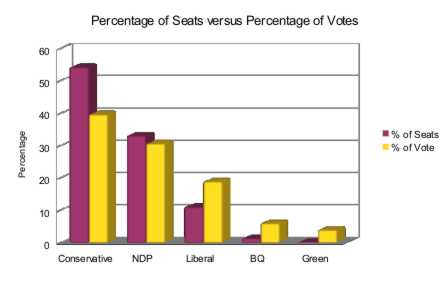
What would a representative Parliament look like? Here’s what we have now.

Party Elected % of Seats % of Vote
Conservative 167 54.2 39.6
NDP 102 33.1 30.6
Liberal 34 11 18.9
BQ 4 1.3 6
Green 1 0.3 3.9

Source: http://www.sfu.ca/~aheard/elections/results.html. (Note, percentages to not add up to 100, probably because of some rounding in the original data. But you get the idea.)

The top two parties clearly have more MPs than their share of the popular vote would justify. It looks like this.

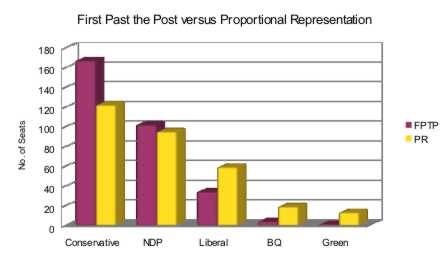
Now, look what happens when MPs are elected in proportion to their party’s share of the popular vote.

Party FPTP PR
Conservative 167 122
NDP 102 95
Liberal 34 59
BQ 4 19
Green 1 13

(Note: the above chart needed some rounding to make it work – but it’s close enough.) It would look like this.

As things stand now, Stephen Harper has an undeserved majority in Parliament – one he will use to impose his minority, right wing agenda on the majority of Canadians who voted for other visions of Canada. Under the current rules, he can do what he wants without reference to the other parties.

In a PR Parliament, Harper would be compelled to negotiate with some or all of the other parties in order to keep his job. Parliament would be representative and this, I believe, is a necessary first step in fixing our broken democracy.

Electoral reform must become a priority for all who call themselves democrats. In the past, both the Greens and the NDP have said they favour PR. We have to encourage them to make it their priority. At the same time, if we leave it up to any political party, we will be disappointed. It’s up to us to make it happen.

“What if the Gulf could sue BP?” asks Maude Barlow, National Chairperson of the Council of Canadians. “What if the ocean around Japan could sue the owners of the nuclear facility? What if the Athabasca River could sue everybody? What if Lake Winnipeg could sue for the nitrates we dump into it everyday?”

On International Mother Earth Day, April 22, 2011, Barlow spoke to a packed hall in Winnipeg, Manitoba on the international campaign for the Rights of Nature and the need to retake the Commons from corporate predators. Her appearance was sponsored by the Council of Canadians (Winnipeg Chapter) and the Canadian Centre for Policy Alternatives (Manitoba Office).

This is an excerpt from her speech that I recorded at the Fort Garry Hotel.

April 20, 2011: Dennis Lewycky (NDP), Ilona Niemczyk (Liberal) and Jacqueline Romanow (Green) at a Federal Election Forum on the Environment at the First Universalist Unitarian Church in Winnipeg. Photo: Paul S. Graham

If the state of our environment is a defining issue for you in this Canadian federal election, you must be disappointed at the scant, superficial mainstream media coverage to date. Despair no more.

I attended an “all-candidates” forum on the environment in Winnipeg last night (April 20, 2011), and posted a two hour video on YouTube to redress this portion of our democratic deficit. (For other insightful creations, go to http://youtube.com/redriverpete – but I digress.)

The phrase “all candidates” sits between inverted commas because the Conservative Party, true to form, chose not to participate. The Bloc Quebecois was not invited, understandably, because it is not running in Winnipeg (or elsewhere outside of Quebec). Other parties were excluded because they are not running candidates in all ridings.

Nonetheless, representatives of the Greens, the NDP and the Liberals were there. All gave good accounts of their respective parties’ positions. The questions put by the organizers were challenging in substance and comprehensive in scope. Panelists and audience members addressed each other intelligently, thoughtfully and respectfully. In short, it was an informative, educational evening, refreshingly free of the rhetorical bombast that passes for political discourse in this era of spin doctors and attack ads.

The candidates were:

The forum was held at the Unitarian Universalist Church and moderated by CJOB Radio’s morning talk show host Richard Cloutier. It was sponsored by:

Grab some non-GM popcorn if you can find some, kick back and enjoy. And don’t forget to share this with friends and family, because it may be one of the few opportunities they will have to compare the environmental positions of three of the four main parties running across Canada. As for the Tories, the silent empty chair on the stage pretty much illustrates their environmental platform.

The more we learn about the so-called humanitarian intervention in the skies above Libya, the less it looks like a war Canadians should support. Like the bogus humanitarian claims Tories and Liberals have used to support extending Canadian participation in the occupation of Afghanistan, the war against Libya has more to do with imperialism and any humanitarian benefit is simply “collateral.”

US Democratic Party Congressman Dennis Kucinich recently drew attention to the amazing similarity between the NATO invasion of Libya and a NATO war game entitled “Operation Southern Mistral 2011.”

“While war games are not uncommon, the similarities between ‘Southern Mistral’ and ‘Operation Odyssey Dawn’ highlight just how many unanswered questions remain regarding our own military planning for Libya.

The ‘Southern Mistral’ war games called for Great Britain-French air strikes against an unnamed dictator of a fictional country, “Southland.” The pretend attack was authorized by a pretend United Nations Security Council Resolution. The ‘Southern Mistral’ war games were set for March 21-25, 2011.

On March 19, 2011, the United States joined France and Great Britain in an air attack against Muammar Gaddafi’s Libya pursuant to UN Security Council Resolution 1973.

Scheduling a joint military exercise that ends up resembling real military action could be seen as remarkable planning by the French and British, but it also highlights questions  regarding the United States’ role in planning for the war. We don’t know how long the attack on Libya has been in preparation, but Congress must find out. We don’t know who the rebels really represent and how they became armed, but Congress must find out. (Denis Kucinich, Kucinich: President Had Time to Consult with International Community, Not Congress? | Congressman Dennis J. Kucinich, Press Release, March 29, 2011)

Professor Michel Chossudovsky, of Global Research, in an article entitled When war games go live: “Staging” a “humanitarian” war against “Southland,” shows that the similarity is no coincidence.

Rep. Kucinich does not appear to have a Canadian counterpart who is questioning why we are involved, much less speaking out against it. Harper’s decision to send jet fighters to bomb Libya was supported unanimously by Canada’s MPs, some of whom one would expect to do their homework before being caught up in media-hyped war hysteria.

Did any of them stop to consider why we are doing nothing to stop the governments of Bahrain, Saudi Arabia, Yemen, Jordan, Qatar and Oman from murdering their citizens in large numbers? Did none of them find it odd that the uprising in Libya was armed and violent from the beginning — in stark contrast to the peaceful mass movements Canada has refused to defend? Isn’t it strange that we will rush to war against Gaddafi who, arguably is no better or no worse than any number of despots but we will not do a thing to restrain the routine brutality of the Israeli state against Palestinians?

The war in Libya is the pink elephant on the campaign trail that none of our politicians want to acknowledge. We have to change this.

With the annual retreat of snow and ice blessedly underway, the crap and crud that mysteriously didn’t make it into my back lane dumpster is revealed in all of its putrescence. I call this a mystery because I don’t know how apparently sentient, reasonably healthy, bipedally-capable adults with opposable thumbs could miss the dumpster’s gaping maw and deposit their refuse behind it, under it, beside it — anywhere but in the damn dumpster. But they did. And because it apparently  bothers me more than my neighbours, I suppose I will have to clean it up.

After I stopped fuming at the unfairness of it all, I started thinking about garbage. We make a lot of it. Even little Winnipeg (pop. 684,000) manages to dispose of over 200,000 tonnes annually. While this is a minuscule share of the estimated 1.2 billion tonnes of municipal waste that is tossed away every year around the world, it’s still a lot. Judging from what doesn’t make it to the landfill, such as the recently mapped Atlantic Garbage Patch, it’s probably a lot more and definitely unsustainable.

Strangely, I’m grateful for my messy neighbours. Were it not for their disagreeable practices, I wouldn’t have taken the time to think about garbage at all. Bag it. Toss it (hopefully in the dumpster). Forget it. Out of sight, out of mind. Somebody takes it away, never to be seen again.

But most garbage doesn’t really go far. Nor does it go away. Not for decades. As it slowly decomposes, it leaches poisons into the groundwater and expels noxious gases into the atmosphere. Garbage is both a symptom and a cause of serious, potentially game ending challenges to human survival – which brings me to Canada’s federal election, replete as it is with the toxic flatulence that passes for political wisdom these days.

I gotta tell ya, looking at the sorry record of politicians of all stripes, I’m almost at the point of erecting a billboard in my yard that screams “DON’T VOTE. YOU’LL ONLY ENCOURAGE THEM!”

Yes, yes. I know. Stephen Harper is a contemptible, war-mongering, fossil-fueled son of a bitch and if he gets a majority he’ll shred the social safety net, torch the CBC and declare the Fourth Reich. (I don’t really think he’s a Nazi, but he has twice shut down Parliament to avoid the embarrassment of being held accountable by the Official Opposition. This betrays a certain contempt for democracy. It could become habit forming.)

Michael Ignatieff? Ummm. No. No thank you. I have nothing against Iggy personally (except for his support for the Iraq war and torture, until it became a political liability). But no. He leads the Liberal Party that has governed Canada for most of the last 143 years with unswerving loyalty to big business. In this respect their role is indistinguishable from that of the Conservatives. Stephen and Iggy: two little corporate castrati singing the Hallelujah Capitalist Chorus.

This brings us to Jack Layton and the NDP. (Though I like his style, I won’t bother with Gilles Duceppe until he does the anatomically impossible and runs candidates in the rest of Canada.)

I have voted NDP since I was old enough to vote – and that was a long time ago. In my youth I supported them because of their ties to labour, their socialist roots (sadly all but plucked out by now) and their willingness to take risks on behalf of working people (think Tommy Douglas and Medicare).

As I grew older and, if not wiser at least more experienced, I voted NDP because it represented the lesser of evils. The NDP might not be perfect, I reasoned, but at least it wasn’t as bad as the others. Or so it seemed.

After countless focus groups and rebrandings “Today’s NDP” (as we call it in Manitoba) has morphed into something approximating the Liberal Party – which is good news for the Liberal Party and bad news for the New Democrats.

Grits and Dippers want to put a human face on the economic system that creates all the garbage I was kvetching about at the top of the page. Tories aren’t so sentimental. So, while there are differences between the three parties, they owe a common allegiance to capitalism. And while all of them, to varying degrees, talk about environmental issues, none are willing to put The Environment front and centre in their vision for Canada.

Which brings me to Elizabeth May and the Green Party of Canada. Canada’s Green Party is unique in Canadian electoral politics because it has put the environment front and centre, where it belongs. They put forward a set of principles and proposals which, if adopted, would give me a measure of confidence about my grandchildren’s future.

Check out their program. I don’t agree with everything (who does?) but I like their approach. Intelligent. Straightforward. Thoughtfully developed and thought provoking. It won’t fit into a series of TV sound bites. You’ll be challenged and pleasantly inspired.

Can the Greens form the government? Not this time, but that shouldn’t disqualify them. Part of the reason we’re in this mess is because we vote for the “lesser of evils.” Motivated by fear, we support something we don’t want to block something we fear more. Or, because we don’t want to “waste our vote,” we give it to someone we think might win, even if they don’t really have that much to offer – a brain deadening strategy if ever there was one.

If you like the Green Program, vote Green. Your vote will not be wasted. To quote Tennyson, “‘Tis better to have loved and lost than never to have loved at all.” The same applies to voting.