On August 3, 2011 – four days after being viciously assaulted in his Winnipeg apartment, Harvey Sanderson Junior died of his injuries. He was 27.

What made this crime especially shocking was that Harvey had brittle bone disease, a condition that confined him to a wheelchair.

Friends, neighbours and people who had never met him were saddened and horrified by Harvey’s murder.

And so, on August 12, they joined together with the Manitoba League of Persons with Disabilities to express their grief and their solidarity at a vigil for Harvey and all other persons with disabilities who are victims of violence.

The story does not end here. Within hours of Sanderson’s unconscious body being transported to the hospital, Winnipeg City Police arrested two suspects, Bobbi Melissa McKay and John Raven Ward, both 27, and charged them with aggravated assault and robbery. Following Sanderson’s death, police announced they were considering upgrading these charges.

The way in which a police spokesperson expressed this has raised red flags for local activists:

“Given the nature of the condition of the victim in this case, it’s something that has be looked at very carefully in consultation with the Crown’s office,” said Const. Rob Carver, spokesman for the Winnipeg Police Service.

The concern is that the Crown will prosecute McKay and Ward for aggravated assault, rather than murder, because of a misguided belief that Sanderson’s disability, rather than his beating, was the cause of his death. As Bonnie Bieganski said at the vigil:

“He was a healthy male with a disability. Yes, he had brittle bone disease but that disease does not require emergency brain surgery, the use of life support to sustain him nor induce a comatose state. Sanderson would be alive today if he had not been brutally beaten. The fact that the Crown will only upgrade the charges if it can be proven that it was the assault that killed Sanderson is an outrage.”

That Sanderson’s killing might be treated differently because of his disability is not an isolated or unrealistic concern. As we heard from several speakers at Harvey Sanderson’s vigil, vigilance is called for.

On Monday, August 6, 1945, at 8:15 a.m., the nuclear bomb “Little Boy” was dropped on Hiroshima, Japan by an American B-29 bomber, the Enola Gay. An estimated 130,000 people were killed.

On August 9, 1945, Nagasaki was the target of America’s second atomic bomb attack. At 11:02 a.m., the north of the city was destroyed and an estimated 70,000 people were killed by the bomb nicknamed “Fat Man.”

Over the years and decades that followed, thousands more died from a variety of radiation induced diseases. Even now, after more than six decades, many aftereffects persist, including leukemia, A-bomb cataracts, and cancers of thyroid, breast, lungs, salivary glands, birth defects, and disfiguring radiation burn scars.

The psychological damage arising from widespread chronic illness and the destruction of families and communities cannot be measured.

For many years, Winnipeggers have commemorated these tragedies and reaffirmed our commitment to peace and freedom from nuclear terror. We symbolize our commitment with a Lantern Ceremony.
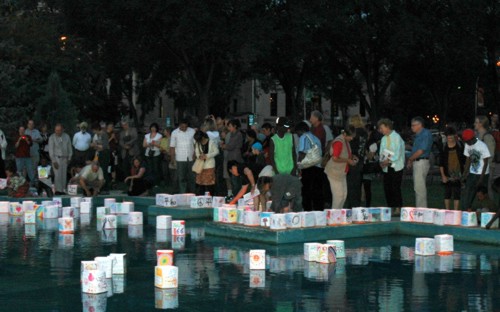
Aug. 6, 2010: Winnipeggers gather at Memorial Park to launch their Lanterns for Peace. Photo: Paul S. Graham
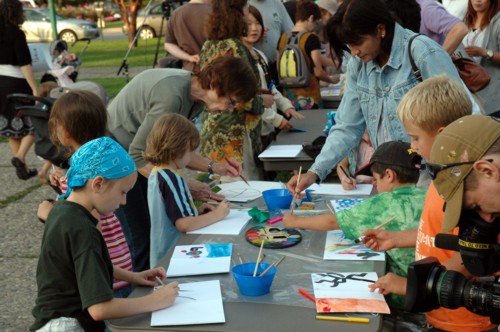
Aug. 6, 2010: Lanterns reflect the individual aspirations of the artist. Photo: Paul S. Graham
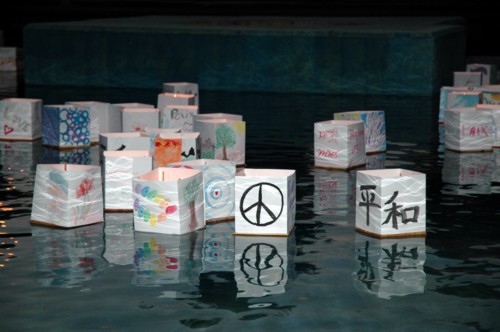
August 6, 2010: Winnipeg Lanterns for Peace. Photo: Paul S. Graham

The Lantern Ceremony is part of an ancient Buddhist Ceremony (O-Bon), that commemorates the lives of deceased loved ones. For many years around the world, this ceremony has been used on Hiroshima Peace Day to honour and embrace the memory of those who died because of the attacks.

During these ceremonies, participants are invited to design a lantern that represents their thoughts and feelings regarding personal losses, global concerns of peace, nuclear disarmament and any other issue relevant to keeping our planet safe.

In addition to lanterns, we make origami peace cranes to commemorate the story of “Sadako and a Thousand Paper Cranes.”

Sadako Sasaki, a 10-year old girl, became sick with leukemia from the effects of the atomic bomb in post war Japan. She believed in an ancient tale that if you made 1000 paper cranes, you would be granted a wish. She wished for good health.

She died before she completed making the cranes and her classmates completed the task for her. Each year, thousands of paper cranes from all over the world adorn the statue of Sadako in the Hiroshima Peace Park in Hiroshima, Japan.

As important as it is to commemorate the horrible tragedies of August 6 and 9, 1945, more is required of us to prevent a recurrence of this disaster. Nine countries are known to possess nuclear weapons (United States, Russia, United Kingdom, France, China, India, Pakistan, North Korea and Israel). Together, they possess an estimated 8,000 active nuclear warheads and more than 22,000 in storage. The explosion (accidental or deliberate) of only one of these weapons would cause unthinkable suffering and destruction.

The nuclear threat is too serious to be ignored. We cannot rest until each of these nuclear weapons has been dismantled.

How you choose to work for a nuclear free world is up to you. There are numerous options. Here a few of the many Internet resources available to help you get involved.

If you live in or close to Winnipeg, you should consider contacting any of the sponsors of Winnipeg Lanterns for Peace:

And, of course, you shouldn’t miss out on Winnipeg Lanterns for Peace 2011.

Finally, the Canadian Peace Alliance is a good source of information on peace groups across Canada. The important thing is to become informed and involved.

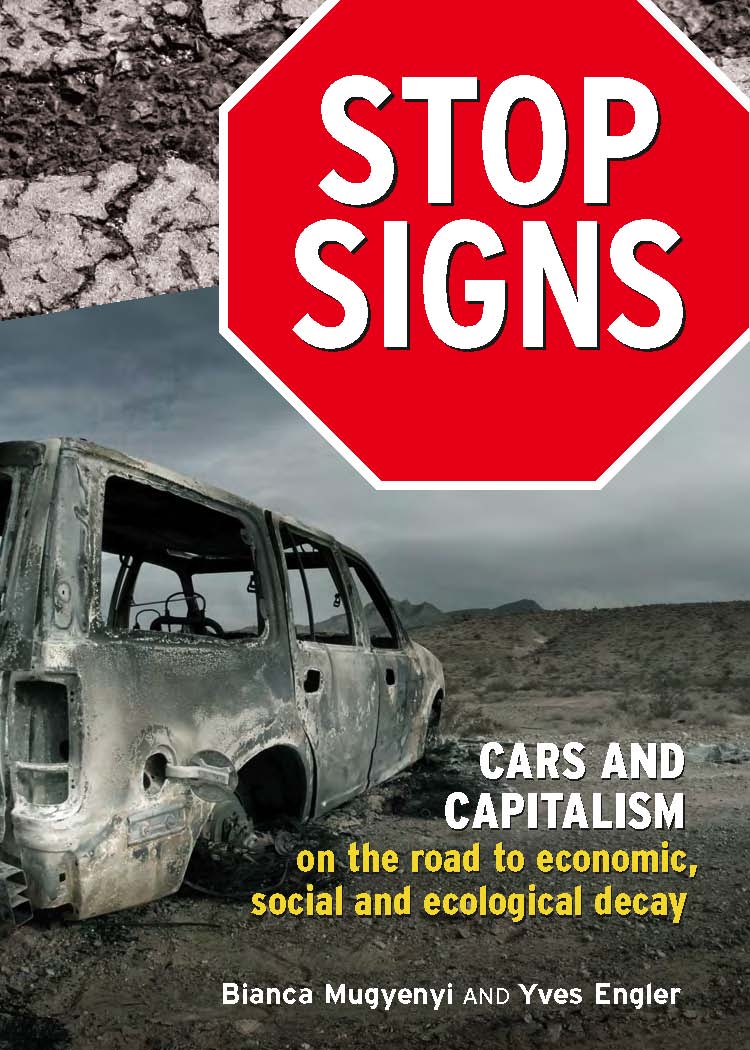
I’m half-way through “Stop Signs: Cars and Capitalism on the road to economic, social and ecological decay” by Bianca Mugyenyi and Yves Engler and I’m already regretting my decision, a year ago, to replace my aging Mazda with a brand new Kia Soul. I would have been better off with a bus pass and the world would have been one infinitesimally tiny step closer to sanity.

By every conceivable measure, private automobile ownership is an irrational choice that drains our health, destroys our environment and locks us in a downward spiral of indebtedness. In a discussion hosted by the Manitoba Eco-Network on July 7, 2011 in Winnipeg, Yves Engler explains why.

On June 8, 2011, Project Peacemakers Forum panelists Loraine MacKenzie Shepherd and Howard Davidson discussed “Israel and Palestine: What is going on and what can we do?”

Did they succeed in answering these questions? Yes and no. No, because this is a huge, complex topic and considerably more time would be required to present it in a comprehensive way. Yes, because they provide a starting point for people trying to get a sense of the issue, both in terms of understanding some of the complexities and in pointing to actions people can take to contribute to a resolution of the conflict.

Loraine MacKenzie Shepherd is an Adjunct Professor at the Faculty of Theology at the University of Winnipeg. As a member of the General Council Theology and Inter-church Interfaith Committee, she was part of an official United Church delegation that went to Israel and Palestine in February of this year, to update United Church policies and theology on the Middle East.

Howard Davidson is an Associate Professor in Extended Education at the University of Manitoba. He is also a member of the steering committee of Independent Jewish Voices and has visited Israel and the Occupied Territories on several occasions. He has published articles on Education and the Occupation.

Today, Winnipeg activists responded to the actions of the Greek government to block the Tahrir and other vessels that make up Freedom Flotilla II from sailing for Gaza with an information picket in the city’s Osborne Village neighbourhood.

The Tahrir is the Canadian vessel in the Flotilla. As with all of the other boats and crews, the Tahrir is committed to peace and nonviolence. Its mission is to deliver humanitarian aid to the suffering people of Gaza and to pressure the Israeli government to end its illegal and oppressive blockade of Gaza.

Get informed and take action. These folks can provide both information and opportunities for action.

Canadian Boat to Gaza’s vessel, the Tahrir, is one of several ships attempting peacefully to end Israel’s illegal blockade of Gaza. Tahrir is a part of Freedom Flotilla II, sponsored by groups from Belgium, Denmark, Australia, United States, France, Spain, Italy, Ireland, the U.K, Greece, Turkey, Malaysia, and more.  The Flotilla aims to travel to Gaza with approximately 10 vessels including both passenger and cargo ships carrying humanitarian aid.

Greek officials said today that they have banned local and foreign-flagged ships destined for Gaza from leaving the country’s ports. The Greek coast guard has boarded Tahrir in an effort to prevent it from sailing.

We can expect that Canadian solidarity organizations will be mobilizing support for the Canadian Boar to Gaza and Freedom Flotilla II. Please respond when the call goes out.

The following news release provides more information.

The blockade of Gaza reaches the shores of Greece! As it attempts to sail, the Canadian Boat to Gaza, the Tahrir, blockaded in Greece

Greek coast guard are now on board the Tahrir attempting to arrest Sandra Rush, Jewish Canadian member of the Canada boat to Gaza Steering Committee, who is refusing to surrender boat’s registration papers.

Efforts to stop Freedom Flotilla 2 – Stay Human from sailing have included diplomatic pressure and manipulation, economic blackmail, bureaucratic obstacles, baseless and slanderous allegations against the flotilla and the delegates, and sabotage of at least two vessels.

“The world watched as an intensive campaign to prevent the Tahrir and the entire Freedom flotilla II from sailing was underway.  We have been unjustly and duplicitously treated.” said Irene MacInnes of the Tahrir organizing committee. “The government of Israel, shamefully with the tacit support of the Harper government, is doing everything in its power to maintain the blockade. Today, as a result of the concerted efforts of the 4th largest military power in the world and its backers, we have been prevented from sailing to Gaza. Yet we will persevere in our attempts till the blockade is lifted.”

“Israel has in effect extended the illegal blockade of Gaza to Greek ports, using the Greece’s economic difficulties to influence the government’s position”, said David Heap of the organizing committee.

“We remain absolutely clear that the Canadian Boat to Gaza has not been, is not, and has no intention of, breaking any laws. It is the blockade of Gaza that is illegal under international law. We have a legal and moral obligation to challenge the blockade, given the failure of the international community to act”, said Dylan Penner of the organizing committee. “This is why we must continue our attempts to sail to Gaza: to challenge the illegal and immoral blockade and to equally challenge the Canadian federal government’s support for it.”

Meanwhile the US boat to Gaza, The Audacity of Hope, is at a standoff with the Greek Navy boats, refusing orders to return to shore.

For biographies of delegates aboard the Tahrir visit: www.tahrir.ca/content/delegates-board-tahrir

UPDATE: Canadian Boat to Gaza urges supporters to email/fax the governments of Canada, Greece and Israel. More information and sample letters are available here.

The governments of Canada and the European Union are negotiating a treaty called the Comprehensive Economic and Trade Agreement. They hope to sign it by the end of 2011.

This treaty will take power from local governments in Canada and give it to large transnational corporations headquartered in Europe. These huge companies could take over the delivery of vital public services – such as water, transit, energy and health care – whether local communities like it or not. It’s NAFTA on steroids.

The time to stop CETA is now. Paul Moist, president of the Canadian Union of Public Employees, speaking in Winnipeg on June 27th, explains.


The fight to block CETA is being led by the Canadian Union of Public Employees and the Council of Canadians. CUPE’s Paul Moist and the Council’s Maude Barlow have been crisscrossing the country in an effort to drum up opposition to this treaty. You owe it to yourself to get informed and get involved. For more information:

On June 3, 2011, when Brigette DePape, a 21-year old parliamentary page from Manitoba, pulled out a “Stop Harper” sign during the opening session of Canada’s 41st Parliament, she was escorted out of the room and quickly fired from her position.

Her solitary act of civil disobedience in resistance to the policies of the Harper government not only inspired an outpouring of support, but also called to mind another Manitoba woman, Nellie McClung. In 1912, McClung helped organize the Political Equality League and throughout the 1920s championed female suffrage and a host of measures to combat the social injustices of her time.

On June 18, 2011, a few of us took a trip over to the Manitoba Legislature to express our solidarity with Brigette DePape by bringing her message to the Nellie McClung Memorial located on the grounds of the same Legislature where Nellie won, for Canadian women, the right to vote.

Winnipeggers rallied in support of locked-out CUPW members in Winnipeg June 16, 2011. Photo: Paul S. Graham

This, just in, from Derek Blackadder at LabourStart. While it is addressed to trade unionists it should resonate with anyone who believes in democracy. The Conservative government’s decision to impose back-to-work legislation strikes at the heart of democracy; it is a form of forced labour, something expressly forbidden by the International Labour Organization of which Canada is a member.

If you think the Tories will stop with postal workers, think again. We must stop Harper here.

Please support the LabourStart campaign and tell Lisa Rait and Stephen Harper what they can do with their back-to-work legislation.


As trade unionists we understand that the right to free collective bargaining without interference from the state is fundamental to what we do.

When the state interferes on behalf of an employer our rights as workers are at stake.

‘Our’ newly-elected Conservative majority government is using the Post Office lockout as the first salvo in its war on trade unions in this country.

The legislation not only forces an end to free collective bargaining, it imposes wages that are less than those Canada Post had tabled.

It is virtually unprecedented for back-to-work legislation in Canada to impose terms and conditions of employment. (You can read the bill in PDF form here.)

Our CUPW e-campaign is within sight of the 10,000 messages mark.

The Minister of Labour is saying that she has thousands of messages demanding legislation to end the strike and to impose new conditions of employment on post office workers.

Help give the union the ability to say ‘we have tens of thousands of messages demanding free collective bargaining’.

Help build not only CUPW’s fightback, but the 4 year long fightback that has just started.

Join this campaign here and pass this link along to ALL your contacts!


See also: Video: Winnipeg Solidarity with the Postal Workers

On June 16, about 1,000 members of several Winnipeg unions rallied at the main post office in Winnipeg in solidarity with the Canadian Union of Postal Workers. The rally, one of many to be held across the country, was in response to federal government plans to legislate CUPW members back to work.

The union has been waging a rotating strike that started in Winnipeg on June 2 and then moved to other cities. Canada Post locked out the workers on June 14.

On June 20, the federal Conservative government tabled back-to-work legislation that will force the two sides to accept a form of binding arbitration called final offer selection. Under FOS, each side tables their final offer and the arbitrator picks one.

When governments force an end to strikes they undermine free collective bargaining. To put it another way,  they are trampling on our democratic rights. Some call this fascism; others feudalism. In any case, F-words, such as fightback, are entirely appropriate.

More information: Canadian Union of Postal Workers