Archive for the ‘Peace’ Category

Michael Ignatieff and Co. can’t get enough criticism for their desertion of Bill  C-440 to suit me. But let’s not deny the  Tories their fair share of the shame. Against the will of most Canadians, the Tories have conducted a campaign of persecution against American war resisters since coming to power. In their slavish admiration of American imperialism, they ignore important aspects of international law. In their eagerness to crawl into bed with war criminals, they are complicit in some of the most horrendous crimes against humanity of this century.

The Tories spare no effort to prevent war resisters from exercising their right to conscientious objection. Wednesday’s defeat of Bill C-440, to which they unanimously voted “nay” is just the most recent example. Because the War Resisters Support Campaign web site is replete with examples of the Tory pogrom against conscientious objectors, I won’t deal with that here.

Instead, I want to address the standard Tory refrain that war resisters are “cowards” or “deserters” who should shut up, stay in the army and keep killing or rot in an American prison.

Nazis, Nuremberg and Numb Tory Memories

Despite their “Conservative” label, the Tories have forgotten important aspects of our shared history, chief among them the Second World War and the trials of Nazi war criminals at Nuremberg in 1945 and 1946. In 1950, the UN International Law Commission codified the legal principles that emerged during these trials. The Tories would do well to acquaint themselves with the Nuremberg Principles because they are key to understanding why American war resisters should be granted sanctuary in Canada.

Principle VI states,

“The crimes hereinafter set out are punishable as crimes under international law:

(a) Crimes against peace:
(i) Planning, preparation, initiation or waging of a war of aggression or a war in violation of international treaties, agreements or assurances;
(ii) Participation in a common plan or conspiracy for the accomplishment of any of the acts mentioned under (i).

(b) War crimes: Violations of the laws or customs of war which include, but are not limited to, murder, ill-treatment or deportation of slave labor or for any other purpose of the civilian population of or in occupied territory; murder or ill-treatment of prisoners of war or persons on the Seas, killing of hostages, plunder of public or private property, wanton destruction of cities, towns, or villages, or devastation not justified by military necessity.

(c) Crimes against humanity: Murder, extermination, enslavement, deportation and other inhumane acts done against any civilian population, or persecutions on political, racial, or religious grounds, when such acts are done or such persecutions are carried on in execution of or in connection with any crime against peace or any war crime.”

A “war of aggression” is a military conflict waged without the justification of self-defense or the sanction of the United Nations. Under the Nuremberg Principles, a war of aggression is a “crime against peace.” The invasion of Iraq, perpetrated by the U.S. and its allies under the guise of protecting the world against non-existent weapons of mass destruction meets the definition of a “crime against peace.”

I have italicized those portions which apply to this invasion, a crime of overwhelming proportions which resulted in the destruction of a nation, the displacement of almost four million people and the death of an estimated 1.3 million. War resisters are refusing to participate in this crime, and who can blame them?

What of the Tory argument that war resisters signed a contract with the U.S. military and therefore should honour their contract (i.e., kill Iraqis in a “crime against peace”)?

Nuremberg Principle 4 provides some guidance. It states: “The fact that a person acted pursuant to order of his Government or of a superior does not relieve him from responsibility under international law, provided a moral choice was in fact possible to him”.

In other words, to say your were “just following orders” is no defense. War resisters understand this. They have made a conscientious decision to refuse to participate in this massive crime against humanity. War resisters embody the Nuremberg Principles; most Canadians recognize this and welcome them to our country.

Canada’s obligation to protect refugees

Canada is a signatory to, and therefore legally required to follow, the 1951 UN Refugee Convention and 1967 Protocol. Article 33 says:

“No Contracting State shall expel or return (‘refouler’) a refugee in any manner whatsoever to the frontiers of territories where his life or freedom would be threatened on account of his race, religion, nationality, membership of a particular  social group or political opinion.”

If war resisters are not “political refugees” I don’t know who is. There is no question that they face imprisonment if returned to the U.S. because a number of them have been deported and subsequently jailed. It is clear that Canada is in violation of the UN Refugee Convention.

What now?

Stephen Harper and the Conservative Party are committed to deporting every American war resister they can find, regardless of Canadian public opinion or international law. Harper was an early hawk on Iraq, and there is no reason to believe he has modified his position.

Short of replacing them in the next election, we will not resolve this issue satisfactorily.

The situation is further complicated by the actions of Liberal leader Michael Ignatieff and a small gang of liberal MPs who absented themselves from Wednesday’s House of Commons vote on Bill C-440, thereby dooming it to defeat (143-136). I’m not a Liberal, but I sincerely hope the 57 Liberal MPs who voted for C-440 rouse their party to get rid of him. For more than a few reasons, he’s a liability Liberals can no longer afford.

In the near term, the best we can manage is to provide moral and material support to the War Resisters Support Campaign. That’s plenty enough to keep us busy.

On Aug. 6, the 1945 nuclear bombing of Hiroshima and Nagasaki will be marked with a Lantern Ceremony at Memorial Park in Winnipeg. The keynote address will be given by MP Bill Siksay (Burnaby-Douglas) on a private members bill (C-447) now before Parliament for the establishment of a Department of Peace.

Date: Friday, August 6, 2010
Place: Memorial Park (by the fountain, York Avenue and Memorial Boulevard)
Time: Lantern making begins at 7:30 p.m.; speakers begin at 8:30 p.m.; lanterns will be launched at 9:15 p.m.

The annual commemoration of the Hiroshima/Nagasaki bombings is part of a world wide observance held to promote nuclear disarmament and world peace. In Winnipeg, the event is sponsored by the Manitoba Japanese Canadian Citizens Association, Peace Alliance Winnipeg, and Project Peacemakers.

In August, 1945, after 6 months of firebombing attacks on 67 Japanese cities, US President Harry Truman ordered the atomic bombing of Hiroshima (August 6) and Nagasaki (August 9). The death toll was enormous – 140,000 in Hiroshima and 80,000 in Nagasaki by the end of 1945. Many more thousands died over the months and years to come from injuries and illnesses caused by radiation poisoning.

For many years, Winnipeggers have commemorated these tragedies and reaffirmed our commitment to peace and freedom from nuclear terror. We symbolize our commitment with a Lantern Ceremony.

The Lantern Ceremony is part of an ancient Buddhist Ceremony (O-Bon), that commemorates the lives of deceased loved ones. For many years around the world, this ceremony has been used on Hiroshima Peace Day to remember and embrace the memory of people who died because of the atomic bombing of Hiroshima and Nagasaki. During these ceremonies, participants are invited to design a lantern that represents their thoughts and feelings regarding personal losses, global concerns of peace, nuclear disarmament and any other issues relevant to keeping our planet safe.

Video of last year’s Lantern Ceremony in Winnipeg

Sadako and a Thousand Paper Cranes

In addition to lanterns we will be making origami peace cranes to commemorate the story of “Sadako and a Thousand Paper Cranes.”

Sadako Sasaki, a young girl of 10 years old, became sick with leukemia from the effects of the atomic bomb in post war Japan. She believed in an ancient tale that if you made 1000 paper cranes, you would be granted a wish. She wished for good health.

She died before she completed making the cranes and her classmates completed the task for her.

Each year, thousands of paper cranes from all over the world adorn the statue of Sadako in the Hiroshima Peace Park in Hiroshima, Japan.

Bill C-447 – An Act to establish the Department of Peace

Bill Siksay, MP (Burnaby-Douglas) is the mover of Bill C-447 – An Act to Establish a Department of Peace. Seconded by Jim Karygiannis, MP (Scarborough-Agincourt ), the bill passed First Reading in the House of Commons, Sept. 30, 2009. Mr. Siksay will speak about this bill at the Lantern Ceremony.

You can read the full Bill in English and French, here: Bill C-447

According to the Campaign to Establish a Canadian Department of Peace, the mandate envisioned for the Minister of Peace is to “reinvigorate Canada’s role as a peacekeeper and peacebuilder” as follows:

1. Develop early detection and rapid response processes to deal with emerging conflicts and establish systemic responses to post-conflict demobilization, reconciliation and reconstruction

2. Lead internationally to abolish nuclear, biological, chemical weapons, to reduce conventional weapon arsenals and to ban the weaponization of space

3. Implement the UN Declaration and Programme of Action on a Culture of Peace (1999) to safeguard human rights and enhance the security of persons and their communities

4. Implement UN Resolution 1325 on the key role played by women in the wide spectrum of peacebuilding work

5. Establish a Civilian Peace Service that, with other training organizations, will recruit, train and accredit peace professionals and volunteers to work at home and abroad, as an alternative to armed intervention.

6. Address issues of violence in Canada by promoting nonviolent approaches that encourage community involvement and responsibility such as Restorative Justice, Nonviolent Communication (NVC) and Alternate Dispute Resolution (ADR)

7. Support the development of peace education at all levels including post-secondary peace and conflict studies

8. Promote the transition from a war-based to a peace-based economy.

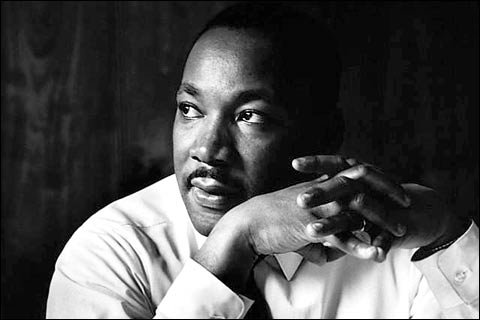
It’s Martin Luther King Day in the United States. It’s a big deal in the land of toxic derivatives; even the stock markets are closed in his memory.

Once harassed and stalked by the the FBI, King’s memory is now regularly and hypocritically invoked by those who stand on his shoulders.

Were King alive he would have just celebrated his 81st birthday. Had he survived the assassin’s bullet he would still be followed by spooks and menaced by that which he famously described as “the greatest purveyor of violence in the world today” — the U.S. government.

Speaking at Riverside Church in New York City on April 4, 1967, King exposed the hypocrisy of the U.S. government and called on it to end the war in Vietnam. His words sent shock waves through the land because he articulated a truth that millions of Americans had not been allowed to hear.

He shared with them his outrage at the subversion of democracy, the murder of men, women and children, the destruction of cultures and livelihoods and cruel irony that black and white Americans were being sent to kill and die together by a country that segregated them at home.

Martin Luther King exposed the Big Lie of American imperialism that day in New York City; exactly one year later, in Memphis, Tennessee, he would pay for his truth-telling with his life.

In reading his speech today I’m struck by the parallels between Vietnam (and America’s other wars in Laos and Cambodia) and the current day “war on terrorism” in Iraq, Afghanistan, Pakistan, and increasingly, in Yemen.

Read King’s speech for yourself; then re-read it and make a few substitutions:

  • “terrorists” for “communists”
  • “Al-Quaida” for “Viet Cong”
  • “Afghanistan” for “Vietnam”
  • “America” for “America”

Most of the actors have different names but the script is the same weary, blood-soaked, tear-stained tale.

The antidote remains the same, as well. King called upon his fellow Americans to oppose the war nonviolently, creatively and without letting up. But he acknowledged that anti-war protests were not enough. As King put it:

The war in Vietnam is but a symptom of a far deeper malady within the American spirit, and if we ignore this sobering reality we will find ourselves organizing clergy- and laymen-concerned committees for the next generation. They will be concerned about Guatemala and Peru. They will be concerned about Thailand and Cambodia. They will be concerned about Mozambique and South Africa. We will be marching for these and a dozen other names and attending rallies without end unless there is a significant and profound change in American life and policy.

King maintained that America needed make radical changes.

We must rapidly begin the shift from a “thing-oriented” society to a “person-oriented” society. When machines and computers, profit motives and property rights are considered more important than people, the giant triplets of racism, materialism, and militarism are incapable of being conquered.

Sounds like 2010, to me.

Remembrance Day has always held profound significance for me, perhaps because I grew up on military bases among people of my parents’ generation who had experienced the horrors of World War Two.

I remember the sadness in my father’s eyes when he would mull over faded pictures of a friend who never came home. I remember chuckling about the lighter moments of POW life related by a friend’s father, but registering how he refused to talk about what it was like to be captured at Dieppe. I often think of another long lost friend, the son of a bomb disposal expert, who was forced to watch his psychologically damaged father commit suicide in a drunken stupor some 20 years after the war ended.

While I make a point of observing Remembrance Day, I shun the large military gatherings with the mournful buglers and the howitzers’ deafening “salutes.” To me, these kinds of observances seem calculated to ensure we will continue to view war as equal measures of valour and glory. They do not present war as what it is: legalized murder and clear evidence that, after millennia of evolution, we still lack the imagination it takes to live in peace.

Remembrance Day has its origins in the wake of World War One: the so-called “war to end war.” While WW1 has often been presented as a struggle between the forces of democracy and tyranny, it was, in reality, a clash of empires that yielded 40 million deaths and laid the basis for an even larger conflagration a generation later.

WW1 is often portrayed as when Canada “came of age.” Canada won the right to play with the big dogs by sacrificing (in round numbers) almost 67,000 of its sons and daughters. I’ve often wondered how our lives would have differed if this tremendous human potential had not been squandered, in Flanders and elsewhere.

Every Canadian who went through our school system is familiar with the poem by Colonel John McCrae, himself a casualty of “The Great War.”

In Flanders Fields
written in 1915 by John McCrae

In Flanders fields the poppies blow
Between the crosses, row on row,
That mark our place; and in the sky
The larks, still bravely singing, fly
Scarce heard amid the guns below.

We are the Dead. Short days ago
We lived, felt dawn, saw sunset glow,
Loved, and were loved, and now we lie
In Flanders fields.

Take up our quarrel with the foe:
To you from failing hands we throw
The torch; be yours to hold it high.
If ye break faith with us who die
We shall not sleep, though poppies grow
In Flanders fields.

For me, the poppy is an object of meditation on the tragedy of blood needlessly spilled over the past century, and on the folly of our latest military adventure in Afghanistan. Switching imperial masters, we now send our troops to kill and to die on behalf of the American Empire, the British Empire having passed its best-before date sometime around 1945.

The poppy is iconic; in a curious way, it unites us. You will find it on the lapels of peaceniks and militarists and everyone in between.

The poppy is sacred: it reminds us of young lives brutally snuffed.

The poppy is evil: it urges us to “take up our quarrel with the foe.”

The poppy is a major source of income in Afghanistan for corrupt government officials, warlords and insurgents alike.

I won’t be attending any Remembrance Day ceremonies this year, either. But I will be wearing my poppy, and I will remember.

Stretcher Bearers Bringing in Wounded at Vimy Ridge

Every Nov. 11, I get a little weepy.The knowledge that behind the solemn ceremonies and the 21-gun salutes from capitals across the country lie millions of premature deaths and incalculable suffering is overwhelming.

This weekend, the Vimy Ridge Memorial in France has been re-opened and our political and military leaders are mouthing platitudes about sacrifice, democracy, and nation-building. 3,598 Canadians were killed and 7,104 wounded in the battle of Vimy Ridge, and so it is only fitting that we lay to rest some of the bullshit that has been flowing, ostensibly in their memory.

Much is made of the valour and sacrifice of the Canadians at Vimy. Valour means courage under fire and to be sure, our ancestors were brave. One account of the battle says the artillery barrage was so loud it could be heard in southern England, 100 miles away. Imagine the fear this din would have inspired on all sides; imagine being able to stand up and walk, much less fight, in this hellish environment.

And they were sacrificed – gutted on the altar of imperial ambition. Four empires: the Austro-Hungarian, German, Ottoman, and Russian disintegrated, and the Allies divided up the spoils. We continue to reap that whirlwind in the Middle East, among other places.

Democracy? I suppose it’s a relative term, even today. Prior to WW1 the Germans had an emperor and a parliament; we had a king and a parliament. Women were not allowed to vote in either country. Citizens and combatants on both sides were force-fed a stew of lies about their evil adversaries, but looking back over 90 years, it is difficult to see WW1 as a struggle for democracy.

Nation building? In Canada, the battle of Vimy Ridge is portrayed as key breakthrough in the evolution of Canada from a British colony to an independent state. Under British command, Canadians planned, led, provided most of the Allied fighters at Vimy and prevailed. Their blood, we are told, helped us win a seat at the Versailles peace negotiations, which led to our ever growing autonomy on the world stage (which presumably led us to our present status as a vassal of the American Empire — but I digress).

The folks who depend on a compliant source of cannon fodder for current and future wars want us to believe that the battle of Vimy Ridge was a GOOD THING. They want us to believe that Canada “came of age” in the Great War. WW1 is presented as an essential rite of passage, sanctified by our emerging nationhood, almost an historical inevitability if we were ever to find our place in the world. Today’s warmongers are even trying to bask in the reflected glow of long ago bombardments as they direct our young people to slaughter in Afghanistan. (National Defence Minister Gordon O’Connor put it this way: “And much like the Battle at Vimy Ridge, our involvement in Afghanistan is, in many ways, helping to define us as a nation today. A nation that stands up for what we believe in.”)

But consider this: of the 620,000 Canadians who fought in the Great War, 67,000 were killed and 241,000 were wounded. Imagine what a country we might have built if these young men had remained at home, with their families, in their communities.

Friends of mine have an old photo hanging in their dining room of a large gathering of Winnipeggers, taken sometime in the 1920s. One is struck by the conspicuous absence of young men.

Imagine the waste.

vimy pic1


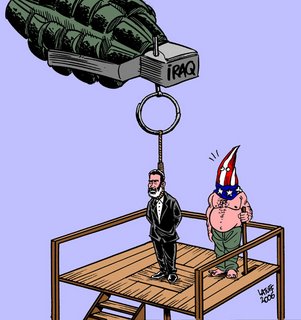
Saddam hangingAnd if any mischief follow, then thou shalt give life for life, eye for eye, tooth for tooth, hand for hand, foot for foot, burning for burning, wound for wound, stripe for stripe.
– Exodus 21:23

A day in the life of the average Iraqi has been reduced to identifying corpses, avoiding car bombs and attempting to keep track of which family members have been detained, which ones have been exiled and which ones have been abducted.
– riverbend, Baghdad Burning

Saddam Hussein didn’t have nearly enough body parts to compensate for the damage he did. Nor does George Bush.

It’s a pity, really, that George and Saddam will not have the opportunity to share what should be their just desserts: sharing a jail cell for the rest of their natural lives, with perhaps an opportunity for community service should either demonstrate he could be safely let out on the streets or display an aptitude for that kind of thing.

An eye for an eye makes the whole world blind.
– Mahatma Gandhi

‘Nuff said?