Posts Tagged ‘Canada’

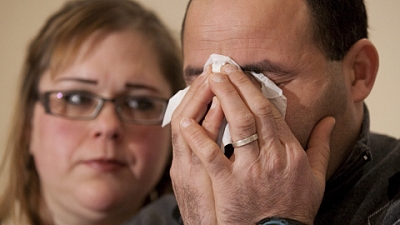
Mohamed Harkat and wife Sophie Lamarche at a press conference in Ottawa, Dec. 10, 2010. Photo: Sean Kilpatrick

By Sophie Lamarche

What was expected to be the end of a long nightmare and a great end to 2010 turned out to be a disaster. We can’t really put 2010 behind us because our battle continues. On Dec. 9th, 2010, the day before International Human Rights Day and the 8th-year anniversary of my husband Mohamed Harkat’s arrest under a security certificate, the Harkat family, his legal team, and his supporters across the country got a big punch in the guts.

It is one, Moe and I never expected. One, which many never expected! Our family, supporters, groups, unions and legal experts were all shocked at the recent ruling made by Justice Simon Noel from the Federal Court of Canada to uphold the security certificate against Moe.

The certificate was found ”reasonable” under the lowest standard of proof in a Canadian court. This decision was based on secret evidence neither Mohamed nor his public counsels could see or test for national security reasons. All that because CSIS believes, thinks, or assumes that Moe was involved or will be involved with terrorism in the past, present, or future. That position could cover any one of us at any time.

To this day, he still does not know the evidence against him. We have all been kept in the dark for eight years.

Mohamed Harkat was arrested and thrown in jail on Dec. 10th, 2002. He is the only inmate to ever be detained for 43 long months at the Ottawa Carleton Detention Centre without ever knowing why or without ever being charged. That day will be engraved in my mind for the rest of my life.

My mom says she’ll always remember the sound and fear in my voice when I called her on her cell phone after Moe was arrested. I was hysterical; terrorism was such a taboo subject after 9/11, and still is. Who on earth wants to be associated with the word terrorism or allegations related to terrorism?

What I was really after was for the truth to come out. I was never afraid of the truth. I had one look into Moe’s eyes on our first visit in jail, I knew then I had to fight. But between you and me, I knew even before looking into his eyes that he had nothing to do with those absurd allegations. Mohamed has always denied all the allegations.

For three-and-a-half years, I visited my husband in an icy cold or burning hot room behind a dirty thick glass window, with rotten food on the floor or big bugs on the walls, while talking through a broken recorded telephone, surrounded by guards who watched us from every angle for every minute of the visit. And let’s not forget the bad treatment and killer looks before even going in. We were only entitled to two visits per week for 20 minutes, and that’s only if we were lucky to get a ”good” guard who would bring him in on time and then start the phone.

We stared and mimed through glass many times without having a working phone. After waiting for hours to see him, he would be brought (the first year) with shackles around his ankles to his waist and to his wrists. His orange suit was so bright he could probably be seen from space. It seems like he was treated worse than the biggest criminal in this country.

They put him in solitary confinement for the first year, and only took him out for one or two showers per week if he was lucky. He did not have access to fresh air or outdoors for the first six months and was kept in isolation from all the other inmates, without anything to read or to do.

I did not sleep for years. I was always worried for his safety and waiting by the phone for his collect call that often never came. He was the one inmate everyone in prison knew and talked about, but that no one had seen. Everyone there saw him in the newspapers and on TV but he did not. He was kept away from the general population.

We got nothing! The men were basically “kidnapped” from their sections one day only to be transferred in total secrecy. An inmate from OCDC called me collect to say Moe had never returned to his section – this is how I found out about it. The fear was within me once more.

After three-and-a-half frustrating years in detention, Moe was finally released on bail — but the government appealed his bail, of course! I had him back but both he and I became full-time prisoners in our home for the following four years.

I was a jail guard to my own husband and pretty much cut from the outside world. Moe was released under the toughest bail conditions in Canadian history. He could never be left alone in the house or in our yard. We were together every minute of every day, unless another court-appointed surety could ”release” me of my duties for a few minutes or hours.

There were surveillance cameras in our home, our phone was tapped and every conversation was open for CSIS and CBSA to listen to, all our mail was intercepted. We only had three outings per week of four hours each, Moe to this day still wears a GPS electronic tag around his ankle at all times, my computer room is under lock and key, and no cell phones or similar communications devices are allowed in our home.

While out on pre-approved outings, we were followed by between two and six CBSA officers wearing bulletproof vests and carrying guns. Every location and person we were in contact with had to be pre-approved at least 48 hours in advance. This included our newborn nephew and my 80-year-old grandmother.

Many friends and outings were denied, including his own 40th birthday party and our wedding anniversary outing. I took Moe with me when I went to pre-approved pap tests, into changing rooms, and we were forced to use shared family washrooms in public buildings since he could never be left alone.

That was our life for almost four years until, suddenly, the government ordered almost all restrictions lifted in Sept. 2009. Apparently, Moe was no longer a threat. For four years, we were humiliated, degraded and dehumanized in every way possible. Needless to say, when the conditions changed, it was about time, because I was very close to exploding! Many conditions still remain, including the GPS tag and ban on use of a computer and cell phone, but life is different. That’s the price of freedom in Canada!

Life has been a real soap opera for us the past eight years. Many would not believe some of my many stories. Some could not care less. But I always ask them “if you were in my husband’s shoes and you were detained without charge or access to the evidence… would you accept the process???”

No honest Canadian has ever agreed to that. Why should refugees or immigrants be treated differently?

In Sept. 2007, the Supreme Court of Canada unanimously found the Security Certificate process unconstitutional. One for us, zero for CSIS! They had one year to draft a new law that ended up being just as bad the second time around.

The main difference was a cosmetic changed created by adding the position of special advocates who can see some secret evidence, but can never talk with public counsels unless permitted by the court or the accused.

Same old thing, nothing new. The new process is very frustrating and remains as secretive. When the second security certificate was re-issued to Moe in Feb. 2008, the cover letter was addressed to Hassan Almrei.

Mistake number one! Wrong guy? Wrong allegations? Imagine what goes on in the back. Imagine what kind of evidence is presented in secret?

For the record, we know the special advocates do not have access to all material, only what CSIS chooses to release. They also don’t have access for cross-examination of some human sources and informants, only their files. You call that fair? Not only did we lose the reasonableness in Dec. 2010, but also on legal arguments on the constitutionality and abuse of process. Both applications for stay of proceedings were denied. Zero for us, one for CSIS!!!

Before we end this article, let’s talk about the abuse of process done by the hands of CSIS.

They use evidence that comes or derives from torture, their main informant failed a lie detector test, and CSIS failed to tell the court, they listened to solicitor/clients calls for months until they were caught, they destroyed every piece of original material in our case (notes, tapes, intercepts, interviews… everything).

If it were a criminal case, it would not stand a chance.

They raided our home in May 2008, two week before our hearing, in order to find so-called evidence. They sent 16 CBSA officers, three sniffer dogs (normally used for locating currency, drugs and explosives), two OPP and two RCMP officers to guide the dogs. The search lasted over six hours and they took out over 20 boxes of material including my computer, which is in a locked basement and contained all my communications with public counsels.

They searched every inch of our house for evidence, when they already knew or approved everything we ever did (GPS, surveillance cameras, tapped phone, intercepted mail and followed during outings), our house was probably safer than Prime Minister Stephen Harper’s residence.

If that’s not abuse… what is??? If you are still doubtful, may I remind you that the evidence is kept secret for national security reasons and on numerous counts, CSIS was found guilty of deporting people to torture based on baseless evidence.

Will we learn from the past? What is my husband to do? If he does not testify, he will be considered to be the one hiding something. When he does testify, he is called a liar, a terrorist. It’s his word versus the secret evidence, secret files. Goliath versus the whale. His word against a machine, a secret informant, our own Canadian government and CSIS. It’s a loss, loss situation.

What happens next for us? The appeal process is just as unfair and biased as the hearing itself since the very same judge who found the certificate ”reasonable” has to certify a question to allow for an appeal to his decision.

We hope to appeal all the way back to the Supreme Court of Canada so that the whole process is found unconstitutional once again. How many more years of this nightmare? Our plans for the future (kids, work, and a home) have been put on hold again — for how long? An entire family is devastated.

In the meantime, Moe and I live with a huge cloud over our heads every day that reminds us of the possibility of deportation to face imprisonment, torture or death. Canada wants to return him, if they do, they will have his blood on their hands.

On January 21st, 2011 Moe was issued his deportation papers. The letter said he was inadmissible to stay in Canada because he was a threat to the safety of Canadians and for National security reasons. Proceedings are in place. Another big blow. Moe, who has been devastated since December, is having difficulty sleeping, eating and doing day-to-day things without having to worry constantly. He has been seeing a professional for years. He’s in the dark, just like the secret evidence. The battle ahead of us is long and painful. We are grateful to the many supporters who came out on a cold winter day to the building of CBSA to protest their anger and disapproval. Canadian Border Services Agency was so scared of a couple of ragging grannies and tons of media, that they had locked themselves up in their offices and closed all the blinds!

How long will this last, how long will my family be submitted to psychological torture, imprisonment. My country has failed me. I’m ashamed at how my husband and the other men are being treated by the Canadian government.

We continue to fight because of your support. You give us the strength and motivation to go on. We thank our supporters for their love, friendship, dedication and unconditional support.

If you believe in due process, please sign our new statement www.harkatstatement.com

Contact your MP and demand that these men get a fair and open trial so the evidence is made public for all Canadians to see and for the truth to finally come out. We are not afraid of the truth.

Pity and Fear will not get us anywhere. Don’t say silent in the face of injustice. One day it could be you.

Take a stand.

We CAN make a difference!

May justice prevail!


See also: Justice for Mohamed Harkat

The secret trial of Mohamed Harkat remains an affront to all who cherish democracy and justice. Convicted and condemned to deportation on the basis of secret evidence that he was not allowed to see, Mr. Harkat faces deportation to his native Algeria where he would face imprisonment and torture, if not death.

Mohamed Harkat is continuing his struggle for a fair hearing. Visit his site and read his story. Sign the petition that calls for an end to the police state tactics that allow people to be detained indefinitely and deported without being tried in a fair, public and impartial trial.

And circulate this new video to everyone you know. At a time when people around the world are standing up to demand basic democratic freedoms, it is time Canadians regained some of ours.


See also:

Speaking at a forum, Jan. 23, 2011, sponsored by Peace Alliance Winnipeg and Project Peacemakers, author/activist Yves Engler explores Stephen Harper’s foreign policy and how it cost Canada its bid, in 2010, for a seat on the United Nations Security Council.

I’ve written about this before – the F-35 stealth fighter deal stinks to high heaven. Over priced and over sold, the stealthiest thing about this “defense contract” is the assault on Canadian taxpayers over the next several decades as we are robbed of $30 billion to bankroll the merchants of death.

This weapons system is designed for one thing only: fighting wars of aggression. We must send a clear message to Ottawa that we will no longer tolerate the use of our dollars to fuel the international war machine.

Above is a video I shot over the weekend in which Michael Bueckert of Project Peacemakers makes the case for tearing up Stephen Harper’s order for 65 of these death planes. Below is the text of his remarks, also published at the Peace Alliance Winnipeg News.

Call your MP today and tell him/her to shoot down this despicable deal without further delay.


The F-35 Stealth Fighter: A bad deal for Canada

By Michael Bueckert, Program Coordinator, Project Peacemakers

As you may know, this past July, the Conservative government announced what could be the single largest military procurement in Canada’s history when it declared its intention to buy 65 F-35 Lightning II aircraft (A.K.A. “Joint Strike Fighters”) to replace our aging fleet of CF-18s starting in 2016.

If you are familiar with this issue, then you are probably also aware of the narrow way in which the media has presented it.

On one side are the supportive arguments, provided by the Conservative government, military brass and the aerospace companies. When replacing our aging CF-18s, the F-35s are considered necessary for a number of reasons; namely, they provide interoperability with the U.S., they have the best, newest capabilities available, and the deal will create and support Canadian jobs. Additionally, by committing now we would secure the price at a low level.

And then there is the critical argument, provided by the main opposition parties: the deal is based on a sole-source contract, and without appropriate market competition we will inevitably be paying too much for the planes, and there may be better alternatives out there.

So the way it is framed, the debate is essentially one side saying that the F-35s are the best possible planes and this deal will support our army and industry, versus the other side saying that the deal is irresponsible and that we should have an open competition to get the best price.

This excludes the many important critiques being made by analysts in the peace community, primarily by the folks at Project Ploughshares, and by Steven Staples at the Rideau Institute. It is their work that I will draw from most in this presentation.

So let’s look at some of the main arguments put forward by proponents of the F-35 deal.

First of all, is the planes themselves. Proponents argue that these Fifth Generation fighter jets are top notch, with stealth and interoperability technology that makes them second to none.

As Defense Minister Peter McKay has said, “This aircraft is the best that we can provide our men and women in uniform, and this government is committed to giving them the very best.”

Without spending much time on this, what is it that the F-35 is designed to do?

Well, they are geared for aggressive military roles. According to the CBC, it is designed for tactical bombing and aerial warfare, equipped with a 25-millimeter gun, air-to-ground and air-to-air missiles, plus a variety of bombs. As Steven Staples puts it, the F-35 is “highly capable in air-to-air combat against other advanced fighters,” designed as “a first strike fighter-bomber intended for use in ‘shock and awe’ attacks.”

Well, I think that anyone who has read accounts of the American “shock-and-awe” bombing campaign of Iraq can appreciate how sickening it is just to imagine ourselves with that kind of capability.

But even without an appeal to moral sensibilities, even if we believe that in some cases the use of fighter planes is justifiable, and that national defence is a primary responsibility, we don’t have to look any further than the Government’s own 2008 “Canada First” defense strategy document to see that the purchase of these planes is inappropriate.

In that document, the government outlined the various threats that Canada could face in the future. According to Project Ploughshares, “you would be hard pressed to create a credible scenario from them where a stealth-enabled fighter jet is logically part of Canadian Forces’ response.”

This sentiment is reflected by Major General Leonard Johnson (retired), who argued in the Ottawa Citizen that apart from the incredulous prospect of war against an advanced enemy–Iran doesn’t count–it is “hard to see any useful military role” for the F-35.

And this argument–that there is no necessary role for the F-35 either domestically or internationally–is essentially accepted by F-35 proponents. Rather than point to how the planes could be used, they point to the unpredictable threats of an unknown future. We need the planes in order to keep our options open, and keep an aggressive militarism on the table.

The second main argument used by F-35 proponents is that by committing to these planes we are getting a good deal, and that it will provide and protect Canadian jobs. Conversely, rejecting the deal will waste taxpayers money and threaten billions of dollars in contracts for Canadian companies.

Well, to analyze these claims we need to look at the deal and the Joint Strike Fighter program in more detail.

Canada joined the Joint Strike Fighter program in 1997, under the Liberal government. The JSF program is a partnership of nine countries—the US, UK, Italy, Netherlands, Turkey, Norway, Denmark, Australia and Canada—to invest in the development, production and sustainment of three versions of a stealth, multi-role aircraft. Lockheed Martin won over Boeing in an early competition to develop the planes for the program. To date, Canada has invested 168 million U.S. dollars in the program, and is committed to spending an additional 551 million dollars between now and 2051 in production costs.

The planes are currently in the Production, Sustainment and Follow-on Development stage, and we are expected to start receiving them in 2016. What Canada did last summer is unusual, when it committed to buying 65 planes before they had even been completed, or tested.

The planes themselves, when we buy them, are said to total $9 Billion, with up to $7 Billion in maintenance costs over their lifespan. That would bring the total cost of the planes to $16 Billion, on top of the 711 million dollars in ongoing investment.

This sounds like a lot of money in itself, but even the $16 Billion is bound to be too low, for a number of reasons.

First, the program has been plagued by cost overruns, and estimates continue to grow. Project Ploughshares, using U.S.-based data, has estimated that the planes will come to a total cost of $30 Billion, which is about double what officials are saying. Further, because the planes are not completed and have not been tested, and there is simply no idea how much we will have to pay.

In testimony to the Canadian parliament, U.S. military critic Winslow Wheeler warned about the possibility of the planes being much more expensive than advertised. His testimony is worthy of being quoted at length:

“In this country, advocates cite various figures, all of them misleading. The gimmicks include excluding important parts of the airplane, such as the engine, excluding all development costs, using obsolete dollars that understate the contemporaneous cost, and – in your case – using American, not Canadian, dollars. There are other tricks that can be hard to unravel; I encourage you to thoroughly research any unit costs cited to you.

“Neither you nor I currently know, but it is certain that the costs being cited to you now are the ‘buy-in’ costs. Real costs, when your government negotiates an actual contract and as the program goes through its life cycle, are sure to be an unpleasant surprise to you.”

Moreover, the cost per plane is based on an estimated global market that is steadily decreasing. The more planes sold, the cheaper they will be, but many countries are starting to back down from their previous commitments. Project Ploughshares has reported on the fact that the sales projections quoted by proponents are now 10 years out of date; the 2001 projection was that 5,179 planes would be sold, and now it is more likely to be between 2 thousand and 3500. Using the old estimates are almost certainly intended to deceive, as they drastically reduce the expected price.

All this is to say that the 16 Billion dollar price tag is likely to be drastically inaccurate, and the supposedly good deal is not looking quite so good.

But what about the argument that this deal is good for supporting Canadian jobs? This is the most populist, and most common argument being put forward. (It should probably be noted that if the Government was committed to Keynesian economics, there are ways of supporting jobs that don’t involve manufacturing weapons. But let’s look at this anyway).

It is true that Canadian companies have benefited so far. Industry Canada notes that to date 350 million dollars in contracts have been awarded to 85 Canadian companies and research laboratories, which is more than Canadians have invested so far. Proponents say that up to $12 Billion is potentially available to Canadian companies in industrial benefits.

Some of those benefits are being realized right here in Winnipeg. A recent Winnipeg Free Press article highlighted Bristol Aerospace, noting its contracts to build horizontal tail components, and other parts for the F-35. According to the article, Bristol has committed about $100 million in capital spending to equip its Winnipeg plant, expects to ship 1 Billion dollars in parts, and had already shipped 35 million dollars worth of parts before we committed to purchasing the jets.

It is clear that Bristol, and the industry, have a lot of vested interest in this deal. Which is why its parent company, Magellan Aerospace Corporation, has come out with other companies to support the F-35 deal, citing outdated and exaggerated statistics.

However, while Canadian arms manufactures may have benefited so far, it is not at all certain that these privileges will continue. There are no guaranteed contracts built into the procurement deal. All we have is the opportunity to bid on them, and competition from industry in other countries is growing as they demand a fairer share in the distribution of contracts. Moreover, the figure of $12 Billion in potential industrial benefits is based on the outdated market projections I explained earlier, which assume an exaggerated number of planes will be manufactured.

Labour, for its part, has refused to passively accept these figures, but has refrained from speaking against the deal itself. Instead, the Canadian Auto Workers union has called for $16 Billion of guaranteed contracts to be included in the procurement deal, a demand that is certain to be ignored.

Now, what I have just done is to argue that the proposed financial benefits to Canada are not nearly as high as stated by officials and industry. The F-35s will cost much more than we think, and will give back fewer jobs than we expect. It is important to point out the misinformation that is provided on this issue, as proponents continue to sell the deal to Canadians. But the point is not simply that they are too expensive, as the Opposition parties claim. Yes, they are expensive, but we are not calling for cheaper fighter planes.

We should remember that the CF-18s, the planes which we are looking to replace, had been used to drop bombs on Iraq in 1991, and on Kosovo in 1999. Upgrading these planes–as suggested by Steven Staples–is not a peaceful alternative to the F-35s, although it would be cheaper. Similarly, buying unmanned drones to patrol the arctic–also suggested by Staples–does not get us much farther, because drones are easily incorporated into weapons systems.

Richard Sanders, of the Coalition to Oppose the Arms Trade, is disturbed about how analysts focus primarily on the relative cost of the F-35s, as if cheaper fighter planes will be more peaceful fighter planes. I tend to agree; we need to challenge not just these planes, but all fighter planes, all military spending. But we can start by working to ensure that we do not purchase the F-35, which would be a monumental waste of money towards immoral ends.

This article is the text of Michael Bueckert’s presentation to the Feb. 20, 2011 annual meeting of Peace Alliance Winnipeg.

Support the CBC: Sign the petition

Posted: December 15, 2010 in Communications
Tags: ,

On November 23rd, Stephen Harper’s secret plan for the CBC was revealed when the Parliamentary Secretary to the Minister of Canadian Heritage mused publicly about killing our public broadcaster! You can hear the audio for yourself here.

On Dec 6th, the matter of the government’s plan for the CBC was raised in Parliament. The Heritage Minister was asked to disavow his Parliamentary Secretary’s idea of cutting all funding to the CBC. Twice Minister Moore was asked to dismiss the notion that the government should kill public broadcasting. And, twice he refused to do so. You can see the exchange in the House of Commons here.

It’s widely known that the Prime Minister Harper exercises absolute control of his government’s messaging. None of his Ministers, Parliamentary Secretaries or MPs speak out without prior approval from the Prime Minister’s Office.

We recognize the threat posed by Harper could be the most serious peril CBC has ever faced. Now is the time for all of us who love and depend on the CBC to stand up and be counted.

Please sign the petition and help spread the word!

Mohamed Harkat and wife Sophie at a press conference in Ottawa, Dec. 10, 2010. Photo: Sean Kilpatrick

I don’t know whether Mohamed Harkat is a terrorist or not. Neither do you. How could we? Harkat was convicted in a secret trial, based on secret “evidence” provided by shadowy sources who will remain unknown to Mr. Harkat and the rest of us unless we overturn the unjust, draconian laws that made this travesty of justice possible.

Yesterday Federal Court Justice Simon Noel upheld the security certificate issued against Mohamed Harkat in 2002, opining that ” . . . although the danger associated to Mr. Harkat has diminished over time, he still poses a danger to Canada, but at a lesser level . . .” This decision makes it possible for Immigration Canada to deport Mr. Harkat to his native Algeria where he would face imprisonment and torture, if not death.

A security certificate according to Public Safety Canada is a document issued by the immigration minister to force the “removal from Canada of non-Canadians who have no legal right to be here and who pose a serious threat to Canada and Canadians.”

Under the legislation governing security certificates (Bill C-3), courts are permitted to consider secret information in closed sessions. The defendant is not permitted to see this information or to question it. “Special advocates,” appointed by the minister who issued the certificate, are allowed to see the secret information, but they are not allowed to disclose it to the defendant or his lawyer. (See this in-depth analysis of security certificates.)

This process is such an egregious violation of the principle of natural justice it boggles the mind that we allow it to exist. Under Canadian law, citizens are allowed to face their accusers in open court, to have ALL of the evidence laid out before them, to cross-examine witnesses, and defend themselves. They are considered innocent until they are proven guilty in a fair and transparent process. The security certificate process violates all of these principles and should outrage any Canadian who believes in human rights.

This process should also make citizens fear for their own safety. We are next, as the Combating Terrorism Act, which passed second reading this fall, makes clear. This act, which applies to ALL OF US, provides for warrantless arrests, compulsory testimony and 12-month preventive imprisonment of people suspected of planning terrorist acts. It is the perfect companion to the practice of allowing courts to rely on “evidence” provided by anonymous spooks hiding beneath the cloak of “national security.”

Mohamed Harkat is continuing his eight year struggle for a fair hearing. Visit his site and read his story. It is one that should concern all Canadians.

Go to the Playlist

Over the past 2 weeks, George Galloway spoke to packed halls from Halifax to Yellowknife. Winnipeg was no exception, with more than 400 people crowding into the Broadway Disciples United Church on Nov. 26 to hear Galloway’s passionate plea on behalf of Free Speech, Free Afghanistan and Free Palestine.

Galloway repeated his pledge to donate “every cent” of the compensation he expects to result from his defamation suit against the Canadian government to the Canadian anti-war movement. He also announced plans to launch a Canadian wing of Viva Palestina, in Calgary, next year. Viva Palestina is a registered UK charity that Galloway helped found that has raised millions of dollars in humanitarian aid for the people of Gaza.

Galloway is a frighteningly talented orator. It is easy to understand why Immigration Minister Jason Kenney would want to keep him out of the country. He spoke knowledgeably, passionately, with great warmth and biting wit, without notes for just over an hour. (My favourite example of his savage wit was a passing reference to Harper and Ignatieff as “Tweedle Dee and Tweedle Dum . . .two cheeks of the same backside” — but I digress.)

Here are only a few of the highlights.

On Kenney’s attempt to keep Galloway out of Canada

“As any bookseller could have told Mr. Kenney, any book that you try to ban usually ends up on the best-seller list.”
“Though the offence against me was considerable, the offence against you was much, much more serious, because what it established and what Justice Mosley’s 60-page caning of Kenney — across a 60-page judgement — what was established was that you have a government of liars and deceivers who are planning to take your rights away.”
On racism, Antisemitism and Zionism
“It is unconscionable to exercise freedom of speech to whip up racial or religious hatred – to whip up hatred of people because of what they are – not for what they’ve done, not for what they believe in, but because of who and what they are. That’s called racism.”
“That somehow I might be a hater of Jews, or in other words, a racist, is as absurd as it is insulting and offensive.”
“We are against the racist, apartheid ideology of Zionism and its practise in the apartheid state of Israel.”
“When people campaigned to end communism in Russia it didn’t mean they wanted to end the people of Russia. It didn’t mean they wanted to eliminate the country of Russia.They were against a political ideology which they believed was wrong and harmful. And that’s the spirit in which we say we are against Zionism. We’re not against the Jewish peiople who live in the land they call Israel and we call Palestine. We’re against the idea that there can be an apartheid state created there where the non-Jews are second class citizens and where the state illegally occupies and controls every aspect of the lives of three million Palestinian people living under occupation in the West Bank, in Gaza and in East Jerusalem.”
On Afghanistan
“Has anyone in Canada ever asked the question how come the Afghan army needs quite so much training? For ten years they’ve been trained by the occupation armies that invaded and occupied Afghanistan . . . The cost of training Hamid Karzai’s puppet regime, paid for by western taxpayers including every one of you,  is $1 billion per month . . . with no noticeable improvement in their performance. Nobody’s training the Taliban and they’re doing quite well.”
“Nobody has every successfully occupied Afghanistan. Even Alexander the Great did not succeed in occupying Afghanistan and Stephen Harper is not Alexander the Great.”
“The Afghans are quite good at fighting. They don’t need much training. And they will never accept the foreign occupation of their country. Full stop.”
“We have to get out of Afghanistan, not just because we can’t afford it, not just because our own young men are being killed, but because we’re achieving the opposite of what needs to be done. We’re deepening that swamp [of bitterness], rather than draining that swamp.”
“Bush and Blair and Harper and, I dare say Kenney, are willing to fight to the last drop of other people’s blood and that’s just immoral.”
On Democracy
“I’m not a supporter of Hamas. It doesn’t matter how many times these raving bloggers in Canada or these raving ministers in Ottawa contend it, the judge has already opined on this point and his decision is final.  I’m not a supporter of Hamas but I am a supporter of democracy. And the only people entitled to choose the leadership of the Palestinian people are the Palestinian people themselves. This is surely ABC. I mean how else could it be?
“I don’t like Stephen Harper. I wouldn’t have voted for him. But I can’t pretend that he’s not the Prime Minister of Canada. I can’t appoint somebody else as the Prime Minister of Canada though the vision of Michael Ignatieff just flitted across my mind. Talk about Tweedle Dee and Tweedle Dum. Two cheeks of the same backside. I can’t appoint Ignatieff or Layton of anyone else as the leader of Canada. I have to accept the outcome of the elections in Canada.
“Well, as we say we’re fighting for democracy every time we go to war, the Palestinians had democracy. They had an election. It was the only, only, free, democratic election ever held in any Arab country, ever, in all history. It was described by Jimmy Carter, no less, as pristine. Pristine. Chrystal clear. Transparent. Perfect. We just didn’t like the result. So what did we do? We immediately imposed a siege to starve the children of the votes, to punish them for how their parents had voted.
“How democratic is that? That’s hypocrisy, not democracy. But that’s exactly what we did and that siege has now lasted for four long years.”

Today is the day the Canadian Peace Alliance has asked Canadians who oppose extending the stay of Canadian troops in Afghanistan to phone, fax, write, email their MPs, party leads, the PM, etc. If you haven’t, please get to it. More details at http://www.acp-cpa.ca/en/VirtualMarch.html.

Stuck for ideas? Just tell them how you feel. Here’s mine:

Prime Minister Stephen Harper <pm@pm.gc.ca>

Gilles Duceppe <Duceppe.G@parl.gc.ca>

Michael Ignatieff <Ignatieff.M@parl.gc.ca>

Jack Layton <Layton.J@parl.gc.ca>

Gentlemen,

I am one of the overwhelming majority of Canadians who are opposed to any continuation of our military involvement in Afghanistan. This includes providing military training of any kind.

I am deeply disturbed at the appalling waste of human life (Canadian, NATO, Afghans on all sides). I feel morally compromised that my tax dollars are helping to pay for this carnage.

In my view, Canada’s involvement was wrong from the beginning. Despite the tiny fig leaf of legality afforded by the UN after the invasion, the invasion was a “crime of aggression” under international law; the ongoing occupation is a crime against humanity, committed to further the imperial designs of the United States and multinational corporate interests who have reaped the huge benefits of multi-billion dollar war spending. History will not look kindly on the Liberal and Conservative Party leaders who have brought us to this point.

Make no mistake, continuing to support this war and the hideously corrupt regime of Hamid Karzai under the guise of “training” fools no one.

Mr. Harper: you lied to the people about ending Canada’s military participation in 2011 and you lied when you said any extension would be subject to a debate in  the House of Commons. You have developed a habit of hiding from Parliament when it suits your purpose and you will pay a huge price in the coming election.

Mr. Ignatieff: your complicity in defying the will of the Canadian people can only lead to the growing cynicism that Canadians feel when faced with politicians who will not listen to the people on important issues. It is astounding that you continue to squander opportunities to do the right thing and to lead Canada onto a principled, peaceful path. And you expect to become Prime Minister?

Mr. Duceppe: opposition to this war is stronger in Quebec than anywhere else in Canada. I hope you will act accordingly and oppose any further support for this madness.

Mr. Layton: I appreciate your opposition to the extension of this so-called “mission.” Remain strong and steadfast and be confident that the majority of Canadians support you when you call for the return of all Canadian troops. You may be the only national political leader who understands the need for peace, but, in this, you have millions of followers.

In summary, I insist that you bring ALL of our troops home from Afghanistan by July 2011, if not sooner.

Sincerely,

Paul S. Graham
Winnipeg, Manitoba

Harper’s decision to continue Canada’s participation in the occupation of Afghanistan beyond 2011 is no surprise to anyone who has been paying attention. Ignatieff’s acquiescence is similarly unsurprising. Still, in light of previous statements, their hypocrisy is impressive. For example:

“We will not be undertaking any activities that require any kind of military presence, other than the odd guard guarding an embassy. We will not be undertaking any kind activity that requires a significant military force protection, so it will become a strictly civilian mission.”
–Stephen Harper quoted in National Post, January 6, 2010

“We’re bound by the parliamentary resolution. I’ve said clearly that our party’s position currently is that the military phase of the mission ends in 2011.”
–Michael Ignatieff quoted by Canadian Press, February 2009

“Mr. Speaker, as members of the House know, we made a pledge during the last election campaign to put international treaties and military engagements to a vote in this chamber.”
–Stephen Harper in the House of Commons, May 17, 2006

Tory-Liberal strategists and their apologists in the mainstream media are framing the issue in terms of training versus combat. By misrepresenting the character of the military mission they hope to defuse outrage over the promise not to commit Canada to “military engagements” without a Parliamentary vote.

Their refusal to debate the issue in the House of Commons deprives the NDP and BQ of an opportunity to challenge the government’s plans. It may also divert them from what should be the real issue, namely: “Should Canada have any involvement in Afghanistan?”

Most Canadians oppose continued military involvement in Afghanistan. A CBC-EKOS poll in April 2010 indicated that 60 per cent of Canadians opposed an extension of the military mission beyond 2011. A September 2010 Global News poll confirmed this view, with 61 per cent opining that “all Canadian troops need to come home.”

One has to ask what kind of democracy we have if the governing party and the principle opposition party can collude to flout the will of the majority of Canadians on issues as important as war and peace. Harper’s decision is one more indication of his lack of fitness to govern our country; Ignatieff’s complicity confirms his unsuitability to succeed Mr. Harper in the next election.

Where does this leave the NDP? A recent NDP statement is problematic:

“Harper waited until MPs left Ottawa and then engaged in a backroom deal with the Ignatieff Liberals to extend the military mission in Afghanistan. This is wrong,” said New Democrat Leader Jack Layton. “A majority of Canadians say they are against extending the military mission – Conservatives and Liberals must start listening to Canadians, not just to each other.”

“What New Democrats are saying is we need an increased focus on diplomacy, development and governance in Afghanistan, in order to build a lasting peace to this region,” said Layton. “Canada’s military has served with honour and done its fair share, now it’s time for Canada’s contribution to be through aid and diplomacy.”

Layton expresses his opposition to continued military action and his support for the peaceful aspirations of Canadians. This is positive.

However, his opportunistic genuflection to “Canada’s military” which “has served with honour and done its fair share” misleads Canadians about the shameful character of Canada’s involvement in America’s imperial war. The fact is, before the UN gave the occupation a fig-leaf of legality, the American-led invasion was a naked act of aggression, a crime against humanity, a war of aggression that had been on the drawing board well before Sept. 11, 2001. By supporting this war, Canada’s political leaders (Liberal and Conservative) are the moral equivalent of the Nazis we hanged at Nuremberg; our troops are their hired guns.

Layton’s commitment to ongoing aid for the the corrupt gang of drug lords and crooks that allegedly governs Afghanistan (aka, the Karzai government) reveals either a complete misreading of the war in Afghanistan (which is as much as anything else a civil war between ethnically defined contenders) or a preference for the kinder, gentler forms of imperialism that have characterized Canadian foreign policy in the past (also known as “peace keeping”).

The fact is, any Canadian involvement in Afghanistan that lends support to the Karzai government puts us on the side of America’s imperial project. Layton should know better.

Where does this leave the peace movement? I suppose we should be grateful for any kind of Parliamentary allies, however imperfect. That said, it seems unlikely that Parliament will extract us from this war or keep us out of future American imperial adventures.

In a recent article, Michel Chossudovsky argues:

“The holding of mass demonstrations and antiwar protests is not enough. What is required is the development of a broad and well organized grassroots antiwar network which challenges the structures of power and authority.

“What is required is a mass movement of people which forcefully challenges the legitimacy of war, a global people’s movement which criminalizes war.

“Antiwar protest does not question the legitimacy of those to whom the protest is addressed.

“Protest is accepted under Western style “democracy”, precisely because it accepts the established political order, while exerting pressure on political leaders to shift their policy stance.

“Protest serves the interests of the war criminals in high office, to whom the demands are directed.

“Ultimately what is at stake is the legitimacy of the political and military actors and the economic power structures, which control the formulation and direction of US foreign policy.”

While much of his article appears to be more directed at the American peace movement, these concerns need to be addressed by Canadian activists if we are to move beyond the limitations of Layton’s lame response.

by Yves Engler

In a stunning international rebuke Stephen Harper’s government lost its bid for a UN Security Council seat last week. The vote in New York was the world’s response to a Canadian foreign policy designed to please the most reactionary, shortsighted sectors of the Conservative Party’s base — evangelical Christian Zionists, extreme right-wing Jews, Islamophobes, the military-industrial-academic-complex, mining and oil executives and old cold-warriors.

Over the past four year Harper’s government has been offside with the world community on a whole host of issues. Canada was among a small number of countries that refused to recognize the human right to water or sign the UN Declaration on the Rights of Indigenous Peoples. On two occasions Ottawa blocked consensus at the Rotterdam Convention to place chrysotile asbestos, a known toxin, on its list of dangerous products and in November Finance Minister Jim Flaherty refused to even consider British PM Gordon Brown’s idea of a global tax on international financial transactions.

Close to the companies making huge profits on the Tar Sands, the Conservatives repeatedly sabotaged international climate negotiations. They angered many in the Commonwealth by blocking a resolution calling for a “binding commitment” on rich countries to reduce emissions and at a UN climate conference in Bangkok last year, many delegates from poorer countries left a negotiating session in protest after a Canadian suggestion to scrap the Kyoto Protocol as the basis of negotiations.

Israel’s best friend

The Conservatives extreme “Israel no matter what” position definitely hurt its chance on Tuesday. “It’s hard to find a country friendlier to Israel than Canada these days,” explained Israeli Foreign Minister, Avigdor Lieberman, who emigrated from Moldova when he was 20 but still feels fit to call for the expulsion of Palestinian citizens of Israel.

The Conservatives publicly endorsed Israel’s 2006 attack on Lebanon, voted against a host of UN resolutions supporting Palestinian rights and in February Ottawa delighted Israeli hawks by canceling $15 million in funding for the UN agency for Palestine Refugees (UNRWA). The money was transferred to Palestinian security reform.

For the past three years Canada has been heavily invested in training a Palestinian security force designed to oversee Israel’s occupation of the West Bank and “to ensure that the PA [Palestinian Authority] maintains control of the West Bank against Hamas,” as Canadian ambassador to Israel Jon Allen was quoted as saying by the Canadian Jewish News. According to deputy Foreign Affairs minister Peter Kent, Operation PROTEUS, Canada’s military training mission in the West Bank, is the country’s “second largest deployment after Afghanistan” and it receives “most of the money” from a five-year $300 million Canadian aid program to the Palestinians.

At the same time as Canadian “aid” strengthens the most compliant Palestinian political factions, the Conservatives have refused any criticism of Israel’s onslaught against the 1.5 million people living in Gaza. Canada was the only country at the UN Human Rights Council to vote against a January 2008 resolution that called for “urgent international action to put an immediate end to Israel’s siege of Gaza.”

Later in 2008 Israel unleashed a 22-day military assault on Gaza that left 1,400 Palestinians dead. In response many governments condemned the bombing and Venezuela broke off all diplomatic relations. Israel didn’t need to worry since Ottawa was prepared to help out. The Canadian embassy now represents Israel’s diplomatic interests in Caracas.

Threatening Iran

While Brazil and Turkey tried to dissipate hostility towards Iran, Harper used his pulpit as host of the G8 to pave the way for a possible U.S.-Israeli attack. A February 17 Toronto Star article was headlined: “Military action against Iran still on the table, Kent says.” The junior foreign minister explained that “it’s a matter of timing and it’s a matter of how long we can wait without taking more serious preemptive action.”

“Preemptive action” is a euphemism for a bombing campaign. Canadian naval vessels are already running provocative maneuvers off Iran’s coast and by stating that “an attack on Israel would be considered an attack on Canada,” Kent is trying to create the impression that Iran may attack Israel. But it is Israel that possesses nuclear weapons and threatens to bomb Iran, not the other way around.

While Ottawa considers Iran’s nuclear energy program a major threat, Israel’s atomic bombs have not provoked similar condemnation. The Harper government abstained on a number of near unanimous votes asking Israel to place its nuclear weapons program under International Atomic Energy Agency (IAEA) controls and in September Bloomberg cited Canada as one of three countries that opposed an IAEA probe of Israel’s nuclear facilities as part of an Arab led effort to create a nuclear-weapons-free Middle East.

Cold war throwback

Not content with taking on Iran, the military-minded Conservatives turned on Russia. Harper referred to Russia as “aggressive” and in a throwback to the Cold War, Defence Minister Peter MacKay added that Ottawa would respond to Russian flights in the Arctic by flying Canadian fighter jets near Russian airspace. Making sure that Moscow got the message, during a July 2007 visit to the Ukraine MacKay said Canada would help provide a “counterbalance” to Russia.

Haiti

Ottawa even prioritized the military over aid in the face of the incredible suffering caused by Haiti’s earthquake. Two thousand Canadian troops were deployed while several Heavy Urban Search Rescue Teams were readied but never sent. Foreign Affairs Minister Lawrence Cannon explained that the teams were not needed because “the government had opted to send Canadian Armed Forces instead.”

Overthrown in February 2004 by a joint U.S./France/Canada destabilization campaign, Haiti’s most popular political party, Fanmi Lavalas, has been barred from participating in elections. The Conservatives supported Fanmi Lavalas’ exclusion, congratulating Haiti’s puppet government for bringing “a period of stabilization” good for “investment and trade.” Ottawa backed up its words with deeds, adding tens of millions of dollars to a Haitian prison and police system that has been massively expanded and militarized since the 2004 coup.

Honduras

Ottawa gave its tacit support to the Honduran military’s removal of elected president Manuel Zelaya in June 2009. Mexico’s Notimex reported that Canada was the only country in the hemisphere that did not explicitly call for Zelaya’s return to power and Canadian officials repeatedly criticized Zelaya at the Organization of American States (OAS). The ousted government complained that Ottawa failed to suspend aid to Honduras, which is the largest recipient of Canadian assistance in Central America. Nor did Ottawa exclude the Honduran military from its Military Training Assistance Program.

The Harper government opposed Zelaya’s move to join the Hugo Chavez led Alba, the Bolivarian Alliance for the People of Our Americas, which is a response to North American capitalist domination of the region. Canada has actively supported the U.S.-led campaign against the government of Venezuela. In mid-2007 Harper toured South America “to show [the region] that Canada functions and that it can be a better model than Venezuela,” in the words of a high-level foreign affairs official. During the trip, Harper and his entourage made a number of comments critical of the Venezuelan government.

Colombia si. Venezuela no.

After meeting only members of the opposition during a trip to Venezuela in January, Peter Kent told the media that “democratic space within Venezuela has been shrinking and in this election year, Canada is very concerned about the rights of all Venezuelans to participate in the democratic process.”

Venezuela’s ambassador to the 34-country OAS, Roy Chaderton Matos, responded: “I am talking of a Canada governed by an ultra right that closed its Parliament for various months to (evade) an investigation over the violation of human rights — I am talking about torture and assassinations — by its soldiers in Afghanistan.”

Despite the move to the left among the majority of the region’s governments Harper moved closer to Latin America’s most right-wing state. Colombia’s terrible human rights record did not stop Harper from signing a free-trade agreement that even Washington couldn’t stomach.

The trade agreement as well as the Harper government’s shift of aid from Africa to Latin America was designed to support Canadian corporate interests and the region’s right-wing governments and movements. Barely discussed in the media, the main goal of the shift in aid was to stunt Latin America’s recent rejection of neoliberalism and U.S. dependence.

The Congo

One issue mentioned in a number of media reports about Canada’s loss last week had to do with the Congo. At the G8 in June the Conservatives pushed for an entire declaration to the final communiqué criticizing the Congo for attempting to gain a greater share of its vast mineral wealth. Months earlier Ottawa began to obstruct international efforts to reschedule the country’s foreign debt, which was mostly accrued during more than three decades of Joseph Mobuto’s dictatorship and the subsequent war.

Canadian officials “have a problem with what’s happened with a Canadian company,” Congolese Information Minister Lambert Mende said referring to the government’s move to revoke a mining concession that Vancouver-based First Quantum acquired under dubious circumstances during the 1998-2003 war. “The Canadian government wants to use the Paris Club [of debtor nations] in order to resolve a particular problem”, explained Mende. “This is unacceptable.”

The mining industry increasingly represents Canada abroad. Canadian miners operate more than 3,000 projects outside this country and many of these mines have displaced communities, destroyed ecosystems and resulted in violence. This doesn’t bother the Harper government, which is close to the most retrograde sectors of the mining industry. Last year they rejected a proposal – agreed to by the Mining Association of Canada under pressure from civil society groups — to make diplomatic and financial support for resource companies operating overseas contingent upon socially responsible conduct. Despite countless horror stories suggesting the contrary, the Conservatives claim that voluntary standards are the best way to improve Canadian mining companies’ social responsibility.

Afghanistan

Finally, the Conservatives have knowingly supported torture in Afghanistan and embraced an increasingly violent counterinsurgency war. Apparently, Canadian Joint Task Force 2 commandos regularly take part in nighttime assassination raids, which are highly unpopular with the Afghan population.

Losing the Security Council seat will hopefully cost the Conservatives some votes and temper their more extreme international positions. But, for those of us working to radically transform Canadian foreign policy the consequences of the loss may be much greater. There has probably never been a bigger blow to the carefully crafted image of Canada as a popular international do-gooder, a mythology that blinds so many Canadians to our country’s real role in the world.

Yves Engler is the author of The Black Book of Canadian Foreign Policy and Canada and Israel: Building Apartheid. He’ll be touring in Mid November to speak on “Why Canada lost its bid for a Security Council seat.” Anyone interested in organizing a talk please e-mail: yvesengler (at) hotmail.com.


See also: Video: How Canada lost its bid for a UN Security Council Seat, a presentation by Yves Engler in Winnipeg on Jan. 23, 2011.