Close "Guantanamo North"

Posted: February 3, 2007 in Uncategorized

Mohammad Mahjoub, Mahmoud Jaballah and Hassan Almrei, inmates of Canada’s “Guantanamo North” are on hunger strike to protest their indefinite detention at Kingston’s Immigration Holding Centre. After two months without food or medical care, they are extremely weak and suffering from various medical problems.

According to rabble.ca, “Despite last week’s visit by Public Safety Minister Stockwell Day, who did not meet with the detainees, there has been no negotiation with the men, and no effort to end a critical situation that could turn deadly at any time.”

Their crime? No one, least of all the prisoners, knows. Under the Immigration and Refugee Protection Act, the Canadian Security Intelligence Service can initiate a process which leads to the arrest of permanent residents or refugees who have committed no crime, throw them in jail, and detain them indefinitely with the aim of deporting them, even in the face of potential torture and death. Neither they nor their lawyers are allowed to see the “information” upon which CSIS makes allegations against them.

Consequently, all have been imprisoned under a “security certificate,” Mahjoub, since 2000 and the others since 2001.

As the revelations surrounding the illegal deportation, imprisonment and torture of Canadian Maher Arar show, the shadowy, undemocratic processes of Canadian and American intelligence agencies violate human rights, rather than protect them. If there was ever a time to demand that the Canadian government respect human rights, it is now, and a good place to begin is to join with the hundreds of organizations and individuals who have demanded an end to the use of “security certificates” by the government of Canada.

How? You can begin by endorsing the following statement by sending an email to tasc@web.ca with your name, title, affiliation and address, saying: “I ENDORSE THE STATEMENT”


Statement Against Secret Trial Security Certificates

We, the undersigned, have grave concerns regarding the continued use of sections 9, 76-87 of the Immigration and Refugee Protection Act, which allow for the imprisonment in Canada of refugees and permanent residents under the authority of a “Security Certificate”.

We are particularly concerned that those detained under security certificates are:

  • Being imprisoned indefinitely on secret evidence, though no charges have been laid against them;
  • Tried in unfair trials where the evidence is not disclosed to the detainee or their lawyer;
  • Denied the right to appeal when the certificate is upheld in a process that uses the lowest standard of proof of any court in Canada;
  • Subject to deportation even when they face unfair imprisonment, torture or death.

We believe that the Security Certificate process is undemocratic and that it violates fundamental human rights, which the government of Canada has committed itself to through the Canadian Charter of Rights and Freedoms, the UN Universal Declaration of Human Rights, the UN Convention on Refugees, the International Covenant on Civil and Political Rights and the UN Convention on Torture. Accordingly, we demand that the Security Certificate process be abolished. For those currently imprisoned under security certificates, we demand:

  • That they be released immediately; or, if any case against them actually exists, that they be allowed to defend themselves in open, fair and independent trials with full disclosure of the case against them.
  • That they not be deported.

While you’re at it, write your MP. Better yet, insist on a meeting. The existence of “Guantanamo North” is a national disgrace, and the sooner we put an end to it, the better.

Resources

Labour in Love

Posted: January 27, 2007 in Uncategorized

Labour in Love.JPG

Labour in Love: the Mayworks Valentine Social

“Join us as we celebrate romantic unions — and unions in general!”

With music from singer-songwriter Adi Sara Kreindler & friends, Hugo Torres-Cereceda and Johnny Broadway.

Friday, February 9, 2007
Winnipeg Press Club (331 Smith St.)
Lower Level, Ramada Marlborough Hotel
Doors open @ 7 pm • Admission: $10

Proceeds support the Mayworks Arts Festival.

Tickets available at: Press Club • Winnipeg Labour Council Offices (502-Union Centre, 270 Broadway Ave.) • Workers Organizing Resource Centre (Mezzanine, 280 Smith St.) • or call Derek Black (256.9818) or Glenn Michalchuk (589.7840).

Download and post the Labour in Love Poster.

Winnipeg’s mayor, Sam Katz, has established something called an Economic Opportunity Commission to identify how the City can offset the approximately $62 million in business tax it collects every year.

In the words of the Mayor, “Unfortunately the business tax has long been identified as an impediment to growth. Fortunately, we’re going to eliminate it.”

This suggests to me that the Mayor has made up his mind. Axing the business tax has been a key plank for Katz in his last two elections. Regardless of the nature or quality of the EOC’s recommendations, he plans to deliver on this one. The EOC process is window dressing and will likely provide a platform for promoting other aspects of the Mayor’s pro-business agenda, such as privatization, contracting out, and reductions in services.

The EOC process has a veneer of democracy insofar as the public is invited to submit suggestions, in writing or online. But bear in mind that the discussion is about how businesses taxes should be eliminated, not if. And it is very much a one way process in that citizens are invited to submit recommendations, but there is no forum for citizens to see which recommendations have been submitted and who made them. Neither is there a way to debate them. This is unfortunate, because internet technology makes it easy to set up web forums that would facilitate the lively public debate that this issue deserves.

The makeup of the EOC is revealing. The members are all, in one way or another, strongly linked to the business community. Conspicuously absent are people who would bring alternative perspectives. There are no members associated with labour, or community development, aboriginal people, social services – and certainly no representatives of the workers who provide Winnipeg’s public services.

Also revealing are the links the EOC site provides for further information. In addition to links to various City sites and reports, there is a list of pro-business sites that clearly support the Mayor’s one-sided rightwing vision. As with the EOC membership, alternative visions are not present.

While the fix is in, the EOC process does provide at least a partial forum to debate critical issues underlying the future of Winnipeg. Although we can’t afford to limit our activities to making submissions that may never see the light of day, we shouldn’t ignore the opportunity to express our views.

Disclosure Time: I’m not a fan of our Mayor. And last year, I managed the electoral campaign of Marianne Cerilli, in which we put forward a positive, constructive vision for Winnipeg that remains relevant. I invite you to review these ideas here.

DANCE DOWN THA WALL 3!

Posted: January 17, 2007 in Uncategorized

Dance Down Tha Wall

The Canada-Palestine Support Network-Winnipeg (CanPalNet) presents:

DANCE DOWN THA WALL 3!
A fund raiser for the International Solidarity Movement, Winnipeg Local featuring Winnipeg’s funk & rap road map to dance floor justice and harmony, DJ Co-Op and Mama Cutsworth!

Saturday, February 3, 2007
Winnipeg Press Club
Lower Level, Ramada Marlborough Hotel
331 Smith Street
Winnipeg

Doors open at 8:30 pm
Admission: $10.00
Tickets are available at Mondragon Bookstore and Coffeehouse (91 Albert St.) and at the Winnipeg Press Club.

This social event is co-sponsored by the Uniter, CKUW 95.9 FM, Mondragon Bookstore and Coffeehouse, G7 Welcoming Committee and Peace Alliance Winnipeg. For more information, please contact CanPalNet at 942-1588 ext.1 or at 947-5093.

CanPalNet-Winnipeg is the local chapter of the International Solidarity Movement: a non-violent international organization working for peace in Palestine and an end to Israel’s longstanding and illicit occupation. (You might recall the ISM American member Rachel Corrie, who was crushed to death by an Israeli bulldozer while standing in front of a house set for demolition.)

The monies raised by CanPalNet-Winnipeg are used for educational seminars, panel discussions and other events, but the overwhelming majority of funds are used to dispatch volunteers to Palestine as witnesses to the occupation, and as workers in defense of ordinary Palestinians. They also hold an annual Canada-Palestine film festival, which so far has showcased over 20 films (feature length and documentary) on the conflict — films which rarely see the light of day in North America.

So, mark your calendar for February 3.

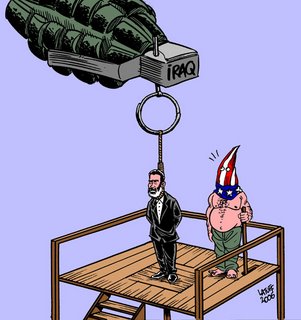
Saddam hangingAnd if any mischief follow, then thou shalt give life for life, eye for eye, tooth for tooth, hand for hand, foot for foot, burning for burning, wound for wound, stripe for stripe.
– Exodus 21:23

A day in the life of the average Iraqi has been reduced to identifying corpses, avoiding car bombs and attempting to keep track of which family members have been detained, which ones have been exiled and which ones have been abducted.
– riverbend, Baghdad Burning

Saddam Hussein didn’t have nearly enough body parts to compensate for the damage he did. Nor does George Bush.

It’s a pity, really, that George and Saddam will not have the opportunity to share what should be their just desserts: sharing a jail cell for the rest of their natural lives, with perhaps an opportunity for community service should either demonstrate he could be safely let out on the streets or display an aptitude for that kind of thing.

An eye for an eye makes the whole world blind.
– Mahatma Gandhi

‘Nuff said?

What's a war cost??

Posted: December 28, 2006 in Uncategorized

According to an article in today’s Winnipeg Free Press, the projected cost of Canada’s “mission” (i.e., aggression) in Afghanistan will be, by 2009, about $4 billion. To date, the invasion has cost Canada $2.2 billion and 45 lives.

Of course, the numbers don’t convey the real magnitude of the tragedy involved– the tens of thousands of Afghanis killed, the hundreds of Coalition deaths, the thousands of wounded on all sides, and the profound suffering of the families and communities left to cope with the aftermath.

On the fiscal side, I suppose Canadians can be grateful we’re not Americans. Those folks have been saddled an estimated $76 billion tab so far, and they still haven’t nabbed bin Laden. Nonetheless, imagine what we might have accomplished with the $2.2 billion we’ve spent to date on the war. For example:

  • Housing: We could have built about 15,000 modest bungalows and given them away to homeless people.
  • Employment: We could have paid 73,000 person years of employment at a living wage ($30,000/annum/worker).
  • Daycare: We could have created more than 200,000 new child day care spaces.
  • Medicine: We could have trained 20,000 doctors or 80,000 nurses or some combination thereof.

Admittedly, my calculations are crude, but the point is, one can do a lot with $2.2 billion. How would you have chosen to spend this money?

Framing the Left

Posted: December 21, 2006 in Uncategorized

How can someone hold both progressive and conservative values at the same time? And how do folks on the Left communicate with them?

Trish Hennessy and Keri-Anne Finn address these questions in the December 2006 issue of the CCPA Monitor, in an article entitled Facing Some Hard Truths: Progressives need to relearn how they “frame” their message.

The key to unwrapping this apparent contradiction and effectively communicating a progressive message is to grasp that we have grown accustomed to placing people on a continuum — left-centre-right or progressive-moderate-conservative — or mainstream versus fringe. Unfortunately, such distinctions are misleading. Most folks just don’t fit neatly into tidy categories. Many if not most of us are “biconceptuals” — folks who can, for example, support unions and care about the environment on one hand and crave tax cuts and vote Tory on the other.

We respond to politicians (and presumably to activists) not so much according to the policies they espouse but to the values we perceive they represent. If their values overlap with ours we are more likely to support them.

We can have the most wonderful set of social or economic policies in the world, but if we do not “frame” these policies in terms of the values espoused by our fellow citizens, our policies will be misunderstood, opposed or ignored.

Finn and Hennessy draw on the work of Dr. George Lakoff and his new book Thinking Points. Lakoff is a senior fellow at the Rockridge Institute, which describes itself as “a non-profit, non-partisan think tank dedicated to strengthening our democracy by providing intellectual support to the progressive community.” At Rockridge, the stated mission is to use “research in human cognition to help progressives make arguments that make sense to their audience.”

I’m not going to recap either Lakoff or Hennessy and Finn’s treatment of his analytical framework. Follow the links and go directly to the sources. I think you will find their discussions interesting and compelling.

What I would like to do, though, is to invite a discussion on values — not the values of the teeming masses of “biconceptuals” out there who stubbornly insist on voting for the status quo. No, what I think we need to talk about are “our” values.

What values mark those of us who consider ourselves “progressive” or “on the Left” or however you want to characterize it? What do we stand for? What is the moral foundation for socialism, feminism, environmentalism, your-favourite-ism?

Try not to confuse “values” with “policies.” Dig deep into your core.

Why is this important?

Because, I don’t think we can begin to convince other people of our ideas unless we can empathize with them. And we cannot begin to empathize until we have a clear understanding of where we are coming from.

That’s the mission. I intend to take a whack at this, myself, in future posts. I hope you will join in.

Canada’s national phone-in show, CBC’s Cross Country Checkup, invited listeners, yesterday, to call and write in on the topic of charity. The question: “What motivates you to give charity? What puts you off?” And for two hours, listeners told their stories.

We learned that most charitable giving in Canada involves the faithful supporting their churches, that people are increasingly skeptical about professional fund raisers and the charity industry, and that many, if not most of the people who phoned in were somewhat self-satisfied with their contributions.

Listeners were invited to email comments as well, and you can find a selection here.

I’m the last person in the world to criticize generosity. I believe that people who share their money and/or their time to help someone else deserve respect. But I gotta tell ya, I really wish someone had seriously questioned why one of the wealthiest countries on the planet needs so many charities in the first place.

Leaving aside whether churches and think tanks (like the Fraser Institute) should be recipients of tax deductible charitable donations in the first place, why do we have so many people in need and why do they have to depend on the charitable whims of their fellow citizens?

Forgive me for stating the obvious, but people are poor when they do not have enough money. And dependence on charity arises when governments evade their responsibilities.

So what is poverty, anyway? The Canadian Council on Social Development (CCSD) has published a handy little fact sheet that sets it out in tabular form. A single person living in a major Canadian city would be considered poor if she earned $20,778 before taxes. The same person living in a rural area could evade poverty by making $14,303. A family of four would need an income of $38,610 to live in Winnipeg, and only $26,579 to live in the country, and so on.

According to the Canadian Union of Public Employees: “A wage of less than $10 an hour is widely accepted as a low pay poverty wage because a single individual working full-time all year would need at least this amount to earn above Statistics Canada’s low income levels for a larger Canadian city. Single parents and those supporting more than themselves require at least $13 an hour to reach these low income levels.”

Also according to CUPE: “analysis of detailed labour force survey data for 2005 shows:

  • Over 17% of Canadian workers (more than 2.3 million) were paid less than $10 per hour in 2005.
  • More than one in five of all working women – over 1.4 million – were paid less than $10 an hour in 2005.
  • One in eight male workers (12.8%), or 892,000 workers, were paid a poverty wage in 2005.
  • Over 1.1 million of those working for less than $10 an hour were 25 years of age or older.
  • More than 50% – or over 1.3 million – of all young workers were paid less than $10.
  • A high ratio of seniors – more than 21% — also work for less than $10 an hour.
  • More than 1.2 million “full-time” workers (defined as those who worked more than 30 hours at their main job) were paid less than $10 an hour at this job. Many other low paid workers worked multiple jobs at low wages, but were classified as part-time.”

That’s the so-called “working poor.” Folks who rely on social assistance are worse off, both financially and in the sense that they are in most cases unable to escape dependence on a miserly state.

So, how poor are they? Once again, the CCSD has a useful fact sheet. Check them out. Social assistance rates, depending on where you live and if you have dependents, provide from 20% to 73% of what you need to reach the poverty line. They are a disgrace. And 2.5 million Canadians live that reality.

Is it any wonder that the number of food banks in Canada has grown from one, 25 years ago, to 649 this year. Or that the Canadian Association of Food Banks reports that over 750,000 people per month use their services?

As I stated so simplemindedly: people are poor when they do not have enough money. And dependence on charity arises when governments evade their responsibilities.

We are long overdue for two reforms in this country that would go a long way to relieving poverty:

  1. increase the minimum wage to a living wage
  2. increase social assistance rates to enable those who are unable to work to live above the poverty line

We can afford it. The federal government (and every provincial government, excluding that of PEI) have posted budgetary surpluses in the past year. There is no shortage of cash; all that is needed is political will.

If every person who made a charitable donation in the past year (however this is defined) were to insist that our elected officials would enact these two measures, the need for charity in Canada would diminish greatly.

Charity, on the domestic front at least, would be reserved for exceptional circumstances. What an uncharitable thought.

Taxes are bad?

Posted: December 14, 2006 in Uncategorized

In Canada it is an unquestioned article of faith that taxes are – at worst, a Satanic invention – at best, a necessary evil that needs to be restrained. Opponents of taxation argue that government taxation restricts economic growth and makes us poor. The sooner taxes are reduced, the better for all, they say. In the words of Prime Minister Stephen Harper , “all taxes are bad” (presumably this includes the ones that pay his salary).

The tax cutters come in all sizes, shapes and political persuasions. Even Manitoba’s NDP Premier, Gary Doer, boasts of having brought in “significant and sustainable tax cuts in four main areas: personal, business, property as well as Manitoba’s first corporate income tax cut since the Second World War.”

When social democrats like Doer shamelessly proclaim neo-con dogma, it seems unlikely we will find politicians who favour maintaining taxes, or good heavens, increasing them. And it’s too bad, because there is strong evidence that taxes are good for us. A study conducted by Neil Brooks and Thaddeus Hwong, and published by the Canadian Centre for Policy Alternatives December 6, 2006, argues convincingly that “tax cuts are disastrous for the well-being of a nation’s citizens.”

The study compares high-tax Nordic countries and low-tax Anglo-American countries on 50 social and economic measures and finds the high-tax Nordic countries score better in 42 of them. For example, the high-tax Nordic countries have:

  • lower rates of poverty, more equal income distribution, and more economic security for their workers
  • a higher GDP per capita (GDP is “gross domestic product” — the total market value of all the goods and services produced within the borders of a nation during a specified period.)
  • higher rates of household saving and net national saving
  • greater innovation, including a higher percentage of GDP spent on research and development
  • higher rates of secondary school and university completion
  • less drug use, more leisure time, and higher life satisfaction

The CCPA says “the U.S. falls near the bottom of the 21 industrialized countries in a strikingly large number of social indicators. It also ranks as the most dysfunctional country by a considerable margin. In contrast, Finland ranks near the top of the industrialized world in most of the social indicators and has been named the most competitive country in the world by the World Economic Forum four years in a row.”

Canada falls somewhere between the two extremes but our political and business elites seem dedicated to accelerating our race to the bottom.

The 55-page study is available for download free of charge. You’ll need Adobe Reader to open the 512kb file.

It’s well worth reading. And the next time you hear politicians chanting neo-con mantras (taaaaaxxxx cuuutttsss . . . taaaaaxxxx cuuutttsss), spank them with it (metaphorically speaking, of course). Then, sit them down and educate them. With a federal election (and a Manitoba provincial one) around the corner, there will be lots of opportunities.

Canadian Death Toll in Afghanistan

Posted: November 27, 2006 in Uncategorized

According to the Canadian Press, 44 Canadian soldiers and one Canadian diplomat have been killed in Afghanistan since 2002.

2006

Nov. 27 — Two Canadian soldiers killed when a suicide car bomber attacked their Bison armoured personnel carrier on the outskirts of Kandahar city. Their identities were not immediately released.

Oct. 14 — Sgt. Darcy Tedford, based at CFB Petawawa, and Pte. Blake Williamson from Ottawa, killed in ambush west of Kandahar.

Oct. 7 — Trooper Mark Andrew Wilson of the Royal Canadian Dragoons, based in Petawawa, Ont., killed when his armoured vehicle was hit by a roadside explosion in the Panjwaii district.

Oct. 3 — Sgt. Craig Gillam and Cpl. Robert Mitchell of the Royal Canadian Dragoons, based in Petawawa, Ont., killed in series of mortar, rocket attacks just west of Kandahar city.

Sept. 29 — Pte. Josh Klukie of First Battalion, Royal Canadian Regiment, based in Petawawa, Ont., killed by explosion in Panjwaii while on foot patrol.

Sept. 18 — Pte. David Byers, Cpl. Shane Keating and Cpl. Keith Morley, all of 2nd Battalion, Princess Patricia’s Canadian Light Infantry based in Shilo, Man.; and Cpl. Glen Arnold, 2 Field Ambulance, based in Petawawa, Ont., killed in suicide bicycle bomb attack on foot patrol in Panjwaii.

Sept. 4 — Pte. Mark Graham, who was based at CFB Petawawa, killed when two NATO planes accidentally strafed Canadian troops in the Panjwaii district.

Sept. 3 — Sgt. Shane Stachnik, Warrant Officer Frank Robert Mellish, Pte. William Cushley and Warrant Officer Richard Francis Nolan, all based at CFB Petawawa, Ont., killed in fighting in Panjwaii district.

Aug. 22 — Cpl. David Braun, who was based at Shilo, Man., killed in a suicide bomb attack in Kandahar City.

Aug. 11 — Cpl. Andrew Eykelenboom, 23, of Comox, B.C., stationed with 1st Field Ambulance, based in Edmonton, killed in suicide attack.

Aug. 9 — Master Cpl. Jeffrey Walsh, 33, of Princess Patricia’s Canadian Light Infantry, based in Shilo, Man., killed by apparent accidental discharge of rifle.

Aug. 5 — Master Cpl. Raymond Arndt, 31, of Loyal Edmonton Regiment, killed when large truck collided head-on with his G-Wagon patrol vehicle.

Aug. 3 — Cpl. Christopher Reid, 34, of 1st Battalion of Princess Patricia’s Canadian Light Infantry, based in Edmonton, killed by roadside bomb. Three other members of same battalion killed in rocket-propelled grenade attack by Taliban forces west of Kandahar: Sgt. Vaughan Ingram, 35, Cpl. Bryce Keller, 27, and Pte. Kevin Dallaire, 22.

July 22 — Cpl. Francisco Gomez, 44, of Princess Patricia’s Canadian Light Infantry, based in Edmonton, and Cpl. Jason Warren, 29, of Black Watch, Royal Highland Regiment of Canada, based in Montreal, killed when car packed with explosives rammed their armoured vehicle.

July 9 — Cpl. Anthony Boneca, 21, reservist from Lake Superior Scottish Regiment based in Thunder Bay, Ont., killed in firefight.

May 17 — Capt. Nichola Goddard, artillery officer based in Shilo, Man., with 1st Royal Canadian Horse Artillery, killed in Taliban ambush during battle in Panjwaii region. She was first Canadian woman to be killed in action while serving in combat role.

April 22 — Cpl. Matthew Dinning of Richmond Hill, Ont., stationed with 2nd Canadian Mechanized Brigade in Petawawa, Ont., Bombardier Myles Mansell of Victoria, Lieut. William Turner of Toronto, stationed in Edmonton, and Cpl. Randy Payne, born in Lahr, Germany, stationed at CFB Wainright, Alta., all killed when their G-Wagon destroyed by roadside bomb near Gumbad.

March 29 — Pte. Robert Costall of Edmonton, machine-gunner, killed in firefight with Taliban insurgents in Sangin district of Helmand province.

March 2 — Cpl. Paul Davis of Bridgewater, N.S., and Master Cpl. Timothy Wilson of Grande Prairie, Alta., killed when their armoured vehicle ran off road in Kandahar area.

Jan. 15 — Glyn Berry, British-born Canadian diplomat who had served with Foreign Affairs Department since 1977, killed in suicide bombing near Kandahar.

2005

Nov. 24 — Pte. Braun Woodfield, born in Victoria and raised in Eastern Passage, N.S., killed when his armoured vehicle rolled over near Kandahar.

2004

Jan. 27 — Cpl. Jamie Murphy, 26, of Conception Harbour, Nfld., killed in suicide bombing while on patrol near Kabul.

2003

Oct. 2 — Sgt. Robert Short, 42, of Fredericton, and Cpl. Robbie Beerenfenger, 29, of Ottawa, killed in roadside bombing southwest of Kabul.

2002

April 17 — Sgt. Marc Leger, 29, of Lancaster, Ont., Cpl. Ainsworth Dyer, 24, of Montreal, Pte. Richard Green, 21, of Mill Cove, N.S., and Pte. Nathan Smith, 27, of Tatamagouche, N.S., all killed when U.S. F-16 fighter mistakenly bombed Canadians on pre-dawn training exercise. Eight other Canadians wounded in friendly-fire incident.