UPDATE: You can watch a video report of Yves Engler’s March 15th Winnipeg presentation here.
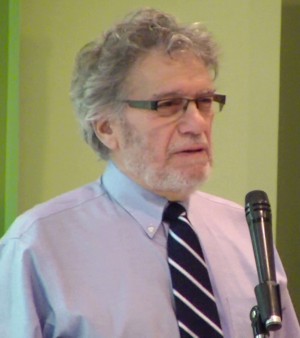
Foreign policy analyst Yves Engler will be speaking in Winnipeg Thursday about his newest book, Lester Pearson’s Peacekeeping: The Truth May Hurt.
Date: Thursday, March 15, 2012 Time: 7:30 p.m. Location: Mondragon Bookstore and Coffee House, 91 Albert Street, Winnipeg Admission: Free. Donations will be requested to help defray expenses.
Written in the form of a submission to an imagined “Truth and Reconciliation” commission about Canada’s foreign policy past Lester Pearson’s Peacekeeping: The Truth May Hurtchallenges one of the most important Canadian foreign policy myths – that of Lester B. Pearson as peacekeeper.
Lester Pearson is one of Canada’s most important political figures. A Nobel Peace Prize laureate, he is considered a great peacekeeper and ‘honest broker.’ But in this critical examination of his work, Pearson is exposed as an ardent cold warrior who backed colonialism and apartheid in Africa, Zionism, coups in Guatemala, Iran and Brazil and the U.S. invasion of the Dominican Republic. A beneficiary of U.S. intervention in Canadian political affairs, he also provided important support to the U.S. in Vietnam and pushed to send troops to the American war in Korea.
Yves Engler has published five other books:
Stop Signs — Cars and Capitalism on the Road to Economic, Social and Ecological Decay (with Bianca Mugyenyi)
The Black Book of Canadian Foreign Policy (Shortlisted for the Mavis Gallant Prize for Non Fiction in the Quebec Writers’ Federation Literary Awards)
Playing Left Wing: From Rink Rat to Student Radical and (with Anthony Fenton)
Canada in Haiti: Waging War on The Poor Majority
Canada and Israel: Building Apartheid
His six books have been praised by Naomi Klein, Noam Chomsky, William Blum, Rick Salutin and many others.
Winnipeg, March 11, 2012: Winnipeggers rally outside of Tory MP Joyce Bateman's office demanding the federal government allow a full inquiry into the federal election robocall scandal. Photo: Paul S. Graham
While Prime Minister Stephen Harper undoubtedly wishes this issue would disappear, Canadians marched in more than two dozen cities today, demanding a full inquiry into the federal election robocall scandal. In Winnipeg, over 100 rallied at the corner of Osborne Street and River Avenue where organizer Josh Brandon expressed the sense of outrage that many Canadians feel about the undermining of Canada’s electoral system. Speakers Kevin Lamoureux (Liberal MP for Winnipeg North) and Judy Wasylycia-Leis (former NDP MP for the same riding) urged them to support an NDP-sponsored bill that would grant Elections Canada greater powers to investigate electoral fraud, including the more than 30,000 complaints filed by Canadians about the last federal election.
At the conclusion of the speeches, the demonstrators marched to the Winnipeg South Centre office of Tory MP Joyce Bateman, to present her with a petition regarding concerns about robocalls that were made to voters in that riding. In the previous election Bateman narrowly defeated the Liberal incumbent, Anita Neville.
St. Boniface MP Shelley Glover recently lectured Winnipeg broadcaster Michael Welch of CKUW-FM 95.9 on the virtues of “ethical oil” and the “balanced” approach of the Conservative government to energy development that has obtained the “support” of aboriginal people for tar sands development and the Enbridge Pipeline Proposal. Michael checked her assertions with Gerald Amos, former elected Chief Councillor for the Haisla First Nation for 12 years and a leader of the fierce opposition that is being mounted by communities across BC to the Enbridge proposal.
Was Glover poorly informed or spinning for her boss, Stephen Harper? Watch the video and judge for yourself.
After you’ve watched this, you may want to watch Tar Sands, Pipelines and Tankers – the forum at which Gerald Amos spoke, along with Wade Davis, Lynne Fernandez and Anne Lindsey.
The National Energy Board is conducting hearings on Enbridge’s proposal for a pipeline from Alberta’s tar sands to the town of Kitimat in the heart of BC’s Great Bear Rainforest. If approved, over 200 oil tankers would be navigating the difficult waters off BC’s Northwest Coast each year, making widespread environmental damage to BC’s coastline only a matter of time. Moreover, it will facilitate the marketing of even more dirty oil from Alberta’s tar sands, fueling that unfolding ecological catastrophe with profound consequences for the rest of Canada and the world.
The project is meeting fierce opposition, especially in northern BC, and the federal government has declared war on anyone who opposes this project. In Winnipeg, a coalition of environmental groups banded together to hold a public forum on February 16, 2012 at the University of Winnipeg entitled Tar Sands, Pipelines and Tankers. Over 300 people turned out to view an excellent 16-minute documentary by Pacific Wild entitled Oil in Eden and to dialogue with an expert panel, moderated by journalist Ricard Cloutier.
The Panel
Dr. Wade Davis is Explorer in Residence, National Geographic Society, Visiting Professor and Senior Fellow of the Masters in Development Practice (MDP) Indigenous Development program, University of Winnipeg.
As well, he is the author of The Sacred Headwaters: the fight to save the Stikine, Skeena and Nass.
Gerald Amos was Chief Councillor for the Haisla First Nation for 12 years. He has been a leading voice for conservation in Canada for thirty years.
He is the author of an open letter to Prime Minister Stephen Harper and Natural Resources Minister, Joe Oliver “No apology forthcoming.”
Lynne Fernandez, of the Canadian Centre of Policy Alternatives has an MA in economics from the University of Manitoba. As a research associate at the Manitoba office of the Canadian Centre for Policy Alternatives, Lynne has studied municipal and provincial social and economic policy. She is also interested in labour and environmental issues.
Anne Lindsey is former executive director of the Manitoba Eco-Network. Since 1984, Anne has worked on such Manitoba and national issues as nuclear waste, forestry, food, pesticides and environmental reviews.
I hope you can schedule some time to view the video report I prepared in collaboration with Ken Harasym for Winnipeg Community TV. At two-and-a-half hours, it is long, but it is crammed with information and analysis that make it well worth the time.
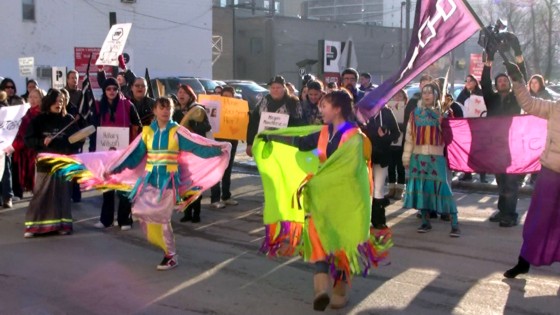
Winnipeg, Feb. 14, 2012: Protesters pause outside the Department of Indian Affairs in Winnipeg to sing and dance during the Men's Gathering and Unity Walk for Missing and Murdered Women. Photo: Paul Graham
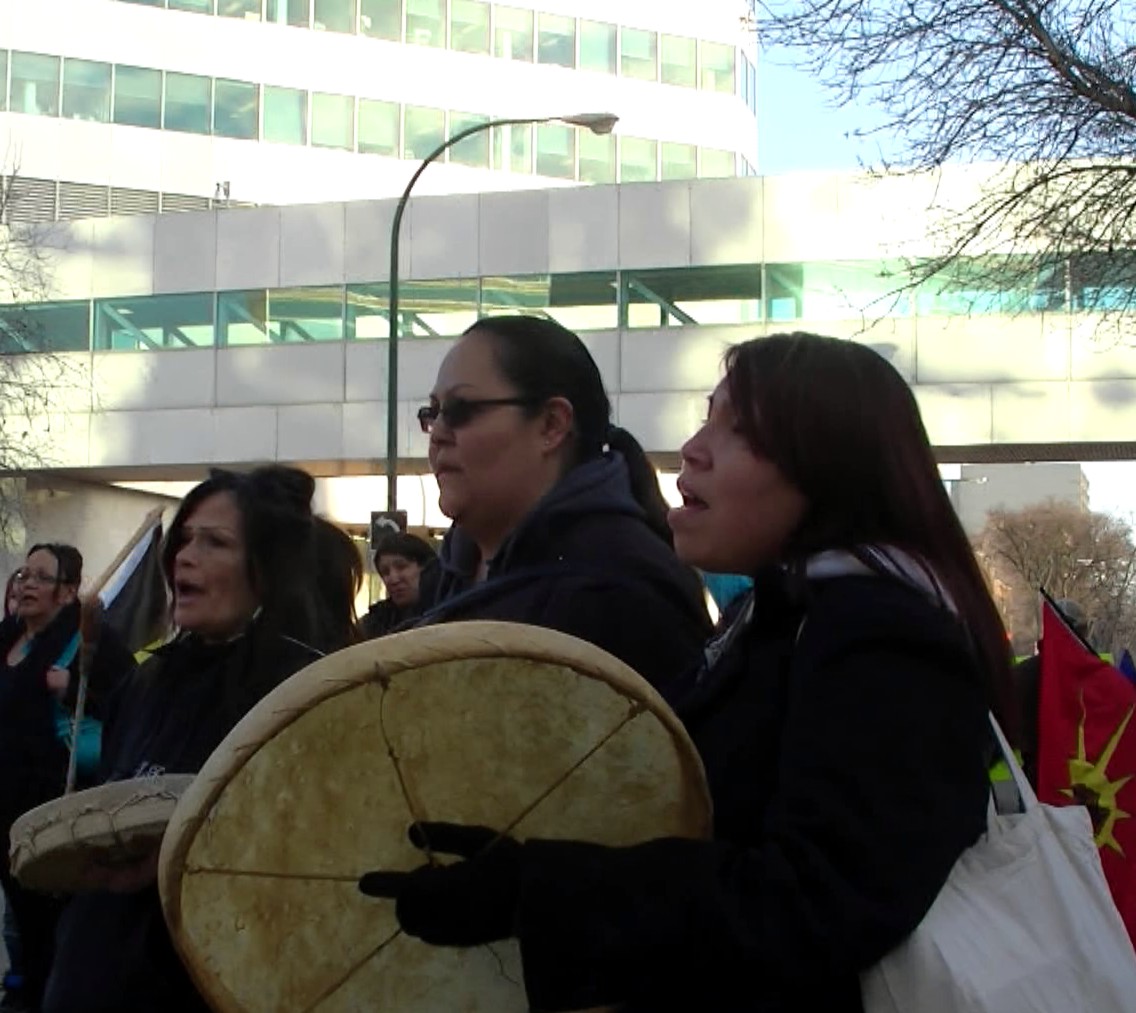
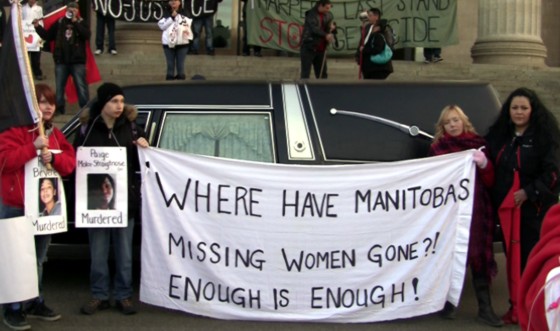
Winnipeg, February 14, 2012: A group of aboriginal men held a march to show solidarity with the families of missing and murdered aboriginal women in Canada. While the march was organized by men, there were no restrictions on who could attend – all were welcome – and there was a good turnout of men, women and children of all ages.
Feb. 14, 2012: Protesters outside the Law Courts Building in Winnipeg during the Men's Gathering and Unity Walk for Missing and Murdered Women. Photo: Paul Graham
The march began at the corner of Carlton Street and Portage Avenue, the site of the Aboriginal Peoples Television Network, and wound through downtown Winnipeg, stopping at the Department of Indian Affairs, the Assembly of Manitoba Chiefs and the Law Courts Building, before ending up at the Manitoba Legislative Building. Despite the marked police presence (several squad cars, a helicopter overhead), the marchers remained peaceful and good spirited. I use the word “despite” because it was clear the marchers would have preferred the cops to be putting their energies into catching killers and finding missing women.
While some estimates put the number of missing and murdered women at 600, no one really knows. What is clear is that not nearly enough is being done to locate these women and to stop the carnage.
Feb. 14, 2012: Protesters in front of a symbolic hearse at the Manitoba Legislature in Winnipeg during the Men's Gathering and Unity Walk for Missing and Murdered Women. Photo: Dwayne Crowe
Here are some links that can help you understand this issue in more depth:
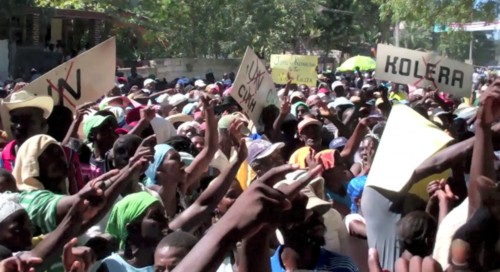
December 9, 2011: Angered by the UN-caused cholera epidemic that has claimed thousands, Haitians rallied at the UN Stabilization Mission in Haiti (MINUSTAH) Base at St. Marc. Photo: from a video produced by Nick Stratton, Bureau des Avocats Internationaux. Watch it at http://ijdh.org/archives/24340.
Two years after an earthquake killed 158,000, the majority of Haitians continue to battle against hunger, disease, homelessness and political repression. Half a million people remain in refugee camps and many thousands who have found other accommodations are living in buildings that have been designated as unsafe and requiring demolition or major repairs.
Clean water is unavailable to almost half the population and sanitation, in the form or latrines, is available to only 34%. It is a formula for disease, and the 2010 cholera outbreak, traced to the criminally negligent sewage disposal practices of UN troops, sickened nearly 500,000 people and killed more than 6,500 others.
With all of the aid money that has been pouring into Haiti, it would not be unreasonable to expect living conditions to be much better than they are. Journalist Kim Ives, a writer and editor of Haiti Liberté, who spoke on this topic last Thursday at the University of Manitoba, provided this summary:
$2.4 billion in bilateral relief aid (emergency aid) delivered to date
$4.5 billion was pledged for bilateral recovery in 2010, 2011 (plus $1 billion for debt relief). As of Dec, 2011, $2.4 billion of that was delivered.
Donors have dispersed an additional $560 million in recovery assistance.
An additional $3.1 billion for relief and recovery from NGOs and other private donors. (The largest share of that came from the Red Cross, which raised $1.4 billion; of that, only 50% has been spent. I wonder where the rest went?)
Cholera treatment funding of $172 million has been promised; $130 million has been disbursed.
Clearly something is wrong. Kim Ives summarized the obstacles to effective aid and reconstruction as follows:
A weak and under-funded national government, as a result of two centuries of foreign intervention and plunder
A large presence of international aid organizations and UN agencies, accountable, first and foremost, to their donors and home governments
A right-wing presidency brought to power through an exclusionary and fraudulent electoral process
A foreign police and military force (MINUSTAH) dating from the 2004 coup d’etat and whose purpose is to preserve the status quo
Winnipeg’s fabled North End, long known for its contributions to the arts, popular culture and radical politics, has always had a reputation for being a tough place to grow up. These days, however, crime, violence, gangs and poverty seem to be its defining characteristics, at least in the minds of folks who do not live there.
On January 15, 2012, the United Jewish People’s Order and the Association of United Ukrainian Canadians — organizations with deep, historic roots in north Winnipeg, held a public forum entitled “The North End – the Good and the Bad.” Their intent was to engage North Enders in a discussion of challenges they face and to highlight some of the forces for progress in the neighborhood.
Moderator: Roz Usiskin, United Jewish People’s Order
Panelists (in order of appearance):
– Sel Burrows, Point Douglas community activist
– Kevin Chief, MLA, Point Douglas and Minister of Children and Youth Opportunities
– Cindy Coker, executive director, SEED Winnipeg, Inc.
– Jim Silver, co-director, University of Winnipeg Urban and Inner-City Studies Program
It was an informative and useful discussion, as far as it went. I learned a lot. Cindy Coker and Jim Silver described some of the programs they and others are providing and the encouraging results that are emerging. Kevin Chief’s account of his election campaign showed that high levels of citizen engagement are manifesting in an area more known for political apathy. I particularly enjoyed Sel Burrows’ account of how the residents of the Point Douglas neighborhood banded together to reduce the local crime rate to levels comparable with those of much more affluent neighborhoods.
Michael Champagne challenges the audience to join with the young people of the North End who are "organizing ourselves to make a difference in our community." Photo: Paul S. Graham
That said, much was left unsaid, and I hope that UJPO and AUUC, in collaboration with other community-based organizations, offer future opportunities for discussion. Glaringly absent from this forum was any radical critique that would shine a light on the inadequacy of the social work approach to community development that seems so in vogue these days. Right at the end of the question period a young man named Michael Champagne stood up and challenged the audience to join with neighborhood youth who are self-organizing to reinvigorate their community. I hope that Mr. Champagne and others like him are on the podium the next time UJPO and AUUC hold a public forum.
Gerry Caplan is a former CUSO field officer, author of The Betrayal of Africa, a weekly, online columnist for The Globe and Mail, a featured television political commentator and a veteran CCF-NDP war horse. He was also my boss at CUSO for a brief period in the late 70s, something he doesn’t remember – which may be all for the best :-).
Gerry was the keynote speaker at a dinner held in Winnipeg December 10, 2011 to mark the 50th anniversary of CUSO and the 63rd anniversary of the adoption of the Universal Declaration of Human Rights by the United Nations on Dec. 10, 1948.
The title of his talk was advertised as “When good people do bad things.” Fortunately for those present and for his reputation as a rabble rouser, the theme that emerged would be more appropriately described as “solidarity, not charity.”
This event was sponsored by the University of Winnipeg Global College, CUPE Manitoba, the Manitoba Council for International Co-operation and CUSO-VSO. It was held at the Union Centre in downtown Winnipeg. Here is my video report.
Making war has been a human pursuit for thousands of years.
Playing at war, it would seem, is at least as old. This ancient Greek toy, a model of a war chariot, fashioned from clay, has survived the millennia to bear witness to our enduring attachment to violence and domination.
War requires warriors. Because killing is not something that comes naturally to most of us, a long period of preparation is usually needed. It begins, in childhood, with the toys we give to our children.
The design and marketing of war toys are anything but child’s play. According to an article in the New York Times, the US military and the American toy industry have a long history of working together. It’s a relationship where both parties benefit – toys are more realistic and often, toys have inspired weapons development. But there’s more. As the author observes:
“Because the newest generation of soldiers grew up playing with electronic toys and games, the symbiosis between them is nearly genetic. Today’s troops received their basic training as children.”
The popularity of violent video games inspired the US Army to develop its very own video game, which it provides free of charge from its web site. According to the late Gary Webb, an American investigative journalist of considerable renown,
“America’s Army isn’t merely a game, recruiting device or a public-relations tool, though it is certainly all of those things. It’s also a military aptitude tester. And it was designed that way from the start.”
A growing body of evidence confirms that exposure to violent toys, games and media can increase aggressive behavior, desensitize people to violence, and contribute to an exaggerated fear of the world.
Dr. Darlene Hammell, of the University of British Columbia Faculty of Medicine explains:
“A close examination of the issue raises concerns that war toys teach children that:
war is a game, an exciting adventure.
killing is acceptable, even fun.
violence or the threat of violence is the only way to resolve conflicts.
the world is divided into “goodies” and “baddies” where the bad guys are devoid of human qualities and their destruction is desirable.”
For the past 10 years, Winnipeg’s Project Peacemakers has conducted an annual inspection of Winnipeg toy stores. The objective is to raise awareness about the levels of violence in children’s toys and games, and to call on retailers, government, and the wider community to take steps to limit this violence.
I tagged along with an inspection team, last month, as it looked at two of the eleven stores covered in this year’s survey and prepared this video report.
The envelope. please . . .
Here is how the stores performed in terms of providing peaceful, constructive playthings – as opposed to war toys.
Excellent: Children’s Museum Commendable: A Child’s Place, Hans Christian Toys, Scholar’s Choice, Toad Hall Acceptable: BJ’s Toy Store, Kit and Kabooble Needs Improvement: Dollarama, Toys “R” Us, Zellers
Although a team visited a local Walmart, they were informed that Project Peacemakers would be unable to publicize its findings without first contacting Walmart’s public relations office. Project Peacemakers declined to rate the store, leaving you to draw your conclusions, if not about their toys, then about Walmart’s public relations savvy.
It oughtta be a crime
Under international law, most wars are crimes – though the likelihood of prosecution is low (unless you are on the losing side). War toys, however, remain perfectly legal in most places. Thankfully, there are exceptions. In 2009, Venezuela passed a “Law Prohibiting War Video Games and War Toys.” Prior to this, according to the Peace and Conflict Monitor, Sweden and Norway have “successful voluntary restriction” of war toy sales, Malta prohibits their import, Greece bans television advertising and Australia places some restrictions on imports. The Monitor says the European Parliament has recommended that its member states ban advertising of war toys and reduce their sale, though I could find no evidence that this has happened.


 Written in the form of a submission to an imagined “Truth and Reconciliation” commission about Canada’s foreign policy past Lester Pearson’s Peacekeeping: The Truth May Hurtchallenges one of the most important Canadian foreign policy myths – that of Lester B. Pearson as peacekeeper.






 Paul S. Graham