Salvador Allende

Salvador Allende

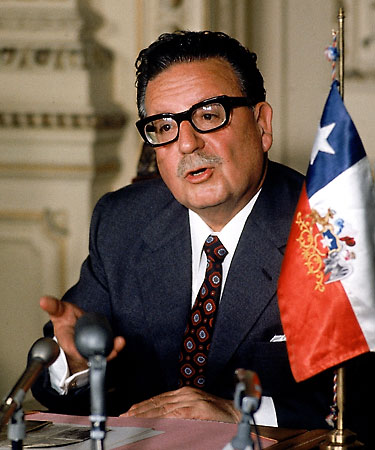
Forty years ago, on September 11, 1973, the military forces commanded by General Augusto Pinochet, overthrew the democratically elected government of Chile led by Salvador Allende. Thousands of people were killed. Many thousands more were imprisoned.

The coup d’etat was swift, brutal and merciless. It was carried out by the Chilean oligarchs with the active assistance of the United States. Overnight, the progressive social and economic measures introduced by the Allende government were overturned, condemning Chile’s working class to lives of poverty and oppression.

Perhaps 500,000 Chileans were forced into exile, relocating to countries around the world. Several hundred found themselves in my home town, Winnipeg, where they have made significant and lasting contributions to the life of our city.

This past month, the Winnipeg Chilean community, like many such communities in the Chilean diaspora world wide, has been commemorating the tragedy of Sept. 11, 1973 with film screenings, cultural performances and events such as the one I participated in tonight as part of a panel discussion that included former Manitoba Premier, Howard Pawley, former MP Judy Wasylycia-Leis, and Darrell Rankin, head of the Manitoba wing of the Communist Party of Canada.

Each of us drew on our experiences to talk about the significance of September 11, 1973 and our memories of the solidarity movement with the people of Chile. What follows is the text of my remarks.
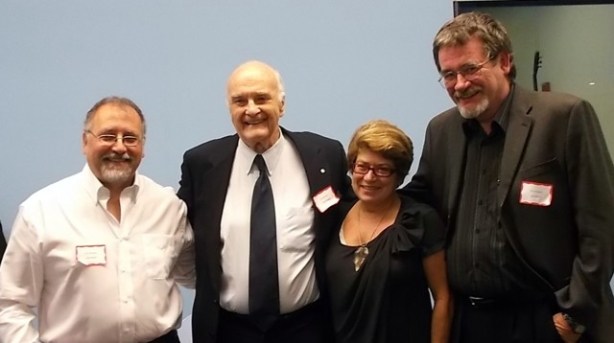

Panelists (l-r): Darrell Rankin, Howard Pawley, Judy W,, Paul Graham. Photo: Maggi Robinson

Panelists (l-r): Darrell Rankin, Howard Pawley, Judy Wasylycia-Leis, Paul Graham. Photo: Maggi Robinson

Forty years is a long time to remember what I knew and when I knew it, but I seriously doubt that I could have located Chile on a map on the day that Augusto Pinochet seized power and destroyed so many lives.

In September 1973 I was a student at the University of Manitoba. I was active in student politics and becoming aware of some of the forces that shape our lives. But our struggles were more local and immediate. For example, there was a strike at the U of M that year, and some of us looked for ways to support the people on strike.

However, in time, our impulse to act locally led us to think more globally.

Throughout the 1970s Winnipeg was fertile ground for many kinds of political activism. We had a vibrant anti-war movement. It mobilized support for American draft resisters, opposed the war in Vietnam and campaigned for nuclear disarmament.

I think the first demonstration I attended had to do with American nuclear testing in Amchitka, an island in Alaska’s Aleutian Islands. This movement became quite broad by the early 1980s, with annual Walks for Peace that attracted up to 20,000 people.

The anti-apartheid movement was quite active here in the 70s, supporting liberation movements in South Africa, Mozambique, Angola and what was then known as Rhodesia.

The women’s movement was gaining strong momentum. There would be many victories in successive decades, including reproductive rights, equal pay for work of equal value, state supported childcare and the right of women to work in so-called nontraditional occupations.

Environmentalism was being born in Winnipeg. It is interesting to note that the Amchitka nuclear test that drew me and a couple hundred other people to the US consulate in 1971 was a catalyst for the creation of Greenpeace. We can thank the Vancouver “Don’t Make a Wave” committee which sent a boat named “Greenpeace” to protest the blast and later adopted the boat’s name as their own.

White progressives were waking up to the struggles of aboriginal peoples and getting involved in campaigns around mercury poisoning at Grassy Narrows, support for the Dene who were opposing the Mackenzie Valley Pipeline, and struggles led by the American Indian Movement related to the Wounded Knee occupation and the case of Leonard Peltier, who many believe was framed for the murder of 2 FBI agents in 1975.

Relatively new to government, the NDP introduced some progressive reforms, such as public auto insurance and reduced medicare premiums. As a Party, it was more active in political education than it has been for many years since and published a newspaper for its members. To the left of the NDP we had, for a time, at least five revolutionary groups. To this collection of radical lefties we should add members of the New Democratic Youth, and former members of the Waffle movement that had been expelled from the NDP. We had at least three left wing book stores, and Canadian Dimension magazine, still published in Winnipeg, was enjoying its largest circulation ever.

Also working for social change were a number of largely (but not exclusively) faith based organizations dedicated to international development and social justice. In a more secular vein, Oxfam, CUSO, and the IDEA Centre engaged in similar work. To various degrees, these groups were beginning to think in terms of solidarity and linking the struggles of oppressed people in the so-called Third World with those of people living in Canada. With the exception of the IDEA Centre, most of them continue to be active and make up the Manitoba Council for International Co-operation.

I could go on, but I’m sure you get the picture. Winnipeg was, in the 1970s, politically progressive, diverse and vibrant. It was a welcoming environment for the refugees of Pinochet’s terror and one that was enriched by these newcomers.

In 1975, when Chileans started arriving in Winnipeg, I had just begun working at the IDEA Centre. IDEA stood for Intercultural Development Education Association. Its mission was to promote support for international development. We were housed at 418 Wardlaw Avenue, in the company of like minded organizations, including CUSO, the Manitoba Council for International Cooperation and the Agassiz Food Co-op.

IDEA offered a lot of things to a lot of different kinds of people. We operated a resource library that specialized in international development. We did programs with schools and held regular educational evenings, usually on Wednesdays, that were combined with a potluck supper.

Our most useful function, I think, was that we provided meeting space, printing facilities and a welcoming environment in which a wide range of individuals and groups could meet, plan and organize.

As the Chilean community began to form in Winnipeg, and as people found their bearings, the IDEA Centre was one of the places that welcomed them, worked with them and learned from them.

It was at the IDEA Centre that I met people like Jaime Carasco, Hugo Torres, Olga Flandez, Rosa Candia, Pablo Herrera and many others. Bonds of friendship, collaboration and respect were formed in those days that have endured to the present. With all of this in mind, I have two observations with which I will close:

Most of the Canadians with whom I worked in that period fell into one of two categories.

One was made up of individuals who were motivated by faith-based or secular humanitarian values; we had little to no direct, personal experience of poverty, oppression, or repression; our understanding was largely theoretical.

The other group included people who had traveled, worked abroad and witnessed poverty and abuse; in some cases they helped struggle against it. Others in this group had had similar Canadian experience. But our perceptions were conditioned by our largely middle class, privileged backgrounds. At the end of the day, we could go home to a relatively comfortable existence.

The arrival of the Chilean refugees, and their participation in Winnipeg’s political life changed this. It enriched our understanding of solidarity. It made it real. Suddenly American imperialism wasn’t some abstract system directed by sociopaths we would never meet. Through our new Chilean friends we could learn what it was all about. It was no longer theoretical. It was flesh and blood. And this strengthened our resolve and deepened our understanding.

My second observation has to do with the Chileans themselves. Like all newcomers, their first priority was getting oriented, learning English, finding jobs, decoding Canadian culture and coping with all of the stress that this involves. Add to this the need to recover from the trauma of the coup, of prison and torture, of having to uproot and flee, of losing their friends, families, homes, communities and country. You have to ask where they found the energy to not only survive, but to reach out and participate in the political life of their new community.

Not everyone was able to manage this. But many were, and their solidarity work went beyond resistance to Pinochet’s military junta. In the years that followed their arrival in Winnipeg, US backed governments carried out vicious repressions rights across Central and South America. If there was a solidarity committee for any of these struggles operating in Winnipeg you could be sure to find at least one Chilean on it.

In 1980, I had the privilege of being able to travel to Nicaragua with a group of solidarity activists from across Western Canada. At least one third of the group were Chilean Canadians who had worked hard to support the Nicaraguan revolution. They understood, better than most, that freedom for Nicaragua would contribute to the same in their own country and throughout Latin America. History has shown they were right. Latin America is much less dominated by American imperialism than it has ever been.

Another quick example and I’ll wrap up. On Oct. 25, 1983, the United States invaded Grenada, a tiny Caribbean nation of 91,000 people. People worldwide were outraged. The UN General Assembly called the invasion a “flagrant violation of international law.”

Three days later, in Winnipeg, there was a demonstration at the US Consulate, then on Pembina Highway. Several hundred people participated.

It began peacefully, but we soon had our own invasion to deal with. A half dozen members of the Winnipeg Rifles militia unit, decked out in camouflage jackets, charged the steps to disrupt the speakers and touched off what some described as a “police riot.”

Rather than arrest the militia goons, the police began arresting demonstrators. Six were arrested and many more were roughed up. Four of those arrested were Chilean.

Now, this little statistic could be used by folks uncomfortable with refugees as evidence they are troublemakers. Having been an active participant in that demonstration and the subsequent defence committee, I see things differently.

They were arrested because they were unwilling to let their comrades be detained by police. They were arrested because they refused to be intimidated by right wing thugs in camouflage uniforms. They were arrested because they would not allow what happened in their home country to happen in another without standing up and saying “Nunca mas!” – “Never again!”

That was the spirit of the Chilean community in Winnipeg in those early years. A spirit of resistance to oppression. A spirit of resilience. A spirit of courage. I think this spirit lives on and continues to inspire all of us.


Winnipeg Peace in Syria Rally

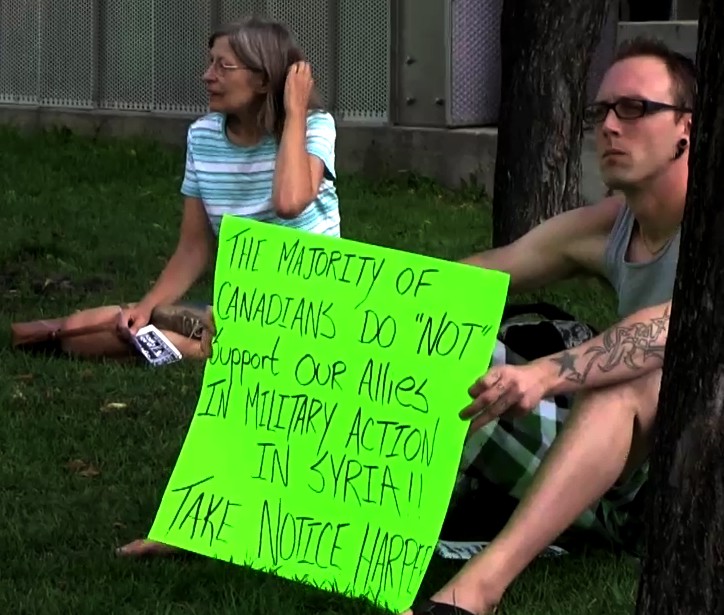
Sept. 7, 2013: Winnipeggers rallied at the Manitoba Legislature in opposition to an attack on Syria and distributed literature on Memorial Boulevard and Broadway. Photo: Paul S. Graham

Sept. 7, 2013: For the second time in a week, Winnipeggers rallied in solidarity with the people of Syria and in opposition to a US led attack. After a brief gathering on the steps of the Manitoba Legislature, the demonstrators took to the streets to hand out literature and talk with their fellow Winnipeggers.

Speaking on behalf of No War with Syria (Winnipeg), Chris Zanewich said, “ The decision to carry out a “limited” attack on Syria will carry dire consequences. If nothing is done to intervene peacefully, an increase in civilian casualties along with the displacement of millions of peaceful Syrians will undoubtedly be the harsh reality.”

Zanewich said that the appropriate remedy for those accused of chemical weapons attacks would be “ a fair democratic trial.” Elaborating on Chris’s comments, No War with Syria (Winnipeg) representative Tara Mann explained that “Darkness cannot drive out darkness, hate cannot drive out hate. Hate multiplies hate, violence multiplies violence, creating a destructive spiral. Peace cannot be achieved through violence, hatred, and greed; it can only be attained through truth, love and understanding.  Humanity must understand this concept. Or else. We will continue to experience separation, and we will continue to experience war with each other over money, oil, power, skin colour, and religion for the remainder of our existence on this planet.”

Manitoba Peace Council representative Cheryl-Anne Carr said that the struggle of the Syrian people for democratic rights has been “hijacked by the West” to serve Western interests. Regarding Canada’s pro-military intervention stance in this crisis, she noted that

“Canada is the third largest investor in Syria and we have some actual leverage with that country if we wanted to use it without encouraging missile strikes. A few short years ago, the Harper government had such confidence in the Assad government we in Winnipeg had to fight tooth and nail to keep a young man from being deported to torture and death in Syria. The Harper government openly said no harm would come to him, that it did not think Assad hurt his own people, that nations were sovereign and made their own rules.”

Glenn Michalchuk, of Peace Alliance Winnipeg, was the last to speak. He observed that “When we demonstrate against the threat of U.S bombing we are not blind to the suffering of the Syrian people or indifferent to their struggle against internal reaction. The Syrian people have the right to determine their future for themselves and to build their country as they see fit. But this right will not come from the bombs of the U.S. Nor will it come from the interference of the U.S., Britain, Canada, France and Saudi Arabia to fuel civil war with arms and foreign fighters. This right will not come from Russia which for decades considered Syria its client state in the Middle East to protect its interests in that region against the maneuverings of the United States.”

Complete texts of the speeches delivered by Carr and Michalchuk are available here and here, respectively.

For more, watch my video report.


Aug. 31, 2013: Two of the Winnipeggers who gathered at the Canadian Human Rights Museum to oppose military intervention in Syria. Photo: Paul S. Graham

Aug. 31, 2013: Two of the Winnipeggers who gathered at the Canadian Human Rights Museum to oppose military intervention in Syria. Photo: Paul S. Graham

By Peace Alliance Winnipeg

As the United States moves closer to a direct military strike on Syria, the world draws closer to a conflict that could spread well beyond the boundaries of that war-torn nation.

The pretext for an American strike is an allegation, as yet unproven, that Syrian government forces used sarin gas on opposition forces and civilians. A UN weapons inspection team is on site to determine if chemical weapons were used, though it has no mandate to determine who might have used them. Regardless of what the UN might say, the American government has decided to press on with “punishing” the Syrian regime. No such action is mandated by the 1925 Geneva Protocol on chemical weapons, and an attack would violate international law.

Despite the US government’s assertions of overwhelming proof, only France has said it will join the US in an attack. The British Parliament, last week, voted against military intervention. The UN Security Council has refused to authorize a strike. NATO has ruled out military action.

British MPs voted against military action because the British people were well aware of the falsified British and American intelligence reports that were used to justify attacking Iraq in 2003. That invasion caused the deaths of hundreds of thousands of Iraqis and almost 5,000 coalition troops. Four million Iraqis became refugees, the country’s infrastructure was destroyed and Iraqi society was fragmented by sectarian violence that continues to this day.

Canada has funneled more than $5 million to opposition forces and endorsed the use of military force. PM Harper has ambiguously stated that, “at the present time the Government of Canada has no plans, we have no plans of our own, to have a Canadian military mission.” Although Canada has said that it doesn’t intend to send troops, it has provided the US government with consistent political support. We must pressure the Canadian government to reverse that support and we must express our opposition to the US war drive.

The Syrian war is widening

The people of Syria have already suffered over two years of a devastating war, with more than a hundred thousand Syrians killed and millions driven from their homes. What began as a nonviolent protest and then civil war has expanded to sectarian and even more dangerous international conflict.

Syria is a battleground where conflicts are being fought out between regional powers (Saudi Arabia and Iran) and global powers (the US and Russia). A US military attack would worsen the conflict between heavily armed and powerful forces, seriously escalating the war and further destabilizing the Middle East.

Attacking Syrian forces with cruise missiles and drones, which is what the US military is likely to do, will only add to the death toll and delay the peace negotiations that must ultimately bring this war to a close. Even if, through some miracle, the violence remains contained within Syria, the price will still be paid by the Syrian people.

Antiwar sentiment is strong and growing

Last weekend there were antiwar demonstrations around the world. Protests were held in more than 12 Canadian cities, including Winnipeg.

This attack can be prevented, but only with a huge global response. We need to show our solidarity with the people of Syria and stop the US from launching its missiles under the guise of humanitarian intervention. The lives of tens of thousands more Syrians are at stake.

What can we do, here, in Winnipeg?

There are positive, constructive steps we can take to show our support for the people of Syria. We can contact our Members of Parliament. We can insist that they reconvene Parliament and take the following constructive steps:

1. Provide genuine humanitarian aid to the victims of the civil war in the form of food, medical supplies and financial contributions to the reputable humanitarian aid groups that have been stretched to the breaking point by this crisis.

2. End all forms of material and political support to opposition forces.

3. Adopt a genuinely neutral position on the world stage and press for peace talks that involve all of the contending forces.

Parliament must be reconvened to reverse the damage that our government has done by taking sides in this civil war. Canada has to become a responsible voice for peace in the Middle East and the world. If you don’t know how to get hold of your MP, here are some phone numbers.

  • Niki Ashton (Churchill): 204-677-1333
  • Joyce Bateman (Winnipeg South Centre): 204-983-1355
  • Candice Bergen (Portage-Lisgar): 204-822-7440
  • James Bezan (Selkirk-Interlake): 204-785-6151
  • Rod Bruinooge (Winnipeg South): 204-984-6787
  • Steven Fletcher (Charleswood-St. James-Assiniboia): 204-984-6432
  • Shelly Glover (St. Boniface): 204-983-3183
  • Kevin Lamoureux (Winnipeg North): 204-984-1767
  • Pat Martin (Winnipeg Centre): 204-984-1767
  • Joy Smith (Kildonan-St. Paul): 204-984-6322
  • Robert Sopuck (Dauphin-Swan River-Marquette): 204-848-7000
  • Lawrence Toet (Elmwood-Transcona): 204-984-2499

For more complete contact information, go here.

What else can we do?

Get educated. There are excellent sources of critical analysis on the Internet. Here are a couple:

Centre for Research on Globalization

Middle East Research and Information Project

Get involved. You can find No War With Syria (Winnipeg) on Facebook. Peace Alliance Winnipeg is also on Facebook, and on the Internet.

Please contact us. Together, we can do our part to work for peace.

Reposted from Peace Alliance Winnipeg News


Aug. 31, 2013: Winnipeggers rallied to voice opposition to foreign intervention in Syria's civil war. Photo: Paul S. Graham

Aug. 31, 2013: Winnipeggers rallied to voice opposition to foreign intervention in Syria’s civil war. Photo: Paul S. Graham

About 50 Winnipeggers rallied at the Canadian Museum of Human Rights Saturday afternoon to express their opposition to foreign military interventions in Syria. The rally, organized by Winnipeg Alternative Media, was one of many held on Saturday across Canada, and was part of an international campaign to prevent the Syrian crisis from escalating into a world war.

In this video report, organizers explain what is at stake.


August 6, 2011: Nick Ternette at Winnipeg's Annual Lanterns for Peace ceremony marking the anniversaty of the 1945 US nuclear bombing of Hiroshima and Nagasaki. Photo: Paul S. Graham

August 6, 2011: Nick Ternette at Winnipeg’s Annual Lanterns for Peace ceremony marking the anniversaty of the 1945 US nuclear bombing of Hiroshima and Nagasaki. Photo: Paul S. Graham

For more than 30 years, Winnipeggers have come together, in June, to march for peace. In doing so, we strive to educate our neigbours about the the roots of war and to keep alive the message that peace and social justice are inextricably interwoven.

This year, we dedicated the festival to our longtime friend and comrade in the struggle for peace and justice, Nick Ternette. Politically active in many arenas, Nick worked for social justice until the end of his life, despite the health challenges that ultimately caused his death on March 3rd, 2013.

Featured speakers at this year’s event included political activist Emily Ternette, who provided a loving tribute to her departed husband, and David Barsamian, host of the weekly American political affairs program, Alternative Radio, which has been running for 27 years.

In addition to the speeches of Emily Ternette and David Barsamian, my video report includes a brief interview with Nick, held as we marched along during the 2012 Walk for Peace.

Links:

Peace Alliance Winnipeg
Project Peacemakers


Winnipeg, April 21, 2013: Some of the participants in the 10th annual Seventh Generation Walk for Mother Earth, at the Oodena Circle at The Forks. Photo: Paul S. Graham

Winnipeg, April 21, 2013: Some of the participants in the 10th annual Seventh Generation Walk for Mother Earth, at the Oodena Circle at The Forks. Photo: Paul S. Graham


Despite the inclement weather, this year’s Seventh Generation Walk for Mother Earth was a lively celebration that began at Central Park and ended at Thunderbird House, with stops along the way at the Manitoba Hydro headquarters and the Oodena Circle at The Forks.

Held on Sunday, April 21, this year’s walk was in support of the Voices of Indigenous Women and in solidarity with the growing Idle No More Movement.

Speakers included Susanne McCrea of the Boreal Forest Network, Ko’ona Cochrane, Alberteen Spence, Judy da Silva, Kristen Andrews, Myrle Ballard and Diane Maytwayashing.

Here’s my video report.


whose winnipeg posterMarch 14, 2013: The Social Planning Council of Winnipeg, in partnership with OURS Winnipeg, For the Love of Winnipeg and Planners’ Network Manitoba, held a well attended public forum at the Millennium Library to discuss how decisions about land use are made in Winnipeg.

In a wide ranging discussion, Winnipeg’s civic government was criticized for lacking vision, accountability and transparency, along with a tendency to favor the private interests of developers over those of citizens and communities.

Topics included the Armstrong Point Residents Association fight to prevent private school expansion, the OURS group fight to preserve green space and City owned golf courses, the Parker Lands Preservation campaign to preserve the Parker wetlands, the Corydon Residents’ Association who had their secondary plan process suddenly cancelled, and the campaign to restore Victoria Park as an important historic site.

Here is my video report.


April 4, 2013, Winnipeg: Opponents of the Reed Lake Mine in northern Manitoba confront HudBay Mineral's officials. Photo: Paul S. Graham

April 4, 2013, Winnipeg: Opponents of the Reed Lake Mine in northern Manitoba confront HudBay Mineral’s officials. Photo: Paul S. Graham

Opponents of Hudbay Mineral’s planned copper mine at Reed Lake, Manitoba held a peaceful demonstration at an information meeting held by the company at a Holiday Inn in Winnipeg. The demonstrators, many of whom are active in the Idle No More movement, confronted HudBay officials for about 15 minutes to voice their opposition and to demand a halt to the project.

Reed Lake is in the Grass River Provincial Park, about 110 kilometres east of Flin Flon. The mining project is a joint venture of HudBay Minerals and VMS Ventures, Inc.

The fact this mining operation is under construction in a provincial park has outraged environmentalists and First Nations communities alike.

April 4, 2013, Winnipeg: At a news conference announcing opposition to HudBay's Reed Lake Mine - (l-r) Grand Chief David Harper, Manitoba Keewatinowi Okimakanak, Chief Arlen Dumas, Mathias Colomb Cree Nation, Grand Chief Derek Nepinak, Assembly of Manitoba Chiefs and Eric Reder, Wilderness Committee. Photo: Paul S. Graham

April 4, 2013, Winnipeg: At a news conference announcing opposition to HudBay’s Reed Lake Mine – (l-r) Grand Chief David Harper, Manitoba Keewatinowi Okimakanak, Chief Arlen Dumas, Mathias Colomb Cree Nation, Grand Chief Derek Nepinak, Assembly of Manitoba Chiefs and Eric Reder, Wilderness Committee. Photo: Paul S. Graham

At a news conference held earlier that evening, representatives of the Mathias Colomb Cree Nation, the Assembly of Manitoba Chiefs, the Manitoba Keewatinowi Okimakanak and the Wilderness Committee pledged to oppose the mine because it is being built within the traditional territory of the MCCN without their permission.

Here are my video reports.


Jo Seenie Redsky: "we’re your last resort." Photo: Paul S. Graham

Jo Seenie Redsky: “We’re your last resort.” Photo: Paul S. Graham

If your only source of information is the mainstream news media you can be forgiven for wondering what the Idle No More movement is all about. Since it burst on the scene late last year, media attention has darted from demonstrations to blockades to the fasts of elders and chiefs — with an occasional sustained flurry of excitement when the PMO tried to smear Chief Theresa Spence.

Discussions of the abrogation of historic treaty rights or the corporate pillaging Stephen Harper has buried, like poisonous turds, in his omnibus budget bills, do not lend themselves to the tidy sound bites that nourish the media and feed the news cycle.

Having spent last Sunday afternoon at a panel discussion sponsored by Peace Alliance Winnipeg and Project Peacemakers, I can assure you that Idle No More is about nearly everything that is wrong with our society, but fundamentally it is about love. Love of family, friends, complete strangers, future generations, the air we breathe, the water we drink, the earth we walk on.

Feb. 24, 2013: Jerry Daniels speaking about Idle No More in Winnipeg. Photo: Paul S. Graham

Jerry Daniels: ” The issue is sustainable development.” Photo: Paul S. Graham

Idle No More is inclusive and green. As panelist Jerry Daniels puts it, “A sustainable future is important to not only aboriginal people, it is important to all of us . . . the issue is sustainable development – sustainable futures for our children.” For Leah Gazan, “it’s not just about indigenous people of Canada any more, it’s about all of us. It’s about all of us sharing this land in a really good way.”

Idle No More is about redressing the damage we have done to ourselves and the environment, and preventing more of the same. Chickadee Richard sums it up in as tidy a sound bite as you could find anywhere: “As you heal, you heal Mother Earth.”

Chickadee Richard, Feb. 24, 2013

Chickadee Richard: “As you heal, you heal Mother Earth.” Photo: Paul S. Graham

Michael Champagne: "An injustice to one is an injustice to all." Photo: Paul S. Graham

Michael Champagne: “An injustice to one is an injustice to all.” Photo: Paul S. Graham

Idle No More is about aboriginal youth, says Michael Champagne, but about aboriginal youth unlike those of previous generations: “not only are we educated in Western institutions . . . , we are also educated by the Chickadees of the world, by our elders and our ancestors and our community and we are able to learn about the strength and resilience of our ancestors and our nations.”

Idle No More is about human solidarity. Champagne continues: “We’re able to hear those teachings within the medicine wheel and understand that we are all related regardless of the colour of our skin, and like a circle, it is not complete if one of you is missing . . . if you’re hurting, I’m hurting . . . and if I’m hurting, so are you . . . An injustice to one is an injustice to all.” Champagne was consistent; he included Stephen Harper in the company of those damaged by the system Idle No More seeks to overturn.

Lori Mainville: "no fear, no surrender, only love." Photo: Paul S. Graham

Lori Mainville: “no fear, no surrender, only love.” Photo: Paul S. Graham

Idle No More cannot be contained or controlled says Lori Mainville. “The media poses a skewed version – always trying commodify or standardize or put it in a dichotomy and this is a people’s movement. The definition rests with the people and our relationship with the people, our allies, our brothers and sisters in each moment as this energy reveals itself. There’s no way you can cap [it].”

Idle No More is an obligation for those who love Mother Earth. “I guess you could say in . . . protecting the land, the waters, we’re your last resort,” says Jo Seenie Redsky. “I know the world is watching our people here, in the country of Canada, to see us rise up and protect what everybody needs to protect and that’s the land and the waters and those yet to come.”

Leah Gazan: "Idle No More is the newest version of a 500-year struggle." Photo: Paul S. Graham

Leah Gazan: “Idle No More is the newest version of a 500-year struggle.” Photo: Paul S. Graham

At its base, says Redsky, Idle No More is about love. “There’s an unconditional love that we have for our kids. That protection that we have for them is the same protection that we need to have for Mother Earth.” For Lori Mainville, whatever the risks, “I keep remembering that the greatest equalizer is love . . . no fear, no surrender, only love . . . For me, it’s about love as a mother and a grandmother and a sister and a community member.”

My reduction of this discussion to a matter of love aside, it is difficult to sum up a discussion of this importance in a few paragraphs.

Fortunately, I brought my video camera.

If you want to get involved, you can find Idle No More on Facebook and on the World Wide Web. As the weather warms, I have a feeling you’ll be able find it and join it in the streets. Don’t hesitate, because I’m sure you’ll receive a warm welcome.


Roger-Annis 640

Roger Annis at the Feb. 24, 2013 annual meeting of Peace Alliance Winnipeg. Photo: Paul S. Graham

Is the military intervention in Mali by France, with the assistance of the United States, Canada and others an example of a humanitarian intervention launched to protect a fragile democracy from the incursion of Muslim terrorists? Or is France meddling in the affairs of its former colony to protect its business interests and further the political and economic interests of its NATO partners?

Roger Annis, coordinator of the Canada-Haiti Action Network and longtime political activist, explored these questions at the Annual General Meeting of Peace Alliance Winnipeg, held Feb. 24, 2013 in Winnipeg.

If you want to read more on this issue, Roger has published a number of thoughtful articles on his blog.