Stephen-Harper-in-jailAccording to the Canadian Press, “The prime minister’s chief of staff went to Stephen Harper for approval of a secret plan that would have seen the Conservative party repay Mike Duffy’s contested expenses and whitewash a Senate report, new RCMP documents suggest.”

According to the article by Jennifer Ditchburn and Steve Rennie, published today:

When the party balked at the ultimate total of Duffy’s $90,000 bill, however, Nigel Wright paid the bill himself — apparently without Harper’s knowledge. Harper has called that a “deception.”

But emails included in Wednesday’s new RCMP court filings quote Wright as getting a green light from Harper when the original plan was to have the party pay. The plan was to be kept secret.

“I do want to speak to the PM before everything is considered final,” Wright wrote in one February dispatch. An hour later, he followed up: “We are good to go from the PM…”

Despite the predictable denials of the Prime Minster and his staff, it is beginning to look like Mr. Harper was involved in a plot that would appear to any reasonable person to violate Criminal Code provisions that prohibit bribery of public office holders. Here is the section of the Criminal Code that seems to be applicable.

Bribery of judicial officers, etc.

119. (1) Every one is guilty of an indictable offence and liable to imprisonment for a term not exceeding fourteen years who

(a) being the holder of a judicial office, or being a member of Parliament or of the legislature of a province, directly or indirectly, corruptly accepts, obtains, agrees to accept or attempts to obtain, for themselves or another person, any money, valuable consideration, office, place or employment in respect of anything done or omitted or to be done or omitted by them in their official capacity, or

(b) directly or indirectly, corruptly gives or offers to a person mentioned in paragraph (a), or to anyone for the benefit of that person, any money, valuable consideration, office, place or employment in respect of anything done or omitted or to be done or omitted by that person in their official capacity.

This new revelation is strongly reminiscent of the Cadman Affair. In 2005, the minority Liberal government of Paul Martin was in deep trouble. The Tories were intent on bringing them down, but the vote would be close. In Like a Rock: The Chuck Cadman Story, Vancouver writer Tom Zytaruk told the story of attempts by Conservative Party officials to offer financial inducements to independent MP Chuck Cadman in return for his support in bringing down the Liberals. The Tories were unsuccessful in getting Cadman’s support. However, an interview with Stephen Harper conducted by Zytaruk makes it clear that Harper was aware of his Party’s efforts to buy Cadman’s vote.

Here is a transcript of this interview. You can listen to the Harper-Zytaruk interview here.

Zytaruk: “I mean, there was an insurance policy for a million dollars. Do you know anything about that?”

Harper: “I don’t know the details. I know that there were discussions, uh, this is not for publication?”

Zytaruk: “This (inaudible) for the book. Not for the newspaper. This is for the book.”

Harper: “Um, I don’t know the details. I can tell you that I had told the individuals, I mean, they wanted to do it. But I told them they were wasting their time. I said Chuck had made up his mind, he was going to vote with the Liberals and I knew why and I respected the decision. But they were just, they were convinced there was, there were financial issues. There may or may not have been, but I said that’s not, you know, I mean, I, that’s not going to change.”

Zytaruk: “You said (inaudible) beforehand and stuff? It wasn’t even a party guy, or maybe some friends, if it was people actually in the party?”

Harper: “No, no, they were legitimately representing the party. I said don’t press him. I mean, you have this theory that it’s, you know, financial insecurity and, you know, just, you know, if that’s what you’re saying, make that case but don’t press it. I don’t think, my view was, my view had been for two or three weeks preceding it, was that Chuck was not going to force an election. I just, we had all kinds of our guys were calling him, and trying to persuade him, I mean, but I just had concluded that’s where he stood and respected that.”

Zytaruk: “Thank you for that. And when (inaudible).”

Harper: “But the, uh, the offer to Chuck was that it was only to replace financial considerations he might lose due to an election.”

Zytaruk: “Oh, OK.”

Harper: “OK? That’s my understanding of what they were talking about.”

Zytaruk: “But, the thing is, though, you made it clear you weren’t big on the idea in the first place?”

Harper: “Well, I just thought Chuck had made up his mind, in my own view …”

Zytaruk: “Oh, okay. So, it’s not like, he’s like, (inaudible).”

Harper: “I talked to Chuck myself. I talked to (inaudible). You know, I talked to him, oh, two or three weeks before that, and then several weeks before that. I mean, you know, I kind of had a sense of where he was going.”

Zytaruk: “Well, thank you very much.”

In both cases, it appears that Mr. Harper was aware of plans by his Conservative Party associates to bribe a judicial office holder. In the most recent instance, he is said to have given the green light to a plan to pay Duffy off. In the former, he admitted that he knew about the plan to buy Cadman’s support.

Surely, by now there are grounds for criminal charges.


I wonder how many Manitobans have received an email from their Manitoba NDP MLA entitled “A Fairer Deal for Renters.” I wonder how many are as pissed off as I am about what it represents.


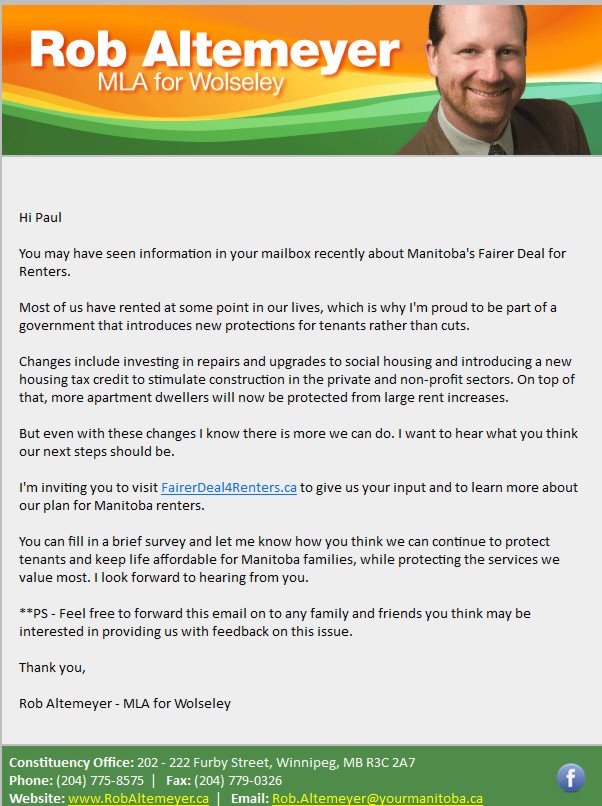
Hi PaulRA Emailer

You may have seen information in your mailbox recently about Manitoba’s Fairer Deal for Renters.

Most of us have rented at some point in our lives, which is why I’m proud to be part of a government that introduces new protections for tenants rather than cuts.

Changes include investing in repairs and upgrades to social housing and introducing a new housing tax credit to stimulate construction in the private and non-profit sectors. On top of that, more apartment dwellers will now be protected from large rent increases.

But even with these changes I know there is more we can do. I want to hear what you think our next steps should be.

I’m inviting you to visit FairerDeal4Renters.ca to give us your input and to learn more about our plan for Manitoba renters.

You can fill in a brief survey and let me know how you think we can continue to protect tenants and keep life affordable for Manitoba families, while protecting the services we value most. I look forward to hearing from you.

**PS – Feel free to forward this email on to any family and friends you think may be interested in providing us with feedback on this issue.

Thank you,

Rob Altemeyer – MLA for Wolseley


At first glance, it appears rather innocuous — an MLA informing his constituent of new government initiatives and inviting input into future policies that will help tenants and other Manitoba families. If you didn’t follow up on the opportunity by clicking on FairerDeal4Renters.ca, you might think that it was a genuine invitation. You might think “How thoughtful of him to ask. I feel so included. This government really cares!” You might.

I clicked on the aforementioned link and found myself — not on a page dedicated to tenants’ interests, as one might have suspected from the name of the link — but on a page on the Manitoba NDP Caucus web site. As promised, it provided a bit more information on how life had gotten better for Manitoba tenants. Then came the survey — and this is what pissed me off.


How can we continue to keep life affordable for Manitoba families?

RA Emailer2Continue investing in safe, affordable housing units for seniors.
Protect consumers with fair and transparent cable and Internet contracts.
Keep Manitoba Hydro public and Hydro rates low.
Protect Manitobans from American-style, two-tier health care.
Keep post-secondary tuition affordable.
Continue building public infrastructure, including schools, hospitals and Quick Care Clinics.


Nowhere is there an opportunity to comment on the plethora of genuine issues and policy concerns that would impact on tenants in particular or citizens in general. Instead we are presented with a tick-box menu of vaguely worded motherhood statements that reflect existing government policy, with a text box at the end for comments.

This is not consultation. It is pre-election propagandizing. The Manitoba government did something similar in the lead up to this year’s provincial budget.

I wish I could say I was disappointed, but this bogus, tawdry, cynical approach to “consultation” is well established. Everyone does it. Governments, corporations, political parties. They smile, appear concerned and insult our intelligence on their way to the bank. The NDP is hardly unique. No wonder voter turn-outs are in decline.

Winnipeg Free Press columnist Mary Agnes Welch nailed it when she described this particular email message as “NDP bait and switch.”

Until political parties learn to engage honestly with citizens, our democracy will continue to wither.

October 26, 2013: Diane Orihel, founder and director of the Coalition to Save ELA, speaks to a workshop in Winnipeg on water quality sponsored bu Idle No More Manitoba. Photo: Paul S. Graham

October 26, 2013: Diane Orihel, founder and director of the Coalition to Save ELA, speaks to a workshop in Winnipeg on water quality sponsored by Idle No More Manitoba. Photo: Paul S. Graham

Dr. Diane Orihel is the founder of the Coalition to Save ELA.The Coalition to Save ELA is a nonpartisan group of scientists and citizens concerned about the future of Canada’s Experimental Lakes Area.

Located in northwestern Ontario, the ELA consists of 58 small lakes and their watersheds that have been set aside for research. Since 1968, these lakes have provided scientists with a natural laboratory to study the physical, chemical, and biological processes in living lake ecosystems. Research conducted in the ELA has been critical to maintaining the quality of fresh water in Canada and many other countries.

Last year, the federal government announced plans to close the facility in 2013. Supporters of the ELA mounted a vigorous national and international campaign to maintain federal support. They have been partially successful, insofar as the Ontario government has committed to a short-term agreement to work with Winnipeg’s International Institute for Sustainable Development to spend up to $2 million a year. Under the agreement, IISD will oversee lake monitoring and the federal department of Fisheries and Oceans will continue its remediation work.

Celebrations would be premature. According to Orihel, “it is now illegal to conduct whole eco-system experiments at ELA.” And whole ecosystem experimentation is precisely what put ELA “on the world map,” according to Orihel. And hence, the campaign to save the ELA continues.

Orihel spoke recently at a workshop on water quality and oil fracking. This workshop was sponsored by Idle No More Manitoba as a part of its Red Feather Campaign in solidarity with the people of Elsipogtog, New Brunswick, who have been resisting plans to frack for oil in their territory.

Her topic was “The Five Main threats to Lake Winnipeg.” These threats, in the order in which she presented them, are nutrient pollution. toxic chemicals, climate change, invasive species and the “federal government under the leadership of Stephen Harper.”

I recorded the workshop on Oct. 26, 2013 at Neechi Commons in Winnipeg.


Dennis LeNeveu

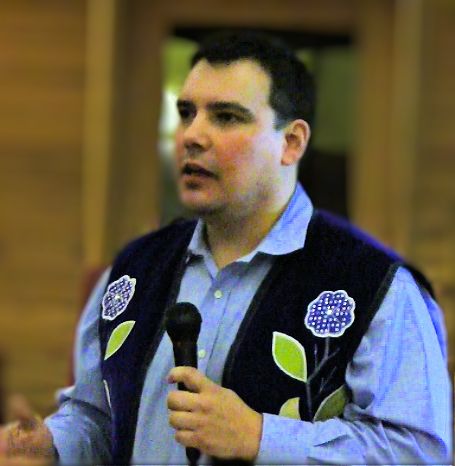
Winnipeg, Oct. 26, 2013: Retired scientist Dennis Le Neveu spoke at a forum on the environmental hazards of fracking, sponsored by Idle No More Manitoba. Photo: Paul S. Graham

Fracking is a process used to extract oil and natural gas. It involves drilling horizontal wells into rock formations and injecting a mixture of fresh water, chemicals and sand under high pressure to fracture the rock and release the oil and gas.

Fracking has been linked with contaminated water aquifers,  air pollution and earthquakes.

In Manitoba, the gas extracted with the oil is hydrogen sulfide, a toxic gas that is lethal in small concentrations. The gas is burned off and returns to earth as sulphur dioxide, also known as acid rain.

Last year in Manitoba, 570 new horizontal wells were drilled, and more than 600 are projected for 2013.

This presentation was sponsored by Idle No More Manitoba as a part of its Red Feather Campaign in solidarity with the people of Elsipogtog, New Brunswick, who have been resisting plans to frack for oil in their territory.

The presenter, Dennis Le Neveu, is a retired scientist who has written on this topic for the Fall 2013 edition of Eco Journal, published by the Manitoba Eco-Network.

It was recorded on Oct. 26, 2013 at Neechi Commons in Winnipeg.


No Prairie PipelineTransCanada Pipelines’ proposed “Energy East” pipeline project, which is intended to transport Alberta tar sands crude to eastern Canada, is meeting growing opposition from First Nations, environmentalists and citizens who live along the planned route.

The Winnipeg chapter of the Council of Canadians, along with Idle No More and the Boreal Forest Network held a public forum on the issue on October 22, 2013. Speakers included Maryam Adrangi, the Council of Canadians’ Energy and Climate Campaigner, and Crystal Green, Michael Kannon and Nina Was’te of Idle No More. The forum was moderated by Susan McCrea of the Boreal Forest Network and held at the Mondragon Book Store and Coffee House.

Ken Harasym recorded and I edited this video report.


Winnipeg, Oct. 12, 2013: Jingle dancers ready themselves to welcome the UN Special Rapporteur on the Rights of Indigenous Peoples. Photo: Paul S. Graham

Winnipeg, Oct. 12, 2013: Jingle dancers ready themselves to welcome the UN Special Rapporteur on the Rights of Indigenous Peoples. Photo: Paul S. Graham

Winnipeg, Canada: Thousands gathered at the intersection of Portage and Main Street to welcome the UN Special Rapporteur on the Rights of Indigenous Peoples, Professor James Anaya, with a Jingle Dance. Speaking in this clip are Jo Redsky and Michael Champagne, activists in Canada’s Idle No More movement.

Among the many issues outstanding between the First Nations and the Government of Canada is the refusal of the federal government to hold a national inquiry into the documented murders or disappearances of over 600 aboriginal women in Canada. Stephen Harper has been distinctly cool towards the visit of the UN Special Rapporteur, but until the Canadian government takes serious steps to address the needs of Canada’s First Nations they will continue to seek support in the international arena.

October 8, 2013 - Green Party leader Elizabeth May, speaking at the Speak Up For Democracy Town Hall Meeting in Winnipeg. Photo: Paul S. Graham

October 8, 2013 – Green Party leader Elizabeth May, speaking at the Speak Up For Democracy Town Hall Meeting in Winnipeg. Photo: Paul S. Graham

Canadian democracy ain’t what it used to be and what it used to be was far from ideal. Still, fewer of us are voting and even fewer are satisfied with the outcome.

Over the past 20 years, voter turnout has declined precipitously. Of the 24.2 million citizens eligible to vote in the 2011 federal election, only 14.8 million, or 61.1 per cent did so. Of those who voted, 39.6 per cent, or 5.8 million voters chose a Conservative candidate. In other words, the government of Canada was elected by fewer than 25 per cent of eligible voters. 9.4 million Canadians chose not to vote for anyone; this is nearly twice as many as those who elected the governing party.

Among those of us who have chosen to vote, there is widespread dissatisfaction with the way this is represented in the House of Commons. The following table shows the distribution of seats following the 2011 federal election.

Party

Elected

% of Seats

% of Vote

Conservative

167

54.2

39.6

NDP

102

33.1

30.6

Liberal

34

11

18.9

BQ

4

1.3

6

Green

1

0.3

3.9

Source: http://www.sfu.ca/~aheard/elections/results.html. (Note, percentages to not add up to 100, probably because of some rounding in the original data. But you get the idea.)

The top two parties clearly have more MPs than their share of the popular vote would justify. It looks like this.

Now, look what happens when MPs are elected in proportion to their party’s share of the popular vote.

Party

FPTP

PR

Conservative

167

122

NDP

102

95

Liberal

34

59

BQ

4

19

Green

1

13

(Note: the above chart needed some rounding to make it work – but it’s close enough.) It would look like this.

Would adoption of a proportional representation system increase voter turnouts in elections? It might. Those who are convinced that their vote does not count might be encouraged to participate in a process that offered a more representative outcome.

However, all the electoral system reforms in the world will be fruitless unless the governments we elect learn to behave in a more democratic fashion.

A common refrain among voters is that once elected, Members of Parliament become invisible, until the next election, anyway. Stories of MPs frustrated by the their lack of freedom to speak their minds are growing, as are the complaints of reporters who are frustrated with the federal government’s record of providing information that should be made public in a timely way. Government scientists are prevented from discussing their publicly funded research. Organizations that evaluate government policies lose their funding. Critics of government policy find themselves described as dangerous radicals and citizens concerned about fracking are placed under surveillance. Shutting down Parliament to avoid controversy and using omnibus budget bills to to limit Parliamentary examination of legislation can be added to the list.

While our current federal government is notorious for its antidemocratic practices, governments at all levels have fostered a system that insulates them from addressing the concerns of citizens. This growing trend to undemocratic governance in a country that regards itself as a democracy inspired the town hall meeting that took place in Winnipeg Oct. 8, 2013.

Sponsored by Peace Alliance Winnipeg and the Green Party of Canada, “Speak Up for Democracy” featured Elizabeth May, leader of the Green Party and MP for Saanich-Gulf Islands, Dennis Lewycky, executive director of the Social Planning Council of Winnipeg, and Leah Gazan, a leading activist in Idle No More.

More that 200 people packed the Broadway Disciples United Church to hear from them and to discuss with them what must be done to rescue our democracy.

I’ve been to a lot of meetings over the years; this clearly was one of the best. So grab some pop corn, turn off your smart phone and invest the next two hours in pondering one of the most pressing issues of our generation.

Links:
Elizabeth May, MP
Green Party of Canada
Social Planning Council of Winnipeg
Idle No More Manitoba


tour_logo_enGreen Party of Canada Leader Elizabeth May, MP for Saanich-Gulf Islands, is on a cross country tour, billed as “Save Democracy from Politics,” to call for major reforms in Canada’s Parliamentary system. According to May, Canadian democracy is being undermined by excessive partisanship, a party system that punishes MPs who do not toe the party line, and a Prime Minister’s Office that wields the powers that should be exercised by Parliament.

May was in Winnipeg to speak at a town hall meeting co-sponsored by the Green Party and Peace Alliance Winnipeg. I will post the video from that meeting later this week. In the meantime, here’s Michael Welch, News Director of CKUW-FM, in conversation with Elizabeth May.


Links


Oct. 4, 2013: Winnipeggers gathered at the Manitoba Legislature to remember the lives of 600 missing and murdered Aboriginal women in Canada, 75 of whom came from Manitoba. Photo: Paul S. Graham

Oct. 4, 2013: Winnipeggers gathered at the Manitoba Legislature to remember the lives of 600 missing and murdered Aboriginal women in Canada, 75 of whom came from Manitoba. Photo: Paul S. Graham

Winnipeggers gathered at the Manitoba Legislature on Friday afternoon to demand an national inquiry into the causes for the disappearance or death of over 600 indigenous women in Canada in recent years. The demonstrators repeated a longstanding demand for a for national inquiry, something that has gained the support of all provincial premiers and territorial leaders, but which continues to be rejected by the federal government.

Appearing in this video report are Rosanna Deerchild, Chief Francine Meeches,  Judy Wasylycia-Leis, Raven Hart-Bellecourt, Robert Animikii Horton, Jo Redsky, Sierra Noble, Dana Foster and Chief Cathy Merrick.


HR Poster logoWinnipeg, September 28, 2013 – In commemoration of the 40th anniversary of the coup d’etat against the democratically elected government of Salvador Allende, Winnipeg’s Chilean community held numerous educational and cultural events throughout September. On September 28th, the Chilean Human Rights Council of Canada held a conference at the University of Winnipeg entitled “Human Rights – The Chilean Experience.”

Speakers included:
– Dr. Miguel Sanchez, University of Regina, School of Social Work
– Fr. Eduardo Enrique Soto Parra, SJ, Mauro Centre, University of Manitoba
– Claudia Garcia de la Huerta, Journalist
– Dr. Clint Curle, Canadian Museum for Human Rights (Moderator)

Conference Organizers:
– Chilean Human Rights Council of Canada
– Canadian Museum for Human Rights

Conference Sponsors:
– University of Manitoba, Mauro Centre
– University of Winnipeg, Global College