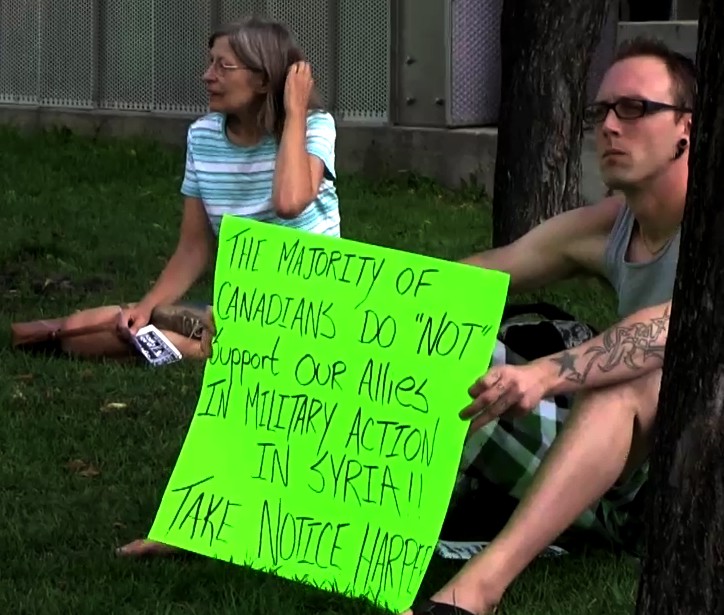
Aug. 31, 2013: Winnipeggers rallied to voice opposition to foreign intervention in Syria’s civil war. Photo: Paul S. Graham
About 50 Winnipeggers rallied at the Canadian Museum of Human Rights Saturday afternoon to express their opposition to foreign military interventions in Syria. The rally, organized by Winnipeg Alternative Media, was one of many held on Saturday across Canada, and was part of an international campaign to prevent the Syrian crisis from escalating into a world war.
In this video report, organizers explain what is at stake.
August 6, 2011: Nick Ternette at Winnipeg’s Annual Lanterns for Peace ceremony marking the anniversaty of the 1945 US nuclear bombing of Hiroshima and Nagasaki. Photo: Paul S. Graham
For more than 30 years, Winnipeggers have come together, in June, to march for peace. In doing so, we strive to educate our neigbours about the the roots of war and to keep alive the message that peace and social justice are inextricably interwoven.
This year, we dedicated the festival to our longtime friend and comrade in the struggle for peace and justice, Nick Ternette. Politically active in many arenas, Nick worked for social justice until the end of his life, despite the health challenges that ultimately caused his death on March 3rd, 2013.
Featured speakers at this year’s event included political activist Emily Ternette, who provided a loving tribute to her departed husband, and David Barsamian, host of the weekly American political affairs program, Alternative Radio, which has been running for 27 years.
In addition to the speeches of Emily Ternette and David Barsamian, my video report includes a brief interview with Nick, held as we marched along during the 2012 Walk for Peace.
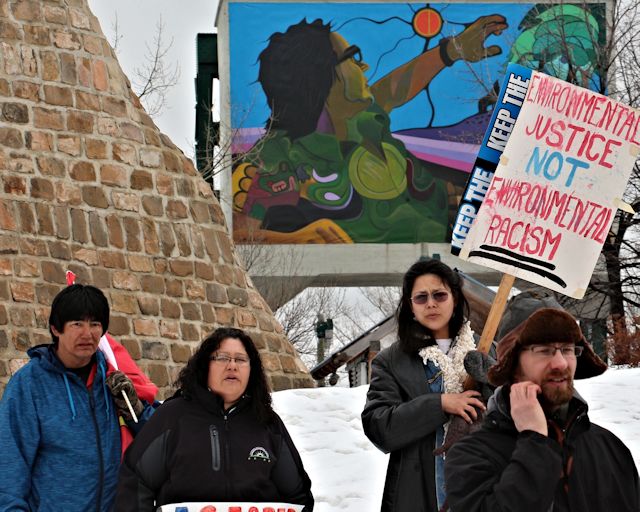
Winnipeg, April 21, 2013: Some of the participants in the 10th annual Seventh Generation Walk for Mother Earth, at the Oodena Circle at The Forks. Photo: Paul S. Graham
Despite the inclement weather, this year’s Seventh Generation Walk for Mother Earth was a lively celebration that began at Central Park and ended at Thunderbird House, with stops along the way at the Manitoba Hydro headquarters and the Oodena Circle at The Forks.
Held on Sunday, April 21, this year’s walk was in support of the Voices of Indigenous Women and in solidarity with the growing Idle No More Movement.
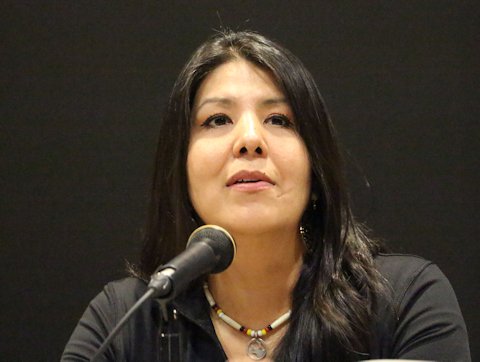
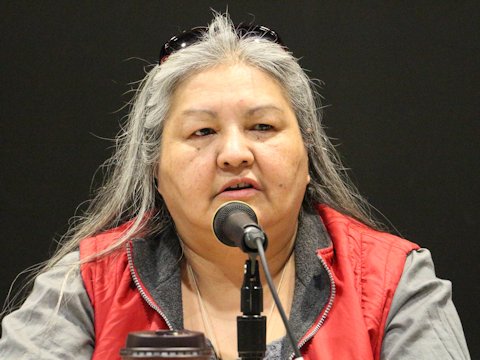
Speakers included Susanne McCrea of the Boreal Forest Network, Ko’ona Cochrane, Alberteen Spence, Judy da Silva, Kristen Andrews, Myrle Ballard and Diane Maytwayashing.
In a wide ranging discussion, Winnipeg’s civic government was criticized for lacking vision, accountability and transparency, along with a tendency to favor the private interests of developers over those of citizens and communities.
April 4, 2013, Winnipeg: Opponents of the Reed Lake Mine in northern Manitoba confront HudBay Mineral’s officials. Photo: Paul S. Graham
Opponents of Hudbay Mineral’s planned copper mine at Reed Lake, Manitoba held a peaceful demonstration at an information meeting held by the company at a Holiday Inn in Winnipeg. The demonstrators, many of whom are active in the Idle No More movement, confronted HudBay officials for about 15 minutes to voice their opposition and to demand a halt to the project.
Reed Lake is in the Grass River Provincial Park, about 110 kilometres east of Flin Flon. The mining project is a joint venture of HudBay Minerals and VMS Ventures, Inc.
The fact this mining operation is under construction in a provincial park has outraged environmentalists and First Nations communities alike.
April 4, 2013, Winnipeg: At a news conference announcing opposition to HudBay’s Reed Lake Mine – (l-r) Grand Chief David Harper, Manitoba Keewatinowi Okimakanak, Chief Arlen Dumas, Mathias Colomb Cree Nation, Grand Chief Derek Nepinak, Assembly of Manitoba Chiefs and Eric Reder, Wilderness Committee. Photo: Paul S. Graham
At a news conference held earlier that evening, representatives of the Mathias Colomb Cree Nation, the Assembly of Manitoba Chiefs, the Manitoba Keewatinowi Okimakanak and the Wilderness Committee pledged to oppose the mine because it is being built within the traditional territory of the MCCN without their permission.
Jo Seenie Redsky: “We’re your last resort.” Photo: Paul S. Graham
If your only source of information is the mainstream news media you can be forgiven for wondering what the Idle No More movement is all about. Since it burst on the scene late last year, media attention has darted from demonstrations to blockades to the fasts of elders and chiefs — with an occasional sustained flurry of excitement when the PMO tried to smear Chief Theresa Spence.
Discussions of the abrogation of historic treaty rights or the corporate pillaging Stephen Harper has buried, like poisonous turds, in his omnibus budget bills, do not lend themselves to the tidy sound bites that nourish the media and feed the news cycle.
Having spent last Sunday afternoon at a panel discussion sponsored by Peace Alliance Winnipeg and Project Peacemakers, I can assure you that Idle No More is about nearly everything that is wrong with our society, but fundamentally it is about love. Love of family, friends, complete strangers, future generations, the air we breathe, the water we drink, the earth we walk on.
Jerry Daniels: ” The issue is sustainable development.” Photo: Paul S. Graham
Idle No More is inclusive and green. As panelist Jerry Daniels puts it, “A sustainable future is important to not only aboriginal people, it is important to all of us . . . the issue is sustainable development – sustainable futures for our children.” For Leah Gazan, “it’s not just about indigenous people of Canada any more, it’s about all of us. It’s about all of us sharing this land in a really good way.”
Idle No More is about redressing the damage we have done to ourselves and the environment, and preventing more of the same. Chickadee Richard sums it up in as tidy a sound bite as you could find anywhere: “As you heal, you heal Mother Earth.”
Chickadee Richard: “As you heal, you heal Mother Earth.” Photo: Paul S. Graham
Michael Champagne: “An injustice to one is an injustice to all.” Photo: Paul S. Graham
Idle No More is about aboriginal youth, says Michael Champagne, but about aboriginal youth unlike those of previous generations: “not only are we educated in Western institutions . . . , we are also educated by the Chickadees of the world, by our elders and our ancestors and our community and we are able to learn about the strength and resilience of our ancestors and our nations.”
Idle No More is about human solidarity. Champagne continues: “We’re able to hear those teachings within the medicine wheel and understand that we are all related regardless of the colour of our skin, and like a circle, it is not complete if one of you is missing . . . if you’re hurting, I’m hurting . . . and if I’m hurting, so are you . . . An injustice to one is an injustice to all.” Champagne was consistent; he included Stephen Harper in the company of those damaged by the system Idle No More seeks to overturn.
Lori Mainville: “no fear, no surrender, only love.” Photo: Paul S. Graham
Idle No More cannot be contained or controlled says Lori Mainville. “The media poses a skewed version – always trying commodify or standardize or put it in a dichotomy and this is a people’s movement. The definition rests with the people and our relationship with the people, our allies, our brothers and sisters in each moment as this energy reveals itself. There’s no way you can cap [it].”
Idle No More is an obligation for those who love Mother Earth. “I guess you could say in . . . protecting the land, the waters, we’re your last resort,” says Jo Seenie Redsky. “I know the world is watching our people here, in the country of Canada, to see us rise up and protect what everybody needs to protect and that’s the land and the waters and those yet to come.”
Leah Gazan: “Idle No More is the newest version of a 500-year struggle.” Photo: Paul S. Graham
At its base, says Redsky, Idle No More is about love. “There’s an unconditional love that we have for our kids. That protection that we have for them is the same protection that we need to have for Mother Earth.” For Lori Mainville, whatever the risks, “I keep remembering that the greatest equalizer is love . . . no fear, no surrender, only love . . . For me, it’s about love as a mother and a grandmother and a sister and a community member.”
My reduction of this discussion to a matter of love aside, it is difficult to sum up a discussion of this importance in a few paragraphs.
Fortunately, I brought my video camera.
If you want to get involved, you can find Idle No More on Facebook and on the World Wide Web. As the weather warms, I have a feeling you’ll be able find it and join it in the streets. Don’t hesitate, because I’m sure you’ll receive a warm welcome.
Roger Annis at the Feb. 24, 2013 annual meeting of Peace Alliance Winnipeg. Photo: Paul S. Graham
Is the military intervention in Mali by France, with the assistance of the United States, Canada and others an example of a humanitarian intervention launched to protect a fragile democracy from the incursion of Muslim terrorists? Or is France meddling in the affairs of its former colony to protect its business interests and further the political and economic interests of its NATO partners?
Roger Annis, coordinator of the Canada-Haiti Action Network and longtime political activist, explored these questions at the Annual General Meeting of Peace Alliance Winnipeg, held Feb. 24, 2013 in Winnipeg.
If you want to read more on this issue, Roger has published a number of thoughtful articles on his blog.
Jan. 4, 2013: Demonstrators calling for an increase in rental rates for income assistance recipients, left dozens of pairs of shoes on the steps of the Manitoba Legislature. Photo: Paul S. Graham
Make Poverty History Manitoba rallied at the Manitoba Legislature on Friday to demand that the provincial government increase the rental allowance provided to recipients of provincial Employment and Income Assistance (EIA). Recalling the kindness of a Winnipeg Transit driver who gave a homeless man a pair of shoes, demonstrators left dozens of pairs of shoes on the steps of the Legislature to send the message that they no longer wish to depend on isolated, random acts of kindness.
EIA recipients are provided with a rental allowance that has increased only slightly over the past two decades. During that same period, rents have gone up by 60 to 70%.
According to Kirsten Bernas, Make Poverty History Manitoba is asking the Province to increase the rental allowance to 75% of median market rent, a move the provincial government estimates would cost approximately $18.5 million annually.
In this video report, Ms. Bernas explains why this increase is long overdue.
Poverty on the increase in Manitoba
According to the Social Planning Council of Winnipeg, “While the national poverty rate has remained relatively stable since 2006, the child poverty rate in Manitoba has been gradually increasing and remains 6.4 percentage points higher than the national average.” The SPCW reports that Manitoba had the second highest child poverty rate in Canada in 2012, with over 20% of our children (about 54,000) living below the poverty line as defined by Statistics Canada’s Low Income Measure After Taxes.
In Manitoba, the fastest growing banks are the food banks. Some statistics gleaned from the Winnipeg Harvest food bank web site tell the story:
Winnipeg Harvest provides emergency food assistance to nearly 64,000 people a month across Manitoba. Therefore, Winnipeg Harvest clients are Manitoba’s second-largest city. This figure is up more than 14% over the same period last year.
More than 47% of its clients are children. For each of the last two years, Manitoba is the #1 province for food bank use.
Winnipeg Harvest feeds more 30,000 children each month. Ten years ago, that number stood at 5,500 children.
Seniors and refugees have more than doubled in food bank use since 2010.
1/3 of families experiencing hunger are dual wage-earner families, i.e, the working poor.
Winnipeg Harvest distributes food to more than 330 agencies throughout Manitoba
The authors appear to believe that poverty rates in Manitoba are shrinking; they make the claim that the number of Manitobans living in poverty went down by 6,000 between 2000 and 2009. Research from the above-cited sources suggests that the opposite trend is more likely.
There are no concrete goals against which the government’s performance can be evaluated. Instead, we are given vague indicators against which progress will be measured.
A second reading of the strategy reveals it to be a glossy, feel-good kind of document which does little to instill confidence that the provincial government is seriously committed to poverty reduction. But don’t take my word for it; read it yourself.
Déjà vu all over again
Source: Statistics Canada (2010). Income in Canada, CANSIM 202-0802 as cited in the Social Planning Council of Winnipeg’s “Child & Family Poverty 2012 Report Card.”
Manitoba’s child poverty rates have remained above the national rate since 1989 when Canada’s House of Commons passed a unanimous all-party resolution to eliminate child poverty by the year 2000. Canada’s national poverty rate remains pretty much where it was in 1990.
In 2009, the House passed another unanimous motion to “develop an immediate plan to eliminate poverty in Canada for all.” The Manitoba government seems to have bought into the legislative zeitgeist. However, unless there are some significant changes in their approach, nothing will change. The rich will get richer and the poor poorer — all of this occurring in the heartland of one of the wealthiest countries in the world.
A good place to start would be to acknowledge that poverty is growing and to act accordingly. This would include setting real goals and dedicating more resources to meet them. It would also mean backing away from its failed strategy of regular tax reductions so we have more resources to allocate to alleviating poverty. It would mean educating the public about the true nature of poverty and taking the risk that an honest dialogue would win over all but the most diehard reactionaries in the province.
Finally, for starters, why not increase the funds allocated to housing in the EIA budget, so that disabled, unemployed and other immiserated Manitobans don’t have to choose between paying the rent or putting food in their bellies?
Oct. 6, 2012: A passerby reads a leaflet distributed by Peace Alliance Winnipeg in Osborne Village. Photo: Paul S. Graham
Activists in at least 6 Canadian cities joined in the International Day of Action yesterday to carry the message “Don’t attack Iran” to our fellow citizens.
In Winnipeg, Peace Alliance Winnipeg held an information picket in the Osborne Village neighbourhood, distributing hundreds of leaflets that exposed the myths that are being spread by our various governments to justify sanctions and a future war against Iran.
At the conclusion of the demonstration, Peace Alliance Winnipeg chairperson, Glenn Michalchuk, spoke about the growing war danger and the implications for Canadians. Here is my video report.
Sept. 21, 2012: Actors Gord Tanner, Sara Constible and Tricia Cooper (l-r) in performance at International Peace Day at the Free Press Cafe in Winnipeg. The evening was sponsored by Project Peacemakers. Photo: Paul S. Graham
Yesterday was International Peace Day. It’s understandable if you missed it. Peace is a rare and beautiful thing in this war-torn world.
Winnipeg’s Project Peacemakers marked International Peace Day 2012 with skits and musical performances at the Free Press Cafe. Performing sketches written by Geoff Hughes and Diane Cooper, actors Tricia Cooper, Sara Constible and Gord Tanner provided a comedic response to the Harper Government’s military spending policies in general and its decision to spend $28 million celebrating the 200th anniversary of the War of 1812.
With skillfully performed covers of songs by Pink Floyd, John Lennon and the Weavers, Tom Penner and Jill Cooper closed out the evening with ballads beloved by peace activists everywhere.
International Peace Day was established by the United Nations in 1981 and first celebrated in September 1982. Since then it has been observed in countries around the world.
Project Peacemakers is a church-based organization that has been active in Winnipeg since 1983. It conducts educational forums, and publishes educational materials on such issues as child soldiers, war-affected children, and violent video games and toys.
While I tend to be skeptical of international days of any kind, I’m glad I went. It was an enjoyable to be surrounded by people who care actively about world peace and the performances were great. Here is my video report.