Archive for the ‘Nibbling on The Empire’ Category

Most Canadians imagine Canada to be a force for good on the world stage. Polite, reasonable, peace-loving and progressive. At least, that is how we like to imagine ourselves.

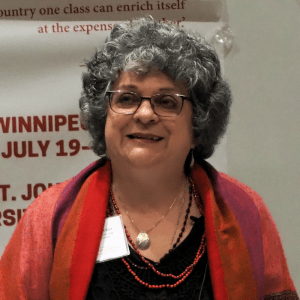
Winnipeg, July 20, 2019: Dr. Maria Páez Victor at the 14th Forum, World Association of Political Economy. Photo: Paul S. Graham

Sadly, it’s a myth. We helped oust the democratically elected Haitian government of Jean-Bertrand Aristide. We helped turn Libya into a failed state. We helped invade Afghanistan and occupied part of it for over a decade. And these are just a few examples of Canada’s backwards foreign policy in this century.

And now, we’re meddling in Venezuela, where our government has joined with the United States to destabilize, undermine and crush the democratically elected, socialist government of Nicholas Maduro and the popular movement that supports it. Yves Engler has written several well researched articles on Canada’s attacks on Venezuela that I recommend you read. Yves’ articles are an effective antidote to the bullshit being passed of as news and analysis in our mainstream media, as is a recent speech by Dr. Maria Páez Victor.

Dr. Páez Victor is a Toronto-based, Venezuelan-born sociologist and activist on the board of the Canadian, Latin American and Caribbean Policy Centre. She speaks with authority and passion about what is at stake in the country of her birth. I recorded her presentation at the 14th Forum of the World Association for Political Economy, held at the University of Manitoba in July.

Returning to the title of this post, why should you care? Simply put, if you want Canada to be a force for good on the world stage, our government’s policies and actions must change. And if you allow our government to continue along its reactionary path without challenging it, you are complicit.

It’s election time in Canada. Ask your candidates where they stand on issues such as this. Make your support for them conditional on their support for a foreign policy that is peaceful, cooperative and supportive of international law. It’s not too much to ask.

2018 was not my most prolific year in terms of video output, but it provided, nonetheless, some interesting and useful insights into the struggle for peace and human rights in various parts of the world. Here is a rundown of the past 12 months and as we like to say in YouTubeLand, if you enjoy any of these, please click the “like” icon and subscribe.

Steve Ellner: What is really happening in Venezuela: The Winnipeg Venezuela Peace Committee held a public forum on Friday, Oct. 19, 2018 entitled “What is really happening in Venezuela?” The forum featured Steve Ellner, professor of economics at the University of Oriente in Puerto La Cruz, Venezuela. Watch.

Yves Engler on Canada’s Left & its Foreign Policy Failures: Yves Engler discusses his latest book, “Left, Right — Marching to the Beat of Imperial Canada.” The book details the failure of Canada’s Left parties, institutions and intellectuals to confront Canada’s support of empire and promotion of corporate interests abroad. Watch.

Niranjan Takle: Journalism under Hindutav Fascist India: Indian journalist Niranjan Takle recounts how the mainstream media in India ignored or refused to publish his report on the suspicious death of Judge Brijgopal Harkishan Loya. Watch.

Israel Palestine International Law Symposium: An impressive line-up of experts on human rights and international law gathered in Winnipeg for a weekend to explore various legal aspects of the Israel-Palestine situation. I recorded all of the sessions.

  • Introduction: Symposium coordinator David Kattenburg explains the origins and purpose of the symposium.
  • Human rights: Rhetoric vs Reality: Lawyer and journalist Dimitri Lascaris describes the failure of western governments to uphold the human rights of Palestinians.
  • Keynote Address: Michael Lynk, who is the United Nations Rapporteur on the situation of human rights in the Occupied Palestinian Territory, explains how international law has largely been ignored or broken by Israel over the past several decades of its occupation of the Palestinian Territory.
  • Israeli Rights and Obligations:  Michael Lynk and Dimitri Lascaris explore different aspects of Israeli’s legal rights and obligations in the Occupied Palestinian Territory.
  • One State or Two?: Professors Michael Lynk and Virginia Tilley speak to this issue.
  • Palestinian Rights & Obligations: In this clip, we hear from human rights advocates Suha Jarrar and Jonathan Kuttab.
  • Palestinian Rights to Resources: Suha Jarrar, a Palestinian human rights researcher and advocate, and currently the Environmental and Gender Policy Researcher at Al-Haq human rights organization in Ramallah, Palestine explains how Israeli companies illegally exploit resources in the Occupied Territories.
  • Is Israel an Apartheid State?: In this clip, Virginia Tilley argues that Israel meets the legal definition of an apartheid state.
  • Dueling Perspectives: In this clip, David Matas defends Israeli practices and policies with regard to the Occupied Palestinian Territories (OPT). Michael Lynk argues that Matas’s arguments are not supported by international law.
  • Canada’s Rights and Obligations: Dimitri Lascaris explains how Canada has not lived up to its obligations under international law.
  • Concluding Remarks: In this final clip from the symposium, we hear from David Kattenburg, Mark Golden and Dean Peachey, key organizers of the event. The symposium was sponsored by (alphabetical order): Independent Jewish Voices Canada, Mennonite Church Manitoba Working Group on Palestine-Israel, Palestinian Canadian Congress, Peace Alliance Winnipeg, United Jewish People’s Order (Winnipeg) and the Winnipeg Centre Federal Green Party Association. Additional information, including Power Point presentations and other documents will be made available at the conference web site.

Winnipeg Lanterns for Peace 2018: Every August, Winnipeggers commemorate the 1945 atomic bombings of Hiroshima (Aug. 6) and Nagasaki (Aug. 9) with a Lantern Ceremony in Memorial Park. We believe it is important to keep the memory of those horrible events alive so that current generations understand we must never allow nuclear weapons to be used again. Watch.

St. Boniface By-election 2018 – Elizabeth May and Françoise Therrien Vrignon: Françoise Therrien Vrignon was the Green Party of Manitoba candidate in the July 17th Manitoba by-election in St. Boniface. With her in this video is Green Party of Canada leader Elizabeth May. Their discussion took place at La Maison des artistes visuels. Watch.

Winnipeg Rally for Refuge: The Canadians Care Coalition in association with Amnesty International, Menno Simons Students Association and the Global College Students Association held a rally entitled “Rally for Refuge: Rescind the safe third country agreement.” The coalition demanded that the Canadian Government rescind the designation of ‘Safe Third Country’ that is applied to the United States because the US is demonstrably unsafe for refugees. The Safe Third Country Agreement denies refugee claimants access to the Canadian refugee determination system if they have come from the United States to the Canadian border. Watch.

Winnipeg Walk for Peace 2018: Winnipeggers held their 37th Annual Winnipeg Walk for Peace. Sponsors: Peace Alliance Winnipeg and the Winnipeg chapter of the Council of Canadians. Watch.

Michel Chossudovsky – The Globalization of War: The Regina Peace Council played host to Professor Michel Chossudovsky, who spoke on the growing dangers of world war and the need to revitalize the peace movement. Professor Chossudovsky is the founder and director of Global Research. Watch.

Al Nakba 70 in Winnipeg: Winnipeggers marked the 70th anniversary of the forcible expulsion of Palestinians from their land and expressed solidarity with the people of Gaza who are under Israeli siege. Watch.

Make Poverty History in Winnipeg: Make Poverty History Manitoba released a comprehensive report on the poverty that affects one in ten Winnipeggers and called on the city’s mayor, Brian Bowman, to take the lead in developing a poverty reduction strategy for the city. Watch.

MFL Day of Mourning 2018: Manitoba’s labour movement held its annual observance in memory of injured and killed workers. Hundreds attended the march from the Union Centre to Memorial Park and the future site of the Firefighters, Peace Officers and Workers Memorial. Watch.

7th Generation Walk for Mother Earth 2018: Winnipeggers marked 15 years of taking to the streets with grassroots land and water defenders.The 7th Generation Walk is alternative to Earth Day, recognizing the resistance and resilience of Indigenous community led campaigns for social and environmental justice. Watch.

Mobilize against the war: Just hours before the United States launched missile attacks on Damascus and Homs, peace activists rallied outside the building housing the US Consulate to speak out against the war and Trump’s declared plan to expand it. The picket was organized by the Manitoba Peace Council. Watch.

Democracy and Elections in Cuba: Two Cuban government representatives visited Winnipeg to discuss Cuba’s electoral system and other issues of interest. The forum was sponsored by the Manitoba-Cuba Solidarity Committee. Watch.

My Jerusalem – Responding to the U.S. Embassy Announcement: Panelists representing Judaism, Christianity and Islam, share their personal reflections on what Jerusalem means to them and the implications of the US announcement to move it’s embassy there. Watch.

Winnipeg Commemorates Quebec Mosque Massacre: Winnipeggers gathered at the Manitoba Legislature to honour the victims of the terrorist attack on the Centre Culturel Islamique de Québec. Watch.

Winnipeg Kurdish Solidarity: In Winnipeg, the Kurdish community rallied at the Canadian Museum for Human Rights in defense of Kurds under Turkish attack in Afrin, Syria. Watch.

North Korea and The United States at a Dangerous Nuclear Crossroads: Michel Chossudovsky is professor emeritus at the University of Ottawa and founder of the Centre for Research on Globalization. He spoke at the University of Manitoba on the history of the United States’ conflict with North Korea and the prospects for nuclear war. Watch. As well, he spoke at the University of Winnipeg. Watch.

Arnold August – Cuba-US Relations from Obama to Trump: On a national tour to promote his book “Cuba-US Relations: Obama and Beyond,” Arnold August spoke at McNally Robinson Books on developments in the two countries relations since the election of Donald Trump. Watch.

That’s it for 2018. Happy New Year, all!


Winnipeg, October 17, 2018: Yves Engler discusses his latest book with an audience at the Université de Saint-Boniface. Photo: Paul S. Graham

Some authors are so prolific you can set your calendar by them. So it is with Yves Engler, who seems to put out a new book every fall. Yves just released his tenth, entitled “Left, Right — Marching to the Beat of Imperial Canada.”

The book details the failure of Canada’s Left parties, institutions and intellectuals to confront Canada’s support for imperialism and promotion of corporate interests abroad.

Part of the solution, says Engler, is to establish a Canadian Foreign Policy Institute that will act as a clearing house for the best alternative research and analysis of Canadian foreign policy.

Yves was in Winnipeg last week to promote the book. The evening was sponsored by Peace Alliance Winnipeg. I recorded his presentation (below) and interviewed him for the Global Research News Hour. Enjoy.

Winnipeg, Dec. 6, 2017 – Professor Johnny Márquez, speaking at Winnipeg’s historic Ukrainian Labour Temple on the political and economic situation in Venezuela. Photo: Paul S. Graham

When it comes to Venezuela, the mainstream media is awash with lies and distortions and the Canadian government is complicit (with the United States) in an attempt to force the overthrow of the democratically elected government of Nicolás Maduro. One can easily imagine Trump and Trudeau agreeing that it would be a crime to leave the largest proven oil reserves in the world (about 297 billion barrels) under the control of a socialist government pledged to use this wealth on behalf of some of the poorest people in the world.

In Winnipeg, a group called the Venezuela Peace Committee has organized a number of educational events to encourage citizens to learn about Venezuela and the struggles of working people for a socialist society. The VPC has a petition on the House of Commons E-Petition web site that calls on the government to cease its sanctions campaign. Here is the text:

E-1353
Petition to the Government of Canada

Whereas:

On September 22, 2017, the Government of Canada imposed new sanctions against Venezuela, Venezuelan officials, and other individuals under the Special Economic Measures Act in violation of the sovereignty of Venezuela;
Such sanctions impede dialogue and peace-building in Venezuela and in the region more generally;
These sanctions impede the normal operation of Venezuela’s duly constituted political processes including elections;
The Government of Canada has supported the U.S. government’s sanctions against Venezuela
The Government of Canada has met with, supported, and continues to echo the demands of Venezuela’s violent anti-government opposition;
The Government of Canada refuses to recognize the legitimacy of Venezuela’s democratically elected government and falsely refers to it as dictatorial; and
The government of Canada seeks to promote foreign intervention in the internal affairs of Venezuela.

We, the undersigned, residents of Canada, call upon the Government of Canada to immediately lift all sanctions against Venezuela, Venezuelan officials, and other individuals, retract all statements in support of US sanctions against Venezuela, immediately cease its support for the efforts of the US and other right wing governments in the Organization of American States (OAS) that violate the sovereignty and self-determination of another member-state and immediately cease all intervention against Venezuela.

The VPC is asking Canadians and friends of Canada to sign the petition. Just sign here.

The petition arose out of a resolution approved by the attendees of a conference held at the University of Manitoba to mark the 100th anniversary of the Russian Revolution. One of the keynote speakers at the conference was Julia Buxton, an internationally recognized expert on Venezuela. I recorded her talk.

Most recently, the VPC arranged for the visit of Professor Johnny Márquez to speak in Winnipeg. Professor Márquez is a Venezuelan lawyer, diplomat and scholar and president of the Latin American and Caribbean Center for Energy and Environment Studies. His first appearance was at the University of Manitoba on Dec. 5, 2017, where he discussed the history of Venezuela’s oil industry and its strategic importance. The following day he presented at Winnipeg’s historic Ukrainian Labour Temple on the current political situation in Venezuela. Both of these videos are linked below.

Hiroshima Tar Sands

Stephen-Harper-in-jailAccording to the Canadian Press, “The prime minister’s chief of staff went to Stephen Harper for approval of a secret plan that would have seen the Conservative party repay Mike Duffy’s contested expenses and whitewash a Senate report, new RCMP documents suggest.”

According to the article by Jennifer Ditchburn and Steve Rennie, published today:

When the party balked at the ultimate total of Duffy’s $90,000 bill, however, Nigel Wright paid the bill himself — apparently without Harper’s knowledge. Harper has called that a “deception.”

But emails included in Wednesday’s new RCMP court filings quote Wright as getting a green light from Harper when the original plan was to have the party pay. The plan was to be kept secret.

“I do want to speak to the PM before everything is considered final,” Wright wrote in one February dispatch. An hour later, he followed up: “We are good to go from the PM…”

Despite the predictable denials of the Prime Minster and his staff, it is beginning to look like Mr. Harper was involved in a plot that would appear to any reasonable person to violate Criminal Code provisions that prohibit bribery of public office holders. Here is the section of the Criminal Code that seems to be applicable.

Bribery of judicial officers, etc.

119. (1) Every one is guilty of an indictable offence and liable to imprisonment for a term not exceeding fourteen years who

(a) being the holder of a judicial office, or being a member of Parliament or of the legislature of a province, directly or indirectly, corruptly accepts, obtains, agrees to accept or attempts to obtain, for themselves or another person, any money, valuable consideration, office, place or employment in respect of anything done or omitted or to be done or omitted by them in their official capacity, or

(b) directly or indirectly, corruptly gives or offers to a person mentioned in paragraph (a), or to anyone for the benefit of that person, any money, valuable consideration, office, place or employment in respect of anything done or omitted or to be done or omitted by that person in their official capacity.

This new revelation is strongly reminiscent of the Cadman Affair. In 2005, the minority Liberal government of Paul Martin was in deep trouble. The Tories were intent on bringing them down, but the vote would be close. In Like a Rock: The Chuck Cadman Story, Vancouver writer Tom Zytaruk told the story of attempts by Conservative Party officials to offer financial inducements to independent MP Chuck Cadman in return for his support in bringing down the Liberals. The Tories were unsuccessful in getting Cadman’s support. However, an interview with Stephen Harper conducted by Zytaruk makes it clear that Harper was aware of his Party’s efforts to buy Cadman’s vote.

Here is a transcript of this interview. You can listen to the Harper-Zytaruk interview here.

Zytaruk: “I mean, there was an insurance policy for a million dollars. Do you know anything about that?”

Harper: “I don’t know the details. I know that there were discussions, uh, this is not for publication?”

Zytaruk: “This (inaudible) for the book. Not for the newspaper. This is for the book.”

Harper: “Um, I don’t know the details. I can tell you that I had told the individuals, I mean, they wanted to do it. But I told them they were wasting their time. I said Chuck had made up his mind, he was going to vote with the Liberals and I knew why and I respected the decision. But they were just, they were convinced there was, there were financial issues. There may or may not have been, but I said that’s not, you know, I mean, I, that’s not going to change.”

Zytaruk: “You said (inaudible) beforehand and stuff? It wasn’t even a party guy, or maybe some friends, if it was people actually in the party?”

Harper: “No, no, they were legitimately representing the party. I said don’t press him. I mean, you have this theory that it’s, you know, financial insecurity and, you know, just, you know, if that’s what you’re saying, make that case but don’t press it. I don’t think, my view was, my view had been for two or three weeks preceding it, was that Chuck was not going to force an election. I just, we had all kinds of our guys were calling him, and trying to persuade him, I mean, but I just had concluded that’s where he stood and respected that.”

Zytaruk: “Thank you for that. And when (inaudible).”

Harper: “But the, uh, the offer to Chuck was that it was only to replace financial considerations he might lose due to an election.”

Zytaruk: “Oh, OK.”

Harper: “OK? That’s my understanding of what they were talking about.”

Zytaruk: “But, the thing is, though, you made it clear you weren’t big on the idea in the first place?”

Harper: “Well, I just thought Chuck had made up his mind, in my own view …”

Zytaruk: “Oh, okay. So, it’s not like, he’s like, (inaudible).”

Harper: “I talked to Chuck myself. I talked to (inaudible). You know, I talked to him, oh, two or three weeks before that, and then several weeks before that. I mean, you know, I kind of had a sense of where he was going.”

Zytaruk: “Well, thank you very much.”

In both cases, it appears that Mr. Harper was aware of plans by his Conservative Party associates to bribe a judicial office holder. In the most recent instance, he is said to have given the green light to a plan to pay Duffy off. In the former, he admitted that he knew about the plan to buy Cadman’s support.

Surely, by now there are grounds for criminal charges.


October 26, 2013: Diane Orihel, founder and director of the Coalition to Save ELA, speaks to a workshop in Winnipeg on water quality sponsored bu Idle No More Manitoba. Photo: Paul S. Graham

October 26, 2013: Diane Orihel, founder and director of the Coalition to Save ELA, speaks to a workshop in Winnipeg on water quality sponsored by Idle No More Manitoba. Photo: Paul S. Graham

Dr. Diane Orihel is the founder of the Coalition to Save ELA.The Coalition to Save ELA is a nonpartisan group of scientists and citizens concerned about the future of Canada’s Experimental Lakes Area.

Located in northwestern Ontario, the ELA consists of 58 small lakes and their watersheds that have been set aside for research. Since 1968, these lakes have provided scientists with a natural laboratory to study the physical, chemical, and biological processes in living lake ecosystems. Research conducted in the ELA has been critical to maintaining the quality of fresh water in Canada and many other countries.

Last year, the federal government announced plans to close the facility in 2013. Supporters of the ELA mounted a vigorous national and international campaign to maintain federal support. They have been partially successful, insofar as the Ontario government has committed to a short-term agreement to work with Winnipeg’s International Institute for Sustainable Development to spend up to $2 million a year. Under the agreement, IISD will oversee lake monitoring and the federal department of Fisheries and Oceans will continue its remediation work.

Celebrations would be premature. According to Orihel, “it is now illegal to conduct whole eco-system experiments at ELA.” And whole ecosystem experimentation is precisely what put ELA “on the world map,” according to Orihel. And hence, the campaign to save the ELA continues.

Orihel spoke recently at a workshop on water quality and oil fracking. This workshop was sponsored by Idle No More Manitoba as a part of its Red Feather Campaign in solidarity with the people of Elsipogtog, New Brunswick, who have been resisting plans to frack for oil in their territory.

Her topic was “The Five Main threats to Lake Winnipeg.” These threats, in the order in which she presented them, are nutrient pollution. toxic chemicals, climate change, invasive species and the “federal government under the leadership of Stephen Harper.”

I recorded the workshop on Oct. 26, 2013 at Neechi Commons in Winnipeg.


Dennis LeNeveu

Winnipeg, Oct. 26, 2013: Retired scientist Dennis Le Neveu spoke at a forum on the environmental hazards of fracking, sponsored by Idle No More Manitoba. Photo: Paul S. Graham

Fracking is a process used to extract oil and natural gas. It involves drilling horizontal wells into rock formations and injecting a mixture of fresh water, chemicals and sand under high pressure to fracture the rock and release the oil and gas.

Fracking has been linked with contaminated water aquifers,  air pollution and earthquakes.

In Manitoba, the gas extracted with the oil is hydrogen sulfide, a toxic gas that is lethal in small concentrations. The gas is burned off and returns to earth as sulphur dioxide, also known as acid rain.

Last year in Manitoba, 570 new horizontal wells were drilled, and more than 600 are projected for 2013.

This presentation was sponsored by Idle No More Manitoba as a part of its Red Feather Campaign in solidarity with the people of Elsipogtog, New Brunswick, who have been resisting plans to frack for oil in their territory.

The presenter, Dennis Le Neveu, is a retired scientist who has written on this topic for the Fall 2013 edition of Eco Journal, published by the Manitoba Eco-Network.

It was recorded on Oct. 26, 2013 at Neechi Commons in Winnipeg.


Winnipeg, Oct. 12, 2013: Jingle dancers ready themselves to welcome the UN Special Rapporteur on the Rights of Indigenous Peoples. Photo: Paul S. Graham

Winnipeg, Oct. 12, 2013: Jingle dancers ready themselves to welcome the UN Special Rapporteur on the Rights of Indigenous Peoples. Photo: Paul S. Graham

Winnipeg, Canada: Thousands gathered at the intersection of Portage and Main Street to welcome the UN Special Rapporteur on the Rights of Indigenous Peoples, Professor James Anaya, with a Jingle Dance. Speaking in this clip are Jo Redsky and Michael Champagne, activists in Canada’s Idle No More movement.

Among the many issues outstanding between the First Nations and the Government of Canada is the refusal of the federal government to hold a national inquiry into the documented murders or disappearances of over 600 aboriginal women in Canada. Stephen Harper has been distinctly cool towards the visit of the UN Special Rapporteur, but until the Canadian government takes serious steps to address the needs of Canada’s First Nations they will continue to seek support in the international arena.

October 8, 2013 - Green Party leader Elizabeth May, speaking at the Speak Up For Democracy Town Hall Meeting in Winnipeg. Photo: Paul S. Graham

October 8, 2013 – Green Party leader Elizabeth May, speaking at the Speak Up For Democracy Town Hall Meeting in Winnipeg. Photo: Paul S. Graham

Canadian democracy ain’t what it used to be and what it used to be was far from ideal. Still, fewer of us are voting and even fewer are satisfied with the outcome.

Over the past 20 years, voter turnout has declined precipitously. Of the 24.2 million citizens eligible to vote in the 2011 federal election, only 14.8 million, or 61.1 per cent did so. Of those who voted, 39.6 per cent, or 5.8 million voters chose a Conservative candidate. In other words, the government of Canada was elected by fewer than 25 per cent of eligible voters. 9.4 million Canadians chose not to vote for anyone; this is nearly twice as many as those who elected the governing party.

Among those of us who have chosen to vote, there is widespread dissatisfaction with the way this is represented in the House of Commons. The following table shows the distribution of seats following the 2011 federal election.

Party

Elected

% of Seats

% of Vote

Conservative

167

54.2

39.6

NDP

102

33.1

30.6

Liberal

34

11

18.9

BQ

4

1.3

6

Green

1

0.3

3.9

Source: http://www.sfu.ca/~aheard/elections/results.html. (Note, percentages to not add up to 100, probably because of some rounding in the original data. But you get the idea.)

The top two parties clearly have more MPs than their share of the popular vote would justify. It looks like this.

Now, look what happens when MPs are elected in proportion to their party’s share of the popular vote.

Party

FPTP

PR

Conservative

167

122

NDP

102

95

Liberal

34

59

BQ

4

19

Green

1

13

(Note: the above chart needed some rounding to make it work – but it’s close enough.) It would look like this.

Would adoption of a proportional representation system increase voter turnouts in elections? It might. Those who are convinced that their vote does not count might be encouraged to participate in a process that offered a more representative outcome.

However, all the electoral system reforms in the world will be fruitless unless the governments we elect learn to behave in a more democratic fashion.

A common refrain among voters is that once elected, Members of Parliament become invisible, until the next election, anyway. Stories of MPs frustrated by the their lack of freedom to speak their minds are growing, as are the complaints of reporters who are frustrated with the federal government’s record of providing information that should be made public in a timely way. Government scientists are prevented from discussing their publicly funded research. Organizations that evaluate government policies lose their funding. Critics of government policy find themselves described as dangerous radicals and citizens concerned about fracking are placed under surveillance. Shutting down Parliament to avoid controversy and using omnibus budget bills to to limit Parliamentary examination of legislation can be added to the list.

While our current federal government is notorious for its antidemocratic practices, governments at all levels have fostered a system that insulates them from addressing the concerns of citizens. This growing trend to undemocratic governance in a country that regards itself as a democracy inspired the town hall meeting that took place in Winnipeg Oct. 8, 2013.

Sponsored by Peace Alliance Winnipeg and the Green Party of Canada, “Speak Up for Democracy” featured Elizabeth May, leader of the Green Party and MP for Saanich-Gulf Islands, Dennis Lewycky, executive director of the Social Planning Council of Winnipeg, and Leah Gazan, a leading activist in Idle No More.

More that 200 people packed the Broadway Disciples United Church to hear from them and to discuss with them what must be done to rescue our democracy.

I’ve been to a lot of meetings over the years; this clearly was one of the best. So grab some pop corn, turn off your smart phone and invest the next two hours in pondering one of the most pressing issues of our generation.

Links:
Elizabeth May, MP
Green Party of Canada
Social Planning Council of Winnipeg
Idle No More Manitoba