Posts Tagged ‘Human Rights’

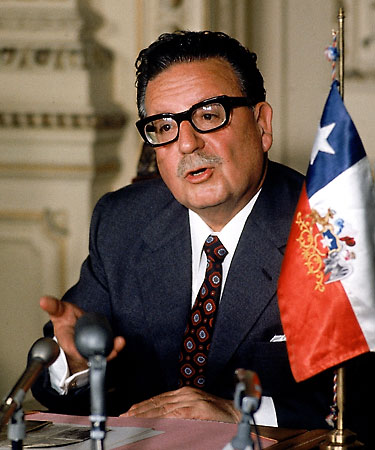
Salvador Allende

Salvador Allende

Forty years ago, on September 11, 1973, the military forces commanded by General Augusto Pinochet, overthrew the democratically elected government of Chile led by Salvador Allende. Thousands of people were killed. Many thousands more were imprisoned.

The coup d’etat was swift, brutal and merciless. It was carried out by the Chilean oligarchs with the active assistance of the United States. Overnight, the progressive social and economic measures introduced by the Allende government were overturned, condemning Chile’s working class to lives of poverty and oppression.

Perhaps 500,000 Chileans were forced into exile, relocating to countries around the world. Several hundred found themselves in my home town, Winnipeg, where they have made significant and lasting contributions to the life of our city.

This past month, the Winnipeg Chilean community, like many such communities in the Chilean diaspora world wide, has been commemorating the tragedy of Sept. 11, 1973 with film screenings, cultural performances and events such as the one I participated in tonight as part of a panel discussion that included former Manitoba Premier, Howard Pawley, former MP Judy Wasylycia-Leis, and Darrell Rankin, head of the Manitoba wing of the Communist Party of Canada.

Each of us drew on our experiences to talk about the significance of September 11, 1973 and our memories of the solidarity movement with the people of Chile. What follows is the text of my remarks.


Panelists (l-r): Darrell Rankin, Howard Pawley, Judy W,, Paul Graham. Photo: Maggi Robinson

Panelists (l-r): Darrell Rankin, Howard Pawley, Judy Wasylycia-Leis, Paul Graham. Photo: Maggi Robinson

Forty years is a long time to remember what I knew and when I knew it, but I seriously doubt that I could have located Chile on a map on the day that Augusto Pinochet seized power and destroyed so many lives.

In September 1973 I was a student at the University of Manitoba. I was active in student politics and becoming aware of some of the forces that shape our lives. But our struggles were more local and immediate. For example, there was a strike at the U of M that year, and some of us looked for ways to support the people on strike.

However, in time, our impulse to act locally led us to think more globally.

Throughout the 1970s Winnipeg was fertile ground for many kinds of political activism. We had a vibrant anti-war movement. It mobilized support for American draft resisters, opposed the war in Vietnam and campaigned for nuclear disarmament.

I think the first demonstration I attended had to do with American nuclear testing in Amchitka, an island in Alaska’s Aleutian Islands. This movement became quite broad by the early 1980s, with annual Walks for Peace that attracted up to 20,000 people.

The anti-apartheid movement was quite active here in the 70s, supporting liberation movements in South Africa, Mozambique, Angola and what was then known as Rhodesia.

The women’s movement was gaining strong momentum. There would be many victories in successive decades, including reproductive rights, equal pay for work of equal value, state supported childcare and the right of women to work in so-called nontraditional occupations.

Environmentalism was being born in Winnipeg. It is interesting to note that the Amchitka nuclear test that drew me and a couple hundred other people to the US consulate in 1971 was a catalyst for the creation of Greenpeace. We can thank the Vancouver “Don’t Make a Wave” committee which sent a boat named “Greenpeace” to protest the blast and later adopted the boat’s name as their own.

White progressives were waking up to the struggles of aboriginal peoples and getting involved in campaigns around mercury poisoning at Grassy Narrows, support for the Dene who were opposing the Mackenzie Valley Pipeline, and struggles led by the American Indian Movement related to the Wounded Knee occupation and the case of Leonard Peltier, who many believe was framed for the murder of 2 FBI agents in 1975.

Relatively new to government, the NDP introduced some progressive reforms, such as public auto insurance and reduced medicare premiums. As a Party, it was more active in political education than it has been for many years since and published a newspaper for its members. To the left of the NDP we had, for a time, at least five revolutionary groups. To this collection of radical lefties we should add members of the New Democratic Youth, and former members of the Waffle movement that had been expelled from the NDP. We had at least three left wing book stores, and Canadian Dimension magazine, still published in Winnipeg, was enjoying its largest circulation ever.

Also working for social change were a number of largely (but not exclusively) faith based organizations dedicated to international development and social justice. In a more secular vein, Oxfam, CUSO, and the IDEA Centre engaged in similar work. To various degrees, these groups were beginning to think in terms of solidarity and linking the struggles of oppressed people in the so-called Third World with those of people living in Canada. With the exception of the IDEA Centre, most of them continue to be active and make up the Manitoba Council for International Co-operation.

I could go on, but I’m sure you get the picture. Winnipeg was, in the 1970s, politically progressive, diverse and vibrant. It was a welcoming environment for the refugees of Pinochet’s terror and one that was enriched by these newcomers.

In 1975, when Chileans started arriving in Winnipeg, I had just begun working at the IDEA Centre. IDEA stood for Intercultural Development Education Association. Its mission was to promote support for international development. We were housed at 418 Wardlaw Avenue, in the company of like minded organizations, including CUSO, the Manitoba Council for International Cooperation and the Agassiz Food Co-op.

IDEA offered a lot of things to a lot of different kinds of people. We operated a resource library that specialized in international development. We did programs with schools and held regular educational evenings, usually on Wednesdays, that were combined with a potluck supper.

Our most useful function, I think, was that we provided meeting space, printing facilities and a welcoming environment in which a wide range of individuals and groups could meet, plan and organize.

As the Chilean community began to form in Winnipeg, and as people found their bearings, the IDEA Centre was one of the places that welcomed them, worked with them and learned from them.

It was at the IDEA Centre that I met people like Jaime Carasco, Hugo Torres, Olga Flandez, Rosa Candia, Pablo Herrera and many others. Bonds of friendship, collaboration and respect were formed in those days that have endured to the present. With all of this in mind, I have two observations with which I will close:

Most of the Canadians with whom I worked in that period fell into one of two categories.

One was made up of individuals who were motivated by faith-based or secular humanitarian values; we had little to no direct, personal experience of poverty, oppression, or repression; our understanding was largely theoretical.

The other group included people who had traveled, worked abroad and witnessed poverty and abuse; in some cases they helped struggle against it. Others in this group had had similar Canadian experience. But our perceptions were conditioned by our largely middle class, privileged backgrounds. At the end of the day, we could go home to a relatively comfortable existence.

The arrival of the Chilean refugees, and their participation in Winnipeg’s political life changed this. It enriched our understanding of solidarity. It made it real. Suddenly American imperialism wasn’t some abstract system directed by sociopaths we would never meet. Through our new Chilean friends we could learn what it was all about. It was no longer theoretical. It was flesh and blood. And this strengthened our resolve and deepened our understanding.

My second observation has to do with the Chileans themselves. Like all newcomers, their first priority was getting oriented, learning English, finding jobs, decoding Canadian culture and coping with all of the stress that this involves. Add to this the need to recover from the trauma of the coup, of prison and torture, of having to uproot and flee, of losing their friends, families, homes, communities and country. You have to ask where they found the energy to not only survive, but to reach out and participate in the political life of their new community.

Not everyone was able to manage this. But many were, and their solidarity work went beyond resistance to Pinochet’s military junta. In the years that followed their arrival in Winnipeg, US backed governments carried out vicious repressions rights across Central and South America. If there was a solidarity committee for any of these struggles operating in Winnipeg you could be sure to find at least one Chilean on it.

In 1980, I had the privilege of being able to travel to Nicaragua with a group of solidarity activists from across Western Canada. At least one third of the group were Chilean Canadians who had worked hard to support the Nicaraguan revolution. They understood, better than most, that freedom for Nicaragua would contribute to the same in their own country and throughout Latin America. History has shown they were right. Latin America is much less dominated by American imperialism than it has ever been.

Another quick example and I’ll wrap up. On Oct. 25, 1983, the United States invaded Grenada, a tiny Caribbean nation of 91,000 people. People worldwide were outraged. The UN General Assembly called the invasion a “flagrant violation of international law.”

Three days later, in Winnipeg, there was a demonstration at the US Consulate, then on Pembina Highway. Several hundred people participated.

It began peacefully, but we soon had our own invasion to deal with. A half dozen members of the Winnipeg Rifles militia unit, decked out in camouflage jackets, charged the steps to disrupt the speakers and touched off what some described as a “police riot.”

Rather than arrest the militia goons, the police began arresting demonstrators. Six were arrested and many more were roughed up. Four of those arrested were Chilean.

Now, this little statistic could be used by folks uncomfortable with refugees as evidence they are troublemakers. Having been an active participant in that demonstration and the subsequent defence committee, I see things differently.

They were arrested because they were unwilling to let their comrades be detained by police. They were arrested because they refused to be intimidated by right wing thugs in camouflage uniforms. They were arrested because they would not allow what happened in their home country to happen in another without standing up and saying “Nunca mas!” – “Never again!”

That was the spirit of the Chilean community in Winnipeg in those early years. A spirit of resistance to oppression. A spirit of resilience. A spirit of courage. I think this spirit lives on and continues to inspire all of us.

On July 9, 2005 , Palestinian civil society put out the call for an international campaign of boycott, divestment and sanctions to compel the Israeli state to follow international law. Specifically, the signatories called on Israel to:

  1. End its occupation and colonization of all Arab lands occupied in June 1967 and dismantle the Wall;
  2. Recognize the fundamental rights of the Arab-Palestinian citizens of Israel to full equality; and
  3. Respect, protect and promote the rights of Palestinian refugees to return to their homes and properties as stipulated in UN Resolution 194.

The BDS campaign has been taken up by human rights activists around the world and there is some evidence that it is having an impact. For example, last month the Norwegian retail chain, VITA, announced it would stop all sales of products originating from settlements in occupied Palestine, including Ahava cosmetics. Also, last month, graduate students at Carleton University overwhelmingly voted in a referendum to call upon the university’s pension fund to divest from four companies that are complicit in the occupation of Palestine. The BDS campaign is being credited with the decision of the West London Waste Authority to exclude French multinational Veolia from a £485 million contract. Veolia helped build and is involved in operating a tram-line which links Jerusalem with illegal Israeli settlements in the Palestinian West Bank; it also takes waste from Israel and illegal  Israeli Settlements and dumps this on Palestinian land at the Tovlan landfill.

One measure of its effectiveness may be the passage of a law in the Israeli Knesset last year that facilitates attacks on supporters of BDS.  After all, if BDS were ineffective, there would be no reason to pass a law against it. According to the Jerusalem Post, the law “allows citizens to bring civil suits against persons and organizations that call for economic, cultural or academic boycotts against Israel, Israeli institutions or regions under Israeli control. It also prevents the government from doing business with companies that initiate or comply with such boycotts.”

“Can boycott, divestment and sanctions stop Israeli apartheid?” was the title of a forum held March 7, 2012 as part of Israeli Apartheid Week 2012 in Winnipeg. Featured speakers were Dalit Baum and Mostafa Henaway. Baum is an Israeli activist and co-founder of WhoProfits.org, a website that exposes corporate complicity in Israel’s subjugation of Palestinians. Henaway is a human rights activist who works with Tadamon! Montreal. Moderated by Lisa Stepnuk, the forum was sponsored by Students Against Israeli Apartheid and the Winnipeg Coalition Against Israeli Apartheid. As usual, I was there for Winnipeg Community TV to record the discussion.


Campaign to divest the Canada Pension Plan from complicity in Israeli Apartheid

The Ottawa-based Coalition to Oppose the Arms Trade has produced an invaluable resource that forms the first step in a campaign to compel the Canada Pension Plan to divest from companies that support Israeli apartheid. According to COAT’s co-ordinator, Richard Sanders,

“COAT’s research cites data from hundreds of sources to expose 64 corporations that have two things in common:

(1) they profit from links to Israeli government institutions, agencies and corporations that hide behind the euphemisms of “defence” and “homeland security,” and

(2) the Canada Pension Plan (CPP) held shares in these companies, with a market value of $1.4 billion in 2011.

You can learn more here.

Gerry Caplan is a former CUSO field officer, author of The Betrayal of Africa, a weekly, online columnist for The Globe and Mail, a featured television political commentator and a veteran CCF-NDP war horse. He was also my boss at CUSO for a brief period in the late 70s, something he doesn’t remember – which may be all for the best :-).

Gerry was the keynote speaker at a dinner held in Winnipeg December 10, 2011 to mark the 50th anniversary of CUSO and the 63rd anniversary of the adoption of the Universal Declaration of Human Rights by the United Nations on Dec. 10, 1948.

The title of his talk was advertised as “When good people do bad things.” Fortunately for those present and for his reputation as a rabble rouser, the theme that emerged would be more appropriately described as “solidarity, not charity.”

This event was sponsored by the University of Winnipeg Global College, CUPE Manitoba, the Manitoba Council for International Co-operation and CUSO-VSO. It was held at the Union Centre in downtown Winnipeg. Here is my video report.

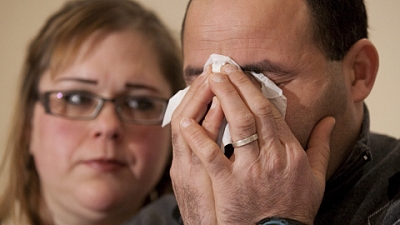
Mohamed Harkat and wife Sophie Lamarche at a press conference in Ottawa, Dec. 10, 2010. Photo: Sean Kilpatrick

By Sophie Lamarche

What was expected to be the end of a long nightmare and a great end to 2010 turned out to be a disaster. We can’t really put 2010 behind us because our battle continues. On Dec. 9th, 2010, the day before International Human Rights Day and the 8th-year anniversary of my husband Mohamed Harkat’s arrest under a security certificate, the Harkat family, his legal team, and his supporters across the country got a big punch in the guts.

It is one, Moe and I never expected. One, which many never expected! Our family, supporters, groups, unions and legal experts were all shocked at the recent ruling made by Justice Simon Noel from the Federal Court of Canada to uphold the security certificate against Moe.

The certificate was found ”reasonable” under the lowest standard of proof in a Canadian court. This decision was based on secret evidence neither Mohamed nor his public counsels could see or test for national security reasons. All that because CSIS believes, thinks, or assumes that Moe was involved or will be involved with terrorism in the past, present, or future. That position could cover any one of us at any time.

To this day, he still does not know the evidence against him. We have all been kept in the dark for eight years.

Mohamed Harkat was arrested and thrown in jail on Dec. 10th, 2002. He is the only inmate to ever be detained for 43 long months at the Ottawa Carleton Detention Centre without ever knowing why or without ever being charged. That day will be engraved in my mind for the rest of my life.

My mom says she’ll always remember the sound and fear in my voice when I called her on her cell phone after Moe was arrested. I was hysterical; terrorism was such a taboo subject after 9/11, and still is. Who on earth wants to be associated with the word terrorism or allegations related to terrorism?

What I was really after was for the truth to come out. I was never afraid of the truth. I had one look into Moe’s eyes on our first visit in jail, I knew then I had to fight. But between you and me, I knew even before looking into his eyes that he had nothing to do with those absurd allegations. Mohamed has always denied all the allegations.

For three-and-a-half years, I visited my husband in an icy cold or burning hot room behind a dirty thick glass window, with rotten food on the floor or big bugs on the walls, while talking through a broken recorded telephone, surrounded by guards who watched us from every angle for every minute of the visit. And let’s not forget the bad treatment and killer looks before even going in. We were only entitled to two visits per week for 20 minutes, and that’s only if we were lucky to get a ”good” guard who would bring him in on time and then start the phone.

We stared and mimed through glass many times without having a working phone. After waiting for hours to see him, he would be brought (the first year) with shackles around his ankles to his waist and to his wrists. His orange suit was so bright he could probably be seen from space. It seems like he was treated worse than the biggest criminal in this country.

They put him in solitary confinement for the first year, and only took him out for one or two showers per week if he was lucky. He did not have access to fresh air or outdoors for the first six months and was kept in isolation from all the other inmates, without anything to read or to do.

I did not sleep for years. I was always worried for his safety and waiting by the phone for his collect call that often never came. He was the one inmate everyone in prison knew and talked about, but that no one had seen. Everyone there saw him in the newspapers and on TV but he did not. He was kept away from the general population.

We got nothing! The men were basically “kidnapped” from their sections one day only to be transferred in total secrecy. An inmate from OCDC called me collect to say Moe had never returned to his section – this is how I found out about it. The fear was within me once more.

After three-and-a-half frustrating years in detention, Moe was finally released on bail — but the government appealed his bail, of course! I had him back but both he and I became full-time prisoners in our home for the following four years.

I was a jail guard to my own husband and pretty much cut from the outside world. Moe was released under the toughest bail conditions in Canadian history. He could never be left alone in the house or in our yard. We were together every minute of every day, unless another court-appointed surety could ”release” me of my duties for a few minutes or hours.

There were surveillance cameras in our home, our phone was tapped and every conversation was open for CSIS and CBSA to listen to, all our mail was intercepted. We only had three outings per week of four hours each, Moe to this day still wears a GPS electronic tag around his ankle at all times, my computer room is under lock and key, and no cell phones or similar communications devices are allowed in our home.

While out on pre-approved outings, we were followed by between two and six CBSA officers wearing bulletproof vests and carrying guns. Every location and person we were in contact with had to be pre-approved at least 48 hours in advance. This included our newborn nephew and my 80-year-old grandmother.

Many friends and outings were denied, including his own 40th birthday party and our wedding anniversary outing. I took Moe with me when I went to pre-approved pap tests, into changing rooms, and we were forced to use shared family washrooms in public buildings since he could never be left alone.

That was our life for almost four years until, suddenly, the government ordered almost all restrictions lifted in Sept. 2009. Apparently, Moe was no longer a threat. For four years, we were humiliated, degraded and dehumanized in every way possible. Needless to say, when the conditions changed, it was about time, because I was very close to exploding! Many conditions still remain, including the GPS tag and ban on use of a computer and cell phone, but life is different. That’s the price of freedom in Canada!

Life has been a real soap opera for us the past eight years. Many would not believe some of my many stories. Some could not care less. But I always ask them “if you were in my husband’s shoes and you were detained without charge or access to the evidence… would you accept the process???”

No honest Canadian has ever agreed to that. Why should refugees or immigrants be treated differently?

In Sept. 2007, the Supreme Court of Canada unanimously found the Security Certificate process unconstitutional. One for us, zero for CSIS! They had one year to draft a new law that ended up being just as bad the second time around.

The main difference was a cosmetic changed created by adding the position of special advocates who can see some secret evidence, but can never talk with public counsels unless permitted by the court or the accused.

Same old thing, nothing new. The new process is very frustrating and remains as secretive. When the second security certificate was re-issued to Moe in Feb. 2008, the cover letter was addressed to Hassan Almrei.

Mistake number one! Wrong guy? Wrong allegations? Imagine what goes on in the back. Imagine what kind of evidence is presented in secret?

For the record, we know the special advocates do not have access to all material, only what CSIS chooses to release. They also don’t have access for cross-examination of some human sources and informants, only their files. You call that fair? Not only did we lose the reasonableness in Dec. 2010, but also on legal arguments on the constitutionality and abuse of process. Both applications for stay of proceedings were denied. Zero for us, one for CSIS!!!

Before we end this article, let’s talk about the abuse of process done by the hands of CSIS.

They use evidence that comes or derives from torture, their main informant failed a lie detector test, and CSIS failed to tell the court, they listened to solicitor/clients calls for months until they were caught, they destroyed every piece of original material in our case (notes, tapes, intercepts, interviews… everything).

If it were a criminal case, it would not stand a chance.

They raided our home in May 2008, two week before our hearing, in order to find so-called evidence. They sent 16 CBSA officers, three sniffer dogs (normally used for locating currency, drugs and explosives), two OPP and two RCMP officers to guide the dogs. The search lasted over six hours and they took out over 20 boxes of material including my computer, which is in a locked basement and contained all my communications with public counsels.

They searched every inch of our house for evidence, when they already knew or approved everything we ever did (GPS, surveillance cameras, tapped phone, intercepted mail and followed during outings), our house was probably safer than Prime Minister Stephen Harper’s residence.

If that’s not abuse… what is??? If you are still doubtful, may I remind you that the evidence is kept secret for national security reasons and on numerous counts, CSIS was found guilty of deporting people to torture based on baseless evidence.

Will we learn from the past? What is my husband to do? If he does not testify, he will be considered to be the one hiding something. When he does testify, he is called a liar, a terrorist. It’s his word versus the secret evidence, secret files. Goliath versus the whale. His word against a machine, a secret informant, our own Canadian government and CSIS. It’s a loss, loss situation.

What happens next for us? The appeal process is just as unfair and biased as the hearing itself since the very same judge who found the certificate ”reasonable” has to certify a question to allow for an appeal to his decision.

We hope to appeal all the way back to the Supreme Court of Canada so that the whole process is found unconstitutional once again. How many more years of this nightmare? Our plans for the future (kids, work, and a home) have been put on hold again — for how long? An entire family is devastated.

In the meantime, Moe and I live with a huge cloud over our heads every day that reminds us of the possibility of deportation to face imprisonment, torture or death. Canada wants to return him, if they do, they will have his blood on their hands.

On January 21st, 2011 Moe was issued his deportation papers. The letter said he was inadmissible to stay in Canada because he was a threat to the safety of Canadians and for National security reasons. Proceedings are in place. Another big blow. Moe, who has been devastated since December, is having difficulty sleeping, eating and doing day-to-day things without having to worry constantly. He has been seeing a professional for years. He’s in the dark, just like the secret evidence. The battle ahead of us is long and painful. We are grateful to the many supporters who came out on a cold winter day to the building of CBSA to protest their anger and disapproval. Canadian Border Services Agency was so scared of a couple of ragging grannies and tons of media, that they had locked themselves up in their offices and closed all the blinds!

How long will this last, how long will my family be submitted to psychological torture, imprisonment. My country has failed me. I’m ashamed at how my husband and the other men are being treated by the Canadian government.

We continue to fight because of your support. You give us the strength and motivation to go on. We thank our supporters for their love, friendship, dedication and unconditional support.

If you believe in due process, please sign our new statement www.harkatstatement.com

Contact your MP and demand that these men get a fair and open trial so the evidence is made public for all Canadians to see and for the truth to finally come out. We are not afraid of the truth.

Pity and Fear will not get us anywhere. Don’t say silent in the face of injustice. One day it could be you.

Take a stand.

We CAN make a difference!

May justice prevail!


See also: Justice for Mohamed Harkat

The secret trial of Mohamed Harkat remains an affront to all who cherish democracy and justice. Convicted and condemned to deportation on the basis of secret evidence that he was not allowed to see, Mr. Harkat faces deportation to his native Algeria where he would face imprisonment and torture, if not death.

Mohamed Harkat is continuing his struggle for a fair hearing. Visit his site and read his story. Sign the petition that calls for an end to the police state tactics that allow people to be detained indefinitely and deported without being tried in a fair, public and impartial trial.

And circulate this new video to everyone you know. At a time when people around the world are standing up to demand basic democratic freedoms, it is time Canadians regained some of ours.


See also:

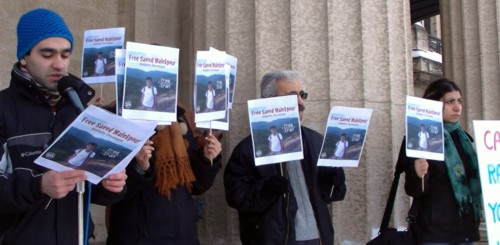
Save Saeed Malekpour

Posted: February 12, 2011 in Human Rights
Tags: ,

Saeed Malekpour is an Iranian-Canadian awaiting execution in Iran’s infamous Evin prison. He’s been held there since 2008 when he was arrested on charges related to developing and promoting a porn site, an allegation he rejects. Since then he’s been held in solitary confinement, tortured and denied the most basic human rights.

Saeed’s plight was news to me until a couple of days ago, and perhaps it is unfamiliar to you as well. Two excellent web sites where you can learn more about Saeed, the danger he faces and what you can do are:

There is no time to lose. Iran is notorious for its willingness to execute prisoners on the flimsiest of pretexts. He could be killed at any moment. Nonetheless, international opinion does save lives. So, please do not delay. Join the campaign to save Saeed Malekpour’s life. Today. Now.

Feb. 12, 2011: Winnipeggers rally at the Manitoba Legislature in support of Saeed Malekpour, an Iranian-Canadian facing execution in Iran. Photo: Paul S. Graham

Mohamed Harkat and wife Sophie at a press conference in Ottawa, Dec. 10, 2010. Photo: Sean Kilpatrick

I don’t know whether Mohamed Harkat is a terrorist or not. Neither do you. How could we? Harkat was convicted in a secret trial, based on secret “evidence” provided by shadowy sources who will remain unknown to Mr. Harkat and the rest of us unless we overturn the unjust, draconian laws that made this travesty of justice possible.

Yesterday Federal Court Justice Simon Noel upheld the security certificate issued against Mohamed Harkat in 2002, opining that ” . . . although the danger associated to Mr. Harkat has diminished over time, he still poses a danger to Canada, but at a lesser level . . .” This decision makes it possible for Immigration Canada to deport Mr. Harkat to his native Algeria where he would face imprisonment and torture, if not death.

A security certificate according to Public Safety Canada is a document issued by the immigration minister to force the “removal from Canada of non-Canadians who have no legal right to be here and who pose a serious threat to Canada and Canadians.”

Under the legislation governing security certificates (Bill C-3), courts are permitted to consider secret information in closed sessions. The defendant is not permitted to see this information or to question it. “Special advocates,” appointed by the minister who issued the certificate, are allowed to see the secret information, but they are not allowed to disclose it to the defendant or his lawyer. (See this in-depth analysis of security certificates.)

This process is such an egregious violation of the principle of natural justice it boggles the mind that we allow it to exist. Under Canadian law, citizens are allowed to face their accusers in open court, to have ALL of the evidence laid out before them, to cross-examine witnesses, and defend themselves. They are considered innocent until they are proven guilty in a fair and transparent process. The security certificate process violates all of these principles and should outrage any Canadian who believes in human rights.

This process should also make citizens fear for their own safety. We are next, as the Combating Terrorism Act, which passed second reading this fall, makes clear. This act, which applies to ALL OF US, provides for warrantless arrests, compulsory testimony and 12-month preventive imprisonment of people suspected of planning terrorist acts. It is the perfect companion to the practice of allowing courts to rely on “evidence” provided by anonymous spooks hiding beneath the cloak of “national security.”

Mohamed Harkat is continuing his eight year struggle for a fair hearing. Visit his site and read his story. It is one that should concern all Canadians.

Rather that acknowledge that growing numbers of Mexican refugee claimants might be fleeing to Canada for legitimate reasons, Stephen Harper has announced that the Mounties will train Mexican federal police to strengthen their efforts in the “war on drugs.” According to the Winnipeg Free Press: “The Mounties will offer tips on interviewing techniques for entry-level police; mid-level officers will learn about money-laundering, undercover tactics, and child exploitation; and senior officers will hear about crisis management, public relations and dealing with civilian leaders.”

It’s a cheap announcement: only 400,000 loonies have been allocated for this program, but it’s a useful one for Harper because it helps perpetuate the myth that Mexico is just like Canada — poorer, perhaps, but fundamentally democratic — and in no way a legitimate source of refugees.

However, it is no coincidence that refugee claims have grown at a time of escalating drug war violence and a marked increase in human rights violations by Mexican police and military forces.

According to the CBC, “Mexico is now the No. 1 source of refugee claims, with the number almost tripling to more than 9,400 since 2005 . . . The figure represents one-quarter of all claims made. About 90 per cent of the claims are rejected.”

In February 2009, Amnesty International reported that:

  • Mexico has so far failed to explicitly recognize the status of international human rights treaties in its Constitution.
  • The authorities have yet to hold anyone to account for the 100 killings and 700 enforced disappearances that took place between the 1960s and 1980s.
  • Mexican federal, state and municipal police officers implicated in serious human rights violations, such as arbitrary detention, torture, rape and unlawful killings, particularly those committed during civil disturbances in San Salvador Atenco and Oaxaca City in 2006, have not been brought to justice.
  • The military justice system continues to try cases of human rights violations despite international human rights standards insisting these should be tried in civilian courts.
  • The number of reports of abuses such as arbitrary detention, torture and other ill-treatment, sexual violence and unlawful killings by security officials has increased during security operations to combat violent criminal gangs.
  • Human rights defenders, particular those in rural areas, often face persecution and sometimes prolonged detention on the basis of fabricated or politically-motivated criminal charges.
  • Indigenous and other marginalized communities sometimes face harassment for opposing development projects affecting their livelihoods.
  • Irregular migrants in transit in Mexico routinely face ill-treatment by state officials as well as sexual and other violence at the hands of criminal gangs.
  • Despite advances in legislation to protect women from violence, implementation is weak. Reporting, prosecution and conviction rates for those responsible for domestic violence, rape and even killings of women remain extremely low. Two years after the adoption of the 2007 General Law to prevent violence against women, two states have not even introduced legislation to enforce it.
  • Poverty and marginalization continue to deprive many rural communities, particularly indigenous peoples, of the right to an adequate standard of living and the right to development, in accordance with their own needs and interests.

You can get the entire report here.

It sounds to me like there are plenty of good reasons why someone might claim to be a Mexican refugee.

Meanwhile, education is a 2-way street. I wonder what the Federales will teach our taser-wielding Mounties.


Armed men surround the mainly Mixtec community of Santo Domingo Ixcatlan, Oaxaca on December 3, 2008. The attackers were working for a local political boss who stood to profit from the sale of communal lands. For months, the group threatened those who opposed the sale and killed three of them in April 2008. Photo credit: Private/Amnesty International. Read more.


Speaking at the University of Southern California in April 2009, Mexican senator and human rights activist Rosario Ibarra presents a lecture on forced disappearances (the state’s covert persecution, apprehension and execution of individuals for political reasons) in Mexico, and on her work to promote human rights and freedom.

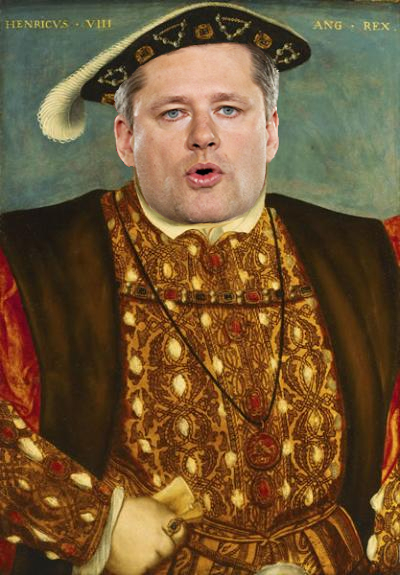
Stephen the First, and hopefully the Last

The Star Chamber was an English court of law at the royal Palace of Westminster that sat between 1487 and 1641, when the court itself was abolished. Initially set up as a court of appeal, it evolved into an instrument of repression. Court sessions were held in secret, with no indictments, no right of appeal, no juries, and no witnesses. In that sense, it bears an amazing resemblance to Stephen Harper’s no-fly list.

Today the CBC reported that two boys named Alistair Butt were stopped while trying to board flights last week because their names matched Harper’s list. According to the Canadian Press, Transport Canada won’t confirm if the boys are on a U.S. no-fly list, an airline no-fly list or Canada’s new no-fly list, which went into effect on June 18.

The boys, aged 10 and 15, were eventually allowed to fly, but you have to wonder at the stupidity of it all. Our government, in the interests of protecting us from terrorism is detaining children at airports while it continues to ignore what the Senate has called “gaping holes” in airport baggage handling security.

And apparently they are letting an allegedly dangerous guy named Alistair Butt roam the country at will — except for flying, anyway. If this man is such a threat to our security, why hasn’t he been arrested and tried? And if he is not actually in the business of blowing up planes or whatever it is the authorities think he wants to do, why can’t he get on a plane unmolested?

These, of course, are rhetorical questions. Rather than perpetrators, the Alistair Butts of this world are the latest victims of the so-called “war against terrorism.”

What is not in question is that this latest version of the Star Chamber has gotta go. It is a dangerous infringement of our civil liberties. It protects no one and inconveniences innocent people. It’s only purposes are to instill fear (which nicely dovetails with its criminal “war against terrorism” in Afghanistan), and appease the Bush leaguers to the south.

Transport Canada hopes to launch a no-fly list, officially known as Passenger Protect, as early as this spring. The stated objective is to guard against terrorist threats. A senior Transport Canada official told a Parliamentary Committee yesterday that individuals will not be told why they are on the list — only that they are on it. And, of course, they won’t be permitted to board the plane. Appeals will be permitted, but without knowing why one is on the list, it would be difficult to know how one could appeal. (The list will be compiled by the same spooks from CSIS and the RCMP who fingered Maher Arar. Hmmmm.)

Meanwhile, Health Canada has consolidated regulations regarding asbestos use; permitted uses include children’s toys and drywall joint cement. In case you missed it, asbestos is a highly toxic mineral; exposure can cause asbestosis, and malignant mesothelioma. It has been linked to autoimmune disorders such as rheumatoid arthritis and multiple sclerosis.

Is there a pattern here? Is this a case of government “protecting” us against low risk threats (terrorist evildoers) while facilitating high risk threats (lung cancer, etc.) perpetrated by corporate evil doers.

According to Mining Watch,

“There has been a worldwide movement to ban both the mining and the use of white asbestos. France banned the use of white asbestos completely in 1997. The UK banned any new use of white asbestos in 1999. Further, by 2005 all EU nations must implement a prohibition on white asbestos. However, despite piles of reports showing the dangers of white asbestos, Canada continues to mine it and export it worldwide.”

Canada’s New Government provides $250,000 annually to the Chrysotile Institute (the mouthpiece for Canada’s asbestos industry), uses Canadian embassies to host asbestos promotion events and sends teams of lawyers around the world to oppose international efforts that might restrict the use of asbestos. (So did Canada’s Old Government!!)

Maybe it is time to rename Health Canada. Disease Canada? Death Canada? Any suggestions would be welcome. Alternatively, we could put Canada’s New Government on a no-fly list.