It’s Israeli Apartheid Week in Winnipeg, Canada and many other cities and towns around the world. In Winnipeg, Israeli Apartheid Week 2011 is taking place on the campuses of the University of Manitoba and the University of Winnipeg.
This clip features a presentation by Howard S. Davidson, Associate Professor of Extended Education at the University of Manitoba and member of Independent Jewish Voices (Canada). He spoke at a workshop entitled “Israeli Apartheid 101” at the University of Winnipeg on March 14, 2011.
Professor Davidson demolishes the arguments of pro-Israel apologists who equate support for Palestinian rights with anti-Semitism. Further, he demonstrates that the term “Israeli apartheid” is a legitimate part of the political discourse in Israel, even while those who use it in Canada and the United States are vilified by Israel’s North American supporters.
In Winnipeg, IAW 2011 is sponsored by:
Students Against Israeli Apartheid (U of W, U of M)
Speaking at a forum, Jan. 23, 2011, sponsored by Peace Alliance Winnipeg and Project Peacemakers, author/activist Yves Engler explores Stephen Harper’s foreign policy and how it cost Canada its bid, in 2010, for a seat on the United Nations Security Council.
Joshua Key is an American Iraq War veteran who sought refuge in Canada because of his war experiences. Author of “The Deserter’s Tale,” Joshua told the story of his recruitment into the U.S. Army, the war crimes he witnessed in Iraq and his subsequent flight to Canada to an audience at McNally Robinson Booksellers in Winnipeg on Jan. 17, 2011.
Like so many young people, Joshua joined the army to escape a life of poverty and support his family. The Army promised he would remain in the US and learn to build bridges, but the ink on his contract was barely dry when he learned he would be deployed to Iraq to blow them up. Basic training turned him into a killing machine, but the brutalities of war transformed him into a deserter, a refugee and a peace activist.
Joshua speaks with authority, simplicity, warmth and honesty. He may have been traumatized by what he has seen and done, but he has not lost his courage or his humanity. He and the many others who have said “no” to the American war machine deserve our admiration and need our support.
Why is the New Democratic Party of Canada such a disappointment to supporters of Palestinian liberation? How is it that the Manitoba NDP is an epicenter, not only for supporting the Zionist project, but attacking those who champion Palestinian rights? What is Canada’s second largest military deployment overseas and how is being used to divide the Palestinian resistance? So many questions! Here’s a video that answers all of these and many more.
Back in January I recorded a presentation entitled “The Manitoba NDP, the Left and Canadian Support for Israel” featuring Winnipeg activist Brian Latour and Montreal based writer/journalist/and-all-around-trouble-maker, Yves Engler. Here it is. As always, comments from all perspectives are welcomed.
I’ve written about this before – the F-35 stealth fighter deal stinks to high heaven. Over priced and over sold, the stealthiest thing about this “defense contract” is the assault on Canadian taxpayers over the next several decades as we are robbed of $30 billion to bankroll the merchants of death.
This weapons system is designed for one thing only: fighting wars of aggression. We must send a clear message to Ottawa that we will no longer tolerate the use of our dollars to fuel the international war machine.
Above is a video I shot over the weekend in which Michael Bueckert of Project Peacemakers makes the case for tearing up Stephen Harper’s order for 65 of these death planes. Below is the text of his remarks, also published at the Peace Alliance Winnipeg News.
Call your MP today and tell him/her to shoot down this despicable deal without further delay.
The F-35 Stealth Fighter: A bad deal for Canada
By Michael Bueckert, Program Coordinator, Project Peacemakers
As you may know, this past July, the Conservative government announced what could be the single largest military procurement in Canada’s history when it declared its intention to buy 65 F-35 Lightning II aircraft (A.K.A. “Joint Strike Fighters”) to replace our aging fleet of CF-18s starting in 2016.
If you are familiar with this issue, then you are probably also aware of the narrow way in which the media has presented it.
On one side are the supportive arguments, provided by the Conservative government, military brass and the aerospace companies. When replacing our aging CF-18s, the F-35s are considered necessary for a number of reasons; namely, they provide interoperability with the U.S., they have the best, newest capabilities available, and the deal will create and support Canadian jobs. Additionally, by committing now we would secure the price at a low level.
And then there is the critical argument, provided by the main opposition parties: the deal is based on a sole-source contract, and without appropriate market competition we will inevitably be paying too much for the planes, and there may be better alternatives out there.
So the way it is framed, the debate is essentially one side saying that the F-35s are the best possible planes and this deal will support our army and industry, versus the other side saying that the deal is irresponsible and that we should have an open competition to get the best price.
This excludes the many important critiques being made by analysts in the peace community, primarily by the folks at Project Ploughshares, and by Steven Staples at the Rideau Institute. It is their work that I will draw from most in this presentation.
So let’s look at some of the main arguments put forward by proponents of the F-35 deal.
First of all, is the planes themselves. Proponents argue that these Fifth Generation fighter jets are top notch, with stealth and interoperability technology that makes them second to none.
As Defense Minister Peter McKay has said, “This aircraft is the best that we can provide our men and women in uniform, and this government is committed to giving them the very best.”
Without spending much time on this, what is it that the F-35 is designed to do?
Well, they are geared for aggressive military roles. According to the CBC, it is designed for tactical bombing and aerial warfare, equipped with a 25-millimeter gun, air-to-ground and air-to-air missiles, plus a variety of bombs. As Steven Staples puts it, the F-35 is “highly capable in air-to-air combat against other advanced fighters,” designed as “a first strike fighter-bomber intended for use in ‘shock and awe’ attacks.”
Well, I think that anyone who has read accounts of the American “shock-and-awe” bombing campaign of Iraq can appreciate how sickening it is just to imagine ourselves with that kind of capability.
But even without an appeal to moral sensibilities, even if we believe that in some cases the use of fighter planes is justifiable, and that national defence is a primary responsibility, we don’t have to look any further than the Government’s own 2008 “Canada First” defense strategy document to see that the purchase of these planes is inappropriate.
In that document, the government outlined the various threats that Canada could face in the future. According to Project Ploughshares, “you would be hard pressed to create a credible scenario from them where a stealth-enabled fighter jet is logically part of Canadian Forces’ response.”
This sentiment is reflected by Major General Leonard Johnson (retired), who argued in the Ottawa Citizen that apart from the incredulous prospect of war against an advanced enemy–Iran doesn’t count–it is “hard to see any useful military role” for the F-35.
And this argument–that there is no necessary role for the F-35 either domestically or internationally–is essentially accepted by F-35 proponents. Rather than point to how the planes could be used, they point to the unpredictable threats of an unknown future. We need the planes in order to keep our options open, and keep an aggressive militarism on the table.
The second main argument used by F-35 proponents is that by committing to these planes we are getting a good deal, and that it will provide and protect Canadian jobs. Conversely, rejecting the deal will waste taxpayers money and threaten billions of dollars in contracts for Canadian companies.
Well, to analyze these claims we need to look at the deal and the Joint Strike Fighter program in more detail.
Canada joined the Joint Strike Fighter program in 1997, under the Liberal government. The JSF program is a partnership of nine countries—the US, UK, Italy, Netherlands, Turkey, Norway, Denmark, Australia and Canada—to invest in the development, production and sustainment of three versions of a stealth, multi-role aircraft. Lockheed Martin won over Boeing in an early competition to develop the planes for the program. To date, Canada has invested 168 million U.S. dollars in the program, and is committed to spending an additional 551 million dollars between now and 2051 in production costs.
The planes are currently in the Production, Sustainment and Follow-on Development stage, and we are expected to start receiving them in 2016. What Canada did last summer is unusual, when it committed to buying 65 planes before they had even been completed, or tested.
The planes themselves, when we buy them, are said to total $9 Billion, with up to $7 Billion in maintenance costs over their lifespan. That would bring the total cost of the planes to $16 Billion, on top of the 711 million dollars in ongoing investment.
This sounds like a lot of money in itself, but even the $16 Billion is bound to be too low, for a number of reasons.
First, the program has been plagued by cost overruns, and estimates continue to grow. Project Ploughshares, using U.S.-based data, has estimated that the planes will come to a total cost of $30 Billion, which is about double what officials are saying. Further, because the planes are not completed and have not been tested, and there is simply no idea how much we will have to pay.
In testimony to the Canadian parliament, U.S. military critic Winslow Wheeler warned about the possibility of the planes being much more expensive than advertised. His testimony is worthy of being quoted at length:
“In this country, advocates cite various figures, all of them misleading. The gimmicks include excluding important parts of the airplane, such as the engine, excluding all development costs, using obsolete dollars that understate the contemporaneous cost, and – in your case – using American, not Canadian, dollars. There are other tricks that can be hard to unravel; I encourage you to thoroughly research any unit costs cited to you.
“Neither you nor I currently know, but it is certain that the costs being cited to you now are the ‘buy-in’ costs. Real costs, when your government negotiates an actual contract and as the program goes through its life cycle, are sure to be an unpleasant surprise to you.”
Moreover, the cost per plane is based on an estimated global market that is steadily decreasing. The more planes sold, the cheaper they will be, but many countries are starting to back down from their previous commitments. Project Ploughshares has reported on the fact that the sales projections quoted by proponents are now 10 years out of date; the 2001 projection was that 5,179 planes would be sold, and now it is more likely to be between 2 thousand and 3500. Using the old estimates are almost certainly intended to deceive, as they drastically reduce the expected price.
All this is to say that the 16 Billion dollar price tag is likely to be drastically inaccurate, and the supposedly good deal is not looking quite so good.
But what about the argument that this deal is good for supporting Canadian jobs? This is the most populist, and most common argument being put forward. (It should probably be noted that if the Government was committed to Keynesian economics, there are ways of supporting jobs that don’t involve manufacturing weapons. But let’s look at this anyway).
It is true that Canadian companies have benefited so far. Industry Canada notes that to date 350 million dollars in contracts have been awarded to 85 Canadian companies and research laboratories, which is more than Canadians have invested so far. Proponents say that up to $12 Billion is potentially available to Canadian companies in industrial benefits.
Some of those benefits are being realized right here in Winnipeg. A recent Winnipeg Free Press article highlighted Bristol Aerospace, noting its contracts to build horizontal tail components, and other parts for the F-35. According to the article, Bristol has committed about $100 million in capital spending to equip its Winnipeg plant, expects to ship 1 Billion dollars in parts, and had already shipped 35 million dollars worth of parts before we committed to purchasing the jets.
It is clear that Bristol, and the industry, have a lot of vested interest in this deal. Which is why its parent company, Magellan Aerospace Corporation, has come out with other companies to support the F-35 deal, citing outdated and exaggerated statistics.
However, while Canadian arms manufactures may have benefited so far, it is not at all certain that these privileges will continue. There are no guaranteed contracts built into the procurement deal. All we have is the opportunity to bid on them, and competition from industry in other countries is growing as they demand a fairer share in the distribution of contracts. Moreover, the figure of $12 Billion in potential industrial benefits is based on the outdated market projections I explained earlier, which assume an exaggerated number of planes will be manufactured.
Labour, for its part, has refused to passively accept these figures, but has refrained from speaking against the deal itself. Instead, the Canadian Auto Workers union has called for $16 Billion of guaranteed contracts to be included in the procurement deal, a demand that is certain to be ignored.
Now, what I have just done is to argue that the proposed financial benefits to Canada are not nearly as high as stated by officials and industry. The F-35s will cost much more than we think, and will give back fewer jobs than we expect. It is important to point out the misinformation that is provided on this issue, as proponents continue to sell the deal to Canadians. But the point is not simply that they are too expensive, as the Opposition parties claim. Yes, they are expensive, but we are not calling for cheaper fighter planes.
We should remember that the CF-18s, the planes which we are looking to replace, had been used to drop bombs on Iraq in 1991, and on Kosovo in 1999. Upgrading these planes–as suggested by Steven Staples–is not a peaceful alternative to the F-35s, although it would be cheaper. Similarly, buying unmanned drones to patrol the arctic–also suggested by Staples–does not get us much farther, because drones are easily incorporated into weapons systems.
Richard Sanders, of the Coalition to Oppose the Arms Trade, is disturbed about how analysts focus primarily on the relative cost of the F-35s, as if cheaper fighter planes will be more peaceful fighter planes. I tend to agree; we need to challenge not just these planes, but all fighter planes, all military spending. But we can start by working to ensure that we do not purchase the F-35, which would be a monumental waste of money towards immoral ends.
This article is the text of Michael Bueckert’s presentation to the Feb. 20, 2011 annual meeting of Peace Alliance Winnipeg.
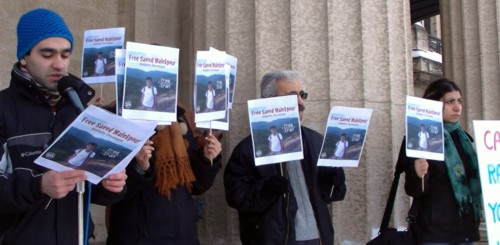
Saeed Malekpour is an Iranian-Canadian awaiting execution in Iran’s infamous Evin prison. He’s been held there since 2008 when he was arrested on charges related to developing and promoting a porn site, an allegation he rejects. Since then he’s been held in solitary confinement, tortured and denied the most basic human rights.
Saeed’s plight was news to me until a couple of days ago, and perhaps it is unfamiliar to you as well. Two excellent web sites where you can learn more about Saeed, the danger he faces and what you can do are:
There is no time to lose. Iran is notorious for its willingness to execute prisoners on the flimsiest of pretexts. He could be killed at any moment. Nonetheless, international opinion does save lives. So, please do not delay. Join the campaign to save Saeed Malekpour’s life. Today. Now.
Feb. 12, 2011: Winnipeggers rally at the Manitoba Legislature in support of Saeed Malekpour, an Iranian-Canadian facing execution in Iran. Photo: Paul S. Graham
About 300 Winnipeggers rallied at the Manitoba Legislature on Saturday in support of the Egyptian struggle for democracy. Joining millions around the world, they chanted “Free Egypt Now!” and “Step down Mubarak!” Here’s some video.
It’s Let Them Stay Week in Canada — a week of activities dedicated to keeping American war resisters in Canada. So I did what any red-blooded Canadian peacenik does at this time of the year – I stood around outside an MP’s office in -25C temperatures with a similarly minded posse of peacenikles. This time it was the Steinbach, Manitoba office of Vic Toews – our Minister of Public Safety – a man who long ago abandoned the pacifist principles of his Mennonite faith while still managing to be twice re-elected in this mega-Mennonite town.
Last April, the Manitoba Legislature debated a resolution calling on the provincial government to “denounce Israeli Apartheid Week as divisive, promoting intolerance and undermining a balanced debate of the Israeli-Palestinian question.” The resolution was never put to a vote, but the debate was enlightening – perhaps in ways unintended by some of the debaters.
Those who spoke in favour of the resolution (from all three parties) argued that democratic Israel could never be accused of practising apartheid and therefore that the term “Israeli apartheid” represented anti-Semitic hate speech.
No members spoke against the resolution, though Gord Makintosh came closest when he said “I do question the resolution’s intention . . .to formally denounce–that’s the wording–the speech of certain Manitobans on campus or anywhere, through unspecified means . . .” He concluded: “But to create a new function for provincial governments of the day in Canada to formally denounce and chill unwelcome speech–and this is unwelcome speech, I can tell you–from time to time should be very thoroughly and carefully debated in this Chamber. I am then at risk of being their next target. Manitoban supporters of Israel are then at risk of becoming a target and we should not be a party to that.”
Strikingly absent from the debate was any acknowledgment that those who use the term “Israeli apartheid” might have have some justification. The resolution was not voted on because some members refused permission for it to be put to a vote. Surely some of them had contrary views but were unwilling or unable to express them.
All in all, the debate was extremely unbalanced and uninformed. Because this issue is likely to resurface in time for this year’s Israeli Apartheid Week, members and supporters of the Winnipeg chapter of Independent Jewish Voices Canada sent a letter to each member of the Manitoba Legislature that makes it clear that “Israeli apartheid” is a problem that is widely acknowledged and discussed by leading Israeli and South African politicians and scholars. I have reprinted it, below.
If you want to get in touch with your MLA on this issue, you can get contact information here.
Dear Member of the Manitoba Legislative Assembly,
“If this bloc of millions of Palestinians cannot vote, that will be an apartheid state.”
These words were spoken by Ehud Barak, Israel’s Minister of Defense and a former prime minister, not by organizers of Israel Apartheid Week (IAW).
How can anyone denounce discussion of Israel and apartheid when a search of the University of Manitoba library catalogue indicates there are over 4,200 articles and 5 books on the topic? Senior Israeli scholars warn of a “creeping apartheid,” and of Israel having become a “Herrenvolk democracy.”
The attached material shows that the question of Israeli apartheid is out there in the most respected circles. It is too late for local pressure groups to ask members of Manitoba’s Legislative Assembly to pass a motion denouncing forums on Israel as an apartheid state. Doing so amounts to asking the legislature to condone censorship.
The discussion of Israel as (or becoming) an apartheid state is underway. An official denouncement by the Manitoba Legislature would amount to a serious infringement on free expression. In effect, students can read about Israeli apartheid in the library — but they should not discuss it. That is what denouncing IAW would mean.
On 15 April 2010 Heather Stefanson (Tuxedo) urged the Legislative Assembly to “denounce Israeli Apartheid Week as divisive, promoting intolerance and undermining a balanced debate of the Israeli-Palestinian question.” She argued that “the word ‘apartheid’ is offensive to victims of apartheid in South Africa and ignores that Israel is a strong democracy that respects the rule of law where citizens of all backgrounds vote and serve in elected office.”
As the attached comment by the Human Science Research Council of South Africa makes clear, South Africans are not offended by the word ‘apartheid’ but by seeing apartheid re-emerge in Israel. Leading voices in South Africa, such as Kader Asmal, Breyten Breytenbach, John Dugard, Antjie Krog, Mahmood Mamdani, Barney Pityana and Desmond Tutu, have named Israel an apartheid state and called for a boycott.
In response to her claim that IAW would promote anti-Semitism and may lead to harassment of Jewish students, MLAs might have noted that the President of the University of Manitoba, David Barnard, reported to the University Board of Governors that IAW in 2010 passed without any report of intimidation.
If this matter comes before the Assembly again, you need to know that apartheid is not an inflammatory, false, dishonest term used maliciously to malign the state of Israel. It is a term debated by former Israeli prime ministers, senior scholars teaching at Israel’s most prestigious universities, and respected scholars in North America.
The statements attached here, and others like them, are not intended to foster anti-Semitism or to vilify the state of Israel. They are carefully considered warnings that Israel itself will suffer if it continues down the road toward apartheid.
We have sent you this information to facilitate your becoming informed about the serious questions being asked by Israeli and non-Israeli scholars and politicians. This is not the time to dissuade students and faculty from organizing Israel Apartheid Week. Debate free of unwarranted constraints should be encouraged. The free expression of opinion on matters put before the public is a hallmark of genuine democracy.
We request that you reply to the above address to state your position on considering a motion in the Manitoba Legislature to denounce Israeli Apartheid Week or any forum on this topic in our universities.
Sincerely,
Derek Black, Lee Anne Block, Erin Bockstael, David Camfield, Elizabeth Carlyle, Anna-Celestrya Carr, Cheryl-Anne Carr, Thane Carr, Aviva Cipilinski, Howard Davidson, Marty Dolin, Mark Etkin, Fagie Fainman, Sid Frankel, Jesse Epp-Fransen, Mark Golden, Cy Gonick, Val Gaffray, Christopher Rigaux, Paul S. Graham, Sate Hamza, Bassam Hozaima, Ghassan Jundi, Krishna Lalbiharie, Brian Latour, Vera Lemecha, Zana Lutifyya, Marilyn McGonigal, Margaret Maier, Kathleen Matheos, Richard Menec, Glenn Michalchuk, Darrell Rankin, Christopher Rigaux, John Ryan, Harold Shuster, Gurdip Singh, Sofia Soriano, Marcia Stentz, Lisa Stepnuk, Daniel Thau-Eleff, Louise Waldman, Marguerite Warner, Michael A. Welch, Michael Welfley, Alon Weinberg, Monique Woroniak, Glen Wreggitt, Diane Zack
Enclosure
Israeli Prime Ministers, South African Leaders, Israeli and non-Israeli Academics Speak Out about Israeli Apartheid. Why Demonize Doing So in Manitoba?
Ehud Barak, Israel’s Minister of Defense and former Prime Minister of Israel:
“As long as in this territory west of the Jordan River there is only one political entity called Israel it is going to be either non-Jewish, or non-democratic,” Barak said. “If this bloc of millions of Palestinians cannot vote, that will be an apartheid state.” [Quoted in “Barak: make peace with Palestinians or face apartheid,” Guardian, 03 February 2010.]
Shulamit Aloni, former Israeli Minister of Education under Yitzhak Rabin
“The US Jewish Establishment’s onslaught on former President Jimmy Carter is based on him daring to tell the truth which is known to all: through its army, the government of Israel practises a brutal form of Apartheid in the territory it occupies.” [ Article appearing in Yediot Acharonot, cited and translated from Hebrew in The Scoop, from Middle East News Service]
John J. Mearsheimer, R. Wendell Distinguished Service Professor, Political Science, University of Chicago:
“…there is not going to be a two-state solution. Gaza and the West Bank will become part of a greater Israel, which will be an apartheid state bearing a marked resemblance to white-ruled South Africa. Israelis and their American supporters invariably bristle at this comparison, but that is the future if they create a greater Israel while denying full political rights to an Arab population that will soon outnumber the Jewish population in the entirety of the land.” [Mearsheimer, J. (01 August 2010). Sinking Ship. American Conservative.]
Ehud Olmert, former Prime Minister of Israel:
“If the day comes when the two-state solution collapses, and we face a South African-style struggle for equal voting rights (also for the Palestinians in the territories), then, as soon as that happens, the State of Israel is finished.” [Quoted in “The two state solution, or Israel is done for,” Haaretz, 09 November 2007]
Baruch Kimmerling (deceased), formerly Distinguished Research Professor, Department of Sociology, University of Toronto and George S. Wise Professor of Sociology, Hebrew University, Jerusalem:
“… Israel [has] ceased being a true democratic state and became a Herrenvolk democracy. This term, coined to describe South Africa under Apartheid, describes a regime in which one group of its subjects (the citizens) enjoys full rights and another group (the non-citizens) enjoys none. The laws of Israel have become the laws of a master people and the morality that of lords of the land.” [Kimmerling, B. (2006). Politicide: The real legacy of Ariel Sharon. London: Verso, p. 39]
Oren Yiftachel, Professor of Political Geography, Ben Gurion University, Beer Sheva, Israel:
The [Gaza] disengagement has indeed made a significant difference to the political geography of Israel/Palestine, but a close examination reveals not a crossing of the watershed toward ending Israeli colonialism in favour of a two state solution but, rather, an Israeli policy of “oppressive consolidation,” a “politics of suspension,” and a perpetual probability of mutual violence. These have combined to create a political geographic order best described as “creeping apartheid.” [Yiftachel, O. ( 2005). Neither two states nor one: The disengagement and “Creeping Apartheid” in Israel/Palestine. The Arab World Geographer/Le Géographe du monde arabe Vol. 8, No 3, 125-129.]
Sciences Research Council of South Africa, South Africa’s statutory research agency:
“[D]iscriminatory treatment cannot be explained or excused on grounds of citizenship, both because it goes beyond what is permitted by ICERD [The Apartheid Convention] and because certain provisions in Israeli civil and military law provide that Jews present in the OPT who are not citizens of Israel also enjoy privileges conferred on Jewish-Israeli citizens in the OPT by virtue of being Jews. Consequently, this study finds that the State of Israel exercises control in the OPT with the purpose of maintaining a system of domination by Jews over Palestinians and that this system constitutes a breach of the prohibition of apartheid.” [Middle East Project of the Democracy and Governance Programme, Human Sciences Research Council of South Africa. (May 2009). Occupation, colonialism, Apartheid? A re-assessment of Israel’s practices in the occupied Palestinian territories under international law, p. 22]
Is there such a thing as “Israeli apartheid” or is that term symptomatic of the “new anti-Semitism” that, according to Israel’s staunchest apologists, is stalking the world? While students in many Canadian universities are now preparing to hold another round of Israel Apartheid Weeks, the question is more than academic.
Recently, the Manitoba Association of Rights and Liberties (MARL) published a piece by David Matas that condemned the concept of Israel Apartheid Week and argued for its prohibition from Canadian universities. I was offended that a human rights association would be party to an attack on free speech, and less than impressed with Matas’s arguments.
I’m therefore pleased to offer a rebuttal by Howard Davidson. Howard is Associate Professor, Extended Education, at the University of Manitoba and a member of Independent Jewish Voices (Canada). He’s also a vigorous anti-war activist and in my view a real champion of human rights — one who MARL should publish if it wishes to retain its claim to supporting human rights.
Banning Israel anti-apartheid weeks at universities, A Reply to David Matas, Senior Legal Counsel, B’nai Brith
By Howard S. Davidson
“If this bloc of millions of Palestinians cannot vote, that will be an apartheid state.”
Ehud Barak, Israel’s Minister of Defence, February 2010
“There is no apartheid in Israel,” writes David Matas, senior legal counsel for B’nai Brith. Those who claim otherwise are propagandists, anti-Semites and their fellow travelers who organize events like Israel Apartheid Week (IAW) on campuses in order to advance a malicious “fantasy” contrived to vilify Israel and intimidate Jewish students.
Last year, attempts to ban IAW were rebuked when university presidents asserted the right of students to organize IAWs as long as these events did not violate university policy on maintaining a respectful environment on campuses. Following IAW at the University of Manitoba, President David Barnard reported to the university’s Board of Governors that IAW proceeded without incident. Nonetheless, Matas insists that student forums on Israel and apartheid are intended to foster anti-Semitism and must be banned.
In a presentation to the Faculty of Law, University of Manitoba, on 21 October 2010, subsequently published by the Manitoba Association for Rights and Liberties,[1] Matas argues that the “charge of apartheid against Israel is one of a barrage of anti-Zionist accusations levied against Israel. Anti-Zionism by definition is rejection of the existence of the Jewish state. That rejection is the denial of the right to self-determination of the Jewish people.” He goes on to state, “The charge that Israel is an apartheid state is connected to anti-Semitism both in substance and in form.”
These are serious accusations made in defence of a dangerous undertaking. If they are false, they represent a threat to a democratic society that cherishes freedom of expression and the right to peaceful dissent. The matter comes down to this: Is discussion of Israel and apartheid a legitimate topic of political and academic discourse or is it, as Matas claims, a “fantasy” perpetuated to incite hatred against Israel? For Matas Israel and the Jewish people are one, therefore, any unfounded criticism of Israel is anti-Semitism.
Given the gravity of his argument and his rich legal experience, one should expect a thoughtful presentation of his position. Instead, he offers up a ruse: hiding from view the legitimate discourse on Israel and apartheid. In fact, far from being a malicious “fantasy,” the subject is a matter of discussion and grave concern for Israeli leaders and academics in and outside Israel.
Because apartheid regimes have proven to be untenable, to say nothing of immoral, the threat of becoming an apartheid state invites disaster. Oren Yiftachel, professor of Political Geography, Ben Gurion University, has called this “creeping apartheid.”
“The [Gaza] disengagement has indeed made a significant difference to the political geography of Israel/Palestine, but a close examination reveals not a crossing of the watershed toward ending Israeli colonialism in favour of a two state solution but, rather, an Israeli policy of ‘oppressive consolidation,’ a ‘politics of suspension,’ and a perpetual probability of mutual violence. These have combined to create a political geographic order best described as ‘creeping apartheid.’”[2]
Israel’s current minister of defence and former prime minister, Ehud Barak, has warned Israelis, “As long as in this territory west of the Jordan River there is only one political entity called Israel it is going to be either non-Jewish, or non-democratic…. If this bloc of millions of Palestinians cannot vote, that will be an apartheid state.”[3]
Barak’s fears were also expressed by Israel’s previous prime minister, Ehud Olmert: “If the day comes when the two-state solution collapses, and we face a South African-style struggle for equal voting rights (also for the Palestinians in the territories), then, as soon as that happens, the State of Israel is finished.”[4]
This view was stated by John J. Mearsheimer, R. Wendell Distinguished Service Professor, Political Science, University of Chicago. Mearsheimer co-authored with Stephen Walt The Israeli Lobby. I am certain that Matas vehemently disagree with Mearsheimer’s analysis of the lobby; however, he cannot paint Mearsheimer as an anti-Zionist, anti-Semite, or someone seeking to incite intimidation and hatred. If Matas read reviews of The Israel Lobby in Foreign Affairs (e.g., L. Carl Brown, September/October 2006) or Dmitri K. Simes’ article in the National Interest, [5] he knows about Mearsheimer’s pro-Israeli credentials. Mearsheimer wrote in the American Conservative:
“…there is not going to be a two-state solution. Gaza and the West Bank will become part of a greater Israel, which will be an apartheid state bearing a marked resemblance to white-ruled South Africa. Israelis and their American supporters invariably bristle at this comparison, but that is the future if they create a greater Israel while denying full political rights to an Arab population that will soon outnumber the Jewish population in the entirety of the land.” [6]
Others claim that Israel has already become an apartheid state, the position taken by organizers of Israel Apartheid Week and shared by Shulamit Aloni, former Israeli Minister of Education under Yitzhak Rabin. Aloni wrote, “The US Jewish Establishment’s onslaught on former President Jimmy Carter is based on him daring to tell the truth which is known to all: through its army, the government of Israel practises a brutal form of Apartheid in the territory it occupies.” [7]
I could quote others who agree. For the sake of brevity I’ll leave it with this comment by Baruch Kimmerling (deceased), formerly Distinguished Research Professor, Department of Sociology, University of Toronto and George S. Wise Professor of Sociology, Hebrew University, Jerusalem:
“… Israel ceased being a true democratic state and became a Herrenvolk democracy. This term, coined to describe South Africa under Apartheid, describes a regime in which one group of its subjects (the citizens) enjoys full rights and another group (the non-citizens) enjoys none. The laws of Israel have become the laws of a master people and the morality that of lords of the land.” [8]
A search of the University of Manitoba library catalogue brings up 17 titles on Israel and apartheid. It is reasonable to assume this would be true of other university libraries. Thus, students are free to research the subject but presidents are being asked to prevent students from organizing discussions on the topic. Or would Matas seek to have these books removed from the libraries on the ground that they are not on a legitimate topic but are propagating a malicious fantasy?
In a democracy Matas is welcomed to express a different opinion (a freedom he would deny to others). That said, he should think twice about claiming that those who believe apartheid in Israel is a clear and present danger are nothing more than anti-Semites.
The only evidence he offers to prove there is no apartheid in Israel is to dismiss any comparison with South African apartheid. As we have seen in the statements quoted here, the South African comparison is frighteningly valid.
Matas contrives his proof by defining apartheid in the narrowest possible terms (i.e., “the denationalization of blacks”). Since Palestinians have not been denationalized there is no apartheid. He neglects to mention a more authoritative definition of apartheid than his own, one provided by the 2002 Rome Statute of the International Criminal Court. The ICC defined apartheid as a crime against humanity “committed in the context of an institutionalized regime of systematic oppression and domination by one racial group over any other racial group or groups and committed with the intention of maintaining that regime.” [9] Do South Africans think this describes the situation in the occupied territories?
Archbishop Desmond Tutu thinks it does. Other leading South Africans expressing the same opinion are Breyten Breytenbach, John Dugard, Antjie Krog, Mahmood Mamdani, and Barney Pityana. It is the conclusion of a report on Israel’s practices in the occupied territories by the Human Sciences Research Council of South Africa, South Africa’s statutory research agency:
[D]iscriminatory treatment cannot be explained or excused on grounds of citizenship, both because it goes beyond what is permitted by ICERD [The Apartheid Convention] and because certain provisions in Israeli civil and military law provide that Jews present in the OPT [Occupied Palestinian Territories] who are not citizens of Israel also enjoy privileges conferred on Jewish-Israeli citizens in the OPT by virtue of being Jews. Consequently, this study finds that the State of Israel exercises control in the OPT with the purpose of maintaining a system of domination by Jews over Palestinians and that this system constitutes a breach of the prohibition of apartheid. [10]
Stating that Israel is (or is becoming) an apartheid state names an impending/horrific state-of-affairs that calls for the immediate end of occupation and respect for Palestinians’ right for self-determination. It is clear from the range of statements cited here that an extensive discourse has emerged on Israel and apartheid.
It is my hope you will become familiar with this discourse and use that knowledge to challenge the ruse being used to convince university presidents to ban Israel Apartheid Week. Freedom of expression and the tradition of dissent make up the life blood of a democratic society.
Howard S. Davidson is Associate Professor, Extended Education, University of Manitoba and member of Independent Jewish Voices (Canada). He can be reached at ijvwinnipeg@gmail.com.
[10] Middle East Project of the Democracy and Governance Programme, Human Sciences Research Council of South Africa. (May 2009). Occupation, colonialism, Apartheid? A re-assessment of Israel’s practices in the occupied Palestinian territories under international law, p. 22 . Retrieved 16 November 2010 http://www.hsrc.ac.za/Document-3227.phtml



 Paul S. Graham