Stephen Harper’s Conservatives like to present themselves as tough on crime, committed to accountable government and respectful of the rule of law. Given their record, we have to ask ourselves, when will we march them off to the nearest penitentiary to begin serving the mandatory minimum sentences they so richly deserve?
Like a Rocky Mountain avalanche in the making, a growing mountain of evidence of Harper’s cynical disregard for the rule of law threatens to bury even the pretense of Canadian democracy. Here are some examples . . .
Canadian Wheat Board Act Violated
On Oct. 18, 2011, Harper’s Conservative government introduced Bill C-18, the Marketing Freedom for Grain Farmers Act, which aims to remove the Canadian Wheat Board’s monopoly over exports of western Canadian wheat and barley. Not only are they proceeding with this legislation in defiance of the expressed will of most western farmers, they are in breech of Section 47.1 of the Canadian Wheat Board Act which requires the permission of grain producers prior to the introduction of this kind of legislation.
2006 Election – the In and Out Scandal
During the 2006 federal election, the Conservative Party tried to get around election spending limits by giving $1.3 million dollars to 67 riding offices that had not yet reached their individual spending limits. The ridings then returned the money to the party, claiming that it was being used to buy advertising. The money was used by the national campaign to fund an advertising blitz in the final weeks of the campaign. The scam might have gone undetected but for the chutzpah of some riding officials who applied to Elections Canada for a 60% reimbursement of their advertising expenses. Four senior Conservative Party members were charged under the Elections Canada Act with overspending and submitting false or misleading election expense documents. Just this month, the Tories successfully plea bargained their way out of facing these charges, agreeing to plead guilty to what the Tory spin-doctors are calling “administrative errors.”
The Cadman Affair and the Criminal Code of Canada
In 2005, the minority Liberal government of Paul Martin was in deep trouble. The Tories were intent on bringing them down, but the vote would be close. In Like a Rock: The Chuck Cadman Story, Vancouver writer Tom Zytaruk tells the story of attempts by Conservative Party officials to offer financial inducements to independent MP Chuck Cadman in return for his support in bringing down the Liberals. The Tories were unsuccessful in getting Cadman’s support. However, an interview with Stephen Harper conducted by Zytaruk makes it clear that Harper was aware of his Party’s efforts to buy Cadman’s vote. And vote buying is a serious offence under the Criminal Code of Canada, one that carries a maximum penalty of 14 years in prison.
Harper has a majority government and opposition parties have been unwilling to step outside of Parliament to hold governments accountable. For these reasons, Harper will remain untouchable unless we organize a broad movement to hold him accountable. There is a clear leadership role for well-resourced organizations such as The Council of Canadians and The Canadian Labour Congress. Perhaps we should remind them.
The Attack on the Canadian Wheat Board: Seven Reasons Non-Farmers Should Care … and Act
Some of the 400 people who rallied in front of the CWB headquarters, Oct. 28, 2011. Photo: Paul S. Graham
On October 18th, Prime Minister Harper introduced legislation, Bill C-18, to dismantle the Canadian Wheat Board. The majority of farmers oppose the Prime Minister’s plan—farmers have repeatedly voted for a strong, effective CWB. Farmers are organizing and protesting. But to save our democratically controlled marketing agency, farm families need your help, and the help of the organizations with which you work.
The loss of the CWB will hurt every Canadian family. Here are seven reasons why non-farmer Canadian citizens should act to help protect the Wheat Board:
1. Privatization and Loss of Economic Control
Few sectors of the Canadian economy are 100% owned and controlled by Canadians. But one is: our multibillion-dollar western wheat and barley marketing system. If the Harper government destroys the CWB, it will turn over to transnational corporations (most of them foreign) a critical sector of our economy that is now owned and controlled by Canadian citizens. What C-18 takes away from farmers and other Canadians, it gives to grain giants such as Cargill.
2. Genetically Modified Food
In 2000, Monsanto moved to introduce genetically modified (GM) wheat. Farm organizations, environmental groups, and citizens’ organizations banded together to stop Monsanto and keep GM wheat out of Canadian fields and foods. United, we succeeded. The CWB was a crucial ally. Many people and organizations believe that had it not been for the work of the CWB, Canadians would now be eating food made from GM wheat. Lose the CWB and we may lose the fight to stop GM wheat.
3. Food Sovereignty
As an alternative to a globalized, long-distance, corporate-controlled food system, many Canadians are advocating Food Sovereignty, wherein farmers and all citizens collectively shape the food system we want for our families. The CWB is a good example of Food Sovereignty in action: a democratic agency controlled by food producers and citizens. By attacking the CWB, this government is pushing back hard against Food Sovereignty, serving notice that our future food system will be more far-flung, more corporate controlled. A government hostile to the CWB is hostile to Food Sovereignty.
4. National Sovereignty
Today, Canada has its own grain production, processing, handling, and transportation systems. Our Canadian Grain Commission sets and enforces quality standards—equal to the highest in the world. The Canadian Food Inspection Agency regulates new seed varieties, keeping harmful ones out and ensuring farmers have access to seeds that grow well in our climate.
Most of our grain flows “east-west”, hauled by Canadian National and Canadian Pacific railways and loaded onto ships at Canadian ports by Canadian workers. If we destroy the CWB, other parts of our Canadian grain system will be destroyed in turn. As the government empowers US-based grain transnationals, those corporations will chafe against Canadian regulations and push for the destruction of our Grain Commission, seed regulations, and the rest of our quality and regulatory systems. Destroying the CWB accelerates the Americanization of our grain and food systems.
Worse, the North American Free Trade Agreement (NAFTA), Chapter 11 gives US-based grain companies a veto over future attempts to rebuild our CWB. If we destroy it, we can’t get it back.
5. Your Economy
The CWB is the cornerstone of our Canadian wheat and barley marketing, handling, and transport systems. Those systems create jobs:
in Winnipeg where the CWB, the Grain Commission, the Canadian International Grains Institute, and other agencies are headquartered;
in Thunder Bay, Ontario; Churchill, Manitoba; Vancouver, B.C.; and Montreal, Quebec; where Canadian export grain is cleaned, blended, and loaded onto ships; and
across Canada as money is retained in this country and spent in rural and urban centres.
The CWB raises farmers’ revenues by $500+ million annually, money largely from foreign nations that is spent in urban and rural businesses across Canada. PriceWaterhouseCoopers calculated the CWB’s total benefit to the Canadian economy at more than $850 million annually. Without the CWB, citizens and communities across the nation will suffer financially.
6. Our Democracy
The vast majority of farmers want a strong, effective CWB. Farmers have reaffirmed that support in 10 votes—3 plebiscites and 7 sets of Directors Elections. Despite this, the Harper government is pushing forward to destroy the CWB. And it is doing so illegally.
Section 47.1 of the CWB Act requires that farmers must vote in favour of major changes to the CWB. The government is ignoring that law and refusing to hold a vote. Also, the government is ramming its legislation through parliament, using closure to limit debate, refusing to let the Agriculture Committee examine the bill, and instead setting up an ad hoc committee to review the bill, but limiting that committee to just 5 minutes per section. Prime Minister Harper has announced he will “walk over” the farmer majority that support the CWB, and he has called his drive to dismantle the CWB a “train barrelling down a Prairie track.” Our federal government is sneering at democracy, evading due process, and bending the law to the breaking point. If these antidemocratic tactics are not challenged, they will be repeated.
7. Farms and the Land
The CWB raises farmers’ prices and incomes. And the CWB provides equitable access to the market for all farmers, big or small. Losing the CWB will accelerate the loss of family farms. In so doing, it will concentrate farmland ownership in fewer and fewer hands. A blow to the CWB is a blow to family-farm agriculture, and the men and women who produce our food.
You can help protect our food supply, sovereignty, economy, and democracy
Time is short. We need to act fast. But action takes just 15 or 20 minutes. What is needed right now is for Canadians to write two short letters:
One to Prime Minister Harper, asking him to scrap Bill C-18, his destroy-the-CWB legislation, and to instead enact policies that foster Food Sovereignty and a strong Canadian nation and economy; and
One letter to Canadian Senators, asking them to resist pressure to fast-track Bill C-18, and to instead give careful and adequate consideration to this detailed and far-reaching legislation; to hold meetings of their Agriculture Committee; and to hear presentations from farmers, workers, businesspeople, and other Canadians who will be affected by this legislation.
Contact information for the Prime Minister
Hon. Stephen Harper
Prime Minister of Canada
80 Wellington Street
Ottawa, ON K1A 0A2
FAX: (613) 941-6900
Email: stephen.harper@parl.gc.ca
Contact information for Senators
Canadian Senators
c/o the Clerk of the Senate
Parliament Building
Ottawa, Ontario
I also think it would be worth it to contact your Member of Parliament. Here are some useful links and a video to round out your resource kit. Don’t delay.
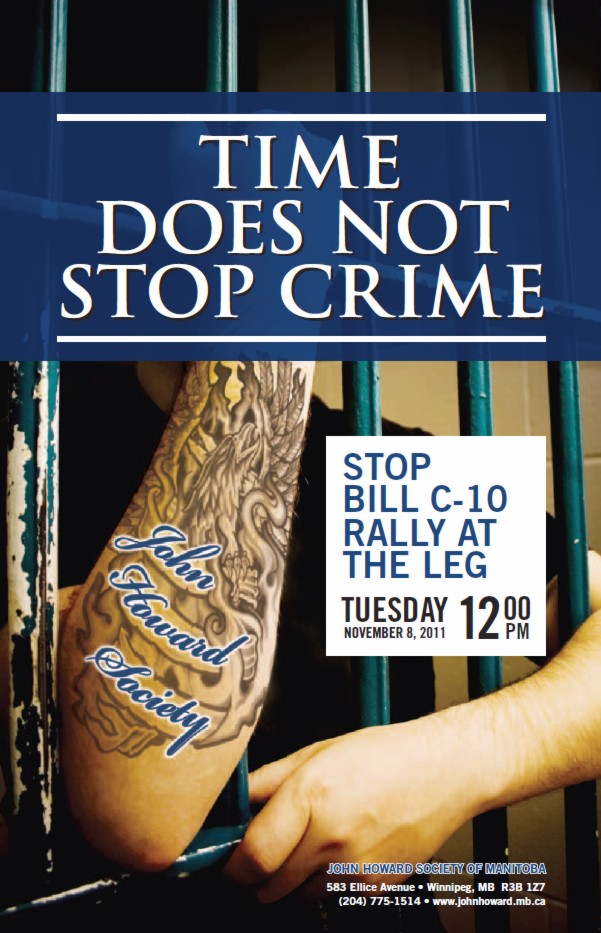
Nov. 8, 2011: 300 Winnipeggers demonstrated at the Manitoba Legislature and the Winnipeg Remand Centre to urge the Manitoba Government to join Quebec, Ontario and Newfoundland and Labrador in opposing the Harper government’s omnibus crime bill, misleadingly titled the Safe Streets and Communities Act (aka Bill C-10). Their key message, “time does not stop crime” rebutted the government’s contention that locking up more offenders for longer periods was an effective crime prevention technique.
As I noted in an earlier post, the John Howard Society of Manitoba estimates Canadians will pay $2 billion annually to cover the costs of the bill, which calls for mandatory minimum sentences for a wide range of crimes regardless of individual circumstances. While this will trigger a huge increase in the number of inmates and a prison construction boom, it will do nothing to address the root causes of crime, nor will it lead to the rehabilitation of offenders.
Speakers:
John Hutton, Executive Director, John Howard Society of Manitoba
Shaun Loney – Executive Director, BUILD
Cora Morgan, Executive Director, Onashowewin
Tracy Booth, Executive Director, Elizabeth Fry Society of Manitoba
Jacquie Nicholson, Literacy Coordinator, John Howard Society of Manitoba
Alex Paterson, Occupy Winnipeg
The protest was sponsored by:
BUILD Winnipeg
Canadian Centre for Policy Alternatives
Canadian Federation of Students
Elizabeth Fry Society of Manitoba
Faculty of Social Work, University of Manitoba
Initiatives for Just Communities
Occupy Winnipeg
Ogijiita Pimatiswin Kinamatwin (OPK)
Mennonite Central Committee of Manitoba
School of Social Work, Université de Saint-Boniface
Social Planning Council of Winnipeg
Southern Chiefs Organization
William (Bill) VanderGraff, Law Enforcement Against Prohibition
Nov. 8, 2011: Some of the 300 people who demonstrated in front of the Winnipeg Remand Centre in opposition to the Conservative Government's Omnibus Crime Bill, C-10. Photo: Paul Graham
The John Howard Society of Manitoba estimates Canadians will pay $2 billion annually to cover the costs of Stephen Harper’s omnibus crime bill. Bill C-10, which calls for mandatory minimum sentences for a wide range of crimes regardless of individual circumstances, will trigger a huge increase in the number of inmates and a requirement to build new prisons. It will do nothing to address the root causes of crime, nor will it lead to the rehabilitation of offenders.
Given the onerous cost, most of which will be borne by the provinces, it’s not surprising that the provincial governments of Quebec, Ontario and Newfoundland & Labrador have spoken out against the bill. In Winnipeg, the John Howard Society and 13 other agencies held a rally, Nov. 8, to tell the government of Manitoba to do likewise.
I recorded the event and will be producing a program for WCTV in the near future. But in the meantime, here’s a short interview with the executive director of the John Howard Society of Manitoba, John Hutton, in which he outlines some of the major problems with the legislation.
Against the wishes of most western farmers, and in defiance of laws that they are sworn to uphold, Stephen Harper and his Conservatives are poised to destroy the Canadian Wheat Board. In truly Orwellian fashion, the Tories describe this as “democracy,” all the while invoking closure on Parliamentary debate and refusing to hold the farmers’ plebiscite that is required by federal law before any such major change can be made to the status of the CWB.
The CWB has been a bone of contention in farm policy circles for decades. While a loud minority of western grain producers have been clamoring for an end to the CWB monopoly on wheat and barley exports, most farmers continue to support the Board, as evidenced by several CWB Board of Directors election results and a recent CWB-sponsored plebiscite. The reason for the Board’s enduring support is that it works for farmers, as opposed to private grain companies who exist to maximize profits for their shareholders.
Urban Canadians have yet to wake up to this issue, though this is starting to happen. The Council of Canadians is prominent in the coalition of organizations leading the fightback. What we city slickers need to get our heads around is that this is, first and foremost, a battle for democracy. It is a struggle against growing corporate control of our food and the relentless corporatization of agriculture that is destroying rural communities.
One one level, the issues are complex. You can get a crash course by watching the video I produced along with my WCTV colleague Ken Harasym. Follow that up with visits to the web sites listed below and you will be well on your way.
On another level, it is very simple: like us, farmers are part of the 99%. We gotta stick together. Occupy that, Stephen Harper!
Despite its well established habit of electing social democratic governments, Winnipeg has claimed some dubious honors — “Murder Capital of Canada” and “Child Poverty Capital of Canada” to name two of the most disturbing. Even though we have had 11 years of NDP government to undo the damage of Gary Filmon’s Conservatives, both poverty and crime are well entrenched in Manitoba, especially in Winnipeg.
92,650 children in Manitoba live in families under the poverty threshold
29,000 children in Manitoba live in families with annual incomes insufficient for meeting basic needs
29,563 Manitoban children use food banks each month because their families cannot afford to purchase the necessary food they require
59,734 Manitobans accessed Employment and Income Assistance
The richest 20% of Manitoban families have more total income than the poorest 60% of the population
The Council says these statistics have not changed significantly since 1989, the year the House of Commons pledged to end child poverty in Canada by the year 2000.
What is to be done? According to the Manitoba Green Party, 80 per cent of all expenditures on social assistance programs are consumed by government bureaucracy. They proposed, in the last provincial election, to replace welfare benefits with a Universal Basic Income benefit, payable to all Manitobans, that would ensure no one slipped below the poverty line. The idea has merit and I hope the Greens continue to explain and promote it.
Yet another group of Manitobans proposes a package of measures they call a “Justice Charter to End Poverty in Manitoba.” I’ve included it at the end of this piece.
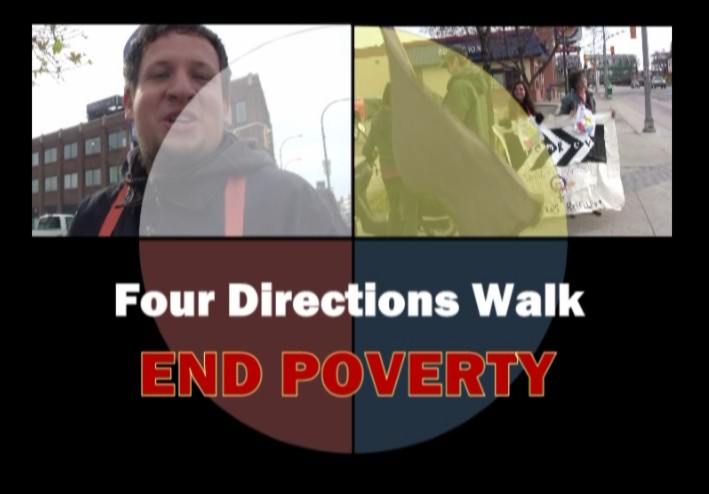
They also hold an annual event called the Four Directions Walk to End Poverty in which four contingents begin their walk on the outskirts of town and converge on the Manitoba Legislature. They held their fourth such walk on Saturday, Oct. 22. Naturally, I brought my video camera.
Justice Charter to End Poverty in Manitoba
We the people of Manitoba, seeing the growing gap between the wealthy and people in need, the working poor, and discriminated groups want to act in a timely manner to reverse the situation, to provide for people with needs and support the right for everyone to contribute to society to the best of their ability. To this end we make these demands and will work to make them a reality:
Housing must be a right and a comfort, not a constant crisis!
End subsidies to private landlords.
Establish stricter rent controls.
Enact a Tenant Bill of Rights.
Build and maintain public housing to the standard building code.
No utility cut-offs; establish a panel with legal power to require landlords to pay.
Universal health care for all, for every need!
Expand medicare into a comprehensive health care system focusing on prevention.
Extend medicare to cover all essential needs such as eye, drug, dental, ambulance and prosthetics.
Reduce pollution from mining and manufacturing, especially next to low income neighborhoods.
Jobs are a human right. Create good-paying jobs for all!
Create jobs through a massive investment in public housing, a public child care program, and conversion to a “green” economy.
Increase the minimum wage to $14 an hour.
Quality job creation by ensuring access to education, ending tuition fees, free student housing, education in Aboriginal and any other language where numbers warrant.
Access to better jobs – reduce the work week with no loss in pay, add paid vacation days and reduce the pension age for women to age 60.
End the Foreign Temporary Worker program, give these workers full labour rights and make them immigrants to Canada, if they so choose.
Provide for those in need!
Introduce a Guaranteed Liveable Income, above the poverty line and indexed to inflation.
Improve special needs benefits and introduce a fast appeals process with free advocacy services.
A public, high quality, free child care program employing well-paid early childhood development professionals.
Establish a hot breakfast program for children in schools.
For injured workers, establish a fast and free appeals process independent of the Workers Compensation Board. Provide free legal services and always respect the right to appeal.
Establish a Manitoba pension credit plan funded by payroll deductions, a surtax on corporate income to top up pensions above the poverty line and an inheritance wealth tax.
Establish a federally-chartered, publicly-owned bank that does not discriminate against people in poverty, is located in low-income areas, and provides free or nonprofit cheque cashing services and international fund transmittals.
Establish a province-wide, free and publicly-owned handi-transit service for people with disabilities.
Establish price controls for essential foods throughout Manitoba.
End racism, sexism and discrimination of all forms!
Support immediate settlement of Aboriginal land claims and emergency action to end housing, health care and education inequality.
Take steps to recognize Aboriginal nations on a new basis in Canada, including full national rights and equal nation to nation relations.
Introduce immediately affirmative action hiring with mandatory quotas for Aboriginal people, people of colour, women and people with disabilities in both the public and private sector.
Job pay equity for all workplaces.
Replace the present legal system of retribution and punishment with principles of restorative justice – restitution and reconciliation; include “ability to pay” as a consideration for sentencing people to jail for nonpayment of fines.
Ban discrimination based on social or mental health conditions in the Human Rights Code.
Introduce a Manitoba Bill of Rights based on the Universal Declaration of Human Rights (1948), adding protections against all forms of sexism.
Reform the democratic system
Establish proportional representation so that people will vote for what they want and so that every person’s vote will count.
Pay Legislators the average worker’s wage and benefits in Manitoba.
The Justice Charter is for discussion by all Manitobans. The annual Four Directions Walk is Winnipeg’s largest annual anti-poverty activity. It is organized to encourage discussion of the ideas in this Charter. We invite groups representing Aboriginal peoples, women, workers, youth and students, people of colour, people with disabilities, injured workers, the working poor, people living in poverty, people of all faiths and nonbelievers – all supportive groups:
To establish a Four Directions Walk in other Manitoba communities.
To discuss the Charter and send us your ideas.
Contact us if you would like to receive information on the annual Walk, held on a Saturday close to the International Day for the Eradication of Poverty (October 17).
On Thursday, George W. Bush and former U.S. president Bill Clinton (himself an accomplished war criminal) will be attending the Surrey Regional Economic Summit at the Sheraton Vancouver Guildford Hotel. Here’s some information from the Canadian Peace Alliance on what you can do to support Bush’s arrest for war crimes.
» Report George W. Bush as a person likely to try to enter Canada contrary to section 35 of the Immigration and Refugee Protection Act.
The Canadian Border Service Agency runs a Border Watch Toll-free line. Their website advertises:
“If you have information about suspicious cross-border activity, please contact the Canada Border Services Agency Border Watch Toll-free Line at 1-888-502-9060.”
George Walker Bush, born July 6, 1945 is likely to try to cross the border into Canada on or about October 18 to 20th 2011 to attend an event in Surrey British Columbia. Mr. Bush has admitted to authorizing and approving the widespread use of torture by the U.S. Armed Forces and the CIA. There are reasonable grounds to believe that George W. Bush, as the President of the United States of America and Commander in Chief of the U.S. Armed Forces between 2001 and 2009, counselled, aided and abetted the commission of torture and other war crimes and crimes against humanity in Iraq, Afghanistan and other locations. Experts estimate that in Iraq alone, over a million innocent men, women and children have died as a consequence of the illegal U.S.-led war on Iraq authorized and directed by George W. Bush.
For more information about the case to charge Bush as a war criminal please see: Lawyers Against the War
» October 20: Peaceful Rally to Protest George W Bush’s Surrey Visit
Thursday, October 20, 11:00 am
Join at the parking lot outside the Bay, Guildford Mall, SW corner of 152 St. & 104 Ave.
For info on this rally, please email stopwar@resist.ca http://stopwarca.wordpress.com/
» Sign the Online petition to arrest George Bush: www.amnesty.ca
Oct. 15, 2011: Scenes from Occupy Winnipeg – and a reminder that what is now called Canada was occupied long before by the aboriginal peoples of this part of the world. It is time the descendants of the Europeans who took the land from the people who were here first do a much better job of sharing it with today’s First Nations.
Winnipeggers took to the streets October 15, 2011 as part of the international outcry against corporate greed that began with Occupy Wall Street. The Flaming Trolleys provided just the right musical foundation, and, as usual, I took my video camera along.
Sept. 30, 2011 - Award-winning Israeli journalist Amira Hass speaking at the University of Winnipeg on the need to end the Israeli occupation of Palestinian territories. Photo: Paul S. Graham
“Inhuman, immoral and unsustainable” are the words used by Amira Hass to describe what she terms “the State of Israel and the privileges it endows to Jews only, at the expense of Palestinians.”
Hass was at the University of Winnipeg Sept. 30, to provide a unique perspective on the Palestinian struggle, that of an Israeli Jew, a woman and a journalist for Haaretz, who has lived and worked in either Gaza or the West Bank for the past 17 years.
Hass was forceful in her denunciation of the conditions under which Palestinians live and uncompromising about the need to end the occupation and restore the rights of Palestinians in Israel and the occupied territories. What especially caught my attention, however, was her diplomatic yet unmistakable suggestion that activists outside of Israel take stock of their own societies and refrain from applying a double standard toward Israel.
“I’m fully aware that I’m speaking here mostly to the privileged. You are also a settler society that owes a large part of its affluence and comfortable life to the disenfranchisement of native peoples,” Hass said early in her presentation. She continued, “I also know that many who are engaged in the struggle for justice for Palestine are aware of it and probably some of you are part of the struggle to undo some of the damage that your communities, that your society, has inflicted on the First Nations.”
Hass returned briefly to this theme late in her presentation. While she expressed profound regret that she and other Israeli activists had not succeeded in convincing fellow citizens to end the suppression of Palestinians, she advised activists to get a sense of proportion.
“I would call for some sort of proportion. The calls about Israeli illegitimacy – I understand them – but I also want to understand why Israel is more illegitimate as a settler society – why is it more illegitimate than Canada. . . . let’s not treat Israel as the only evil in the world.”
If you look at the map Hass used in her presentation (click for a larger view) it would seem that the Israelis have borrowed the Canadian playbook – force the aboriginal peoples onto isolated parcels of land, compel them to live in poverty and control every aspect of their existence until they lose the will to resist. The main difference in this regard is that we’ve been doing this to “our” native peoples for a much longer time.
My take-away from Amira Hass’s presentation: stand up for Palestinian rights, but remember your responsibility for stand up for aboriginal rights in Canada.
Please share this video widely, especially with those who have imbibed deeply at the well of Israeli propaganda. For them, it could be an eye-opener.

 Stephen Harper’s Conservatives like to present themselves as tough on crime, committed to accountable government and respectful of the rule of law. Given their record, we have to ask ourselves, when will we march them off to the nearest penitentiary to begin serving the mandatory minimum sentences they so richly deserve?





 Paul S. Graham