by Peace Alliance Winnipeg

During the Vietnam war, tens of thousands of American conscientious objectors sought refuge in Canada to avoid taking part in a war they could not, in conscience, support. While the Canadian government was slow to respond in a positive way, under persistent pressure from peace, church and labour activists, they were eventually permitted to obtain immigrant status. Many remain in Canada to this day as valued members of our communities.

Fast forward 40 years – many US soldiers have sought refuge here  rather than fight in the Iraq war, a war widely recognized as a crime against humanity. Rather than be complicit in war crimes they left their homes, their families and communities and sought refuge in Canada.

Their pleas for refugee status have been thwarted at every turn by the Harper Government. In defiance of two Parliamentary resolutions calling on the federal government to allow war resisters to stay in Canada, the Harper Government has continued to smear American war resisters as criminals. Minister of Citizenship and Immigration Jason Kenney has publicly labelled them as “bogus refugee claimants.” In July 2010, he issued a bulletin to all Immigration Officers requiring them to red-flag applications that involve US war resisters, labeling them as “criminally inadmissible.”

In recent news, the Harper government ordered U.S. Iraq war resister Kimberly Rivera, her husband Mario and their four young children deported to the United States. Kimberly served in Iraq in 2006, and sought refuge in Canada in 2007 after making the decision that she could no longer participate in the Iraq War. She was the first female US Iraq War resister to come to Canada. Kimberly and her family live in Toronto.

If deported, she faces harsh punishment. War resisters Robin Long and Clifford Cornell, two Iraq war resisters deported by the Harper government, were court-martialed and sentenced to 15 months and 12 months respectively for speaking out against the Iraq War.

Canadian support for American war resisters is widespread. We must redouble our efforts to make the Harper government listen.

Peace Alliance Winnipeg has sent a $300 donation to cover Kimberly Rivera’s legal costs. We have written to each Manitoba MP and we will be taking our message to the Winnipeg Take Canada Back demonstration on September 17th. Here are some things you can do:

1. Write, email, fax and or call your MP. If you wish, you can use or adapt the letter sent by Peace Alliance Winnipeg (below, at the end of this message) or you may wish to adapt the letter being used by the War Resisters Support Campaign.  To get their contact information, follow the links below:

(More MP contact information can be found here.)
2. Make a financial contribution to help with Kimberly Rivera’s legal expenses. You can make a donation online, here. To donate by cheque, make it payable to War Resisters Support Campaign and send to:

War Resisters Support Campaign
Box 23
427 Bloor Street West
Toronto, ON M5S 1X7
Canada

3. Write, email, phone or fax Minister of Citizenship, Immigration and Multiculturalism Jason Kenney and ask him to let Iraq War resister Kimberly Rivera and her family stay in Canada. You can use thisonline letter, or send your own message to:

325 East Block, House of Commons, Ottawa, ON K1A 0A6
Phone: 613-954-1064 Fax: 613-957.2688
Email: jason.kenney@parl.gc.ca, minister@cic.gc.ca

4. Join the Peace Alliance Winnipeg contingent at the Winnipeg Take Canada Back Demonstration on September 17th, 5:00 p.m., at the Manitoba Legislature. More information on this national demonstration, which coincides with the opening of Parliament, can be found here.

If Kimberly and her family are to be allowed to remain in Canada, we need to act now. Please share this message widely, and take action today.


LETTER SENT TO MANITOBA MPs FROM PEACE ALLIANCE WINNIPEG

September 13, 2012

Dear Member of Parliament for Manitoba

Re: Deportation of Kimberly Rivera , American Iraqi war resister

On behalf of the Peace Alliance Winnipeg I ask for your immediate attention and support on an urgent matter regarding the imminent deportation of Kimberly Rivera, a young American war resister, woman and mother. Her appeal to remain in Canada on humanitarian grounds has been denied by the Federal government and deportation is scheduled for as early as September 20, 2012.

Kimberly has sought refuge in Canada on moral grounds, motivated by her conscience, values, and political opposition to the American military action in Iraq. Many thousands of Canadians support her and view her decision and actions as a heroic matter of conscience.

On being forced to return to he US she will face two to five years of imprisonment made all the more harsh by her separation from her young children.

There is nothing to be gained from this inhumane decision and much will be lost. Kimberly losses her freedom and her ability to parent her children; her children lose precious time with their mother; the American military gains nothing but retribution and, as Canadians, we also lose.

This is a serious and symbolic issue for us a nation. If we fail to reverse this deportation decision, and all others like it, Canada loses a significant degree of independence in determining the value of individual conscience particularly as it concerns the matter of conscientious objection. The deportation of war resisters sends the message that Canada does not value those who refuse to fight in war. It further erodes our standing in the world as peace keepers and a middle power capable of being an honest broker on the world stage.

Most troubling we will have failed our long held national values of defending legitimate moral opposition, defending the right to conscience and protecting political refugees from certain prosecution. Our once highly held principle of humanitarian consideration for refugees will be irrevocably threatened along with our national identity as a compassionate and tolerant country.

This is a costly and grave matter for Kimberly and her family and for us as Canadians. It is erroneously being framed as a criminal matter. Deportation of Kimberly and others like her will have far reaching, long term destructive consequences for us all. The real crime is a moral one in allowing this deportation to proceed unchallenged.

In June 2008 and March 2009 Parliament passed resolutions calling for a halt to the deportations of war resisters and allowing them to stay in Canada as permanent residents. Please use your position and voice as a parliamentarian to immediately stop the deportation of Kimberly Rivera.

Glenn Michalchuk
Chair, Peace Alliance Winnipeg

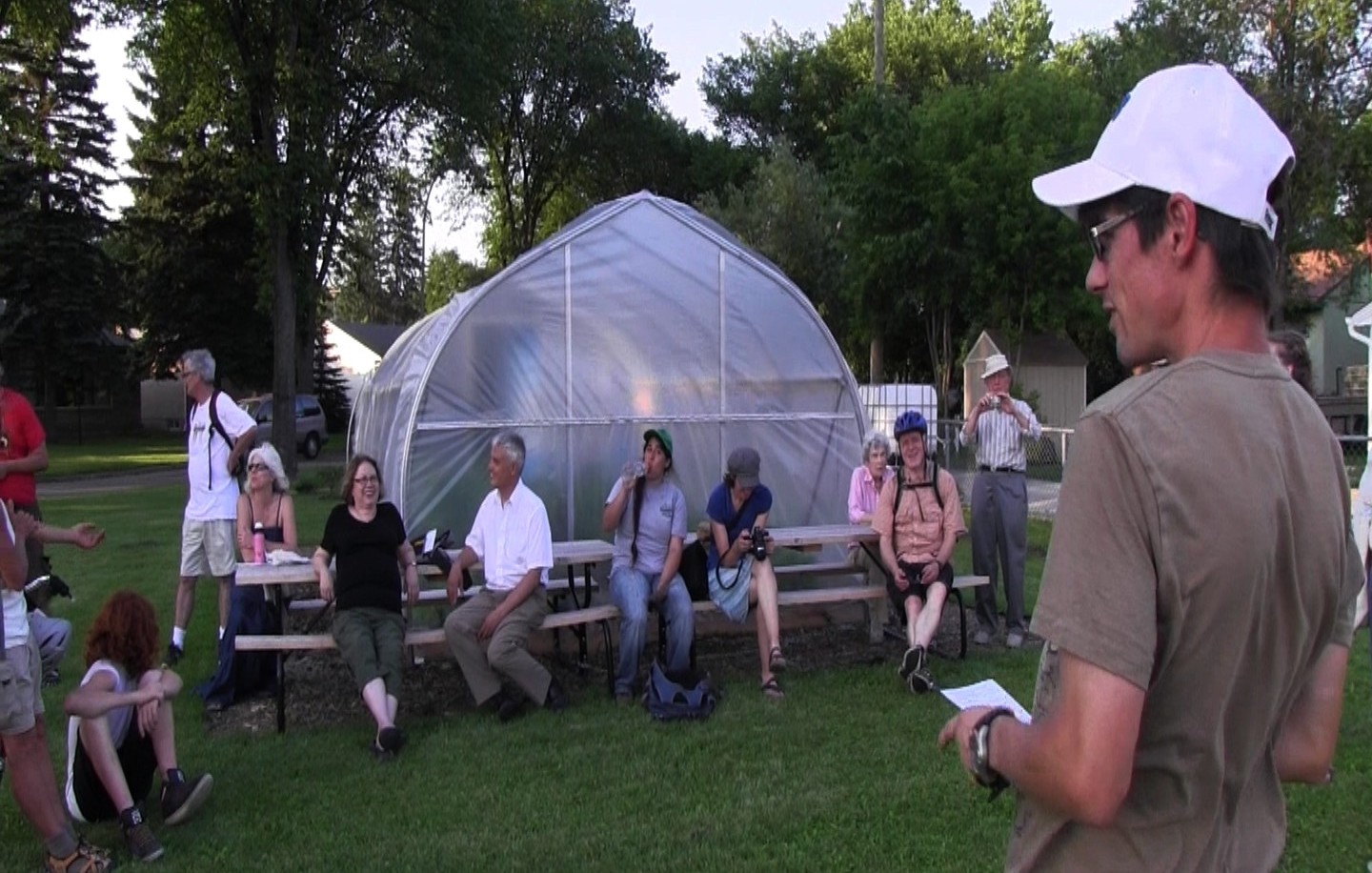
The Riverview Hoop House was one of the projects on display during a walking tour of urban agricultural projects organized by the Sustainable South Osborne Community Co-op in June in Winnipeg. Coordinator Scott Harrison explains how it works. Photo: Paul S. Graham

Where does your food come from? If you’re like most of us, your reach is truly global. Tomatoes from Mexico. Grapes from Chile. Oranges from Florida. Lettuce from California. And that steak on the barbecue? It may have started life on a Manitoba farm but it was probably fattened, slaughtered and processed in Saskatchewan, Alberta or the United States.

While some of our food is grown and processed locally, most of it travels several hundred to several thousand kilometres before it lands on our plates.

Our food doesn’t walk. Ocean going vessels, rail cars, and long haul truckers carry the bulk of it, with some luxury items travelling by air. This far-flung, complex transportation network enables us to enjoy an almost limitless variety of foods from around the world, regardless of the season.

This abundance is a relatively new phenomenon. While the peoples of the world have traded foodstuffs from one region to another throughout recorded history, it was only after the development of fossil fueled modes of transport that our globalized food system became possible.

That era will soon be coming to an end because the energy source that made it all possible is running out. As oil consumption continues to outpace oil discovery and production, energy prices will continue to rise. Because every aspect of our food system, from production, to processing and transportation depends on oil, the prices on our global menu will continue to grow, and they will grow beyond the reach of most citizens.

Simply put, our existing globalized food system is not sustainable. The sooner we begin to make the transition to a more rational system the better.

While governments appear to be largely unaware of this looming threat, small groups of citizens have recognized the problem and are beginning to look for solutions.

One of these is the Sustainable South Osborne Community Co-op, located in Winnipeg, MB. In June 2012, I joined a walking tour of projects the co-op has going in its neighbourhood.

Here is my video report.

Aug. 25, 2012: One of the messages adorning the walkways of Vimy Ridge Park. Photo: Paul S. Graham

The underlying premise of CHALK 4 Peace might best be summed up in a statement attributed to Mahatma Gandhi in 1937: “There is no way to peace; peace is the way.”

CHALK 4 Peace is an annual event that has spread to hundreds of communities world-wide since its inception in 2003 in Arlington, Virginia. The objectives, according to CHALK 4 Peace  are:

  • To promote the arts by coordinating assemblies of young artists of all ages to draw their vision of peace in public and private spaces with sidewalk chalk as a scheduled worldwide event;
  • To advocate for peace in a non-partisan manner such that all people may share their visions and messages of peace without regard to their nationality, ethnicity, or political beliefs;
  •  To encourage relationships between municipalities and artists so that communities around the world become united in supporting the expression of peace.

Winnipeggers celebrated their 6th annual CHALK 4 Peace on Saturday, raising funds for War Child Canada, and bringing sidewalk art, music, and laughter to Vimy Ridge Park.

Performers included Ras Tamils, the Flaming Trolleys and Lindsey White & Mitch Dorge.

Kisa MacIsaac, one of the organizers of the Winnipeg event, explains how this coming together of arts, music and people contributes to a more peaceful world.

You can find find CHALK 4 Peace Winnipeg on Facebook.

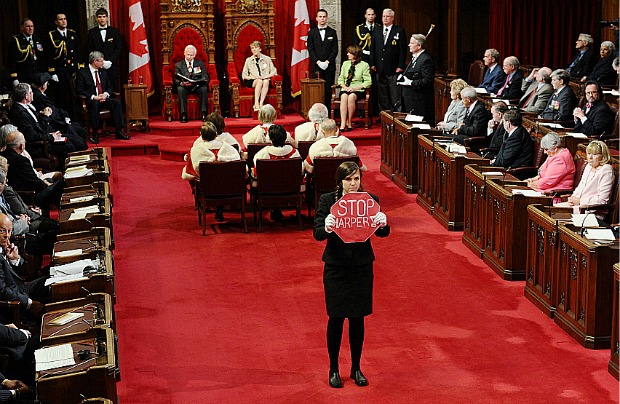
There is no shortage of Stop Harper videos on YouTube. A recent YouTube search yielded 3,740 hits, and I’m sure one could find more with a more refined search. Ever since Brigette DePape interrupted the Speech from the Throne with her iconic stop sign, activists have been inspired to amplify the message in on placards, T-shirts and in song.

What follows is a rundown of videos I’ve shot in and around Winnipeg. I invite readers to share their favorites in the comments section.


Stop Harper . . . the musical

August 2, 2012: Stephen Harper was in Gimli to make political hay out of a pledge to commit $18 million to dealing with the environmental problems facing Lake Winnipeg. After gutting  environmental protection laws in Canada to make way for dirty oil pipeline megaprojects and cancelling funding to the Experimental Lakes Area, we doubted his sincerity.

Despite our best efforts, we never got to see Harper close-up. In fact, his security detail took great pains to ensure he did not have to engage with anyone either than party faithful and selected media. But we did come up with this great song . . .

Hey Harper #StopHarper

Prime Minister Stephen Harper’s political motto must be “so many people to annoy – so little time.” Whether it is gutting environmental protection laws, wasting money on fighter jets that no one else wants to buy, denying health care to refugees or shutting down Parliament to avoid a non-confidence vote, Harper has been a disaster for Canada.

In this clip, Winnipeg’s renowned Flaming Trolleys Marching Band provide words and the rhythms that will be appreciated by any Canadian that is marching for democracy.

National Stop Harper Day in Winnipeg

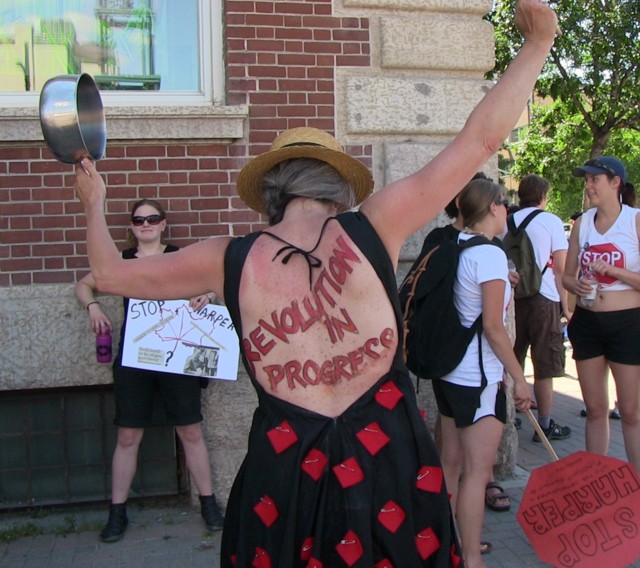
Traditionally a day of celebration, Canada Day 2012 became National Stop Harper Day for Canadians in 12 cities because of the regressive policies of the Harper government, most notably Bill C-38. In Winnipeg, citizens held a Funeral for Canada in the Osborne Village neighbourhood, a display of activist art at the St. Norbert Arts Centre and a Vigil for Canada on the outskirts of The Forks National Historic Site.

Stop Cuts to Refugee Health Care in Canada

Winnipeg, June 18, 2012: Opposition to the Harper government’s plan to cut health care for refugees reverberated across Canada. Joining in a National Day of Action Against Refugee Health Cuts, about 500 Winnipeggers rallied at The Forks to hear from health care professionals and newcomers to Canada about the threats posed by Harper’s plans.

In this clip, Dr. Michael Dillon outlines the impressive line-up of opposition to these cuts, the outcomes of which, according to Canadian Doctors for Medicare, “could range from diabetics not getting their insulin, to children not receiving immunizations, to letting people succumb to heart attacks.”

Joyce has a choice! Let her hear your voice!

Conservative MP Joyce Bateman (Winnipeg South Centre) had a choice: stand up for the democratic rights of her constituents – and all Canadians – or vote for Bill C-38 – a draconian bill that included a budget which cuts a wide range of necessary services with amendments to over 70 existing laws. She chose the latter. By cramming all of these changes into an omnibus bill and rushing it through Parliament’s Finance Committee, Harper prevented MPs from examining and debating these measures in detail. Once again Harper showed his contempt for democracy.

In this clip, marchers gathered at Bateman’s constituency office to ask her to vote against Bill C-38.


Churchill MP Niki Ashton gave an impassioned speech at the July 11th Winnipeg rally for a national inquiry into missing and murdered aboriginal women. In addition to posting the video, I’m providing a transcript because it neatly sums up this ongoing tragedy and the Harper government’s decisions that have served only to make matters worse.


Winnipeg, July 11, 2012: Churchill MP Niki Ashton speaking at a rally in support of provincial and national inquiries into missing and murdered aboriginal woman in Canada. Photo: Paul S. Graham

Our message is clear. There is an epidemic of missing and murdered aboriginal women in Canada.

Let’s look at those statistics. Over 600 aboriginal women missing. One aboriginal woman is three-and-a-half times more likely to experience violence than a non-aboriginal woman. A young aboriginal woman is five times more likely to die from violence than a non-aboriginal woman in Canada.

But this isn’t about the statistics. It’s about the daughters, the sisters, the mothers, the grandmothers, the friends that have gone missing. It is about the broken families and the broken communities and the people that are grieving. And it is time to recognize that we need action. We need a national inquiry into missing and murdered aboriginal women.

International organizations have spoken out. Amnesty International — even the United Nations – are beginning to understand and have said they understand the magnitude of this issue.

But where is our federal government? Not only have they failed to recognize the magnitude of this tragedy, they have cut the programs that would help to be part of the solution — the loss of Sisters in Spirit, the cuts to the Native Women’s Association of Canada, the loss of the National Aboriginal Health Organization, the loss of the Women’s Health Network, the loss of the Aboriginal Healing Foundation, the loss of the First Nations Statistical Institute.

We need action and we need to find out what’s going on. We need an inquiry that will look into the underlying causes of why aboriginal women face so much violence.

The debilitating impact of a residential school legacy, crushing poverty, Third World living conditions on First Nations, overcrowding in housing, the lack of access to education and health care —

My message to Stephen Harper is: “Mr. Harper — if you’re not part of the solution, YOU are part of the problem.”

But in this darkness there is hope. There is hope that, with an inquiry and a call for action and a commitment to that action, we will be able to prevent this violence from continuing to take place. And more importantly, there will be an ability to bring justice to the memories of the women that have been missing, that have been murdered — to their families, to their communities.

So we are here and we are not asking. We are demanding that there be a national response to a national epidemic. We are demanding a national inquiry. And we will not rest until we hear from the federal government — until there is a national inquiry to finally put an end — so that no aboriginal woman — no woman — dies because she is an aboriginal woman — in a country as wealthy as Canada — in the year 2012 and beyond. Thank you. Meegwetch.


More: Video: Manitoba’s Grand Chiefs demand provincial, national & international inquiries into missing & murdered women


Winnipeg: July 11, 2012: Three of the several hundred demonstrators who marched through downtown Winnipeg demanding public inquiries into the the deaths and disappearances of 600 hundred indigenous women in Canada. Photo: Paul S. Graham

More than 600 indigenous women in Canada are believed to have gone missing or been murdered in recent years.  The slowness of governments to act and the lack of progress where governments have acted have spurred Manitoba’s aboriginal organizations to demand full-scale provincial and national inquiries.

The Assembly of Manitoba Chiefs, Manitoba Keewatinowi Okimakanak and the Southern Chiefs Organization have written to Prime Minister Stephen Harper, urging that he hold a national inquiry that would look at all aspects of the issue.

The Chiefs have sent a parallel request to Eric Robinson, Deputy Premier of Manitoba and Minister of Aboriginal and Northern Affairs. Both letters are available on the web site of the Assembly of Manitoba Chiefs.

So far, Manitoba’s and Canada’s governments have shown no interest in public inquiries. Manitoba’s Justice Minister, Andrew Swan, claims he does not support an inquiry because it could “get in the way of a criminal investigation” that led to the arrest of Shawn Cameron Lamb on charges of killing three aboriginal women in Winnipeg.

The Chiefs hope that will change if their efforts to have the United Nations become involved bear fruit. Says MKO Grand Chief David Harper, “The province will not inspect itself, Canada will not inspect itself . . . We’re going to the United Nations.”

The AMC, MKO and SCO held a rally in Winnipeg on July 11, 2012. Several hundred Winnipeggers marched from the Forks National Historic Site to the TD Centre near the corner of Portage and Main in support.

Here is some of the video I shot at this event. Featured in this video clip are Assembly of Manitoba Chiefs Grand Chief Derek Nepinak, respected community elder Mae Louise Campbell and David Harper, Grand Chief of Manitoba Keewatinowi Okimakanak.

In this clip, Winnipeg City Councillor Ross Eadie makes an impassioned plea for justice for Aboriginal People, declaring “We are all Treaty People!”


Canada’s Chief of Defence Staff Gen. Walt Natynczyk Photo: Jake Wright, The Canadian Press

This interview with Canada’s Chief of Defence Staff says more about the psychopathology of militarism than I would have believed could be found in a daily newspaper. Read along with me and ask yourself what kind of madness are we allowing to develop in this country.

My thoughts are in the right hand column. I’d be interested in hearing yours.

Canada’s top soldier says troops ready and eager for new overseas missions

By Bill Graveland, The Canadian Press
Winnipeg Free Press, July 7, 2012

CALGARY – When it comes to future missions for the Canadian Forces, Canada’s top soldier has to battle to keep his eager troops satisfied with staying out of major combat zones for now.

Our military exists, or should exist, to defend this country from aggressors while occasionally helping Torontonians dig out of blizzards and Manitobans fight floods. However, it seems that rather than guardians of national sovereignty and security we have a pack of blood thirsty attack dogs on a leash, restrained only by the herculean efforts of Chief of Defence Staff Gen. Walt Natynczyk.

Canada’s military presence in Afghanistan will come to an end once the current training mission concludes in 2014 and Chief of Defence Staff Gen. Walt Natynczyk acknowledges that’s a disappointment for many soldiers, sailors and air personnel.

If Natynczyk is correct in his assessment, we have allowed our military to become a haven for a large number of homicidal psychopaths. Is this what happens after a decade of war?

“We have some men and women who have had two, three and four tours and what they’re telling me is ‘Sir, we’ve got that bumper sticker. Can we go somewhere else now?’” Natynczyk said in an exclusive interview with The Canadian Press in Calgary.

These men and women need help. Failing that, they should never be allowed to own anything sharper than soup spoons.

“You also have the young sailors, soldiers, airmen and women who have just finished basic training and they want to go somewhere and in their minds it was going to be Afghanistan. So if not Afghanistan, where’s it going to be? They all want to serve.”

I like it when our troops are on hand to fight floods and forest fires. I’d prefer not paying taxes to help them make their bones overseas. If they are really that eager to kill people, our American cousins seem to have an insatiable appetite for cannon fodder.

But Natynczyk is unsure about what is in store for the Canadian Forces or even himself for that matter.

If you believe that, I have some prime muskeg, suitable for agriculture, that you won’t be able to resist.

He has been on the job for four years, which is past the normal tenure for someone in his position, and if he knows what is going to happen next, he isn’t providing any details.

“I’ll just keep on sprinting in this job until I’m told to get off the playing field and recognizing that I’m living in a pretty good time to be in the military,” he said.

Ah, so many people to kill, so little time!

“I never aspired to this job. I just serve. I serve Canadians and the country and look on every day as an opportunity to make a contribution.”

If you really want to serve, Walt, there’s a Starbuck’s near you that is always looking for talent.

Natynczyk said he is telling Canadian troops to keep their “kit packed up” because the world is an unpredictable place right now.

Iran? Syria? Northern BC, if the First Nations don’t allow Enbridge to build it’s Northern Gateway Pipeline?

“The world is turbulent right now and the fact is our allies want more of Canada, more of the men and women who wear Canadian uniforms,” he said.

Our allies want us to kill more brown people who have the misfortune to be in some proximity to undeveloped fossil fuels. We happen to be good at it, I guess.

“I’ve told them all to catch up on that training that lapsed while we had this high operational tempo between Afghanistan and the Olympics and Haiti and Libya, and let’s make sure we have all qualifications and training up to date so when we’re called upon we’re ready to go.”

We’re learning new ways to kill people every day.

The general said outside of Afghanistan, Canada has a number of other smaller missions underway including in the Middle East, Africa and the Caribbean.

Oh, and guess what! We’re opening up seven new military bases on foreign soil in Senegal, South Korea, Kenya, Singapore, Kuwait, Jamaica and Singapore.

Natynczyk said he is satisfied with the success of the Canadian mission to Afghanistan and pointed out that he flew into Kabul on a commercial airliner for the first time when he visited troops in the city last month.

Let’s see now . . . at great cost to ourselves and and a much greater cost to the Afghan people, we’ve helped a gang of drug lords maintain some control of a couple of urban centres which, when NATO leaves, will undoubtedly revert to Taliban control. The good news is, however, when the dust finally settles, commercial airlines will still fly into Kabul – just like they did before we invaded.

He said the departure of Canadian and U.S. troops will give the Afghan forces the little push that they need to succeed.

“It has helped the Afghans in a sense, taking ownership of their own security. One of the real challenges was the sense that NATO and our allies were going to stay there forever. (That) actually was not helpful in terms of their own culture and own atmosphere,” he said.

Natynczyk is a master of understatement.

Natynczyk is focusing much of his efforts now in making sure more attention is being paid to injured soldiers and their families, especially those suffering from the psychological effects of war.

Shattered bodies and broken minds are the inevitable outcomes of war. Why is Natynczyk so eager to get into another one?

“It’s almost easier to handle people with physical injuries, with physical wounds. People can see it. They can understand it, whether it be shrapnel, a broken leg, even these horrific amputations,” he said.

“It’s much more difficult in the mental injury, whether it be post traumatic stress, operational stress injury, traumatic brain injury because we’re just understanding the beginning of a process of understanding the complex nature of this.”

According to The Department of National Defence, 19 men and one woman died by suicide in the Canadian Forces in 2011, up from 12 in 2010. Since 1996, 187 soldiers have committed suicide. How many more suicides are we going to tolerate while the military is figuring out the “complex nature of this”?

Natynczyk said he talked about mental health on his last visit to Kabul, especially about overcoming the “stigma” of mental issues and making sure people come forward if they have a problem.

And how’s that workin’ for ya, Walt?

July 1, 2012: National Stop Harper Day in Winnipeg. Photo: Paul S. Graham

Traditionally a day of celebration, Canada Day 2012 became National Stop Harper Day for Canadians in 12 cities because of the regressive policies of the Harper government, most notably Bill C-38.

In Winnipeg, citizens held a Funeral for Canada in the Osborne Village neighbourhood, a display of activist art at the St. Norbert Arts Centre and a Vigil for Canada on the outskirts of The Forks National Historic Site.

Naturally, I brought my camcorder.


Winnipeg, June 18, 2012: Opposition to the Harper government’s plan to cut health care for refugees is gaining momentum across Canada. Joining in a National Day of Action Against Refugee Health Cuts, about 500 Winnipeggers rallied at The Forks to hear from health care professionals and newcomers to Canada about the threats posed by Harper’s plans.

In this clip, Dr. Michael Dillon outlines the impressive line-up of opposition to these cuts, the outcomes of which, according to Canadian Doctors for Medicare, “could range from diabetics not getting their insulin, to children not receiving immunizations, to letting people succumb to heart attacks.”

More information

June 9, 2012: Citizens opposed to Bill C-38 pause for a moment outside of Conservative MP Joyce Bateman’s Winnipeg South Centre office before continuing to distribute literature in the constituency. Photo: Paul S. Graham

Stephen Harper’s Bill C-38 continues to generate controversy and opposition across Canada. In Winnipeg, a group of citizens have joined Lead Now’s “13 Heroes” campaign that is aimed at convincing enough Conservative MPs across the country to force the Prime Minister to back down on his budget implementation bill. The focus in Winnipeg is on Conservative MP Joyce Bateman (Winnipeg South Centre).

C-38 is an omnibus bill that combines budgetary spending and cuts with amendments to over 70 pieces of existing legislation. Among the bill’s lowlights, it

  • repeals the Canadian Environmental Assessment Act and introduces a weaker version
  • kills Canadian world-class science research centres, closing or selling the Experimental Lakes Area, The Cereal Research Centre at the University of Manitoba, marine & climate-monitoring programs
  • removes protection of endangered species and their habitat, when approving pipeline projects, by amending the Species at Risk Act and the Navigable Waters Protection Act
  • guts the Fisheries Act by removing provisions for habitat protection
  • repeals the Kyoto Protocol Implementation Act
  • eliminates the National Round Table on Environment and Economy
  • repeals the Fair Wages Act
  • reforms Old Age Security by raising the age of eligibility for the program
  • forces EI users to accept work that does not correspond to their training or customary salary

While Canadians and their MPs should debate the merits of these various measures, Harper will not allow this to happen. Because they have been stuffed into one Bill, these proposals will not get the individual attention they deserve. As you read this, the package is being rushed through one Parliamentary Committee — the Finance Committee. The Finance Committee is neither mandated nor equipped to assess the impacts of these wide-ranging amendments. Once again, Harper is showing his contempt for Canadians, for Parliament and for democracy itself.

Parliament may vote on Bill C-38 as soon as June 14th. The Opposition Parties are lined up to oppose the Bill, but with his majority, Harper will prevail unless we can convince some of his backbenchers to stop acting like sheep and listen to their constituents. Thirteen, to be precise. If thirteen Conservative MPs choose democracy, Harper can choose to back down or face an election.

On June 13, expect rallies outside of Conservative MPs offices. You can find out about the one nearest you here. If you live in Winnipeg, two events are planned:

Information picket in front of Joyce Bateman’s office (611 Corydon Avenue) from 4:00 to 6:00 p.m. Show up at three and you can help make picket signs.

Bill C-38 Dialogue Event, The University of Winnipeg, Room 2M70 (515 Portage Ave), from 7:00 to 9:00 pm

If you can’t make it, or abhor crowds, you can still remind Joyce Bateman that she has a choice. Contact her at

House of Commons
Ottawa, Ontario
K1A 0A6
Telephone:  613-992-9475
Fax:  613-992-9586
Email:  Joyce.Bateman@parl.gc.ca

or

102-611 Corydon Avenue
Winnipeg, Manitoba
R3L 0P3
Telephone: 204-983-1355
Fax: 204-984-3979

Finally, here’s a bit of video I recorded Saturday at Joyce Bateman’s office. But first, go to the kitchen and assemble your favorite noisemakers. Then play the video and chant:

“JOYCE HAS A CHOICE! LET HER HEAR YOUR VOICE!”