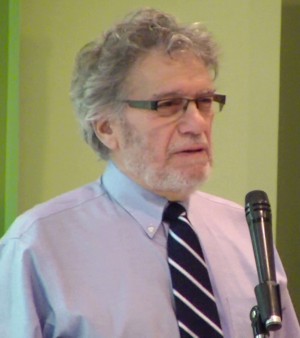
Roger Annis at the Feb. 24, 2013 annual meeting of Peace Alliance Winnipeg. Photo: Paul S. Graham
Is the military intervention in Mali by France, with the assistance of the United States, Canada and others an example of a humanitarian intervention launched to protect a fragile democracy from the incursion of Muslim terrorists? Or is France meddling in the affairs of its former colony to protect its business interests and further the political and economic interests of its NATO partners?
Roger Annis, coordinator of the Canada-Haiti Action Network and longtime political activist, explored these questions at the Annual General Meeting of Peace Alliance Winnipeg, held Feb. 24, 2013 in Winnipeg.
If you want to read more on this issue, Roger has published a number of thoughtful articles on his blog.
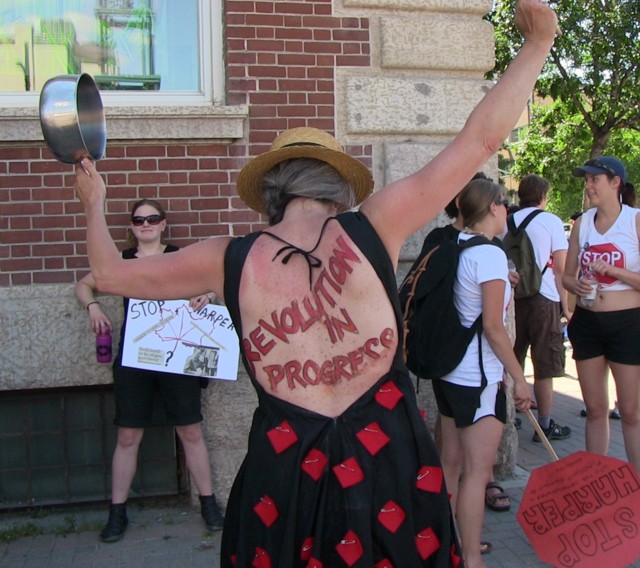
July 1, 2012: National Stop Harper Day in Winnipeg. Photo: Paul S. Graham
Traditionally a day of celebration, Canada Day 2012 became National Stop Harper Day for Canadians in 12 cities because of the regressive policies of the Harper government, most notably Bill C-38.
In Winnipeg, citizens held a Funeral for Canada in the Osborne Village neighbourhood, a display of activist art at the St. Norbert Arts Centre and a Vigil for Canada on the outskirts of The Forks National Historic Site.
Lester B. Pearson has been dead for four decades, but his imagined legacy, that of international peacekeeper, remains one of the defining myths of the Canadian identity. Horrified by our murderous behavior in the occupation of Afghanistan and the bombings of Libya and the former Yugoslavia, the sainted memory of our 14th prime minister is resurrected by people who ought to know better to argue that war-making is not really a Canadian value, that we need to retake our traditional place in the global community as a progressive force for international co-operation, harmony and peace – that we must, again, assume the mantle of our revered Nobel Peace Prize laureate, Mike Pearson.
Yves Engler‘s sixth book, Lester Pearson’s Peacekeeping: The Truth May Hurt, was written to put an end to this nonsense. Canadian foreign policy continues to serve the interests of Canada’s corporate elite, and Pearson’s major contribution to this end was to shift Canadian allegiance from the declining British Empire to the emerging American one. With his peacekeeping fig leaf firmly in place, he backed some of the most murderous thugs of the 20th Century. As Noam Chomsky puts it in the preface to Engler’s book:
“Canada’s Nobel Peace Prize winner and eminent statesman, Lester Pearson was a major criminal, really extreme. He didn’t have the power to be like an American president, but if he had it, he would have been the same. He really tried.”
To encapsulate the book, Yves assembled a list of the “Top 10 things you don’t know about Canada’s most famous statesman, Lester B. Pearson.”
10. Asked in Parliament, he refused to call for Nelson Mandela’s release from prison.
9. He had Canada deliver weapons to the French to put down the Algerian and Vietnamese independence movements.
8. The Kennedy administration helped Pearson win his first minority government.
7. He incited individuals to destroy a peace group after it called for the outlawing of nuclear weapons.
6. Pearson backed the CIA coups in Iran and Guatemala.
5. He described the formation of NATO, not peacekeeping, as the “most important thing I participated in.”
4. Pearson threatened to quit as external affairs minister if Canada failed to deploy ground troops to Korea.
3. He agreed to have Canada’s representatives to the International Control Commission for Vietnam spy for the US and deliver their bombing threats to the North.
2. The world’s leading intellectual, Noam Chomsky, considers Lester Pearson a war criminal.
1. Stephen Harper’s foreign policy resembles that of Pearson more than any Liberal would ever admit.
UPDATE: You can watch a video report of Yves Engler’s March 15th Winnipeg presentation here.
Foreign policy analyst Yves Engler will be speaking in Winnipeg Thursday about his newest book, Lester Pearson’s Peacekeeping: The Truth May Hurt.
Date: Thursday, March 15, 2012 Time: 7:30 p.m. Location: Mondragon Bookstore and Coffee House, 91 Albert Street, Winnipeg Admission: Free. Donations will be requested to help defray expenses.
Written in the form of a submission to an imagined “Truth and Reconciliation” commission about Canada’s foreign policy past Lester Pearson’s Peacekeeping: The Truth May Hurtchallenges one of the most important Canadian foreign policy myths – that of Lester B. Pearson as peacekeeper.
Lester Pearson is one of Canada’s most important political figures. A Nobel Peace Prize laureate, he is considered a great peacekeeper and ‘honest broker.’ But in this critical examination of his work, Pearson is exposed as an ardent cold warrior who backed colonialism and apartheid in Africa, Zionism, coups in Guatemala, Iran and Brazil and the U.S. invasion of the Dominican Republic. A beneficiary of U.S. intervention in Canadian political affairs, he also provided important support to the U.S. in Vietnam and pushed to send troops to the American war in Korea.
Yves Engler has published five other books:
Stop Signs — Cars and Capitalism on the Road to Economic, Social and Ecological Decay (with Bianca Mugyenyi)
The Black Book of Canadian Foreign Policy (Shortlisted for the Mavis Gallant Prize for Non Fiction in the Quebec Writers’ Federation Literary Awards)
Playing Left Wing: From Rink Rat to Student Radical and (with Anthony Fenton)
Canada in Haiti: Waging War on The Poor Majority
Canada and Israel: Building Apartheid
His six books have been praised by Naomi Klein, Noam Chomsky, William Blum, Rick Salutin and many others.
The National Energy Board is conducting hearings on Enbridge’s proposal for a pipeline from Alberta’s tar sands to the town of Kitimat in the heart of BC’s Great Bear Rainforest. If approved, over 200 oil tankers would be navigating the difficult waters off BC’s Northwest Coast each year, making widespread environmental damage to BC’s coastline only a matter of time. Moreover, it will facilitate the marketing of even more dirty oil from Alberta’s tar sands, fueling that unfolding ecological catastrophe with profound consequences for the rest of Canada and the world.
The project is meeting fierce opposition, especially in northern BC, and the federal government has declared war on anyone who opposes this project. In Winnipeg, a coalition of environmental groups banded together to hold a public forum on February 16, 2012 at the University of Winnipeg entitled Tar Sands, Pipelines and Tankers. Over 300 people turned out to view an excellent 16-minute documentary by Pacific Wild entitled Oil in Eden and to dialogue with an expert panel, moderated by journalist Ricard Cloutier.
The Panel
Dr. Wade Davis is Explorer in Residence, National Geographic Society, Visiting Professor and Senior Fellow of the Masters in Development Practice (MDP) Indigenous Development program, University of Winnipeg.
As well, he is the author of The Sacred Headwaters: the fight to save the Stikine, Skeena and Nass.
Gerald Amos was Chief Councillor for the Haisla First Nation for 12 years. He has been a leading voice for conservation in Canada for thirty years.
He is the author of an open letter to Prime Minister Stephen Harper and Natural Resources Minister, Joe Oliver “No apology forthcoming.”
Lynne Fernandez, of the Canadian Centre of Policy Alternatives has an MA in economics from the University of Manitoba. As a research associate at the Manitoba office of the Canadian Centre for Policy Alternatives, Lynne has studied municipal and provincial social and economic policy. She is also interested in labour and environmental issues.
Anne Lindsey is former executive director of the Manitoba Eco-Network. Since 1984, Anne has worked on such Manitoba and national issues as nuclear waste, forestry, food, pesticides and environmental reviews.
I hope you can schedule some time to view the video report I prepared in collaboration with Ken Harasym for Winnipeg Community TV. At two-and-a-half hours, it is long, but it is crammed with information and analysis that make it well worth the time.
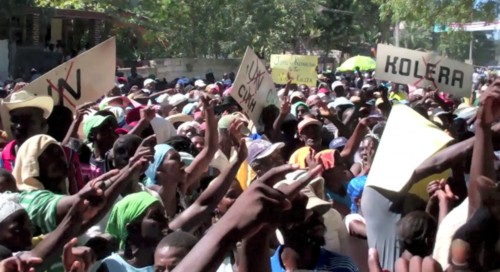
December 9, 2011: Angered by the UN-caused cholera epidemic that has claimed thousands, Haitians rallied at the UN Stabilization Mission in Haiti (MINUSTAH) Base at St. Marc. Photo: from a video produced by Nick Stratton, Bureau des Avocats Internationaux. Watch it at http://ijdh.org/archives/24340.
Two years after an earthquake killed 158,000, the majority of Haitians continue to battle against hunger, disease, homelessness and political repression. Half a million people remain in refugee camps and many thousands who have found other accommodations are living in buildings that have been designated as unsafe and requiring demolition or major repairs.
Clean water is unavailable to almost half the population and sanitation, in the form or latrines, is available to only 34%. It is a formula for disease, and the 2010 cholera outbreak, traced to the criminally negligent sewage disposal practices of UN troops, sickened nearly 500,000 people and killed more than 6,500 others.
With all of the aid money that has been pouring into Haiti, it would not be unreasonable to expect living conditions to be much better than they are. Journalist Kim Ives, a writer and editor of Haiti Liberté, who spoke on this topic last Thursday at the University of Manitoba, provided this summary:
$2.4 billion in bilateral relief aid (emergency aid) delivered to date
$4.5 billion was pledged for bilateral recovery in 2010, 2011 (plus $1 billion for debt relief). As of Dec, 2011, $2.4 billion of that was delivered.
Donors have dispersed an additional $560 million in recovery assistance.
An additional $3.1 billion for relief and recovery from NGOs and other private donors. (The largest share of that came from the Red Cross, which raised $1.4 billion; of that, only 50% has been spent. I wonder where the rest went?)
Cholera treatment funding of $172 million has been promised; $130 million has been disbursed.
Clearly something is wrong. Kim Ives summarized the obstacles to effective aid and reconstruction as follows:
A weak and under-funded national government, as a result of two centuries of foreign intervention and plunder
A large presence of international aid organizations and UN agencies, accountable, first and foremost, to their donors and home governments
A right-wing presidency brought to power through an exclusionary and fraudulent electoral process
A foreign police and military force (MINUSTAH) dating from the 2004 coup d’etat and whose purpose is to preserve the status quo
Gerry Caplan is a former CUSO field officer, author of The Betrayal of Africa, a weekly, online columnist for The Globe and Mail, a featured television political commentator and a veteran CCF-NDP war horse. He was also my boss at CUSO for a brief period in the late 70s, something he doesn’t remember – which may be all for the best :-).
Gerry was the keynote speaker at a dinner held in Winnipeg December 10, 2011 to mark the 50th anniversary of CUSO and the 63rd anniversary of the adoption of the Universal Declaration of Human Rights by the United Nations on Dec. 10, 1948.
The title of his talk was advertised as “When good people do bad things.” Fortunately for those present and for his reputation as a rabble rouser, the theme that emerged would be more appropriately described as “solidarity, not charity.”
This event was sponsored by the University of Winnipeg Global College, CUPE Manitoba, the Manitoba Council for International Co-operation and CUSO-VSO. It was held at the Union Centre in downtown Winnipeg. Here is my video report.
Friends of Canadian Broadcasting continues to raise the alarm over threats to our nation’s public broadcaster and well they should. While Heritage Minister James Moore promised in May to maintain and expand support for the CBC, Tory antipathy to the CBC is well known. Recent initiatives, such as the petition by Tory MP Rob Enders to end CBC funding cast doubt on the Tory pledge to support the CBC. (His surname says it all, eh?)
Because Harper is a notorious control freak, no Tory backbencher who wanted to keep getting nominated would post a petition of this sort without his blessing. This has to be taken seriously.
The Friends have taken a humorous approach in their current attempt to awaken Canadians to the Tory threat. I hope it works.
Under Harper’s majority government, we are beginning to see the unraveling of Canada.
Yesterday, they did something similar to western grain farmers when they effectively killed the Canadian Wheat Board without allowing grain producers their legally required right to a plebiscite on the question.
To complete the portrait of power drunk right wing ideologues, their response to falling crime rates is to build more prisons and jail more offenders for longer sentences in defiance of all the evidence that this approach has not worked anywhere it has been tried.
The next four years will be trying times for Canadians who do not want to see our society hideously disfigured. We will have to fight them every step of the way. Take a moment to see how you can begin this by supporting the Friends of Canadian Broadcasting.
An open letter to Canada’s Prime Minister, Members of Parliament, and Senators, from a broad and diverse coalition of 46 organizations representing millions of Canadians –
Support Canadian Food, Canadian Farmers, and the Canadian Wheat Board
Bill C-18, if passed, will destroy the Canadian Wheat Board (CWB). Agriculture Minister Gerry Ritz has repeatedly stated that he will not recognize the plebiscite recently conducted by the CWB, in which results were clearly in favour of keeping the CWB as the sole marketing agent for prairie wheat and barley intended for human consumption.
The CWB was created by an Act of Parliament, and is run by a 15-member Board of Directors, ten of whom are elected by farmers. The Wheat Board provides fair, equitable, reliable, and cost-effective services to farm families. It provides stability in uncertain times, and is a foundation of Canada’s grain sector.
Ending the single desk authority of the CWB would throw western agriculture into turmoil and would transfer wealth created by Canadian farmers to big, private, often foreign-owned grain companies—money now returned to farmers, who spend it in their communities. The Minneapolis Grain Exchange has already changed its rules to allow for speculation in futures contracts for Canadian wheat and barley—a move which will increase price volatility for purchasers without providing any benefit to farmers.
Canada’s political system is built on representative democracy. This means that the law, not merely the person in power, is to be respected and followed. The CWB Act is a law made by Parliament, and it requires a farmer vote before any substantive changes are made to the single desk authority. Our current government is ignoring this law—refusing to hold the required vote—and moving to eliminate the requirement for a vote. This is deeply concerning, as it strikes at the heart of our Canadian democracy.
We the undersigned:
Recognize the billions of dollars of economic value that the CWB creates each year—for farmers, rural communities, short line railroads, and the whole of Canada—as a result of its superior marketing ability, capacity to defend Canadian interests in trade disputes, and commitment to return to farmers all net proceeds from sales.
Are proud of the strong international reputation for quality and reliability that Canadian wheat and barley have earned—a direct result of the CWB and its companion institutions, the Canadian Grain Commission and Canadian International Grains Institute.
Deplore the government’s disregard for the outcome of the recent plebiscite in which 62% of farmers voted in favour of keeping the single desk for wheat and 51% supported keeping the single desk for barley.
We therefore call upon the Prime Ministers, MPs, and Senators to immediately stop undermining the single desk authority of the CWB. We further insist that Parliament must comply with the Canadian Wheat Board Act, Section 47.1, which requires a binding plebiscite (vote) of farmers before any substantive change to the CWB’s single desk authority is initiated.
Signed:
Agriculture Workers Alliance
Bathurst Street United Church, Toronto
Big Carrot Natural Food Market
Biofreedom
Brandon University Students’ Union
Briarpatch Magazine
Canadian Auto Workers (CAW)
Canadian Labour Congress
Canadian Union of Postal Workers (CUPW)
Canadian Union of Public Employees (CUPE)
Canadian Wheat Board Alliance
CCNB Action (Conservation Council of New Brunswick)
Centre for Social Justice
Coalition On The Niagara Escarpment
Council of Canadians
Council of Canadians – Moose Jaw, Sask. Chapter
Council of Canadians – Prince Albert, Sask. Chapter
Council of Canadians – Winnipeg, Man. Chapter
CWA/SCA (Communications Workers Union) Canada
Food Action Committee of the Ecology Action Centre
Food Secure Canada
Friends of the Canadian Wheat Board
GE Watch Comox Valley
GRAIN
Grain Services Union (GSU)
Greenpeace Canada
Growing Food Security in Alberta
Health Sciences Association of Alberta
Inter Pares
International Brotherhood of Electrical Workers (IBEW) Local 529
Lardeau Valley Seed Savers
Les AmiEs de la Terre de Québec
LIFT (Low Income Families Together)
National Farmers Union
National Union of Public and General Employees (NUPGE)
New Brunswick Common Front for Social Justice
Ontario Public Interest Research Group (OPIRG) – Windsor
Organic Food Council of Manitoba (OFCM)
Oxfam Canada
Saskatchewan Federation of Labour (SFL)
Saskatchewan Union of Nurses (SUN)
Society for a GE Free BC
The Ark Farm, B&B, Vegetables, & Native Plants
Union paysanne
United Church of Canada
United Food and Commercial Workers (UFCW)
Stop the steamroller
Make your voice heard by sending a message to the PM and your MP at Stop the Steamroller.