Nov. 8, 2011: 300 Winnipeggers demonstrated at the Manitoba Legislature and the Winnipeg Remand Centre to urge the Manitoba Government to join Quebec, Ontario and Newfoundland and Labrador in opposing the Harper government’s omnibus crime bill, misleadingly titled the Safe Streets and Communities Act (aka Bill C-10). Their key message, “time does not stop crime” rebutted the government’s contention that locking up more offenders for longer periods was an effective crime prevention technique.
As I noted in an earlier post, the John Howard Society of Manitoba estimates Canadians will pay $2 billion annually to cover the costs of the bill, which calls for mandatory minimum sentences for a wide range of crimes regardless of individual circumstances. While this will trigger a huge increase in the number of inmates and a prison construction boom, it will do nothing to address the root causes of crime, nor will it lead to the rehabilitation of offenders.
Speakers:
John Hutton, Executive Director, John Howard Society of Manitoba
Shaun Loney – Executive Director, BUILD
Cora Morgan, Executive Director, Onashowewin
Tracy Booth, Executive Director, Elizabeth Fry Society of Manitoba
Jacquie Nicholson, Literacy Coordinator, John Howard Society of Manitoba
Alex Paterson, Occupy Winnipeg
The protest was sponsored by:
BUILD Winnipeg
Canadian Centre for Policy Alternatives
Canadian Federation of Students
Elizabeth Fry Society of Manitoba
Faculty of Social Work, University of Manitoba
Initiatives for Just Communities
Occupy Winnipeg
Ogijiita Pimatiswin Kinamatwin (OPK)
Mennonite Central Committee of Manitoba
School of Social Work, Université de Saint-Boniface
Social Planning Council of Winnipeg
Southern Chiefs Organization
William (Bill) VanderGraff, Law Enforcement Against Prohibition
Despite its well established habit of electing social democratic governments, Winnipeg has claimed some dubious honors — “Murder Capital of Canada” and “Child Poverty Capital of Canada” to name two of the most disturbing. Even though we have had 11 years of NDP government to undo the damage of Gary Filmon’s Conservatives, both poverty and crime are well entrenched in Manitoba, especially in Winnipeg.
92,650 children in Manitoba live in families under the poverty threshold
29,000 children in Manitoba live in families with annual incomes insufficient for meeting basic needs
29,563 Manitoban children use food banks each month because their families cannot afford to purchase the necessary food they require
59,734 Manitobans accessed Employment and Income Assistance
The richest 20% of Manitoban families have more total income than the poorest 60% of the population
The Council says these statistics have not changed significantly since 1989, the year the House of Commons pledged to end child poverty in Canada by the year 2000.
What is to be done? According to the Manitoba Green Party, 80 per cent of all expenditures on social assistance programs are consumed by government bureaucracy. They proposed, in the last provincial election, to replace welfare benefits with a Universal Basic Income benefit, payable to all Manitobans, that would ensure no one slipped below the poverty line. The idea has merit and I hope the Greens continue to explain and promote it.
Yet another group of Manitobans proposes a package of measures they call a “Justice Charter to End Poverty in Manitoba.” I’ve included it at the end of this piece.
They also hold an annual event called the Four Directions Walk to End Poverty in which four contingents begin their walk on the outskirts of town and converge on the Manitoba Legislature. They held their fourth such walk on Saturday, Oct. 22. Naturally, I brought my video camera.
Justice Charter to End Poverty in Manitoba
We the people of Manitoba, seeing the growing gap between the wealthy and people in need, the working poor, and discriminated groups want to act in a timely manner to reverse the situation, to provide for people with needs and support the right for everyone to contribute to society to the best of their ability. To this end we make these demands and will work to make them a reality:
Housing must be a right and a comfort, not a constant crisis!
End subsidies to private landlords.
Establish stricter rent controls.
Enact a Tenant Bill of Rights.
Build and maintain public housing to the standard building code.
No utility cut-offs; establish a panel with legal power to require landlords to pay.
Universal health care for all, for every need!
Expand medicare into a comprehensive health care system focusing on prevention.
Extend medicare to cover all essential needs such as eye, drug, dental, ambulance and prosthetics.
Reduce pollution from mining and manufacturing, especially next to low income neighborhoods.
Jobs are a human right. Create good-paying jobs for all!
Create jobs through a massive investment in public housing, a public child care program, and conversion to a “green” economy.
Increase the minimum wage to $14 an hour.
Quality job creation by ensuring access to education, ending tuition fees, free student housing, education in Aboriginal and any other language where numbers warrant.
Access to better jobs – reduce the work week with no loss in pay, add paid vacation days and reduce the pension age for women to age 60.
End the Foreign Temporary Worker program, give these workers full labour rights and make them immigrants to Canada, if they so choose.
Provide for those in need!
Introduce a Guaranteed Liveable Income, above the poverty line and indexed to inflation.
Improve special needs benefits and introduce a fast appeals process with free advocacy services.
A public, high quality, free child care program employing well-paid early childhood development professionals.
Establish a hot breakfast program for children in schools.
For injured workers, establish a fast and free appeals process independent of the Workers Compensation Board. Provide free legal services and always respect the right to appeal.
Establish a Manitoba pension credit plan funded by payroll deductions, a surtax on corporate income to top up pensions above the poverty line and an inheritance wealth tax.
Establish a federally-chartered, publicly-owned bank that does not discriminate against people in poverty, is located in low-income areas, and provides free or nonprofit cheque cashing services and international fund transmittals.
Establish a province-wide, free and publicly-owned handi-transit service for people with disabilities.
Establish price controls for essential foods throughout Manitoba.
End racism, sexism and discrimination of all forms!
Support immediate settlement of Aboriginal land claims and emergency action to end housing, health care and education inequality.
Take steps to recognize Aboriginal nations on a new basis in Canada, including full national rights and equal nation to nation relations.
Introduce immediately affirmative action hiring with mandatory quotas for Aboriginal people, people of colour, women and people with disabilities in both the public and private sector.
Job pay equity for all workplaces.
Replace the present legal system of retribution and punishment with principles of restorative justice – restitution and reconciliation; include “ability to pay” as a consideration for sentencing people to jail for nonpayment of fines.
Ban discrimination based on social or mental health conditions in the Human Rights Code.
Introduce a Manitoba Bill of Rights based on the Universal Declaration of Human Rights (1948), adding protections against all forms of sexism.
Reform the democratic system
Establish proportional representation so that people will vote for what they want and so that every person’s vote will count.
Pay Legislators the average worker’s wage and benefits in Manitoba.
The Justice Charter is for discussion by all Manitobans. The annual Four Directions Walk is Winnipeg’s largest annual anti-poverty activity. It is organized to encourage discussion of the ideas in this Charter. We invite groups representing Aboriginal peoples, women, workers, youth and students, people of colour, people with disabilities, injured workers, the working poor, people living in poverty, people of all faiths and nonbelievers – all supportive groups:
To establish a Four Directions Walk in other Manitoba communities.
To discuss the Charter and send us your ideas.
Contact us if you would like to receive information on the annual Walk, held on a Saturday close to the International Day for the Eradication of Poverty (October 17).
Oct. 15, 2011: Scenes from Occupy Winnipeg – and a reminder that what is now called Canada was occupied long before by the aboriginal peoples of this part of the world. It is time the descendants of the Europeans who took the land from the people who were here first do a much better job of sharing it with today’s First Nations.
Marchers in Saskatchewan in July 2008, in the "Walk for Missing Sisters" to raise awareness about missing aboriginal women, children and men. Photo: Native Women's Association of Canada
It is tragically ironic on this day, declared by the United Nations to be “for the elimination of violence against women,” to read that the UN has called on Canada to properly investigate the disappearances and murders of over 500 aboriginal women that have occured since 1980.
The United Nations is calling on the Harper government to investigate why hundreds of deaths and disappearances of aboriginal women remain unsolved.
It’s asking Ottawa to report back in a year on the status of more than 500 cases that “have neither been fully investigated nor attracted priority attention, with the perpetrators remaining unpunished.”
A federally funded $5-million study by the Native Women’s Association of Canada concludes that 510 aboriginal girls and women have vanished or been murdered since 1980. It calls for an emergency strategy.
This report from the UN is more evidence that the failure to investigate these disappearances is part of a larger, systemic failure to address violence against women, generally. According to the article
The UN committee also wants Ottawa to set minimum standards for welfare to better protect the most vulnerable citizens across Canada. And it raises alarms about lack of shelters for battered women, and Conservative government cuts that wiped out the Court Challenges Program — funding that helped advance minority rights.
The most common form of violence experienced by women globally is physical violence inflicted by an intimate partner. On average, at least one in three women is beaten, coerced into sex or otherwise abused by an intimate partner in the course of her lifetime.
This two-page factsheet is a grim litany of the most abominable crimes against woman that contains disturbingly little on what is being done to end them.
Violence against women is so pervasive that it is easy to feel overwhelmed by it all and seek solace in the knowledge that we are not directly involved in harming women. However, as Albert Einstein reportedly observed:
The world is a dangerous place to live, not because of the people who are evil, but because of the people who don’t do anything about it.
So, if you are not already involved, start doing something about it by learning about the aboriginal girls and women who have vanished or been murdered since 1980. You can begin at Missing Native Women.ca. You can help hold Harper accountable by signing a petition, here. And you can get a swack of info at Canadian Feminist Alliance for International Action.
And then there’s that matter of the war, where we are helping the Americans save the women and girls of Afghanistan, by dropping bombs on them . . .

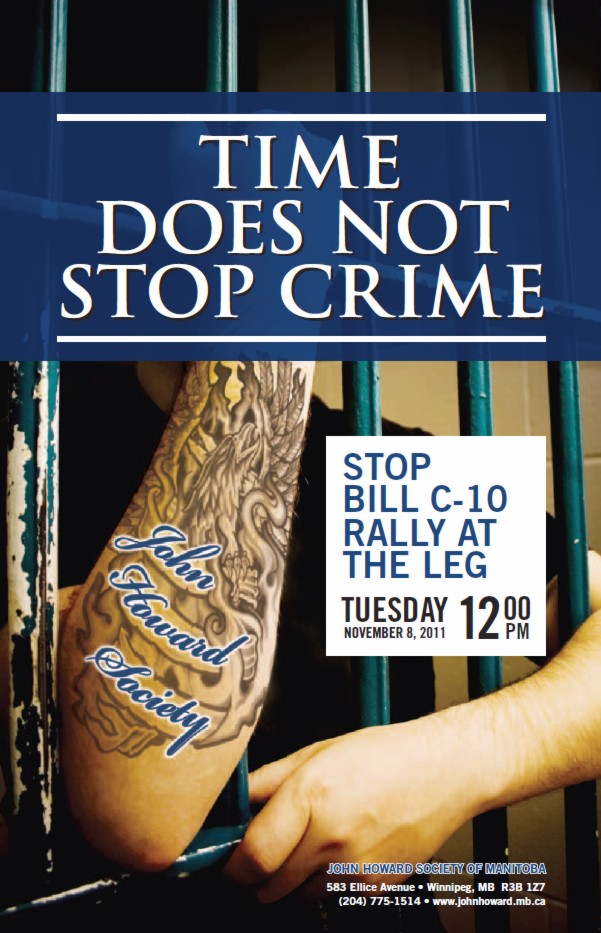 Nov. 8, 2011: 300 Winnipeggers demonstrated at the Manitoba Legislature and the Winnipeg Remand Centre to urge the Manitoba Government to join Quebec, Ontario and Newfoundland and Labrador in opposing the Harper government’s omnibus crime bill, misleadingly titled the Safe Streets and Communities Act (aka Bill C-10). Their key message, “time does not stop crime” rebutted the government’s contention that locking up more offenders for longer periods was an effective crime prevention technique.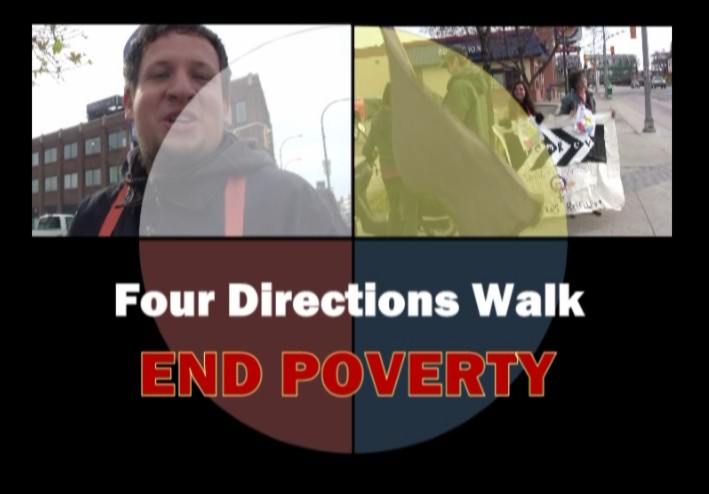


 Paul S. Graham