Author Archive

Mohamed Harkat and wife Sophie Lamarche at a press conference in Ottawa, Dec. 10, 2010. Photo: Sean Kilpatrick

By Sophie Lamarche

What was expected to be the end of a long nightmare and a great end to 2010 turned out to be a disaster. We can’t really put 2010 behind us because our battle continues. On Dec. 9th, 2010, the day before International Human Rights Day and the 8th-year anniversary of my husband Mohamed Harkat’s arrest under a security certificate, the Harkat family, his legal team, and his supporters across the country got a big punch in the guts.

It is one, Moe and I never expected. One, which many never expected! Our family, supporters, groups, unions and legal experts were all shocked at the recent ruling made by Justice Simon Noel from the Federal Court of Canada to uphold the security certificate against Moe.

The certificate was found ”reasonable” under the lowest standard of proof in a Canadian court. This decision was based on secret evidence neither Mohamed nor his public counsels could see or test for national security reasons. All that because CSIS believes, thinks, or assumes that Moe was involved or will be involved with terrorism in the past, present, or future. That position could cover any one of us at any time.

To this day, he still does not know the evidence against him. We have all been kept in the dark for eight years.

Mohamed Harkat was arrested and thrown in jail on Dec. 10th, 2002. He is the only inmate to ever be detained for 43 long months at the Ottawa Carleton Detention Centre without ever knowing why or without ever being charged. That day will be engraved in my mind for the rest of my life.

My mom says she’ll always remember the sound and fear in my voice when I called her on her cell phone after Moe was arrested. I was hysterical; terrorism was such a taboo subject after 9/11, and still is. Who on earth wants to be associated with the word terrorism or allegations related to terrorism?

What I was really after was for the truth to come out. I was never afraid of the truth. I had one look into Moe’s eyes on our first visit in jail, I knew then I had to fight. But between you and me, I knew even before looking into his eyes that he had nothing to do with those absurd allegations. Mohamed has always denied all the allegations.

For three-and-a-half years, I visited my husband in an icy cold or burning hot room behind a dirty thick glass window, with rotten food on the floor or big bugs on the walls, while talking through a broken recorded telephone, surrounded by guards who watched us from every angle for every minute of the visit. And let’s not forget the bad treatment and killer looks before even going in. We were only entitled to two visits per week for 20 minutes, and that’s only if we were lucky to get a ”good” guard who would bring him in on time and then start the phone.

We stared and mimed through glass many times without having a working phone. After waiting for hours to see him, he would be brought (the first year) with shackles around his ankles to his waist and to his wrists. His orange suit was so bright he could probably be seen from space. It seems like he was treated worse than the biggest criminal in this country.

They put him in solitary confinement for the first year, and only took him out for one or two showers per week if he was lucky. He did not have access to fresh air or outdoors for the first six months and was kept in isolation from all the other inmates, without anything to read or to do.

I did not sleep for years. I was always worried for his safety and waiting by the phone for his collect call that often never came. He was the one inmate everyone in prison knew and talked about, but that no one had seen. Everyone there saw him in the newspapers and on TV but he did not. He was kept away from the general population.

We got nothing! The men were basically “kidnapped” from their sections one day only to be transferred in total secrecy. An inmate from OCDC called me collect to say Moe had never returned to his section – this is how I found out about it. The fear was within me once more.

After three-and-a-half frustrating years in detention, Moe was finally released on bail — but the government appealed his bail, of course! I had him back but both he and I became full-time prisoners in our home for the following four years.

I was a jail guard to my own husband and pretty much cut from the outside world. Moe was released under the toughest bail conditions in Canadian history. He could never be left alone in the house or in our yard. We were together every minute of every day, unless another court-appointed surety could ”release” me of my duties for a few minutes or hours.

There were surveillance cameras in our home, our phone was tapped and every conversation was open for CSIS and CBSA to listen to, all our mail was intercepted. We only had three outings per week of four hours each, Moe to this day still wears a GPS electronic tag around his ankle at all times, my computer room is under lock and key, and no cell phones or similar communications devices are allowed in our home.

While out on pre-approved outings, we were followed by between two and six CBSA officers wearing bulletproof vests and carrying guns. Every location and person we were in contact with had to be pre-approved at least 48 hours in advance. This included our newborn nephew and my 80-year-old grandmother.

Many friends and outings were denied, including his own 40th birthday party and our wedding anniversary outing. I took Moe with me when I went to pre-approved pap tests, into changing rooms, and we were forced to use shared family washrooms in public buildings since he could never be left alone.

That was our life for almost four years until, suddenly, the government ordered almost all restrictions lifted in Sept. 2009. Apparently, Moe was no longer a threat. For four years, we were humiliated, degraded and dehumanized in every way possible. Needless to say, when the conditions changed, it was about time, because I was very close to exploding! Many conditions still remain, including the GPS tag and ban on use of a computer and cell phone, but life is different. That’s the price of freedom in Canada!

Life has been a real soap opera for us the past eight years. Many would not believe some of my many stories. Some could not care less. But I always ask them “if you were in my husband’s shoes and you were detained without charge or access to the evidence… would you accept the process???”

No honest Canadian has ever agreed to that. Why should refugees or immigrants be treated differently?

In Sept. 2007, the Supreme Court of Canada unanimously found the Security Certificate process unconstitutional. One for us, zero for CSIS! They had one year to draft a new law that ended up being just as bad the second time around.

The main difference was a cosmetic changed created by adding the position of special advocates who can see some secret evidence, but can never talk with public counsels unless permitted by the court or the accused.

Same old thing, nothing new. The new process is very frustrating and remains as secretive. When the second security certificate was re-issued to Moe in Feb. 2008, the cover letter was addressed to Hassan Almrei.

Mistake number one! Wrong guy? Wrong allegations? Imagine what goes on in the back. Imagine what kind of evidence is presented in secret?

For the record, we know the special advocates do not have access to all material, only what CSIS chooses to release. They also don’t have access for cross-examination of some human sources and informants, only their files. You call that fair? Not only did we lose the reasonableness in Dec. 2010, but also on legal arguments on the constitutionality and abuse of process. Both applications for stay of proceedings were denied. Zero for us, one for CSIS!!!

Before we end this article, let’s talk about the abuse of process done by the hands of CSIS.

They use evidence that comes or derives from torture, their main informant failed a lie detector test, and CSIS failed to tell the court, they listened to solicitor/clients calls for months until they were caught, they destroyed every piece of original material in our case (notes, tapes, intercepts, interviews… everything).

If it were a criminal case, it would not stand a chance.

They raided our home in May 2008, two week before our hearing, in order to find so-called evidence. They sent 16 CBSA officers, three sniffer dogs (normally used for locating currency, drugs and explosives), two OPP and two RCMP officers to guide the dogs. The search lasted over six hours and they took out over 20 boxes of material including my computer, which is in a locked basement and contained all my communications with public counsels.

They searched every inch of our house for evidence, when they already knew or approved everything we ever did (GPS, surveillance cameras, tapped phone, intercepted mail and followed during outings), our house was probably safer than Prime Minister Stephen Harper’s residence.

If that’s not abuse… what is??? If you are still doubtful, may I remind you that the evidence is kept secret for national security reasons and on numerous counts, CSIS was found guilty of deporting people to torture based on baseless evidence.

Will we learn from the past? What is my husband to do? If he does not testify, he will be considered to be the one hiding something. When he does testify, he is called a liar, a terrorist. It’s his word versus the secret evidence, secret files. Goliath versus the whale. His word against a machine, a secret informant, our own Canadian government and CSIS. It’s a loss, loss situation.

What happens next for us? The appeal process is just as unfair and biased as the hearing itself since the very same judge who found the certificate ”reasonable” has to certify a question to allow for an appeal to his decision.

We hope to appeal all the way back to the Supreme Court of Canada so that the whole process is found unconstitutional once again. How many more years of this nightmare? Our plans for the future (kids, work, and a home) have been put on hold again — for how long? An entire family is devastated.

In the meantime, Moe and I live with a huge cloud over our heads every day that reminds us of the possibility of deportation to face imprisonment, torture or death. Canada wants to return him, if they do, they will have his blood on their hands.

On January 21st, 2011 Moe was issued his deportation papers. The letter said he was inadmissible to stay in Canada because he was a threat to the safety of Canadians and for National security reasons. Proceedings are in place. Another big blow. Moe, who has been devastated since December, is having difficulty sleeping, eating and doing day-to-day things without having to worry constantly. He has been seeing a professional for years. He’s in the dark, just like the secret evidence. The battle ahead of us is long and painful. We are grateful to the many supporters who came out on a cold winter day to the building of CBSA to protest their anger and disapproval. Canadian Border Services Agency was so scared of a couple of ragging grannies and tons of media, that they had locked themselves up in their offices and closed all the blinds!

How long will this last, how long will my family be submitted to psychological torture, imprisonment. My country has failed me. I’m ashamed at how my husband and the other men are being treated by the Canadian government.

We continue to fight because of your support. You give us the strength and motivation to go on. We thank our supporters for their love, friendship, dedication and unconditional support.

If you believe in due process, please sign our new statement www.harkatstatement.com

Contact your MP and demand that these men get a fair and open trial so the evidence is made public for all Canadians to see and for the truth to finally come out. We are not afraid of the truth.

Pity and Fear will not get us anywhere. Don’t say silent in the face of injustice. One day it could be you.

Take a stand.

We CAN make a difference!

May justice prevail!


See also: Justice for Mohamed Harkat

The secret trial of Mohamed Harkat remains an affront to all who cherish democracy and justice. Convicted and condemned to deportation on the basis of secret evidence that he was not allowed to see, Mr. Harkat faces deportation to his native Algeria where he would face imprisonment and torture, if not death.

Mohamed Harkat is continuing his struggle for a fair hearing. Visit his site and read his story. Sign the petition that calls for an end to the police state tactics that allow people to be detained indefinitely and deported without being tried in a fair, public and impartial trial.

And circulate this new video to everyone you know. At a time when people around the world are standing up to demand basic democratic freedoms, it is time Canadians regained some of ours.


See also:

It’s Israeli Apartheid Week in Winnipeg, Canada and many other cities and towns around the world. In Winnipeg, Israeli Apartheid Week 2011 is taking place on the campuses of the University of Manitoba and the University of Winnipeg.

This clip features a presentation by Howard S. Davidson, Associate Professor of Extended Education at the University of Manitoba and member of Independent Jewish Voices (Canada). He spoke at a workshop entitled “Israeli Apartheid 101” at the University of Winnipeg on March 14, 2011.

Professor Davidson demolishes the arguments of pro-Israel apologists who equate support for Palestinian rights with anti-Semitism. Further, he demonstrates that the term “Israeli apartheid” is a legitimate part of the political discourse in Israel, even while those who use it in Canada and the United States are vilified by Israel’s North American supporters.

In Winnipeg, IAW 2011 is sponsored by:

  • Students Against Israeli Apartheid (U of W, U of M)
  • Canada Palestine Support Network (Winnipeg
  • Independent Jewish Voices (Winnipeg)- Peace Alliance Winnipeg

The schedule is available here.

Speaking at a forum, Jan. 23, 2011, sponsored by Peace Alliance Winnipeg and Project Peacemakers, author/activist Yves Engler explores Stephen Harper’s foreign policy and how it cost Canada its bid, in 2010, for a seat on the United Nations Security Council.

Joshua Key is an American Iraq War veteran who sought refuge in Canada because of his war experiences. Author of “The Deserter’s Tale,” Joshua told the story of his recruitment into the U.S. Army, the war crimes he witnessed in Iraq and his subsequent flight to Canada to an audience at McNally Robinson Booksellers in Winnipeg on Jan. 17, 2011.

Like so many young people, Joshua joined the army to escape a life of poverty and support his family. The Army promised he would remain in the US and learn to build bridges, but the ink on his contract was barely dry when he learned he would be deployed to Iraq to blow them up. Basic training turned him into a killing machine, but the brutalities of war transformed him into a deserter, a refugee and a peace activist.

Joshua speaks with authority, simplicity, warmth and honesty. He may have been traumatized by what he has seen and done, but he has not lost his courage or his humanity. He and the many others who have said “no” to the American war machine deserve our admiration and need our support.

Contact:

War Resisters Support Campaign

Keep Resisters in Canada Campaign Alberta-Saskatchewan-Manitoba

Why is the New Democratic Party of Canada such a disappointment to supporters of Palestinian liberation? How is it that the Manitoba NDP is an epicenter, not only for supporting the Zionist project, but attacking those who champion Palestinian rights? What is Canada’s second largest military deployment overseas and how is being used to divide the Palestinian resistance? So many questions! Here’s a video that answers all of these and many more.

Back in January I recorded a presentation entitled “The Manitoba NDP, the Left and Canadian Support for Israel” featuring Winnipeg activist Brian Latour and Montreal based writer/journalist/and-all-around-trouble-maker, Yves Engler. Here it is. As always, comments from all perspectives are welcomed.

I’ve written about this before – the F-35 stealth fighter deal stinks to high heaven. Over priced and over sold, the stealthiest thing about this “defense contract” is the assault on Canadian taxpayers over the next several decades as we are robbed of $30 billion to bankroll the merchants of death.

This weapons system is designed for one thing only: fighting wars of aggression. We must send a clear message to Ottawa that we will no longer tolerate the use of our dollars to fuel the international war machine.

Above is a video I shot over the weekend in which Michael Bueckert of Project Peacemakers makes the case for tearing up Stephen Harper’s order for 65 of these death planes. Below is the text of his remarks, also published at the Peace Alliance Winnipeg News.

Call your MP today and tell him/her to shoot down this despicable deal without further delay.


The F-35 Stealth Fighter: A bad deal for Canada

By Michael Bueckert, Program Coordinator, Project Peacemakers

As you may know, this past July, the Conservative government announced what could be the single largest military procurement in Canada’s history when it declared its intention to buy 65 F-35 Lightning II aircraft (A.K.A. “Joint Strike Fighters”) to replace our aging fleet of CF-18s starting in 2016.

If you are familiar with this issue, then you are probably also aware of the narrow way in which the media has presented it.

On one side are the supportive arguments, provided by the Conservative government, military brass and the aerospace companies. When replacing our aging CF-18s, the F-35s are considered necessary for a number of reasons; namely, they provide interoperability with the U.S., they have the best, newest capabilities available, and the deal will create and support Canadian jobs. Additionally, by committing now we would secure the price at a low level.

And then there is the critical argument, provided by the main opposition parties: the deal is based on a sole-source contract, and without appropriate market competition we will inevitably be paying too much for the planes, and there may be better alternatives out there.

So the way it is framed, the debate is essentially one side saying that the F-35s are the best possible planes and this deal will support our army and industry, versus the other side saying that the deal is irresponsible and that we should have an open competition to get the best price.

This excludes the many important critiques being made by analysts in the peace community, primarily by the folks at Project Ploughshares, and by Steven Staples at the Rideau Institute. It is their work that I will draw from most in this presentation.

So let’s look at some of the main arguments put forward by proponents of the F-35 deal.

First of all, is the planes themselves. Proponents argue that these Fifth Generation fighter jets are top notch, with stealth and interoperability technology that makes them second to none.

As Defense Minister Peter McKay has said, “This aircraft is the best that we can provide our men and women in uniform, and this government is committed to giving them the very best.”

Without spending much time on this, what is it that the F-35 is designed to do?

Well, they are geared for aggressive military roles. According to the CBC, it is designed for tactical bombing and aerial warfare, equipped with a 25-millimeter gun, air-to-ground and air-to-air missiles, plus a variety of bombs. As Steven Staples puts it, the F-35 is “highly capable in air-to-air combat against other advanced fighters,” designed as “a first strike fighter-bomber intended for use in ‘shock and awe’ attacks.”

Well, I think that anyone who has read accounts of the American “shock-and-awe” bombing campaign of Iraq can appreciate how sickening it is just to imagine ourselves with that kind of capability.

But even without an appeal to moral sensibilities, even if we believe that in some cases the use of fighter planes is justifiable, and that national defence is a primary responsibility, we don’t have to look any further than the Government’s own 2008 “Canada First” defense strategy document to see that the purchase of these planes is inappropriate.

In that document, the government outlined the various threats that Canada could face in the future. According to Project Ploughshares, “you would be hard pressed to create a credible scenario from them where a stealth-enabled fighter jet is logically part of Canadian Forces’ response.”

This sentiment is reflected by Major General Leonard Johnson (retired), who argued in the Ottawa Citizen that apart from the incredulous prospect of war against an advanced enemy–Iran doesn’t count–it is “hard to see any useful military role” for the F-35.

And this argument–that there is no necessary role for the F-35 either domestically or internationally–is essentially accepted by F-35 proponents. Rather than point to how the planes could be used, they point to the unpredictable threats of an unknown future. We need the planes in order to keep our options open, and keep an aggressive militarism on the table.

The second main argument used by F-35 proponents is that by committing to these planes we are getting a good deal, and that it will provide and protect Canadian jobs. Conversely, rejecting the deal will waste taxpayers money and threaten billions of dollars in contracts for Canadian companies.

Well, to analyze these claims we need to look at the deal and the Joint Strike Fighter program in more detail.

Canada joined the Joint Strike Fighter program in 1997, under the Liberal government. The JSF program is a partnership of nine countries—the US, UK, Italy, Netherlands, Turkey, Norway, Denmark, Australia and Canada—to invest in the development, production and sustainment of three versions of a stealth, multi-role aircraft. Lockheed Martin won over Boeing in an early competition to develop the planes for the program. To date, Canada has invested 168 million U.S. dollars in the program, and is committed to spending an additional 551 million dollars between now and 2051 in production costs.

The planes are currently in the Production, Sustainment and Follow-on Development stage, and we are expected to start receiving them in 2016. What Canada did last summer is unusual, when it committed to buying 65 planes before they had even been completed, or tested.

The planes themselves, when we buy them, are said to total $9 Billion, with up to $7 Billion in maintenance costs over their lifespan. That would bring the total cost of the planes to $16 Billion, on top of the 711 million dollars in ongoing investment.

This sounds like a lot of money in itself, but even the $16 Billion is bound to be too low, for a number of reasons.

First, the program has been plagued by cost overruns, and estimates continue to grow. Project Ploughshares, using U.S.-based data, has estimated that the planes will come to a total cost of $30 Billion, which is about double what officials are saying. Further, because the planes are not completed and have not been tested, and there is simply no idea how much we will have to pay.

In testimony to the Canadian parliament, U.S. military critic Winslow Wheeler warned about the possibility of the planes being much more expensive than advertised. His testimony is worthy of being quoted at length:

“In this country, advocates cite various figures, all of them misleading. The gimmicks include excluding important parts of the airplane, such as the engine, excluding all development costs, using obsolete dollars that understate the contemporaneous cost, and – in your case – using American, not Canadian, dollars. There are other tricks that can be hard to unravel; I encourage you to thoroughly research any unit costs cited to you.

“Neither you nor I currently know, but it is certain that the costs being cited to you now are the ‘buy-in’ costs. Real costs, when your government negotiates an actual contract and as the program goes through its life cycle, are sure to be an unpleasant surprise to you.”

Moreover, the cost per plane is based on an estimated global market that is steadily decreasing. The more planes sold, the cheaper they will be, but many countries are starting to back down from their previous commitments. Project Ploughshares has reported on the fact that the sales projections quoted by proponents are now 10 years out of date; the 2001 projection was that 5,179 planes would be sold, and now it is more likely to be between 2 thousand and 3500. Using the old estimates are almost certainly intended to deceive, as they drastically reduce the expected price.

All this is to say that the 16 Billion dollar price tag is likely to be drastically inaccurate, and the supposedly good deal is not looking quite so good.

But what about the argument that this deal is good for supporting Canadian jobs? This is the most populist, and most common argument being put forward. (It should probably be noted that if the Government was committed to Keynesian economics, there are ways of supporting jobs that don’t involve manufacturing weapons. But let’s look at this anyway).

It is true that Canadian companies have benefited so far. Industry Canada notes that to date 350 million dollars in contracts have been awarded to 85 Canadian companies and research laboratories, which is more than Canadians have invested so far. Proponents say that up to $12 Billion is potentially available to Canadian companies in industrial benefits.

Some of those benefits are being realized right here in Winnipeg. A recent Winnipeg Free Press article highlighted Bristol Aerospace, noting its contracts to build horizontal tail components, and other parts for the F-35. According to the article, Bristol has committed about $100 million in capital spending to equip its Winnipeg plant, expects to ship 1 Billion dollars in parts, and had already shipped 35 million dollars worth of parts before we committed to purchasing the jets.

It is clear that Bristol, and the industry, have a lot of vested interest in this deal. Which is why its parent company, Magellan Aerospace Corporation, has come out with other companies to support the F-35 deal, citing outdated and exaggerated statistics.

However, while Canadian arms manufactures may have benefited so far, it is not at all certain that these privileges will continue. There are no guaranteed contracts built into the procurement deal. All we have is the opportunity to bid on them, and competition from industry in other countries is growing as they demand a fairer share in the distribution of contracts. Moreover, the figure of $12 Billion in potential industrial benefits is based on the outdated market projections I explained earlier, which assume an exaggerated number of planes will be manufactured.

Labour, for its part, has refused to passively accept these figures, but has refrained from speaking against the deal itself. Instead, the Canadian Auto Workers union has called for $16 Billion of guaranteed contracts to be included in the procurement deal, a demand that is certain to be ignored.

Now, what I have just done is to argue that the proposed financial benefits to Canada are not nearly as high as stated by officials and industry. The F-35s will cost much more than we think, and will give back fewer jobs than we expect. It is important to point out the misinformation that is provided on this issue, as proponents continue to sell the deal to Canadians. But the point is not simply that they are too expensive, as the Opposition parties claim. Yes, they are expensive, but we are not calling for cheaper fighter planes.

We should remember that the CF-18s, the planes which we are looking to replace, had been used to drop bombs on Iraq in 1991, and on Kosovo in 1999. Upgrading these planes–as suggested by Steven Staples–is not a peaceful alternative to the F-35s, although it would be cheaper. Similarly, buying unmanned drones to patrol the arctic–also suggested by Staples–does not get us much farther, because drones are easily incorporated into weapons systems.

Richard Sanders, of the Coalition to Oppose the Arms Trade, is disturbed about how analysts focus primarily on the relative cost of the F-35s, as if cheaper fighter planes will be more peaceful fighter planes. I tend to agree; we need to challenge not just these planes, but all fighter planes, all military spending. But we can start by working to ensure that we do not purchase the F-35, which would be a monumental waste of money towards immoral ends.

This article is the text of Michael Bueckert’s presentation to the Feb. 20, 2011 annual meeting of Peace Alliance Winnipeg.

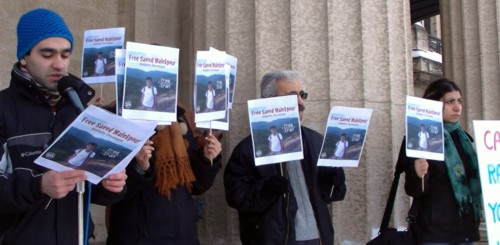
Save Saeed Malekpour

Posted: February 12, 2011 in Human Rights
Tags: ,

Saeed Malekpour is an Iranian-Canadian awaiting execution in Iran’s infamous Evin prison. He’s been held there since 2008 when he was arrested on charges related to developing and promoting a porn site, an allegation he rejects. Since then he’s been held in solitary confinement, tortured and denied the most basic human rights.

Saeed’s plight was news to me until a couple of days ago, and perhaps it is unfamiliar to you as well. Two excellent web sites where you can learn more about Saeed, the danger he faces and what you can do are:

There is no time to lose. Iran is notorious for its willingness to execute prisoners on the flimsiest of pretexts. He could be killed at any moment. Nonetheless, international opinion does save lives. So, please do not delay. Join the campaign to save Saeed Malekpour’s life. Today. Now.

Feb. 12, 2011: Winnipeggers rally at the Manitoba Legislature in support of Saeed Malekpour, an Iranian-Canadian facing execution in Iran. Photo: Paul S. Graham

About 300 Winnipeggers rallied at the Manitoba Legislature on Saturday in support of the Egyptian struggle for democracy. Joining millions around the world, they chanted “Free Egypt Now!” and “Step down Mubarak!” Here’s some video.

It’s Let Them Stay Week in Canada — a week of activities dedicated to keeping American war resisters in Canada. So I did what any red-blooded Canadian peacenik does at this time of the year – I stood around outside an MP’s office  in -25C temperatures with a similarly minded posse of peacenikles. This time it was the Steinbach, Manitoba office of Vic Toews – our Minister of Public Safety – a man who long ago abandoned the pacifist principles of his Mennonite faith while still managing to be twice re-elected in this mega-Mennonite town.

Here is my video report.