Nov. 8, 2011: Some of the 300 people who demonstrated in front of the Winnipeg Remand Centre in opposition to the Conservative Government's Omnibus Crime Bill, C-10. Photo: Paul Graham
The John Howard Society of Manitoba estimates Canadians will pay $2 billion annually to cover the costs of Stephen Harper’s omnibus crime bill. Bill C-10, which calls for mandatory minimum sentences for a wide range of crimes regardless of individual circumstances, will trigger a huge increase in the number of inmates and a requirement to build new prisons. It will do nothing to address the root causes of crime, nor will it lead to the rehabilitation of offenders.
Given the onerous cost, most of which will be borne by the provinces, it’s not surprising that the provincial governments of Quebec, Ontario and Newfoundland & Labrador have spoken out against the bill. In Winnipeg, the John Howard Society and 13 other agencies held a rally, Nov. 8, to tell the government of Manitoba to do likewise.
I recorded the event and will be producing a program for WCTV in the near future. But in the meantime, here’s a short interview with the executive director of the John Howard Society of Manitoba, John Hutton, in which he outlines some of the major problems with the legislation.
Despite its well established habit of electing social democratic governments, Winnipeg has claimed some dubious honors — “Murder Capital of Canada” and “Child Poverty Capital of Canada” to name two of the most disturbing. Even though we have had 11 years of NDP government to undo the damage of Gary Filmon’s Conservatives, both poverty and crime are well entrenched in Manitoba, especially in Winnipeg.
92,650 children in Manitoba live in families under the poverty threshold
29,000 children in Manitoba live in families with annual incomes insufficient for meeting basic needs
29,563 Manitoban children use food banks each month because their families cannot afford to purchase the necessary food they require
59,734 Manitobans accessed Employment and Income Assistance
The richest 20% of Manitoban families have more total income than the poorest 60% of the population
The Council says these statistics have not changed significantly since 1989, the year the House of Commons pledged to end child poverty in Canada by the year 2000.
What is to be done? According to the Manitoba Green Party, 80 per cent of all expenditures on social assistance programs are consumed by government bureaucracy. They proposed, in the last provincial election, to replace welfare benefits with a Universal Basic Income benefit, payable to all Manitobans, that would ensure no one slipped below the poverty line. The idea has merit and I hope the Greens continue to explain and promote it.
Yet another group of Manitobans proposes a package of measures they call a “Justice Charter to End Poverty in Manitoba.” I’ve included it at the end of this piece.
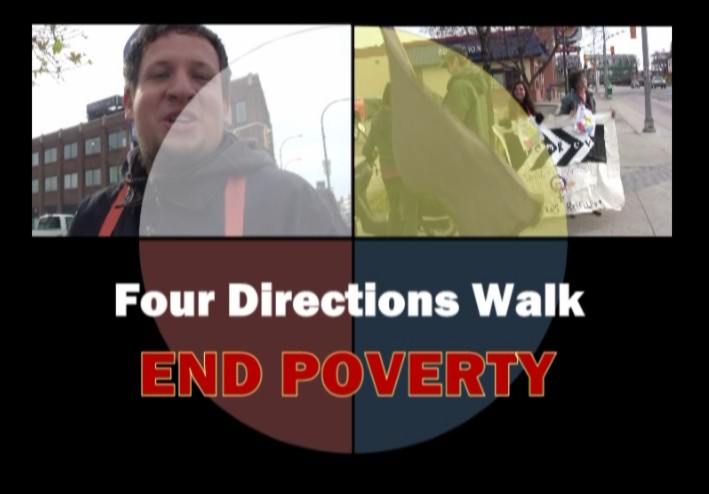
They also hold an annual event called the Four Directions Walk to End Poverty in which four contingents begin their walk on the outskirts of town and converge on the Manitoba Legislature. They held their fourth such walk on Saturday, Oct. 22. Naturally, I brought my video camera.
Justice Charter to End Poverty in Manitoba
We the people of Manitoba, seeing the growing gap between the wealthy and people in need, the working poor, and discriminated groups want to act in a timely manner to reverse the situation, to provide for people with needs and support the right for everyone to contribute to society to the best of their ability. To this end we make these demands and will work to make them a reality:
Housing must be a right and a comfort, not a constant crisis!
End subsidies to private landlords.
Establish stricter rent controls.
Enact a Tenant Bill of Rights.
Build and maintain public housing to the standard building code.
No utility cut-offs; establish a panel with legal power to require landlords to pay.
Universal health care for all, for every need!
Expand medicare into a comprehensive health care system focusing on prevention.
Extend medicare to cover all essential needs such as eye, drug, dental, ambulance and prosthetics.
Reduce pollution from mining and manufacturing, especially next to low income neighborhoods.
Jobs are a human right. Create good-paying jobs for all!
Create jobs through a massive investment in public housing, a public child care program, and conversion to a “green” economy.
Increase the minimum wage to $14 an hour.
Quality job creation by ensuring access to education, ending tuition fees, free student housing, education in Aboriginal and any other language where numbers warrant.
Access to better jobs – reduce the work week with no loss in pay, add paid vacation days and reduce the pension age for women to age 60.
End the Foreign Temporary Worker program, give these workers full labour rights and make them immigrants to Canada, if they so choose.
Provide for those in need!
Introduce a Guaranteed Liveable Income, above the poverty line and indexed to inflation.
Improve special needs benefits and introduce a fast appeals process with free advocacy services.
A public, high quality, free child care program employing well-paid early childhood development professionals.
Establish a hot breakfast program for children in schools.
For injured workers, establish a fast and free appeals process independent of the Workers Compensation Board. Provide free legal services and always respect the right to appeal.
Establish a Manitoba pension credit plan funded by payroll deductions, a surtax on corporate income to top up pensions above the poverty line and an inheritance wealth tax.
Establish a federally-chartered, publicly-owned bank that does not discriminate against people in poverty, is located in low-income areas, and provides free or nonprofit cheque cashing services and international fund transmittals.
Establish a province-wide, free and publicly-owned handi-transit service for people with disabilities.
Establish price controls for essential foods throughout Manitoba.
End racism, sexism and discrimination of all forms!
Support immediate settlement of Aboriginal land claims and emergency action to end housing, health care and education inequality.
Take steps to recognize Aboriginal nations on a new basis in Canada, including full national rights and equal nation to nation relations.
Introduce immediately affirmative action hiring with mandatory quotas for Aboriginal people, people of colour, women and people with disabilities in both the public and private sector.
Job pay equity for all workplaces.
Replace the present legal system of retribution and punishment with principles of restorative justice – restitution and reconciliation; include “ability to pay” as a consideration for sentencing people to jail for nonpayment of fines.
Ban discrimination based on social or mental health conditions in the Human Rights Code.
Introduce a Manitoba Bill of Rights based on the Universal Declaration of Human Rights (1948), adding protections against all forms of sexism.
Reform the democratic system
Establish proportional representation so that people will vote for what they want and so that every person’s vote will count.
Pay Legislators the average worker’s wage and benefits in Manitoba.
The Justice Charter is for discussion by all Manitobans. The annual Four Directions Walk is Winnipeg’s largest annual anti-poverty activity. It is organized to encourage discussion of the ideas in this Charter. We invite groups representing Aboriginal peoples, women, workers, youth and students, people of colour, people with disabilities, injured workers, the working poor, people living in poverty, people of all faiths and nonbelievers – all supportive groups:
To establish a Four Directions Walk in other Manitoba communities.
To discuss the Charter and send us your ideas.
Contact us if you would like to receive information on the annual Walk, held on a Saturday close to the International Day for the Eradication of Poverty (October 17).
On Monday, August 6, 1945, at 8:15 a.m., the nuclear bomb “Little Boy” was dropped on Hiroshima, Japan by an American B-29 bomber, the Enola Gay. An estimated 130,000 people were killed.
On August 9, 1945, Nagasaki was the target of America’s second atomic bomb attack. At 11:02 a.m., the north of the city was destroyed and an estimated 70,000 people were killed by the bomb nicknamed “Fat Man.”
Over the years and decades that followed, thousands more died from a variety of radiation induced diseases. Even now, after more than six decades, many aftereffects persist, including leukemia, A-bomb cataracts, and cancers of thyroid, breast, lungs, salivary glands, birth defects, and disfiguring radiation burn scars.
The psychological damage arising from widespread chronic illness and the destruction of families and communities cannot be measured.
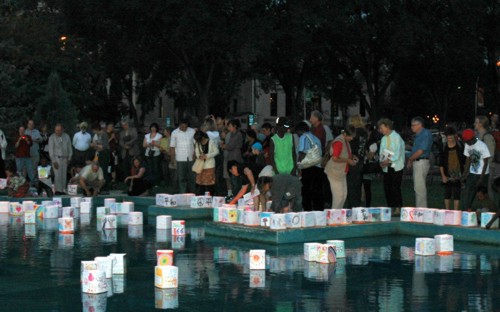
For many years, Winnipeggers have commemorated these tragedies and reaffirmed our commitment to peace and freedom from nuclear terror. We symbolize our commitment with a Lantern Ceremony.
Aug. 6, 2010: Winnipeggers gather at Memorial Park to launch their Lanterns for Peace. Photo: Paul S. Graham
Aug. 6, 2010: Lanterns reflect the individual aspirations of the artist. Photo: Paul S. Graham
August 6, 2010: Winnipeg Lanterns for Peace. Photo: Paul S. Graham
The Lantern Ceremony is part of an ancient Buddhist Ceremony (O-Bon), that commemorates the lives of deceased loved ones. For many years around the world, this ceremony has been used on Hiroshima Peace Day to honour and embrace the memory of those who died because of the attacks.
During these ceremonies, participants are invited to design a lantern that represents their thoughts and feelings regarding personal losses, global concerns of peace, nuclear disarmament and any other issue relevant to keeping our planet safe.
In addition to lanterns, we make origami peace cranes to commemorate the story of “Sadako and a Thousand Paper Cranes.”
Sadako Sasaki, a 10-year old girl, became sick with leukemia from the effects of the atomic bomb in post war Japan. She believed in an ancient tale that if you made 1000 paper cranes, you would be granted a wish. She wished for good health.
She died before she completed making the cranes and her classmates completed the task for her. Each year, thousands of paper cranes from all over the world adorn the statue of Sadako in the Hiroshima Peace Park in Hiroshima, Japan.
As important as it is to commemorate the horrible tragedies of August 6 and 9, 1945, more is required of us to prevent a recurrence of this disaster. Nine countries are known to possess nuclear weapons (United States, Russia, United Kingdom, France, China, India, Pakistan, North Korea and Israel). Together, they possess an estimated 8,000 active nuclear warheads and more than 22,000 in storage. The explosion (accidental or deliberate) of only one of these weapons would cause unthinkable suffering and destruction.
The nuclear threat is too serious to be ignored. We cannot rest until each of these nuclear weapons has been dismantled.
How you choose to work for a nuclear free world is up to you. There are numerous options. Here a few of the many Internet resources available to help you get involved.
Finally, the Canadian Peace Alliance is a good source of information on peace groups across Canada. The important thing is to become informed and involved.
Today, Winnipeg activists responded to the actions of the Greek government to block the Tahrir and other vessels that make up Freedom Flotilla II from sailing for Gaza with an information picket in the city’s Osborne Village neighbourhood.
The Tahrir is the Canadian vessel in the Flotilla. As with all of the other boats and crews, the Tahrir is committed to peace and nonviolence. Its mission is to deliver humanitarian aid to the suffering people of Gaza and to pressure the Israeli government to end its illegal and oppressive blockade of Gaza.
Get informed and take action. These folks can provide both information and opportunities for action.
By Rev. Barb Janes, Crescent-Ft. Rouge United Church, Winnipeg
It takes a village . . .
Raza Family in 2006. Photo: CBC
Crescent Fort Rouge United Church is tickled to announce that the Raza family, who lived in sanctuary in the church from August 3, 2006 to February 29, 2008, has been granted Permanent Resident status in Canada. Our deep gratitude to legal counsel, Ken Zaifman (Zaifman Immigration Lawyers), Canadian Border Service Agency, Citizenship and Immigration Canada and Manitoba Department of Labor and Immigration for finding a solution that balanced the circumstances of the Raza family and the requirements of the Immigration Act.
It has been an amazing journey for both the congregation and this family of eight – our thank you list is a long one. The members of Crescent Fort Rouge United worked diligently and persistently, as did many community members. Neighbouring churches and congregations across Canada offered financial, spiritual and moral support. Volunteers of many religions and of no religion generously stepped up to support the Raza family. Terry Borys of the Louis Riel School Division and then Minister of Education, Citizenship and Youth, the Hon. Peter Bjornson ensured that the school-aged children could return to classes at St. George School. Our then Member of Parliament, Anita Neville, visited the family numerous times, and kept the matter before the public, as did our MLA, Jennifer Howard. Deborah Gray, a Winnipegger with a big heart, made a wonderful contribution to publicize the cause. During the time the Razas were in the church, we were honoured with visits from and even a prayer service with members of Winnipeg’s Muslim community. Local musicians generously gave of their talents for a fund-raising rally.
The family sought sanctuary to avoid deportation under fear of sectarian violence in Pakistan, and for 18 challenging months the church was their benevolent prison. Parents Hassan and Kausar and the four oldest children – Rubab, Mohsin, Zain and Farva – faced potential deportation if they left the church property. (The two youngest, Mahssam and Seema, are Candian citizens.) The church’s boardroom was given over to the family as their living quarters, the second-floor kitchen became Kausar’s domain, and the Upper Hall and Nursery became make-shift classroom spaces until the children were granted permission to return to St. George School. Volunteers served as teachers, grocery-shoppers, nurses, lobbyists, security guards, language teachers, media-liaisons, fun-raisers and fund-raisers. After the family achieved Temporary Resident status and Kausar was accepted into Manitoba’s Provincial Nominee Program (thanks to Albert El Tassi of Peerless Garments), the family secured housing and began the transition back into the community. Many volunteers have continued to be in contact with the Razas, some as family friends, others running a homework club for the children.
The day the Raza family made their frightened way to Crescent Fort Rouge United Church, the baby of the family, Seema, had her first birthday. Today, she is a chatty member of her kindergarten class in the public school system. Kausar and Hassan both have jobs. Life is returning to normal, both for the family and for the congregation.
It has been an amazing journey of faith, hope, and persistence, and we at Crescent Fort Rouge United again offer our thanks to the “village” that worked so hard and gave so generously.
It’s Israeli Apartheid Week in Winnipeg, Canada and many other cities and towns around the world. In Winnipeg, Israeli Apartheid Week 2011 is taking place on the campuses of the University of Manitoba and the University of Winnipeg.
This clip features a presentation by Howard S. Davidson, Associate Professor of Extended Education at the University of Manitoba and member of Independent Jewish Voices (Canada). He spoke at a workshop entitled “Israeli Apartheid 101” at the University of Winnipeg on March 14, 2011.
Professor Davidson demolishes the arguments of pro-Israel apologists who equate support for Palestinian rights with anti-Semitism. Further, he demonstrates that the term “Israeli apartheid” is a legitimate part of the political discourse in Israel, even while those who use it in Canada and the United States are vilified by Israel’s North American supporters.
In Winnipeg, IAW 2011 is sponsored by:
Students Against Israeli Apartheid (U of W, U of M)
About 300 Winnipeggers rallied at the Manitoba Legislature on Saturday in support of the Egyptian struggle for democracy. Joining millions around the world, they chanted “Free Egypt Now!” and “Step down Mubarak!” Here’s some video.
Over the past 2 weeks, George Galloway spoke to packed halls from Halifax to Yellowknife. Winnipeg was no exception, with more than 400 people crowding into the Broadway Disciples United Church on Nov. 26 to hear Galloway’s passionate plea on behalf of Free Speech, Free Afghanistan and Free Palestine.
Galloway repeated his pledge to donate “every cent” of the compensation he expects to result from his defamation suit against the Canadian government to the Canadian anti-war movement. He also announced plans to launch a Canadian wing of Viva Palestina, in Calgary, next year. Viva Palestina is a registered UK charity that Galloway helped found that has raised millions of dollars in humanitarian aid for the people of Gaza.
Galloway is a frighteningly talented orator. It is easy to understand why Immigration Minister Jason Kenney would want to keep him out of the country. He spoke knowledgeably, passionately, with great warmth and biting wit, without notes for just over an hour. (My favourite example of his savage wit was a passing reference to Harper and Ignatieff as “Tweedle Dee and Tweedle Dum . . .two cheeks of the same backside” — but I digress.)
Here are only a few of the highlights.
On Kenney’s attempt to keep Galloway out of Canada
“As any bookseller could have told Mr. Kenney, any book that you try to ban usually ends up on the best-seller list.”
“Though the offence against me was considerable, the offence against you was much, much more serious, because what it established and what Justice Mosley’s 60-page caning of Kenney — across a 60-page judgement — what was established was that you have a government of liars and deceivers who are planning to take your rights away.”
On racism, Antisemitism and Zionism
“It is unconscionable to exercise freedom of speech to whip up racial or religious hatred – to whip up hatred of people because of what they are – not for what they’ve done, not for what they believe in, but because of who and what they are. That’s called racism.”
“That somehow I might be a hater of Jews, or in other words, a racist, is as absurd as it is insulting and offensive.”
“We are against the racist, apartheid ideology of Zionism and its practise in the apartheid state of Israel.”
“When people campaigned to end communism in Russia it didn’t mean they wanted to end the people of Russia. It didn’t mean they wanted to eliminate the country of Russia.They were against a political ideology which they believed was wrong and harmful. And that’s the spirit in which we say we are against Zionism. We’re not against the Jewish peiople who live in the land they call Israel and we call Palestine. We’re against the idea that there can be an apartheid state created there where the non-Jews are second class citizens and where the state illegally occupies and controls every aspect of the lives of three million Palestinian people living under occupation in the West Bank, in Gaza and in East Jerusalem.”
On Afghanistan
“Has anyone in Canada ever asked the question how come the Afghan army needs quite so much training? For ten years they’ve been trained by the occupation armies that invaded and occupied Afghanistan . . . The cost of training Hamid Karzai’s puppet regime, paid for by western taxpayers including every one of you, is $1 billion per month . . . with no noticeable improvement in their performance. Nobody’s training the Taliban and they’re doing quite well.”
“Nobody has every successfully occupied Afghanistan. Even Alexander the Great did not succeed in occupying Afghanistan and Stephen Harper is not Alexander the Great.”
“The Afghans are quite good at fighting. They don’t need much training. And they will never accept the foreign occupation of their country. Full stop.”
“We have to get out of Afghanistan, not just because we can’t afford it, not just because our own young men are being killed, but because we’re achieving the opposite of what needs to be done. We’re deepening that swamp [of bitterness], rather than draining that swamp.”
“Bush and Blair and Harper and, I dare say Kenney, are willing to fight to the last drop of other people’s blood and that’s just immoral.”
On Democracy
“I’m not a supporter of Hamas. It doesn’t matter how many times these raving bloggers in Canada or these raving ministers in Ottawa contend it, the judge has already opined on this point and his decision is final. I’m not a supporter of Hamas but I am a supporter of democracy. And the only people entitled to choose the leadership of the Palestinian people are the Palestinian people themselves. This is surely ABC. I mean how else could it be?
“I don’t like Stephen Harper. I wouldn’t have voted for him. But I can’t pretend that he’s not the Prime Minister of Canada. I can’t appoint somebody else as the Prime Minister of Canada though the vision of Michael Ignatieff just flitted across my mind. Talk about Tweedle Dee and Tweedle Dum. Two cheeks of the same backside. I can’t appoint Ignatieff or Layton of anyone else as the leader of Canada. I have to accept the outcome of the elections in Canada.
“Well, as we say we’re fighting for democracy every time we go to war, the Palestinians had democracy. They had an election. It was the only, only, free, democratic election ever held in any Arab country, ever, in all history. It was described by Jimmy Carter, no less, as pristine. Pristine. Chrystal clear. Transparent. Perfect. We just didn’t like the result. So what did we do? We immediately imposed a siege to starve the children of the votes, to punish them for how their parents had voted.
“How democratic is that? That’s hypocrisy, not democracy. But that’s exactly what we did and that siege has now lasted for four long years.”
On Aug. 6, the 1945 nuclear bombing of Hiroshima and Nagasaki will be marked with a Lantern Ceremony at Memorial Park in Winnipeg. The keynote address will be given by MP Bill Siksay (Burnaby-Douglas) on a private members bill (C-447) now before Parliament for the establishment of a Department of Peace.
Date: Friday, August 6, 2010 Place: Memorial Park (by the fountain, York Avenue and Memorial Boulevard) Time: Lantern making begins at 7:30 p.m.; speakers begin at 8:30 p.m.; lanterns will be launched at 9:15 p.m.
The annual commemoration of the Hiroshima/Nagasaki bombings is part of a world wide observance held to promote nuclear disarmament and world peace. In Winnipeg, the event is sponsored by the Manitoba Japanese Canadian Citizens Association, Peace Alliance Winnipeg, and Project Peacemakers.
In August, 1945, after 6 months of firebombing attacks on 67 Japanese cities, US President Harry Truman ordered the atomic bombing of Hiroshima (August 6) and Nagasaki (August 9). The death toll was enormous – 140,000 in Hiroshima and 80,000 in Nagasaki by the end of 1945. Many more thousands died over the months and years to come from injuries and illnesses caused by radiation poisoning.
For many years, Winnipeggers have commemorated these tragedies and reaffirmed our commitment to peace and freedom from nuclear terror. We symbolize our commitment with a Lantern Ceremony.
The Lantern Ceremony is part of an ancient Buddhist Ceremony (O-Bon), that commemorates the lives of deceased loved ones. For many years around the world, this ceremony has been used on Hiroshima Peace Day to remember and embrace the memory of people who died because of the atomic bombing of Hiroshima and Nagasaki. During these ceremonies, participants are invited to design a lantern that represents their thoughts and feelings regarding personal losses, global concerns of peace, nuclear disarmament and any other issues relevant to keeping our planet safe.
Video of last year’s Lantern Ceremony in Winnipeg
Sadako and a Thousand Paper Cranes
In addition to lanterns we will be making origami peace cranes to commemorate the story of “Sadako and a Thousand Paper Cranes.”
Sadako Sasaki, a young girl of 10 years old, became sick with leukemia from the effects of the atomic bomb in post war Japan. She believed in an ancient tale that if you made 1000 paper cranes, you would be granted a wish. She wished for good health.
She died before she completed making the cranes and her classmates completed the task for her.
Each year, thousands of paper cranes from all over the world adorn the statue of Sadako in the Hiroshima Peace Park in Hiroshima, Japan.
Bill C-447 – An Act to establish the Department of Peace
Bill Siksay, MP (Burnaby-Douglas) is the mover of Bill C-447 – An Act to Establish a Department of Peace. Seconded by Jim Karygiannis, MP (Scarborough-Agincourt ), the bill passed First Reading in the House of Commons, Sept. 30, 2009. Mr. Siksay will speak about this bill at the Lantern Ceremony.
You can read the full Bill in English and French, here: Bill C-447
1. Develop early detection and rapid response processes to deal with emerging conflicts and establish systemic responses to post-conflict demobilization, reconciliation and reconstruction
2. Lead internationally to abolish nuclear, biological, chemical weapons, to reduce conventional weapon arsenals and to ban the weaponization of space
3. Implement the UN Declaration and Programme of Action on a Culture of Peace (1999) to safeguard human rights and enhance the security of persons and their communities
4. Implement UN Resolution 1325 on the key role played by women in the wide spectrum of peacebuilding work
5. Establish a Civilian Peace Service that, with other training organizations, will recruit, train and accredit peace professionals and volunteers to work at home and abroad, as an alternative to armed intervention.
6. Address issues of violence in Canada by promoting nonviolent approaches that encourage community involvement and responsibility such as Restorative Justice, Nonviolent Communication (NVC) and Alternate Dispute Resolution (ADR)
7. Support the development of peace education at all levels including post-secondary peace and conflict studies
8. Promote the transition from a war-based to a peace-based economy.




 Paul S. Graham