Posts Tagged ‘Winnipeg’

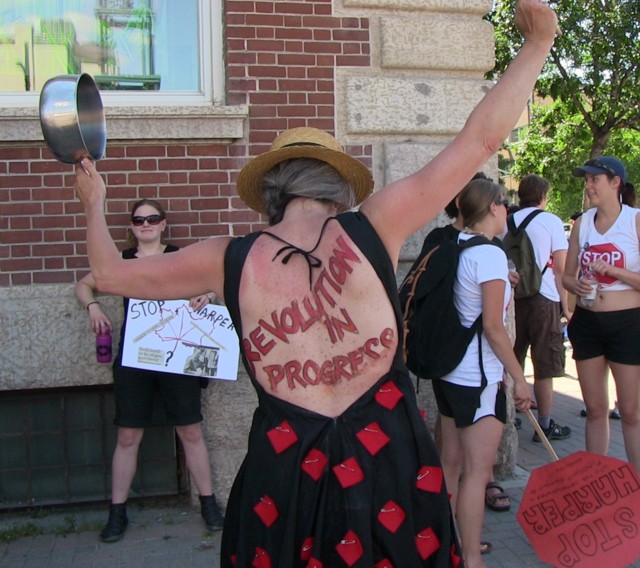
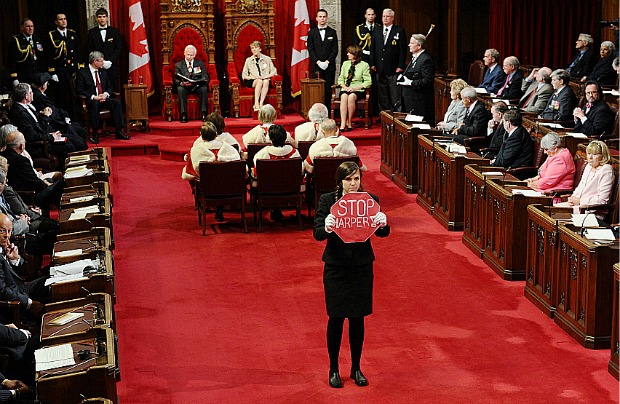
There is no shortage of Stop Harper videos on YouTube. A recent YouTube search yielded 3,740 hits, and I’m sure one could find more with a more refined search. Ever since Brigette DePape interrupted the Speech from the Throne with her iconic stop sign, activists have been inspired to amplify the message in on placards, T-shirts and in song.

What follows is a rundown of videos I’ve shot in and around Winnipeg. I invite readers to share their favorites in the comments section.


Stop Harper . . . the musical

August 2, 2012: Stephen Harper was in Gimli to make political hay out of a pledge to commit $18 million to dealing with the environmental problems facing Lake Winnipeg. After gutting  environmental protection laws in Canada to make way for dirty oil pipeline megaprojects and cancelling funding to the Experimental Lakes Area, we doubted his sincerity.

Despite our best efforts, we never got to see Harper close-up. In fact, his security detail took great pains to ensure he did not have to engage with anyone either than party faithful and selected media. But we did come up with this great song . . .

Hey Harper #StopHarper

Prime Minister Stephen Harper’s political motto must be “so many people to annoy – so little time.” Whether it is gutting environmental protection laws, wasting money on fighter jets that no one else wants to buy, denying health care to refugees or shutting down Parliament to avoid a non-confidence vote, Harper has been a disaster for Canada.

In this clip, Winnipeg’s renowned Flaming Trolleys Marching Band provide words and the rhythms that will be appreciated by any Canadian that is marching for democracy.

National Stop Harper Day in Winnipeg

Traditionally a day of celebration, Canada Day 2012 became National Stop Harper Day for Canadians in 12 cities because of the regressive policies of the Harper government, most notably Bill C-38. In Winnipeg, citizens held a Funeral for Canada in the Osborne Village neighbourhood, a display of activist art at the St. Norbert Arts Centre and a Vigil for Canada on the outskirts of The Forks National Historic Site.

Stop Cuts to Refugee Health Care in Canada

Winnipeg, June 18, 2012: Opposition to the Harper government’s plan to cut health care for refugees reverberated across Canada. Joining in a National Day of Action Against Refugee Health Cuts, about 500 Winnipeggers rallied at The Forks to hear from health care professionals and newcomers to Canada about the threats posed by Harper’s plans.

In this clip, Dr. Michael Dillon outlines the impressive line-up of opposition to these cuts, the outcomes of which, according to Canadian Doctors for Medicare, “could range from diabetics not getting their insulin, to children not receiving immunizations, to letting people succumb to heart attacks.”

Joyce has a choice! Let her hear your voice!

Conservative MP Joyce Bateman (Winnipeg South Centre) had a choice: stand up for the democratic rights of her constituents – and all Canadians – or vote for Bill C-38 – a draconian bill that included a budget which cuts a wide range of necessary services with amendments to over 70 existing laws. She chose the latter. By cramming all of these changes into an omnibus bill and rushing it through Parliament’s Finance Committee, Harper prevented MPs from examining and debating these measures in detail. Once again Harper showed his contempt for democracy.

In this clip, marchers gathered at Bateman’s constituency office to ask her to vote against Bill C-38.


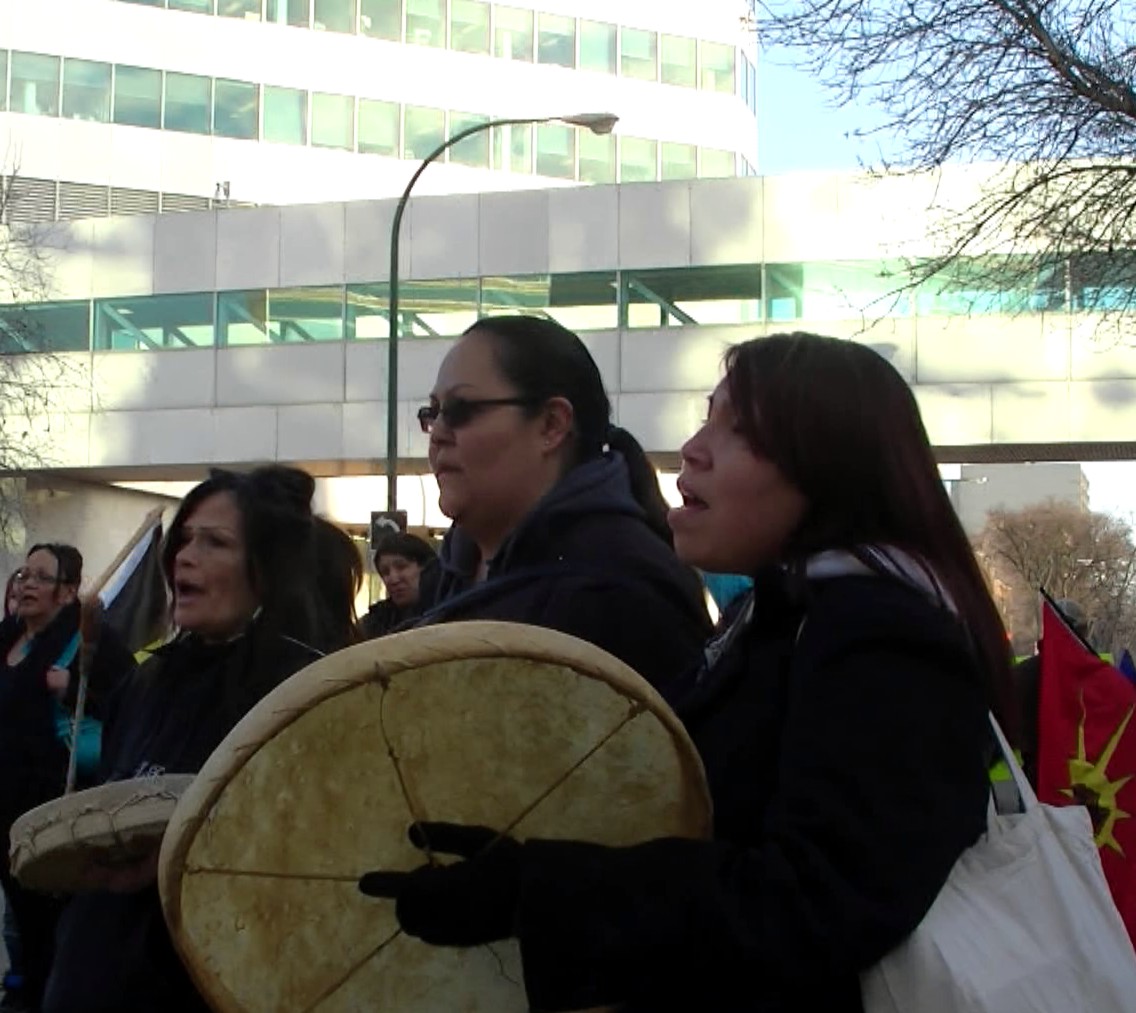
Winnipeg: July 11, 2012: Three of the several hundred demonstrators who marched through downtown Winnipeg demanding public inquiries into the the deaths and disappearances of 600 hundred indigenous women in Canada. Photo: Paul S. Graham

More than 600 indigenous women in Canada are believed to have gone missing or been murdered in recent years.  The slowness of governments to act and the lack of progress where governments have acted have spurred Manitoba’s aboriginal organizations to demand full-scale provincial and national inquiries.

The Assembly of Manitoba Chiefs, Manitoba Keewatinowi Okimakanak and the Southern Chiefs Organization have written to Prime Minister Stephen Harper, urging that he hold a national inquiry that would look at all aspects of the issue.

The Chiefs have sent a parallel request to Eric Robinson, Deputy Premier of Manitoba and Minister of Aboriginal and Northern Affairs. Both letters are available on the web site of the Assembly of Manitoba Chiefs.

So far, Manitoba’s and Canada’s governments have shown no interest in public inquiries. Manitoba’s Justice Minister, Andrew Swan, claims he does not support an inquiry because it could “get in the way of a criminal investigation” that led to the arrest of Shawn Cameron Lamb on charges of killing three aboriginal women in Winnipeg.

The Chiefs hope that will change if their efforts to have the United Nations become involved bear fruit. Says MKO Grand Chief David Harper, “The province will not inspect itself, Canada will not inspect itself . . . We’re going to the United Nations.”

The AMC, MKO and SCO held a rally in Winnipeg on July 11, 2012. Several hundred Winnipeggers marched from the Forks National Historic Site to the TD Centre near the corner of Portage and Main in support.

Here is some of the video I shot at this event. Featured in this video clip are Assembly of Manitoba Chiefs Grand Chief Derek Nepinak, respected community elder Mae Louise Campbell and David Harper, Grand Chief of Manitoba Keewatinowi Okimakanak.

In this clip, Winnipeg City Councillor Ross Eadie makes an impassioned plea for justice for Aboriginal People, declaring “We are all Treaty People!”


July 1, 2012: National Stop Harper Day in Winnipeg. Photo: Paul S. Graham

Traditionally a day of celebration, Canada Day 2012 became National Stop Harper Day for Canadians in 12 cities because of the regressive policies of the Harper government, most notably Bill C-38.

In Winnipeg, citizens held a Funeral for Canada in the Osborne Village neighbourhood, a display of activist art at the St. Norbert Arts Centre and a Vigil for Canada on the outskirts of The Forks National Historic Site.

Naturally, I brought my camcorder.


What is your course?
Our course is the conscience of humanity.

What is your final destination?
Our final destination is the betterment of mankind.

Nov. 4, 2011: David Heap, in the wheel house of The Tahrir, in radio contact with Israeli commandos who were preparing to forcibly board the boat.

On November 4, 2011, the Canadian boat, The Tahrir, en route to Gaza bearing medical supplies and solidarity, was boarded on the high seas by the Israeli Navy, as was the Irish vessel, the MV Saoirse. The crews were taken to Ashdod, held in prison for six days, and deported.

David Heap was among those captured, and on May 22, 2012, he was in Winnipeg to recount this gripping story and build support for a new solidarity project, Gaza’s Ark. Harold Shuster and I recorded it for Winnipeg Community TV.


Winnipeg, May 4, 2012: Hereditary Chief Tsodih of the Nak’azdli First Nation speaking at a news conference at Circle of Life Thunderbird House. Photo: Paul S. Graham

The Yinka Dene Alliance is on a cross country mission to tell Canadians why they have decided to refuse the construction of the Enbridge Gateway Pipeline across their land. They arrived on VIA Rail last night and held a news conference this morning at the Circle of Life Thunderbird House in Winnipeg. Mainstream media response was underwhelming; it appears that most were distracted by Jim Flaherty’s visit to the Winnipeg Mint to watch the last shiny copper come off the assembly line today. Oh, those shiny pennies!! Oh, how bedazzling for the media!

Because most of the mainstream media declined the invitation to participate, you and your friends are unlikely to find out what was said — unless you watch this video and share it widely.


If you don’t have 52 minutes, here’s an interview I recorded last night at Union Station with Hereditary Chief Na’Moks.

The National Energy Board is conducting hearings on Enbridge’s proposal for a pipeline from Alberta’s tar sands to the town of Kitimat in the heart of BC’s Great Bear Rainforest. If approved, over 200 oil tankers would be navigating the difficult waters off BC’s Northwest Coast each year, making widespread environmental damage to BC’s coastline only a matter of time. Moreover, it will facilitate the marketing of even more dirty oil from Alberta’s tar sands, fueling that unfolding ecological catastrophe with profound consequences for the rest of Canada and the world.

The project is meeting fierce opposition, especially in northern BC, and the federal government has declared war on anyone who opposes this project. In Winnipeg, a coalition of environmental groups banded together to hold a public forum on February 16, 2012 at the University of Winnipeg entitled Tar Sands, Pipelines and Tankers. Over 300 people turned out to view an excellent 16-minute documentary by Pacific Wild entitled Oil in Eden and to dialogue with an expert panel, moderated by journalist Ricard Cloutier.

The Panel

Dr. Wade Davis is Explorer in Residence, National Geographic Society, Visiting Professor and Senior Fellow of the Masters in Development Practice (MDP) Indigenous Development program, University of Winnipeg.

As well, he is the author of The Sacred Headwaters: the fight to save the Stikine, Skeena and Nass.

Gerald Amos was Chief Councillor for the Haisla First Nation for 12 years. He has been a leading voice for conservation in Canada for thirty years.

He is the author of an open letter to Prime Minister Stephen Harper and Natural Resources Minister, Joe Oliver “No apology forthcoming.”

Lynne Fernandez, of the Canadian Centre of Policy Alternatives has an MA in economics from the University of Manitoba. As a research associate at the Manitoba office of the Canadian Centre for Policy Alternatives, Lynne has studied municipal and provincial social and economic policy. She is also interested in labour and environmental issues.

Anne Lindsey is former executive director of the Manitoba Eco-Network. Since 1984, Anne has worked on such Manitoba and national issues as nuclear waste, forestry, food, pesticides and environmental reviews.

This event was organized by the Manitoba Eco-Network, Green Action Centre, Climate Change Connection, the Council of Canadians (Winnipeg), and the Green Action Committee of the First Unitarian-Universalist Church, with the support of the University of Manitoba’s Global Political Economy Program and the University of Winnipeg.

I hope you can schedule some time to view the video report I prepared in collaboration with Ken Harasym for Winnipeg Community TV. At two-and-a-half hours, it is long, but it is crammed with information and analysis that make it well worth the time.

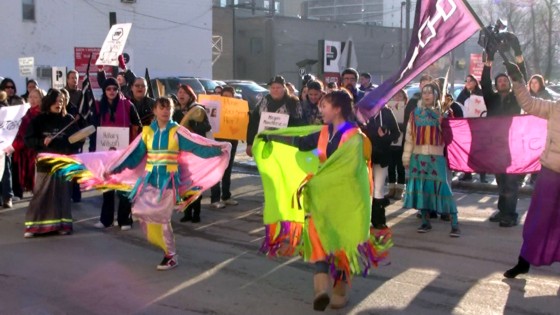
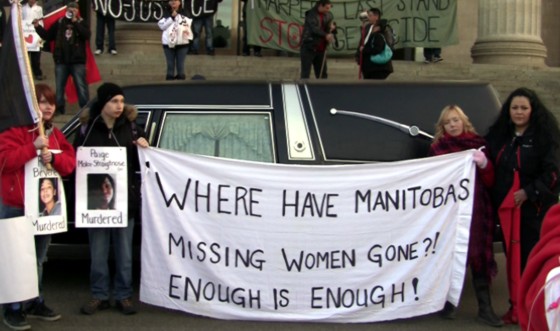
Winnipeg, Feb. 14, 2012: Protesters pause outside the Department of Indian Affairs in Winnipeg to sing and dance during the Men's Gathering and Unity Walk for Missing and Murdered Women. Photo: Paul Graham

Winnipeg, February 14, 2012: A group of aboriginal men held a march to show solidarity with the families of missing and murdered aboriginal women in Canada. While the march was organized by men, there were no restrictions on who could attend – all were welcome – and there was a good turnout of men, women and children of all ages.

Feb. 14, 2012: Protesters outside the Law Courts Building in Winnipeg during the Men's Gathering and Unity Walk for Missing and Murdered Women. Photo: Paul Graham

The march began at the corner of Carlton Street and Portage Avenue, the site of the Aboriginal Peoples Television Network, and wound through downtown Winnipeg, stopping at the Department of Indian Affairs, the Assembly of Manitoba Chiefs and the Law Courts Building, before ending up at the Manitoba Legislative Building. Despite the marked police presence (several squad cars, a helicopter overhead), the marchers remained peaceful and good spirited. I use the word “despite” because it was clear the marchers would have preferred the cops to be putting their energies into catching killers and finding missing women.

While some estimates put the number of missing and murdered women at 600, no one really knows. What is clear is that not nearly enough is being done to locate these women and to stop the carnage.

Feb. 14, 2012: Protesters in front of a symbolic hearse at the Manitoba Legislature in Winnipeg during the Men's Gathering and Unity Walk for Missing and Murdered Women. Photo: Dwayne Crowe

Here are some links that can help you understand this issue in more depth:

And here is my video report.

Making war has been a human pursuit for thousands of years.

Playing at war, it would seem, is at least as old. This ancient Greek toy, a model of a war chariot, fashioned from clay, has survived the millennia to bear witness to our enduring attachment to violence and domination.

War requires warriors. Because killing is not something that comes naturally to most of us, a long period of preparation is usually needed. It begins, in childhood, with the toys we give to our children.

The design and marketing of war toys are anything but child’s play. According to an article in the New York Times, the US military and the American toy industry have a long history of working together. It’s a relationship where both parties benefit – toys are more realistic and often, toys have inspired weapons development. But there’s more. As the author observes:

“Because the newest generation of soldiers grew up playing with electronic toys and games, the symbiosis between them is nearly genetic. Today’s troops received their basic training as children.”

The popularity of violent video games inspired the US Army to develop its very own video game, which it provides free of charge from its web site. According to the late Gary Webb, an American investigative journalist of considerable renown,

America’s Army isn’t merely a game, recruiting device or a public-relations tool, though it is certainly all of those things. It’s also a military aptitude tester. And it was designed that way from the start.”

A growing body of evidence confirms that exposure to violent toys, games and media can increase aggressive behavior, desensitize people to violence, and contribute to an exaggerated fear of the world.

Dr. Darlene Hammell, of the University of British Columbia Faculty of Medicine explains:

“A close examination of the issue raises concerns that war toys teach children that:

  • war is a game, an exciting adventure.
  • killing is acceptable, even fun.
  • violence or the threat of violence is the only way to resolve conflicts.
  • the world is divided into “goodies” and “baddies” where the bad guys are devoid of human qualities and their destruction is desirable.”

For the past 10 years, Winnipeg’s Project Peacemakers has conducted an annual inspection of Winnipeg toy stores. The objective is to raise awareness about the levels of violence in children’s toys and games, and to call on retailers, government, and the wider community to take steps to limit this violence.

I tagged along with an inspection team, last month, as it looked at two of the eleven stores covered in this year’s survey and prepared this video report.

The envelope. please . . .

Here is how the stores performed in terms of providing peaceful, constructive playthings – as opposed to war toys.

Excellent: Children’s Museum
Commendable: A Child’s Place, Hans Christian Toys, Scholar’s Choice, Toad Hall
Acceptable: BJ’s Toy Store, Kit and Kabooble
Needs Improvement: Dollarama, Toys “R” Us, Zellers

Although a team visited a local Walmart, they were informed that Project Peacemakers would be unable to publicize its findings without first contacting Walmart’s public relations office. Project Peacemakers declined to rate the store, leaving you to draw your conclusions, if not about their toys, then about Walmart’s public relations savvy.

It oughtta be a crime

Under international law, most wars are crimes – though the likelihood of prosecution is low (unless you are on the losing side). War toys, however, remain perfectly legal in most places. Thankfully, there are exceptions. In 2009, Venezuela passed a “Law Prohibiting War Video Games and War Toys.” Prior to this, according to the Peace and Conflict Monitor, Sweden and Norway have “successful voluntary restriction” of war toy sales, Malta prohibits their import, Greece bans television advertising and Australia places some restrictions on imports. The Monitor says the European Parliament has recommended that its member states ban advertising of war toys and reduce their sale, though I could find no evidence that this has happened.

Merry Christmas, all.

Occupy Winnipeg took its opposition to Bill C-10, the so-called Safe Streets and Communities Act, to Winnipeg’s West End Library and then proceeded to occupy the constituency office of Manitoba’s Justice Minister, Andrew Swan for 24 hours.

Before doing so, an Occupy Winnipeg spokesperson read the November 17, 2011 statement of the Canadian Bar Association entitled “Ten Reasons to Oppose Bill C-10.” My alter ego, Red River Pete, captured some of the moments.

The Canadian Bar Association statement is available at its web site. Or you can read it below.


November 17, 2011

10 Reasons to Oppose Bill C-10

Bill C-10 is titled the Safe Streets and Communities Act — an ironic name, considering that Canada already has some of the safest streets and communities in the world and a declining crime rate. This bill will do nothing to improve that state of affairs, but, through its overreach and overreaction to imaginary problems, Bill C-10 could easily make it worse. It could eventually create the very problems it’s supposed to solve.

Bill C-10 will require new prisons; mandate incarceration for minor, non-violent offences; justify poor treatment of inmates and make their reintegration into society more difficult. Texas and California, among other jurisdictions, have already started down this road before changing course, realizing it cost too much and made their justice system worse. Canada is poised to repeat their mistake.

The Canadian Bar Association, representing over 37,000 lawyers across the country, has identified 10 reasons why the passage of Bill C-10 will be a mistake and a setback for Canada.

1. Ignoring reality. Decades of research and experience have shown what actually reduces crime: (a) addressing child poverty, (b) providing services for the mentally ill and those afflicted with FASD, (c) diverting young offenders from the adult justice system, and (d) rehabilitating prisoners, and helping them to reintegrate into society. Bill C-10 ignores these proven facts.

2. Rush job. Instead of receiving a thorough review, Bill C-10 is being rushed through Parliament purely to meet the “100-day passage” promise from the last election. Expert witnesses attempting to comment on over 150 pages of legislation in committee hearings are cut off mid-sentence after just five minutes.

3. Spin triumphs over substance.
The federal government has chosen to take a “marketing” approach to Bill C-10, rather than explaining the facts to Canadians. This campaign misrepresents the bill’s actual content and ensures that its public support is based heavily on inaccuracies.

4. No proper inspection. Contrary to government claims, some parts of Bill C-10 have received no previous study by Parliamentary committee. Other sections have been studied before and were changed — but, in Bill C-10, they’re back in their original form.

5. Wasted youth. More young Canadians will spend months in custodial centres before trial, thanks to Bill C-10. Experience has shown that at-risk youth learn or reinforce criminal behaviour in custodial centres; only when diverted to community options are they more likely to be reformed.

6. Punishments eclipse the crime. The slogan for one proposal was Ending House Arrest for Serious and Violent Criminals Act, but Bill C-10 will actually also eliminate conditional sentences for minor and property offenders and instead send those people to jail. Is roughly $100,000 per year to incarcerate someone unnecessarily a good use of taxpayers’ money?

7. Training predators. Bill C-10 would force judges to incarcerate people whose offences and circumstances clearly do not warrant time in custody. Prison officials will have more latitude to disregard prisoners’ human rights, bypassing the least restrictive means to discipline and control inmates. Almost every inmate will re-enter society someday. Do we want them to come out as neighbours, or as predators hardened by their prison experience?

8. Justice system overload. Longer and harsher sentences will increase the strains on a justice system already at the breaking point. Courts and Crown prosecutors’ offices are overwhelmed as is, legal aid plans are at the breaking point, and police forces don’t have the resources to do their jobs properly. Bill C-10 addresses none of these problems and will make them much worse.

9. Victimizing the most vulnerable. With mandatory minimums replacing conditional sentences, people in remote, rural and northern communities will be shipped far from their families to serve time. Canada’s Aboriginal people already represent up to 80% of inmates in institutions in the prairies, a national embarrassment that Bill C-10 will make worse.

10. How much money? With no reliable price tag for its recommendations, there is no way to responsibly decide the bill’s financial implications. What will Canadians sacrifice to pay for these initiatives? Will they be worth the cost?

Canadians deserve accurate information about Bill C-10, its costs and its effects. This bill will change our country’s entire approach to crime at every stage of the justice system. It represents a huge step backwards; rather than prioritizing public safety, it emphasizes retribution above all else. It’s an approach that will make us less safe, less secure, and ultimately, less Canadian.

© 2011 The Canadian Bar Association


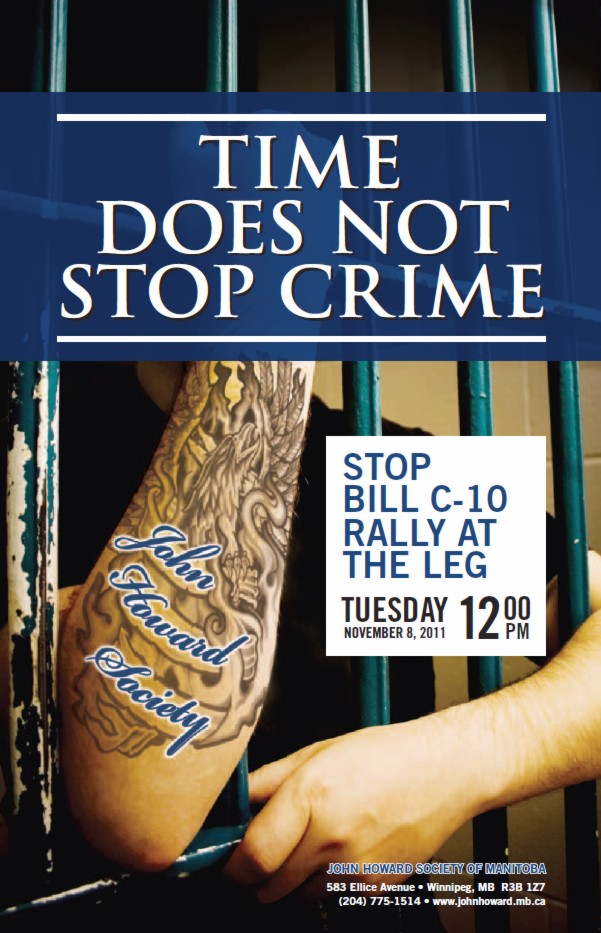
Nov. 8, 2011: 300 Winnipeggers demonstrated at the Manitoba Legislature and the Winnipeg Remand Centre to urge the Manitoba Government to join Quebec, Ontario and Newfoundland and Labrador in opposing the Harper government’s omnibus crime bill, misleadingly titled the Safe Streets and Communities Act (aka Bill C-10). Their key message, “time does not stop crime” rebutted the government’s contention that locking up more offenders for longer periods was an effective crime prevention technique.

As I noted in an earlier post, the John Howard Society of Manitoba estimates Canadians will pay $2 billion annually to cover the costs of the bill, which calls for mandatory minimum sentences for a wide range of crimes regardless of individual circumstances. While this will trigger a huge increase in the number of inmates and a prison construction boom, it will do nothing to address the root causes of crime, nor will it lead to the rehabilitation of offenders.

Speakers:

  • John Hutton, Executive Director, John Howard Society of Manitoba
  • Shaun Loney – Executive Director,  BUILD
  • Cora Morgan, Executive Director, Onashowewin
  • Tracy Booth, Executive Director, Elizabeth Fry Society of Manitoba
  • Jacquie Nicholson, Literacy Coordinator, John Howard Society of Manitoba
  • Alex Paterson, Occupy Winnipeg

The protest was sponsored by:

  • BUILD Winnipeg
  • Canadian Centre for Policy Alternatives
  • Canadian Federation of Students
  • Elizabeth Fry Society of Manitoba
  • Faculty of Social Work, University of Manitoba
  • Initiatives for Just Communities
  • Occupy Winnipeg
  • Ogijiita Pimatiswin Kinamatwin (OPK)
  • Mennonite Central Committee of Manitoba
  • School of Social Work, Université de Saint-Boniface
  • Social Planning Council of Winnipeg
  • Southern Chiefs Organization
  • William (Bill) VanderGraff, Law Enforcement Against Prohibition

For more information about C-10, contact the John Howard Society of Manitoba. And let your MP know what you think.


See also: