
Peace Alliance Winnipeg held its annual general meeting on April 12, 2025. This year’s meeting featured a keynote address by Manitoba author Owen Schalk entitled “Confronting imperialism in the age of Western decline.” Owen is a columnist for Canadian Dimension, the author of Canada in Afghanistan: A story of military, diplomatic, political and media failure, 2003-2023 and the co-author of Canada’s Long Fight Against Democracy with Yves Engler.
Posts Tagged ‘peace movement’
Confronting Imperialism in the Age of Western Decline
Posted: April 14, 2025 in Nibbling on The Empire, PeaceTags: imperialism, Peace Alliance Winnipeg, peace movement
0
Just say “No!” to NATO
Posted: March 12, 2021 in Nibbling on The Empire, Peace, WarTags: NATO, NATO 2030, Peace Alliance Winnipeg, peace movement
The North Atlantic Treaty Organization has embarked on a dangerous plan to expand its reach and military strength by the year 2030. Not only does this increase the risk of world war, it promises to rob even more of the precious resources that member states would have available for social programs (or mitigating climate change, or heavens, tax cuts for working people!)
Speaking at a recent webinar organized by Peace Alliance Winnipeg, Tamara Lorincz detailed the magnitude of NATO’s plans and explained what this means for Canada. She also described some of the ways Canada’s peace movement is resisting increased military spending and other toxic aspects of Canada’s foreign policy.
Tamara is a PhD candidate in Global Governance at the Balsillie School for International Affairs (Wilfrid Laurier University). She is on the board of directors of the Global Network Against Weapons and Nuclear Power in Space and on the international advisory committee of the No to NATO Network. She is a member of the Canadian Voice of Women for Peace and the Women’s International League for Peace and Freedom.
Winnipeg Peace Fest honours Nick Ternette
Posted: July 18, 2013 in Peace, WinnipegTags: antiwar movement, david barsamian, Nick Ternette, Peace Alliance Winnipeg, peace movement, winnipeg peace festival, Winnipeg Walk for Peace

August 6, 2011: Nick Ternette at Winnipeg’s Annual Lanterns for Peace ceremony marking the anniversaty of the 1945 US nuclear bombing of Hiroshima and Nagasaki. Photo: Paul S. Graham
For more than 30 years, Winnipeggers have come together, in June, to march for peace. In doing so, we strive to educate our neigbours about the the roots of war and to keep alive the message that peace and social justice are inextricably interwoven.
This year, we dedicated the festival to our longtime friend and comrade in the struggle for peace and justice, Nick Ternette. Politically active in many arenas, Nick worked for social justice until the end of his life, despite the health challenges that ultimately caused his death on March 3rd, 2013.
Featured speakers at this year’s event included political activist Emily Ternette, who provided a loving tribute to her departed husband, and David Barsamian, host of the weekly American political affairs program, Alternative Radio, which has been running for 27 years.
In addition to the speeches of Emily Ternette and David Barsamian, my video report includes a brief interview with Nick, held as we marched along during the 2012 Walk for Peace.
Links:
Peace Alliance Winnipeg
Project Peacemakers
CHALK 4 Peace Winnipeg 2012
Posted: August 26, 2012 in Peace, WinnipegTags: Canada, chalk 4 peace, peace movement, Winnipeg
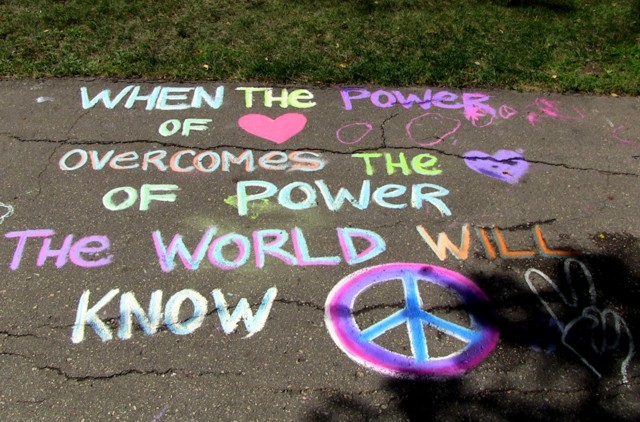
Aug. 25, 2012: One of the messages adorning the walkways of Vimy Ridge Park. Photo: Paul S. Graham
CHALK 4 Peace is an annual event that has spread to hundreds of communities world-wide since its inception in 2003 in Arlington, Virginia. The objectives, according to CHALK 4 Peace are:
- To promote the arts by coordinating assemblies of young artists of all ages to draw their vision of peace in public and private spaces with sidewalk chalk as a scheduled worldwide event;
- To advocate for peace in a non-partisan manner such that all people may share their visions and messages of peace without regard to their nationality, ethnicity, or political beliefs;
- To encourage relationships between municipalities and artists so that communities around the world become united in supporting the expression of peace.
Winnipeggers celebrated their 6th annual CHALK 4 Peace on Saturday, raising funds for War Child Canada, and bringing sidewalk art, music, and laughter to Vimy Ridge Park.
Performers included Ras Tamils, the Flaming Trolleys and Lindsey White & Mitch Dorge.
Kisa MacIsaac, one of the organizers of the Winnipeg event, explains how this coming together of arts, music and people contributes to a more peaceful world.
You can find find CHALK 4 Peace Winnipeg on Facebook.
Winnipeg Lanterns for Peace
Posted: August 4, 2011 in PeaceTags: Canada, Hiroshima Peace Day, Lanterns for Peace, nuclear disarmament, peace movement, Winnipeg
On Monday, August 6, 1945, at 8:15 a.m., the nuclear bomb “Little Boy” was dropped on Hiroshima, Japan by an American B-29 bomber, the Enola Gay. An estimated 130,000 people were killed.
On August 9, 1945, Nagasaki was the target of America’s second atomic bomb attack. At 11:02 a.m., the north of the city was destroyed and an estimated 70,000 people were killed by the bomb nicknamed “Fat Man.”
Over the years and decades that followed, thousands more died from a variety of radiation induced diseases. Even now, after more than six decades, many aftereffects persist, including leukemia, A-bomb cataracts, and cancers of thyroid, breast, lungs, salivary glands, birth defects, and disfiguring radiation burn scars.
The psychological damage arising from widespread chronic illness and the destruction of families and communities cannot be measured.
For many years, Winnipeggers have commemorated these tragedies and reaffirmed our commitment to peace and freedom from nuclear terror. We symbolize our commitment with a Lantern Ceremony.
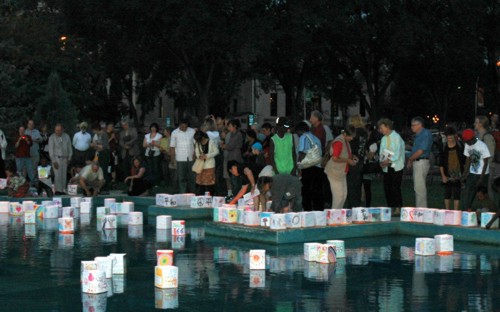
Aug. 6, 2010: Winnipeggers gather at Memorial Park to launch their Lanterns for Peace. Photo: Paul S. Graham

Aug. 6, 2010: Lanterns reflect the individual aspirations of the artist. Photo: Paul S. Graham

August 6, 2010: Winnipeg Lanterns for Peace. Photo: Paul S. Graham
The Lantern Ceremony is part of an ancient Buddhist Ceremony (O-Bon), that commemorates the lives of deceased loved ones. For many years around the world, this ceremony has been used on Hiroshima Peace Day to honour and embrace the memory of those who died because of the attacks.
During these ceremonies, participants are invited to design a lantern that represents their thoughts and feelings regarding personal losses, global concerns of peace, nuclear disarmament and any other issue relevant to keeping our planet safe.
In addition to lanterns, we make origami peace cranes to commemorate the story of “Sadako and a Thousand Paper Cranes.”
Sadako Sasaki, a 10-year old girl, became sick with leukemia from the effects of the atomic bomb in post war Japan. She believed in an ancient tale that if you made 1000 paper cranes, you would be granted a wish. She wished for good health.
She died before she completed making the cranes and her classmates completed the task for her. Each year, thousands of paper cranes from all over the world adorn the statue of Sadako in the Hiroshima Peace Park in Hiroshima, Japan.
As important as it is to commemorate the horrible tragedies of August 6 and 9, 1945, more is required of us to prevent a recurrence of this disaster. Nine countries are known to possess nuclear weapons (United States, Russia, United Kingdom, France, China, India, Pakistan, North Korea and Israel). Together, they possess an estimated 8,000 active nuclear warheads and more than 22,000 in storage. The explosion (accidental or deliberate) of only one of these weapons would cause unthinkable suffering and destruction.
The nuclear threat is too serious to be ignored. We cannot rest until each of these nuclear weapons has been dismantled.
How you choose to work for a nuclear free world is up to you. There are numerous options. Here a few of the many Internet resources available to help you get involved.
- Abolition 2000
- Atomic Bomb Museum
- Global Network Against Weapons and Nuclear Power in Space
- Hiroshima Peace Institute
- Hiroshima Peace Site
- International Physicians for the Prevention of Nuclear War
- Mayors for Peace
If you live in or close to Winnipeg, you should consider contacting any of the sponsors of Winnipeg Lanterns for Peace:
And, of course, you shouldn’t miss out on Winnipeg Lanterns for Peace 2011.
Finally, the Canadian Peace Alliance is a good source of information on peace groups across Canada. The important thing is to become informed and involved.
 Paul S. Graham