UPDATE: You can watch a video report of Yves Engler’s March 15th Winnipeg presentation here.
Foreign policy analyst Yves Engler will be speaking in Winnipeg Thursday about his newest book, Lester Pearson’s Peacekeeping: The Truth May Hurt.
Date: Thursday, March 15, 2012 Time: 7:30 p.m. Location: Mondragon Bookstore and Coffee House, 91 Albert Street, Winnipeg Admission: Free. Donations will be requested to help defray expenses.
Written in the form of a submission to an imagined “Truth and Reconciliation” commission about Canada’s foreign policy past Lester Pearson’s Peacekeeping: The Truth May Hurtchallenges one of the most important Canadian foreign policy myths – that of Lester B. Pearson as peacekeeper.
Lester Pearson is one of Canada’s most important political figures. A Nobel Peace Prize laureate, he is considered a great peacekeeper and ‘honest broker.’ But in this critical examination of his work, Pearson is exposed as an ardent cold warrior who backed colonialism and apartheid in Africa, Zionism, coups in Guatemala, Iran and Brazil and the U.S. invasion of the Dominican Republic. A beneficiary of U.S. intervention in Canadian political affairs, he also provided important support to the U.S. in Vietnam and pushed to send troops to the American war in Korea.
Yves Engler has published five other books:
Stop Signs — Cars and Capitalism on the Road to Economic, Social and Ecological Decay (with Bianca Mugyenyi)
The Black Book of Canadian Foreign Policy (Shortlisted for the Mavis Gallant Prize for Non Fiction in the Quebec Writers’ Federation Literary Awards)
Playing Left Wing: From Rink Rat to Student Radical and (with Anthony Fenton)
Canada in Haiti: Waging War on The Poor Majority
Canada and Israel: Building Apartheid
His six books have been praised by Naomi Klein, Noam Chomsky, William Blum, Rick Salutin and many others.
Winnipeg, March 11, 2012: Winnipeggers rally outside of Tory MP Joyce Bateman's office demanding the federal government allow a full inquiry into the federal election robocall scandal. Photo: Paul S. Graham
While Prime Minister Stephen Harper undoubtedly wishes this issue would disappear, Canadians marched in more than two dozen cities today, demanding a full inquiry into the federal election robocall scandal. In Winnipeg, over 100 rallied at the corner of Osborne Street and River Avenue where organizer Josh Brandon expressed the sense of outrage that many Canadians feel about the undermining of Canada’s electoral system. Speakers Kevin Lamoureux (Liberal MP for Winnipeg North) and Judy Wasylycia-Leis (former NDP MP for the same riding) urged them to support an NDP-sponsored bill that would grant Elections Canada greater powers to investigate electoral fraud, including the more than 30,000 complaints filed by Canadians about the last federal election.
At the conclusion of the speeches, the demonstrators marched to the Winnipeg South Centre office of Tory MP Joyce Bateman, to present her with a petition regarding concerns about robocalls that were made to voters in that riding. In the previous election Bateman narrowly defeated the Liberal incumbent, Anita Neville.
The National Energy Board is conducting hearings on Enbridge’s proposal for a pipeline from Alberta’s tar sands to the town of Kitimat in the heart of BC’s Great Bear Rainforest. If approved, over 200 oil tankers would be navigating the difficult waters off BC’s Northwest Coast each year, making widespread environmental damage to BC’s coastline only a matter of time. Moreover, it will facilitate the marketing of even more dirty oil from Alberta’s tar sands, fueling that unfolding ecological catastrophe with profound consequences for the rest of Canada and the world.
The project is meeting fierce opposition, especially in northern BC, and the federal government has declared war on anyone who opposes this project. In Winnipeg, a coalition of environmental groups banded together to hold a public forum on February 16, 2012 at the University of Winnipeg entitled Tar Sands, Pipelines and Tankers. Over 300 people turned out to view an excellent 16-minute documentary by Pacific Wild entitled Oil in Eden and to dialogue with an expert panel, moderated by journalist Ricard Cloutier.
The Panel
Dr. Wade Davis is Explorer in Residence, National Geographic Society, Visiting Professor and Senior Fellow of the Masters in Development Practice (MDP) Indigenous Development program, University of Winnipeg.
As well, he is the author of The Sacred Headwaters: the fight to save the Stikine, Skeena and Nass.
Gerald Amos was Chief Councillor for the Haisla First Nation for 12 years. He has been a leading voice for conservation in Canada for thirty years.
He is the author of an open letter to Prime Minister Stephen Harper and Natural Resources Minister, Joe Oliver “No apology forthcoming.”
Lynne Fernandez, of the Canadian Centre of Policy Alternatives has an MA in economics from the University of Manitoba. As a research associate at the Manitoba office of the Canadian Centre for Policy Alternatives, Lynne has studied municipal and provincial social and economic policy. She is also interested in labour and environmental issues.
Anne Lindsey is former executive director of the Manitoba Eco-Network. Since 1984, Anne has worked on such Manitoba and national issues as nuclear waste, forestry, food, pesticides and environmental reviews.
I hope you can schedule some time to view the video report I prepared in collaboration with Ken Harasym for Winnipeg Community TV. At two-and-a-half hours, it is long, but it is crammed with information and analysis that make it well worth the time.
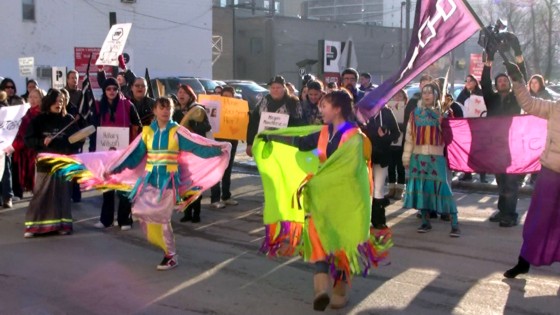
Winnipeg, Feb. 14, 2012: Protesters pause outside the Department of Indian Affairs in Winnipeg to sing and dance during the Men's Gathering and Unity Walk for Missing and Murdered Women. Photo: Paul Graham
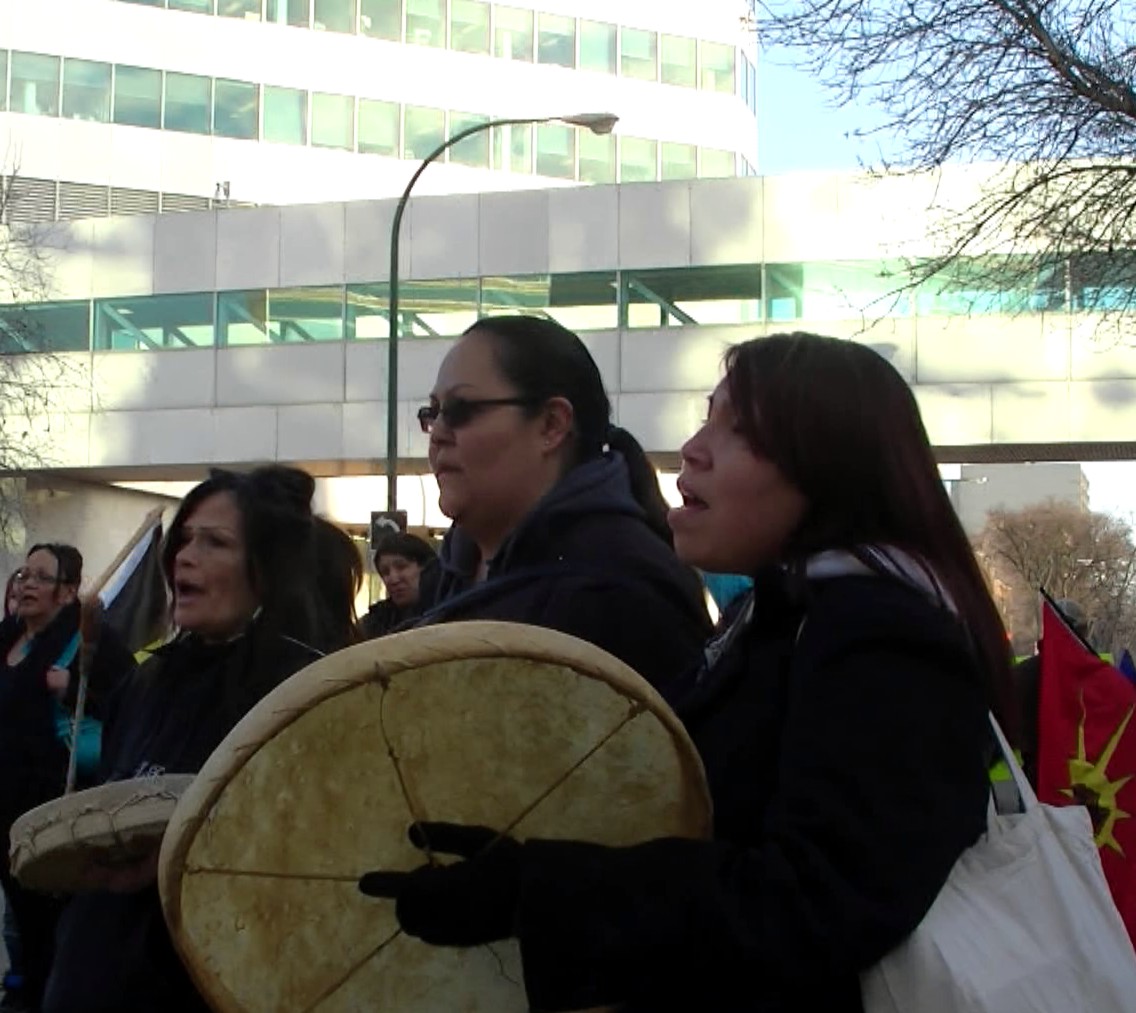
Winnipeg, February 14, 2012: A group of aboriginal men held a march to show solidarity with the families of missing and murdered aboriginal women in Canada. While the march was organized by men, there were no restrictions on who could attend – all were welcome – and there was a good turnout of men, women and children of all ages.
Feb. 14, 2012: Protesters outside the Law Courts Building in Winnipeg during the Men's Gathering and Unity Walk for Missing and Murdered Women. Photo: Paul Graham
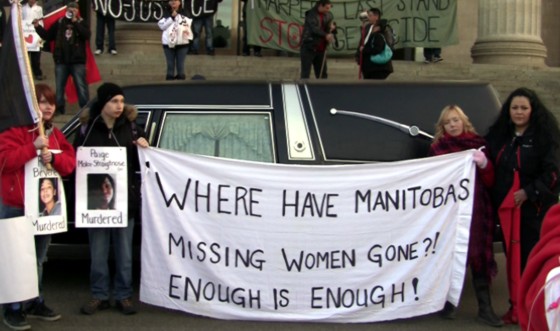
The march began at the corner of Carlton Street and Portage Avenue, the site of the Aboriginal Peoples Television Network, and wound through downtown Winnipeg, stopping at the Department of Indian Affairs, the Assembly of Manitoba Chiefs and the Law Courts Building, before ending up at the Manitoba Legislative Building. Despite the marked police presence (several squad cars, a helicopter overhead), the marchers remained peaceful and good spirited. I use the word “despite” because it was clear the marchers would have preferred the cops to be putting their energies into catching killers and finding missing women.
While some estimates put the number of missing and murdered women at 600, no one really knows. What is clear is that not nearly enough is being done to locate these women and to stop the carnage.
Feb. 14, 2012: Protesters in front of a symbolic hearse at the Manitoba Legislature in Winnipeg during the Men's Gathering and Unity Walk for Missing and Murdered Women. Photo: Dwayne Crowe
Here are some links that can help you understand this issue in more depth:
Friends of Canadian Broadcasting continues to raise the alarm over threats to our nation’s public broadcaster and well they should. While Heritage Minister James Moore promised in May to maintain and expand support for the CBC, Tory antipathy to the CBC is well known. Recent initiatives, such as the petition by Tory MP Rob Enders to end CBC funding cast doubt on the Tory pledge to support the CBC. (His surname says it all, eh?)
Because Harper is a notorious control freak, no Tory backbencher who wanted to keep getting nominated would post a petition of this sort without his blessing. This has to be taken seriously.
The Friends have taken a humorous approach in their current attempt to awaken Canadians to the Tory threat. I hope it works.
Under Harper’s majority government, we are beginning to see the unraveling of Canada.
Yesterday, they did something similar to western grain farmers when they effectively killed the Canadian Wheat Board without allowing grain producers their legally required right to a plebiscite on the question.
To complete the portrait of power drunk right wing ideologues, their response to falling crime rates is to build more prisons and jail more offenders for longer sentences in defiance of all the evidence that this approach has not worked anywhere it has been tried.
The next four years will be trying times for Canadians who do not want to see our society hideously disfigured. We will have to fight them every step of the way. Take a moment to see how you can begin this by supporting the Friends of Canadian Broadcasting.
An open letter to Canada’s Prime Minister, Members of Parliament, and Senators, from a broad and diverse coalition of 46 organizations representing millions of Canadians –
Support Canadian Food, Canadian Farmers, and the Canadian Wheat Board
Bill C-18, if passed, will destroy the Canadian Wheat Board (CWB). Agriculture Minister Gerry Ritz has repeatedly stated that he will not recognize the plebiscite recently conducted by the CWB, in which results were clearly in favour of keeping the CWB as the sole marketing agent for prairie wheat and barley intended for human consumption.
The CWB was created by an Act of Parliament, and is run by a 15-member Board of Directors, ten of whom are elected by farmers. The Wheat Board provides fair, equitable, reliable, and cost-effective services to farm families. It provides stability in uncertain times, and is a foundation of Canada’s grain sector.
Ending the single desk authority of the CWB would throw western agriculture into turmoil and would transfer wealth created by Canadian farmers to big, private, often foreign-owned grain companies—money now returned to farmers, who spend it in their communities. The Minneapolis Grain Exchange has already changed its rules to allow for speculation in futures contracts for Canadian wheat and barley—a move which will increase price volatility for purchasers without providing any benefit to farmers.
Canada’s political system is built on representative democracy. This means that the law, not merely the person in power, is to be respected and followed. The CWB Act is a law made by Parliament, and it requires a farmer vote before any substantive changes are made to the single desk authority. Our current government is ignoring this law—refusing to hold the required vote—and moving to eliminate the requirement for a vote. This is deeply concerning, as it strikes at the heart of our Canadian democracy.
We the undersigned:
Recognize the billions of dollars of economic value that the CWB creates each year—for farmers, rural communities, short line railroads, and the whole of Canada—as a result of its superior marketing ability, capacity to defend Canadian interests in trade disputes, and commitment to return to farmers all net proceeds from sales.
Are proud of the strong international reputation for quality and reliability that Canadian wheat and barley have earned—a direct result of the CWB and its companion institutions, the Canadian Grain Commission and Canadian International Grains Institute.
Deplore the government’s disregard for the outcome of the recent plebiscite in which 62% of farmers voted in favour of keeping the single desk for wheat and 51% supported keeping the single desk for barley.
We therefore call upon the Prime Ministers, MPs, and Senators to immediately stop undermining the single desk authority of the CWB. We further insist that Parliament must comply with the Canadian Wheat Board Act, Section 47.1, which requires a binding plebiscite (vote) of farmers before any substantive change to the CWB’s single desk authority is initiated.
Signed:
Agriculture Workers Alliance
Bathurst Street United Church, Toronto
Big Carrot Natural Food Market
Biofreedom
Brandon University Students’ Union
Briarpatch Magazine
Canadian Auto Workers (CAW)
Canadian Labour Congress
Canadian Union of Postal Workers (CUPW)
Canadian Union of Public Employees (CUPE)
Canadian Wheat Board Alliance
CCNB Action (Conservation Council of New Brunswick)
Centre for Social Justice
Coalition On The Niagara Escarpment
Council of Canadians
Council of Canadians – Moose Jaw, Sask. Chapter
Council of Canadians – Prince Albert, Sask. Chapter
Council of Canadians – Winnipeg, Man. Chapter
CWA/SCA (Communications Workers Union) Canada
Food Action Committee of the Ecology Action Centre
Food Secure Canada
Friends of the Canadian Wheat Board
GE Watch Comox Valley
GRAIN
Grain Services Union (GSU)
Greenpeace Canada
Growing Food Security in Alberta
Health Sciences Association of Alberta
Inter Pares
International Brotherhood of Electrical Workers (IBEW) Local 529
Lardeau Valley Seed Savers
Les AmiEs de la Terre de Québec
LIFT (Low Income Families Together)
National Farmers Union
National Union of Public and General Employees (NUPGE)
New Brunswick Common Front for Social Justice
Ontario Public Interest Research Group (OPIRG) – Windsor
Organic Food Council of Manitoba (OFCM)
Oxfam Canada
Saskatchewan Federation of Labour (SFL)
Saskatchewan Union of Nurses (SUN)
Society for a GE Free BC
The Ark Farm, B&B, Vegetables, & Native Plants
Union paysanne
United Church of Canada
United Food and Commercial Workers (UFCW)
Stop the steamroller
Make your voice heard by sending a message to the PM and your MP at Stop the Steamroller.
Occupy Winnipeg took its opposition to Bill C-10, the so-called Safe Streets and Communities Act, to Winnipeg’s West End Library and then proceeded to occupy the constituency office of Manitoba’s Justice Minister, Andrew Swan for 24 hours.
Before doing so, an Occupy Winnipeg spokesperson read the November 17, 2011 statement of the Canadian Bar Association entitled “Ten Reasons to Oppose Bill C-10.” My alter ego, Red River Pete, captured some of the moments.
The Canadian Bar Association statement is available at its web site. Or you can read it below.
November 17, 2011
10 Reasons to Oppose Bill C-10
Bill C-10 is titled the Safe Streets and Communities Act — an ironic name, considering that Canada already has some of the safest streets and communities in the world and a declining crime rate. This bill will do nothing to improve that state of affairs, but, through its overreach and overreaction to imaginary problems, Bill C-10 could easily make it worse. It could eventually create the very problems it’s supposed to solve.
Bill C-10 will require new prisons; mandate incarceration for minor, non-violent offences; justify poor treatment of inmates and make their reintegration into society more difficult. Texas and California, among other jurisdictions, have already started down this road before changing course, realizing it cost too much and made their justice system worse. Canada is poised to repeat their mistake.
The Canadian Bar Association, representing over 37,000 lawyers across the country, has identified 10 reasons why the passage of Bill C-10 will be a mistake and a setback for Canada.
1. Ignoring reality. Decades of research and experience have shown what actually reduces crime: (a) addressing child poverty, (b) providing services for the mentally ill and those afflicted with FASD, (c) diverting young offenders from the adult justice system, and (d) rehabilitating prisoners, and helping them to reintegrate into society. Bill C-10 ignores these proven facts.
2. Rush job. Instead of receiving a thorough review, Bill C-10 is being rushed through Parliament purely to meet the “100-day passage” promise from the last election. Expert witnesses attempting to comment on over 150 pages of legislation in committee hearings are cut off mid-sentence after just five minutes.
3. Spin triumphs over substance. The federal government has chosen to take a “marketing” approach to Bill C-10, rather than explaining the facts to Canadians. This campaign misrepresents the bill’s actual content and ensures that its public support is based heavily on inaccuracies.
4. No proper inspection. Contrary to government claims, some parts of Bill C-10 have received no previous study by Parliamentary committee. Other sections have been studied before and were changed — but, in Bill C-10, they’re back in their original form.
5. Wasted youth. More young Canadians will spend months in custodial centres before trial, thanks to Bill C-10. Experience has shown that at-risk youth learn or reinforce criminal behaviour in custodial centres; only when diverted to community options are they more likely to be reformed.
6. Punishments eclipse the crime. The slogan for one proposal was Ending House Arrest for Serious and Violent Criminals Act, but Bill C-10 will actually also eliminate conditional sentences for minor and property offenders and instead send those people to jail. Is roughly $100,000 per year to incarcerate someone unnecessarily a good use of taxpayers’ money?
7. Training predators. Bill C-10 would force judges to incarcerate people whose offences and circumstances clearly do not warrant time in custody. Prison officials will have more latitude to disregard prisoners’ human rights, bypassing the least restrictive means to discipline and control inmates. Almost every inmate will re-enter society someday. Do we want them to come out as neighbours, or as predators hardened by their prison experience?
8. Justice system overload. Longer and harsher sentences will increase the strains on a justice system already at the breaking point. Courts and Crown prosecutors’ offices are overwhelmed as is, legal aid plans are at the breaking point, and police forces don’t have the resources to do their jobs properly. Bill C-10 addresses none of these problems and will make them much worse.
9. Victimizing the most vulnerable. With mandatory minimums replacing conditional sentences, people in remote, rural and northern communities will be shipped far from their families to serve time. Canada’s Aboriginal people already represent up to 80% of inmates in institutions in the prairies, a national embarrassment that Bill C-10 will make worse.
10. How much money? With no reliable price tag for its recommendations, there is no way to responsibly decide the bill’s financial implications. What will Canadians sacrifice to pay for these initiatives? Will they be worth the cost?
Canadians deserve accurate information about Bill C-10, its costs and its effects. This bill will change our country’s entire approach to crime at every stage of the justice system. It represents a huge step backwards; rather than prioritizing public safety, it emphasizes retribution above all else. It’s an approach that will make us less safe, less secure, and ultimately, less Canadian.
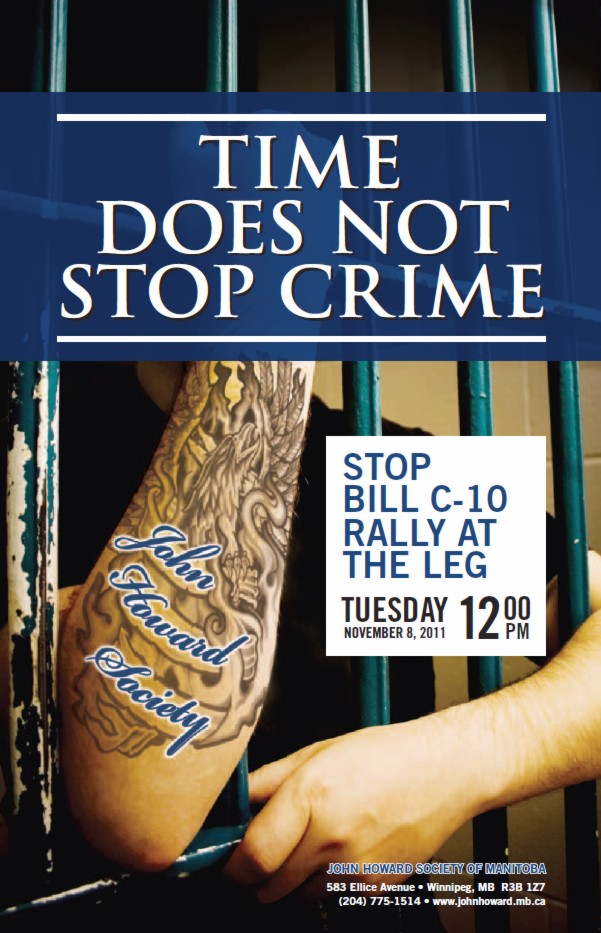
Nov. 8, 2011: 300 Winnipeggers demonstrated at the Manitoba Legislature and the Winnipeg Remand Centre to urge the Manitoba Government to join Quebec, Ontario and Newfoundland and Labrador in opposing the Harper government’s omnibus crime bill, misleadingly titled the Safe Streets and Communities Act (aka Bill C-10). Their key message, “time does not stop crime” rebutted the government’s contention that locking up more offenders for longer periods was an effective crime prevention technique.
As I noted in an earlier post, the John Howard Society of Manitoba estimates Canadians will pay $2 billion annually to cover the costs of the bill, which calls for mandatory minimum sentences for a wide range of crimes regardless of individual circumstances. While this will trigger a huge increase in the number of inmates and a prison construction boom, it will do nothing to address the root causes of crime, nor will it lead to the rehabilitation of offenders.
Speakers:
John Hutton, Executive Director, John Howard Society of Manitoba
Shaun Loney – Executive Director, BUILD
Cora Morgan, Executive Director, Onashowewin
Tracy Booth, Executive Director, Elizabeth Fry Society of Manitoba
Jacquie Nicholson, Literacy Coordinator, John Howard Society of Manitoba
Alex Paterson, Occupy Winnipeg
The protest was sponsored by:
BUILD Winnipeg
Canadian Centre for Policy Alternatives
Canadian Federation of Students
Elizabeth Fry Society of Manitoba
Faculty of Social Work, University of Manitoba
Initiatives for Just Communities
Occupy Winnipeg
Ogijiita Pimatiswin Kinamatwin (OPK)
Mennonite Central Committee of Manitoba
School of Social Work, Université de Saint-Boniface
Social Planning Council of Winnipeg
Southern Chiefs Organization
William (Bill) VanderGraff, Law Enforcement Against Prohibition
Nov. 8, 2011: Some of the 300 people who demonstrated in front of the Winnipeg Remand Centre in opposition to the Conservative Government's Omnibus Crime Bill, C-10. Photo: Paul Graham
The John Howard Society of Manitoba estimates Canadians will pay $2 billion annually to cover the costs of Stephen Harper’s omnibus crime bill. Bill C-10, which calls for mandatory minimum sentences for a wide range of crimes regardless of individual circumstances, will trigger a huge increase in the number of inmates and a requirement to build new prisons. It will do nothing to address the root causes of crime, nor will it lead to the rehabilitation of offenders.
Given the onerous cost, most of which will be borne by the provinces, it’s not surprising that the provincial governments of Quebec, Ontario and Newfoundland & Labrador have spoken out against the bill. In Winnipeg, the John Howard Society and 13 other agencies held a rally, Nov. 8, to tell the government of Manitoba to do likewise.
I recorded the event and will be producing a program for WCTV in the near future. But in the meantime, here’s a short interview with the executive director of the John Howard Society of Manitoba, John Hutton, in which he outlines some of the major problems with the legislation.
On Monday, August 6, 1945, at 8:15 a.m., the nuclear bomb “Little Boy” was dropped on Hiroshima, Japan by an American B-29 bomber, the Enola Gay. An estimated 130,000 people were killed.
On August 9, 1945, Nagasaki was the target of America’s second atomic bomb attack. At 11:02 a.m., the north of the city was destroyed and an estimated 70,000 people were killed by the bomb nicknamed “Fat Man.”
Over the years and decades that followed, thousands more died from a variety of radiation induced diseases. Even now, after more than six decades, many aftereffects persist, including leukemia, A-bomb cataracts, and cancers of thyroid, breast, lungs, salivary glands, birth defects, and disfiguring radiation burn scars.
The psychological damage arising from widespread chronic illness and the destruction of families and communities cannot be measured.
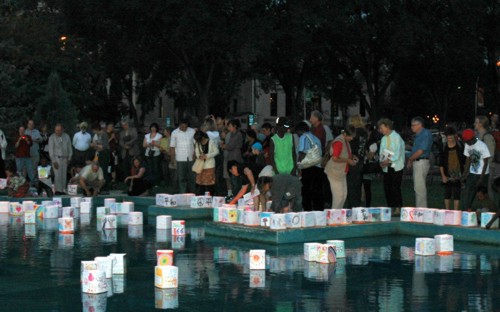
For many years, Winnipeggers have commemorated these tragedies and reaffirmed our commitment to peace and freedom from nuclear terror. We symbolize our commitment with a Lantern Ceremony.
Aug. 6, 2010: Winnipeggers gather at Memorial Park to launch their Lanterns for Peace. Photo: Paul S. Graham
Aug. 6, 2010: Lanterns reflect the individual aspirations of the artist. Photo: Paul S. Graham
August 6, 2010: Winnipeg Lanterns for Peace. Photo: Paul S. Graham
The Lantern Ceremony is part of an ancient Buddhist Ceremony (O-Bon), that commemorates the lives of deceased loved ones. For many years around the world, this ceremony has been used on Hiroshima Peace Day to honour and embrace the memory of those who died because of the attacks.
During these ceremonies, participants are invited to design a lantern that represents their thoughts and feelings regarding personal losses, global concerns of peace, nuclear disarmament and any other issue relevant to keeping our planet safe.
In addition to lanterns, we make origami peace cranes to commemorate the story of “Sadako and a Thousand Paper Cranes.”
Sadako Sasaki, a 10-year old girl, became sick with leukemia from the effects of the atomic bomb in post war Japan. She believed in an ancient tale that if you made 1000 paper cranes, you would be granted a wish. She wished for good health.
She died before she completed making the cranes and her classmates completed the task for her. Each year, thousands of paper cranes from all over the world adorn the statue of Sadako in the Hiroshima Peace Park in Hiroshima, Japan.
As important as it is to commemorate the horrible tragedies of August 6 and 9, 1945, more is required of us to prevent a recurrence of this disaster. Nine countries are known to possess nuclear weapons (United States, Russia, United Kingdom, France, China, India, Pakistan, North Korea and Israel). Together, they possess an estimated 8,000 active nuclear warheads and more than 22,000 in storage. The explosion (accidental or deliberate) of only one of these weapons would cause unthinkable suffering and destruction.
The nuclear threat is too serious to be ignored. We cannot rest until each of these nuclear weapons has been dismantled.
How you choose to work for a nuclear free world is up to you. There are numerous options. Here a few of the many Internet resources available to help you get involved.
Finally, the Canadian Peace Alliance is a good source of information on peace groups across Canada. The important thing is to become informed and involved.


 Written in the form of a submission to an imagined “Truth and Reconciliation” commission about Canada’s foreign policy past Lester Pearson’s Peacekeeping: The Truth May Hurtchallenges one of the most important Canadian foreign policy myths – that of Lester B. Pearson as peacekeeper.









 Paul S. Graham