Posts Tagged ‘Canada’

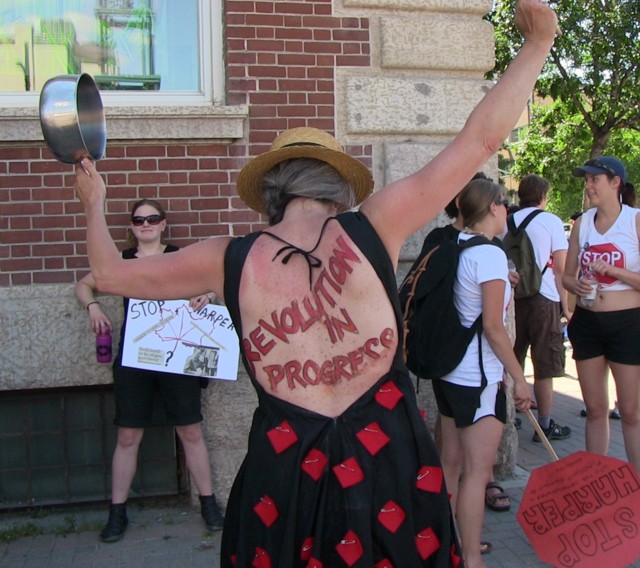
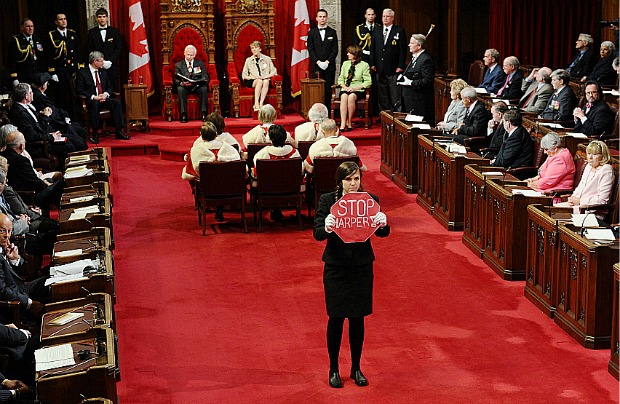
There is no shortage of Stop Harper videos on YouTube. A recent YouTube search yielded 3,740 hits, and I’m sure one could find more with a more refined search. Ever since Brigette DePape interrupted the Speech from the Throne with her iconic stop sign, activists have been inspired to amplify the message in on placards, T-shirts and in song.

What follows is a rundown of videos I’ve shot in and around Winnipeg. I invite readers to share their favorites in the comments section.


Stop Harper . . . the musical

August 2, 2012: Stephen Harper was in Gimli to make political hay out of a pledge to commit $18 million to dealing with the environmental problems facing Lake Winnipeg. After gutting  environmental protection laws in Canada to make way for dirty oil pipeline megaprojects and cancelling funding to the Experimental Lakes Area, we doubted his sincerity.

Despite our best efforts, we never got to see Harper close-up. In fact, his security detail took great pains to ensure he did not have to engage with anyone either than party faithful and selected media. But we did come up with this great song . . .

Hey Harper #StopHarper

Prime Minister Stephen Harper’s political motto must be “so many people to annoy – so little time.” Whether it is gutting environmental protection laws, wasting money on fighter jets that no one else wants to buy, denying health care to refugees or shutting down Parliament to avoid a non-confidence vote, Harper has been a disaster for Canada.

In this clip, Winnipeg’s renowned Flaming Trolleys Marching Band provide words and the rhythms that will be appreciated by any Canadian that is marching for democracy.

National Stop Harper Day in Winnipeg

Traditionally a day of celebration, Canada Day 2012 became National Stop Harper Day for Canadians in 12 cities because of the regressive policies of the Harper government, most notably Bill C-38. In Winnipeg, citizens held a Funeral for Canada in the Osborne Village neighbourhood, a display of activist art at the St. Norbert Arts Centre and a Vigil for Canada on the outskirts of The Forks National Historic Site.

Stop Cuts to Refugee Health Care in Canada

Winnipeg, June 18, 2012: Opposition to the Harper government’s plan to cut health care for refugees reverberated across Canada. Joining in a National Day of Action Against Refugee Health Cuts, about 500 Winnipeggers rallied at The Forks to hear from health care professionals and newcomers to Canada about the threats posed by Harper’s plans.

In this clip, Dr. Michael Dillon outlines the impressive line-up of opposition to these cuts, the outcomes of which, according to Canadian Doctors for Medicare, “could range from diabetics not getting their insulin, to children not receiving immunizations, to letting people succumb to heart attacks.”

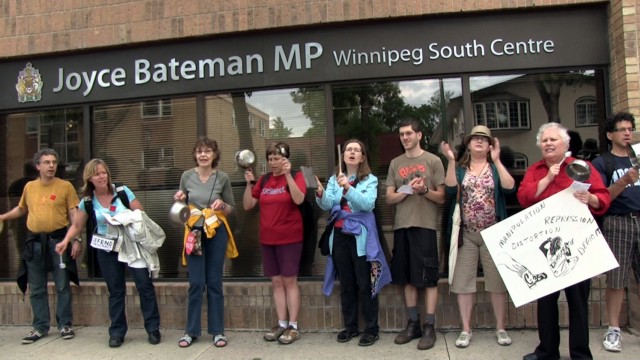
Joyce has a choice! Let her hear your voice!

Conservative MP Joyce Bateman (Winnipeg South Centre) had a choice: stand up for the democratic rights of her constituents – and all Canadians – or vote for Bill C-38 – a draconian bill that included a budget which cuts a wide range of necessary services with amendments to over 70 existing laws. She chose the latter. By cramming all of these changes into an omnibus bill and rushing it through Parliament’s Finance Committee, Harper prevented MPs from examining and debating these measures in detail. Once again Harper showed his contempt for democracy.

In this clip, marchers gathered at Bateman’s constituency office to ask her to vote against Bill C-38.


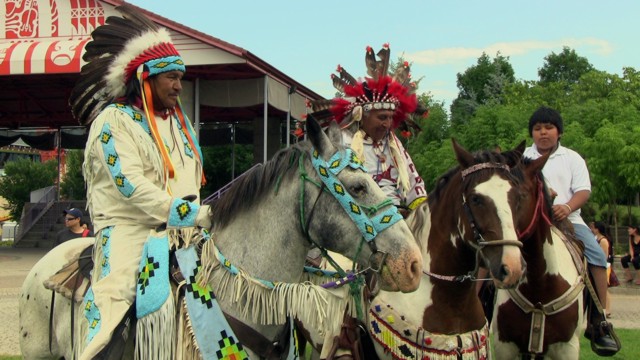
Winnipeg: July 11, 2012: Three of the several hundred demonstrators who marched through downtown Winnipeg demanding public inquiries into the the deaths and disappearances of 600 hundred indigenous women in Canada. Photo: Paul S. Graham

More than 600 indigenous women in Canada are believed to have gone missing or been murdered in recent years.  The slowness of governments to act and the lack of progress where governments have acted have spurred Manitoba’s aboriginal organizations to demand full-scale provincial and national inquiries.

The Assembly of Manitoba Chiefs, Manitoba Keewatinowi Okimakanak and the Southern Chiefs Organization have written to Prime Minister Stephen Harper, urging that he hold a national inquiry that would look at all aspects of the issue.

The Chiefs have sent a parallel request to Eric Robinson, Deputy Premier of Manitoba and Minister of Aboriginal and Northern Affairs. Both letters are available on the web site of the Assembly of Manitoba Chiefs.

So far, Manitoba’s and Canada’s governments have shown no interest in public inquiries. Manitoba’s Justice Minister, Andrew Swan, claims he does not support an inquiry because it could “get in the way of a criminal investigation” that led to the arrest of Shawn Cameron Lamb on charges of killing three aboriginal women in Winnipeg.

The Chiefs hope that will change if their efforts to have the United Nations become involved bear fruit. Says MKO Grand Chief David Harper, “The province will not inspect itself, Canada will not inspect itself . . . We’re going to the United Nations.”

The AMC, MKO and SCO held a rally in Winnipeg on July 11, 2012. Several hundred Winnipeggers marched from the Forks National Historic Site to the TD Centre near the corner of Portage and Main in support.

Here is some of the video I shot at this event. Featured in this video clip are Assembly of Manitoba Chiefs Grand Chief Derek Nepinak, respected community elder Mae Louise Campbell and David Harper, Grand Chief of Manitoba Keewatinowi Okimakanak.

In this clip, Winnipeg City Councillor Ross Eadie makes an impassioned plea for justice for Aboriginal People, declaring “We are all Treaty People!”


Canada’s Chief of Defence Staff Gen. Walt Natynczyk Photo: Jake Wright, The Canadian Press

This interview with Canada’s Chief of Defence Staff says more about the psychopathology of militarism than I would have believed could be found in a daily newspaper. Read along with me and ask yourself what kind of madness are we allowing to develop in this country.

My thoughts are in the right hand column. I’d be interested in hearing yours.

Canada’s top soldier says troops ready and eager for new overseas missions

By Bill Graveland, The Canadian Press
Winnipeg Free Press, July 7, 2012

CALGARY – When it comes to future missions for the Canadian Forces, Canada’s top soldier has to battle to keep his eager troops satisfied with staying out of major combat zones for now.

Our military exists, or should exist, to defend this country from aggressors while occasionally helping Torontonians dig out of blizzards and Manitobans fight floods. However, it seems that rather than guardians of national sovereignty and security we have a pack of blood thirsty attack dogs on a leash, restrained only by the herculean efforts of Chief of Defence Staff Gen. Walt Natynczyk.

Canada’s military presence in Afghanistan will come to an end once the current training mission concludes in 2014 and Chief of Defence Staff Gen. Walt Natynczyk acknowledges that’s a disappointment for many soldiers, sailors and air personnel.

If Natynczyk is correct in his assessment, we have allowed our military to become a haven for a large number of homicidal psychopaths. Is this what happens after a decade of war?

“We have some men and women who have had two, three and four tours and what they’re telling me is ‘Sir, we’ve got that bumper sticker. Can we go somewhere else now?’” Natynczyk said in an exclusive interview with The Canadian Press in Calgary.

These men and women need help. Failing that, they should never be allowed to own anything sharper than soup spoons.

“You also have the young sailors, soldiers, airmen and women who have just finished basic training and they want to go somewhere and in their minds it was going to be Afghanistan. So if not Afghanistan, where’s it going to be? They all want to serve.”

I like it when our troops are on hand to fight floods and forest fires. I’d prefer not paying taxes to help them make their bones overseas. If they are really that eager to kill people, our American cousins seem to have an insatiable appetite for cannon fodder.

But Natynczyk is unsure about what is in store for the Canadian Forces or even himself for that matter.

If you believe that, I have some prime muskeg, suitable for agriculture, that you won’t be able to resist.

He has been on the job for four years, which is past the normal tenure for someone in his position, and if he knows what is going to happen next, he isn’t providing any details.

“I’ll just keep on sprinting in this job until I’m told to get off the playing field and recognizing that I’m living in a pretty good time to be in the military,” he said.

Ah, so many people to kill, so little time!

“I never aspired to this job. I just serve. I serve Canadians and the country and look on every day as an opportunity to make a contribution.”

If you really want to serve, Walt, there’s a Starbuck’s near you that is always looking for talent.

Natynczyk said he is telling Canadian troops to keep their “kit packed up” because the world is an unpredictable place right now.

Iran? Syria? Northern BC, if the First Nations don’t allow Enbridge to build it’s Northern Gateway Pipeline?

“The world is turbulent right now and the fact is our allies want more of Canada, more of the men and women who wear Canadian uniforms,” he said.

Our allies want us to kill more brown people who have the misfortune to be in some proximity to undeveloped fossil fuels. We happen to be good at it, I guess.

“I’ve told them all to catch up on that training that lapsed while we had this high operational tempo between Afghanistan and the Olympics and Haiti and Libya, and let’s make sure we have all qualifications and training up to date so when we’re called upon we’re ready to go.”

We’re learning new ways to kill people every day.

The general said outside of Afghanistan, Canada has a number of other smaller missions underway including in the Middle East, Africa and the Caribbean.

Oh, and guess what! We’re opening up seven new military bases on foreign soil in Senegal, South Korea, Kenya, Singapore, Kuwait, Jamaica and Singapore.

Natynczyk said he is satisfied with the success of the Canadian mission to Afghanistan and pointed out that he flew into Kabul on a commercial airliner for the first time when he visited troops in the city last month.

Let’s see now . . . at great cost to ourselves and and a much greater cost to the Afghan people, we’ve helped a gang of drug lords maintain some control of a couple of urban centres which, when NATO leaves, will undoubtedly revert to Taliban control. The good news is, however, when the dust finally settles, commercial airlines will still fly into Kabul – just like they did before we invaded.

He said the departure of Canadian and U.S. troops will give the Afghan forces the little push that they need to succeed.

“It has helped the Afghans in a sense, taking ownership of their own security. One of the real challenges was the sense that NATO and our allies were going to stay there forever. (That) actually was not helpful in terms of their own culture and own atmosphere,” he said.

Natynczyk is a master of understatement.

Natynczyk is focusing much of his efforts now in making sure more attention is being paid to injured soldiers and their families, especially those suffering from the psychological effects of war.

Shattered bodies and broken minds are the inevitable outcomes of war. Why is Natynczyk so eager to get into another one?

“It’s almost easier to handle people with physical injuries, with physical wounds. People can see it. They can understand it, whether it be shrapnel, a broken leg, even these horrific amputations,” he said.

“It’s much more difficult in the mental injury, whether it be post traumatic stress, operational stress injury, traumatic brain injury because we’re just understanding the beginning of a process of understanding the complex nature of this.”

According to The Department of National Defence, 19 men and one woman died by suicide in the Canadian Forces in 2011, up from 12 in 2010. Since 1996, 187 soldiers have committed suicide. How many more suicides are we going to tolerate while the military is figuring out the “complex nature of this”?

Natynczyk said he talked about mental health on his last visit to Kabul, especially about overcoming the “stigma” of mental issues and making sure people come forward if they have a problem.

And how’s that workin’ for ya, Walt?

July 1, 2012: National Stop Harper Day in Winnipeg. Photo: Paul S. Graham

Traditionally a day of celebration, Canada Day 2012 became National Stop Harper Day for Canadians in 12 cities because of the regressive policies of the Harper government, most notably Bill C-38.

In Winnipeg, citizens held a Funeral for Canada in the Osborne Village neighbourhood, a display of activist art at the St. Norbert Arts Centre and a Vigil for Canada on the outskirts of The Forks National Historic Site.

Naturally, I brought my camcorder.


Winnipeg, June 18, 2012: Opposition to the Harper government’s plan to cut health care for refugees is gaining momentum across Canada. Joining in a National Day of Action Against Refugee Health Cuts, about 500 Winnipeggers rallied at The Forks to hear from health care professionals and newcomers to Canada about the threats posed by Harper’s plans.

In this clip, Dr. Michael Dillon outlines the impressive line-up of opposition to these cuts, the outcomes of which, according to Canadian Doctors for Medicare, “could range from diabetics not getting their insulin, to children not receiving immunizations, to letting people succumb to heart attacks.”

More information

June 9, 2012: Citizens opposed to Bill C-38 pause for a moment outside of Conservative MP Joyce Bateman’s Winnipeg South Centre office before continuing to distribute literature in the constituency. Photo: Paul S. Graham

Stephen Harper’s Bill C-38 continues to generate controversy and opposition across Canada. In Winnipeg, a group of citizens have joined Lead Now’s “13 Heroes” campaign that is aimed at convincing enough Conservative MPs across the country to force the Prime Minister to back down on his budget implementation bill. The focus in Winnipeg is on Conservative MP Joyce Bateman (Winnipeg South Centre).

C-38 is an omnibus bill that combines budgetary spending and cuts with amendments to over 70 pieces of existing legislation. Among the bill’s lowlights, it

  • repeals the Canadian Environmental Assessment Act and introduces a weaker version
  • kills Canadian world-class science research centres, closing or selling the Experimental Lakes Area, The Cereal Research Centre at the University of Manitoba, marine & climate-monitoring programs
  • removes protection of endangered species and their habitat, when approving pipeline projects, by amending the Species at Risk Act and the Navigable Waters Protection Act
  • guts the Fisheries Act by removing provisions for habitat protection
  • repeals the Kyoto Protocol Implementation Act
  • eliminates the National Round Table on Environment and Economy
  • repeals the Fair Wages Act
  • reforms Old Age Security by raising the age of eligibility for the program
  • forces EI users to accept work that does not correspond to their training or customary salary

While Canadians and their MPs should debate the merits of these various measures, Harper will not allow this to happen. Because they have been stuffed into one Bill, these proposals will not get the individual attention they deserve. As you read this, the package is being rushed through one Parliamentary Committee — the Finance Committee. The Finance Committee is neither mandated nor equipped to assess the impacts of these wide-ranging amendments. Once again, Harper is showing his contempt for Canadians, for Parliament and for democracy itself.

Parliament may vote on Bill C-38 as soon as June 14th. The Opposition Parties are lined up to oppose the Bill, but with his majority, Harper will prevail unless we can convince some of his backbenchers to stop acting like sheep and listen to their constituents. Thirteen, to be precise. If thirteen Conservative MPs choose democracy, Harper can choose to back down or face an election.

On June 13, expect rallies outside of Conservative MPs offices. You can find out about the one nearest you here. If you live in Winnipeg, two events are planned:

Information picket in front of Joyce Bateman’s office (611 Corydon Avenue) from 4:00 to 6:00 p.m. Show up at three and you can help make picket signs.

Bill C-38 Dialogue Event, The University of Winnipeg, Room 2M70 (515 Portage Ave), from 7:00 to 9:00 pm

If you can’t make it, or abhor crowds, you can still remind Joyce Bateman that she has a choice. Contact her at

House of Commons
Ottawa, Ontario
K1A 0A6
Telephone:  613-992-9475
Fax:  613-992-9586
Email:  Joyce.Bateman@parl.gc.ca

or

102-611 Corydon Avenue
Winnipeg, Manitoba
R3L 0P3
Telephone: 204-983-1355
Fax: 204-984-3979

Finally, here’s a bit of video I recorded Saturday at Joyce Bateman’s office. But first, go to the kitchen and assemble your favorite noisemakers. Then play the video and chant:

“JOYCE HAS A CHOICE! LET HER HEAR YOUR VOICE!”


What is your course?
Our course is the conscience of humanity.

What is your final destination?
Our final destination is the betterment of mankind.

Nov. 4, 2011: David Heap, in the wheel house of The Tahrir, in radio contact with Israeli commandos who were preparing to forcibly board the boat.

On November 4, 2011, the Canadian boat, The Tahrir, en route to Gaza bearing medical supplies and solidarity, was boarded on the high seas by the Israeli Navy, as was the Irish vessel, the MV Saoirse. The crews were taken to Ashdod, held in prison for six days, and deported.

David Heap was among those captured, and on May 22, 2012, he was in Winnipeg to recount this gripping story and build support for a new solidarity project, Gaza’s Ark. Harold Shuster and I recorded it for Winnipeg Community TV.


Winnipeg, May 4, 2012: Ta’Kaiya Blaney speaking at the Circle of Life Thunderbird House in Winnipeg about the need to oppose the Enbridge Gateway Pipeline Project. Photo: Paul S. Graham

One of the youngest passengers on the Yinka Dene Alliance Freedom Train is Ta’Kaiya Blaney, 11, of Sliammon First Nation in British Columbia. I don’t believe I have seen a more articulate, self-possessed, and inspiring child in my life.

She spoke in Winnipeg last night, at the Circle of Life Thunderbird House, about the struggle to stop the Enbridge Gateway Pipeline. Her presentation was impressive enough, but then she performed “Shallow Waters,” a song she co-wrote with her singing instructor, Aileen De La Cruz, and the audience was entranced.

“Shallow Waters” could become the anthem for all who love and seek to protect the Earth. And Ta’Kaiya Blaney? Well, judge for yourself. She could become pretty much anything she chooses.


Important Links

See also


UPDATE: After posting the first video I went to a Yinka Dene Alliance rally at the historic junction of the Red and Assiniboine Rivers. Ta’Kaiya was one of the featured speakers. Here she performs “Carried Away” – which is both a lament for the loss of the natural environment and a call to action. You can find the lyrics on her web site.

Winnipeg, May 4, 2012: Hereditary Chief Tsodih of the Nak’azdli First Nation speaking at a news conference at Circle of Life Thunderbird House. Photo: Paul S. Graham

The Yinka Dene Alliance is on a cross country mission to tell Canadians why they have decided to refuse the construction of the Enbridge Gateway Pipeline across their land. They arrived on VIA Rail last night and held a news conference this morning at the Circle of Life Thunderbird House in Winnipeg. Mainstream media response was underwhelming; it appears that most were distracted by Jim Flaherty’s visit to the Winnipeg Mint to watch the last shiny copper come off the assembly line today. Oh, those shiny pennies!! Oh, how bedazzling for the media!

Because most of the mainstream media declined the invitation to participate, you and your friends are unlikely to find out what was said — unless you watch this video and share it widely.


If you don’t have 52 minutes, here’s an interview I recorded last night at Union Station with Hereditary Chief Na’Moks.

As a part of Israeli Apartheid Week 2012 in Winnipeg, Paul Burrows and Cheryl-Anne Carr discussed the impact of colonialism on the indigenous peoples of Canada and Palestine. The similarities are disturbing and striking.

The event was sponsored by: