Posts Tagged ‘Canada’

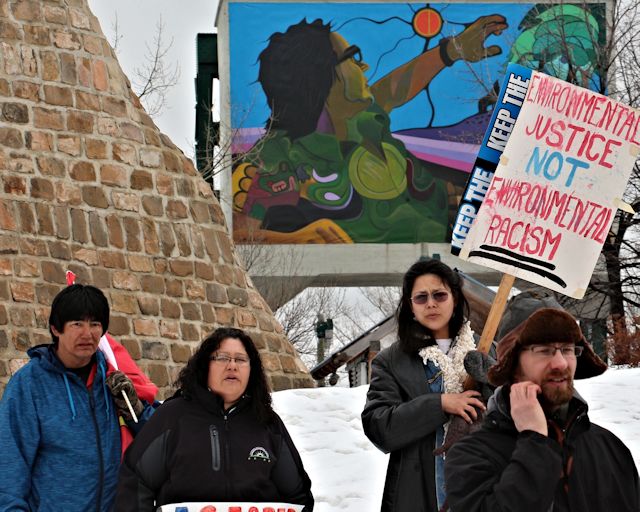
Oct. 4, 2013: Winnipeggers gathered at the Manitoba Legislature to remember the lives of 600 missing and murdered Aboriginal women in Canada, 75 of whom came from Manitoba. Photo: Paul S. Graham

Oct. 4, 2013: Winnipeggers gathered at the Manitoba Legislature to remember the lives of 600 missing and murdered Aboriginal women in Canada, 75 of whom came from Manitoba. Photo: Paul S. Graham

Winnipeggers gathered at the Manitoba Legislature on Friday afternoon to demand an national inquiry into the causes for the disappearance or death of over 600 indigenous women in Canada in recent years. The demonstrators repeated a longstanding demand for a for national inquiry, something that has gained the support of all provincial premiers and territorial leaders, but which continues to be rejected by the federal government.

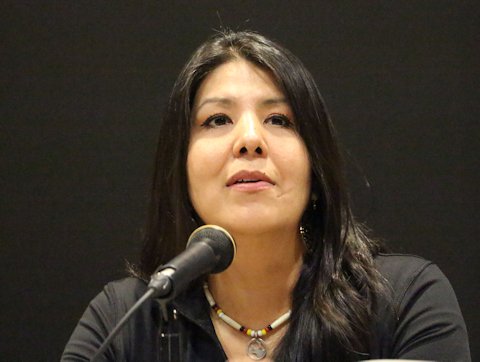
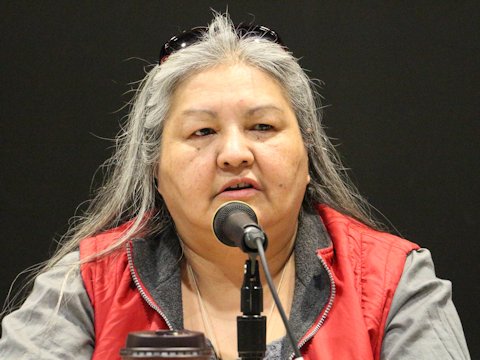
Appearing in this video report are Rosanna Deerchild, Chief Francine Meeches,  Judy Wasylycia-Leis, Raven Hart-Bellecourt, Robert Animikii Horton, Jo Redsky, Sierra Noble, Dana Foster and Chief Cathy Merrick.


Winnipeg Peace in Syria Rally

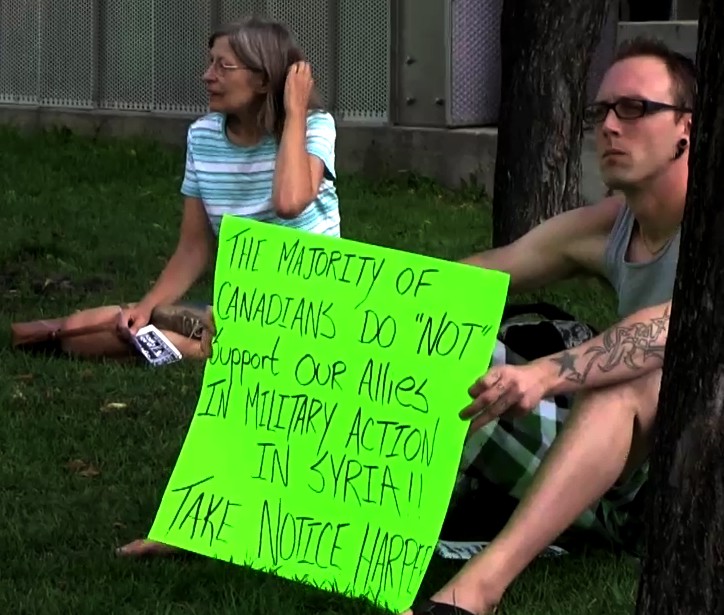
Sept. 7, 2013: Winnipeggers rallied at the Manitoba Legislature in opposition to an attack on Syria and distributed literature on Memorial Boulevard and Broadway. Photo: Paul S. Graham

Sept. 7, 2013: For the second time in a week, Winnipeggers rallied in solidarity with the people of Syria and in opposition to a US led attack. After a brief gathering on the steps of the Manitoba Legislature, the demonstrators took to the streets to hand out literature and talk with their fellow Winnipeggers.

Speaking on behalf of No War with Syria (Winnipeg), Chris Zanewich said, “ The decision to carry out a “limited” attack on Syria will carry dire consequences. If nothing is done to intervene peacefully, an increase in civilian casualties along with the displacement of millions of peaceful Syrians will undoubtedly be the harsh reality.”

Zanewich said that the appropriate remedy for those accused of chemical weapons attacks would be “ a fair democratic trial.” Elaborating on Chris’s comments, No War with Syria (Winnipeg) representative Tara Mann explained that “Darkness cannot drive out darkness, hate cannot drive out hate. Hate multiplies hate, violence multiplies violence, creating a destructive spiral. Peace cannot be achieved through violence, hatred, and greed; it can only be attained through truth, love and understanding.  Humanity must understand this concept. Or else. We will continue to experience separation, and we will continue to experience war with each other over money, oil, power, skin colour, and religion for the remainder of our existence on this planet.”

Manitoba Peace Council representative Cheryl-Anne Carr said that the struggle of the Syrian people for democratic rights has been “hijacked by the West” to serve Western interests. Regarding Canada’s pro-military intervention stance in this crisis, she noted that

“Canada is the third largest investor in Syria and we have some actual leverage with that country if we wanted to use it without encouraging missile strikes. A few short years ago, the Harper government had such confidence in the Assad government we in Winnipeg had to fight tooth and nail to keep a young man from being deported to torture and death in Syria. The Harper government openly said no harm would come to him, that it did not think Assad hurt his own people, that nations were sovereign and made their own rules.”

Glenn Michalchuk, of Peace Alliance Winnipeg, was the last to speak. He observed that “When we demonstrate against the threat of U.S bombing we are not blind to the suffering of the Syrian people or indifferent to their struggle against internal reaction. The Syrian people have the right to determine their future for themselves and to build their country as they see fit. But this right will not come from the bombs of the U.S. Nor will it come from the interference of the U.S., Britain, Canada, France and Saudi Arabia to fuel civil war with arms and foreign fighters. This right will not come from Russia which for decades considered Syria its client state in the Middle East to protect its interests in that region against the maneuverings of the United States.”

Complete texts of the speeches delivered by Carr and Michalchuk are available here and here, respectively.

For more, watch my video report.


Aug. 31, 2013: Two of the Winnipeggers who gathered at the Canadian Human Rights Museum to oppose military intervention in Syria. Photo: Paul S. Graham

Aug. 31, 2013: Two of the Winnipeggers who gathered at the Canadian Human Rights Museum to oppose military intervention in Syria. Photo: Paul S. Graham

By Peace Alliance Winnipeg

As the United States moves closer to a direct military strike on Syria, the world draws closer to a conflict that could spread well beyond the boundaries of that war-torn nation.

The pretext for an American strike is an allegation, as yet unproven, that Syrian government forces used sarin gas on opposition forces and civilians. A UN weapons inspection team is on site to determine if chemical weapons were used, though it has no mandate to determine who might have used them. Regardless of what the UN might say, the American government has decided to press on with “punishing” the Syrian regime. No such action is mandated by the 1925 Geneva Protocol on chemical weapons, and an attack would violate international law.

Despite the US government’s assertions of overwhelming proof, only France has said it will join the US in an attack. The British Parliament, last week, voted against military intervention. The UN Security Council has refused to authorize a strike. NATO has ruled out military action.

British MPs voted against military action because the British people were well aware of the falsified British and American intelligence reports that were used to justify attacking Iraq in 2003. That invasion caused the deaths of hundreds of thousands of Iraqis and almost 5,000 coalition troops. Four million Iraqis became refugees, the country’s infrastructure was destroyed and Iraqi society was fragmented by sectarian violence that continues to this day.

Canada has funneled more than $5 million to opposition forces and endorsed the use of military force. PM Harper has ambiguously stated that, “at the present time the Government of Canada has no plans, we have no plans of our own, to have a Canadian military mission.” Although Canada has said that it doesn’t intend to send troops, it has provided the US government with consistent political support. We must pressure the Canadian government to reverse that support and we must express our opposition to the US war drive.

The Syrian war is widening

The people of Syria have already suffered over two years of a devastating war, with more than a hundred thousand Syrians killed and millions driven from their homes. What began as a nonviolent protest and then civil war has expanded to sectarian and even more dangerous international conflict.

Syria is a battleground where conflicts are being fought out between regional powers (Saudi Arabia and Iran) and global powers (the US and Russia). A US military attack would worsen the conflict between heavily armed and powerful forces, seriously escalating the war and further destabilizing the Middle East.

Attacking Syrian forces with cruise missiles and drones, which is what the US military is likely to do, will only add to the death toll and delay the peace negotiations that must ultimately bring this war to a close. Even if, through some miracle, the violence remains contained within Syria, the price will still be paid by the Syrian people.

Antiwar sentiment is strong and growing

Last weekend there were antiwar demonstrations around the world. Protests were held in more than 12 Canadian cities, including Winnipeg.

This attack can be prevented, but only with a huge global response. We need to show our solidarity with the people of Syria and stop the US from launching its missiles under the guise of humanitarian intervention. The lives of tens of thousands more Syrians are at stake.

What can we do, here, in Winnipeg?

There are positive, constructive steps we can take to show our support for the people of Syria. We can contact our Members of Parliament. We can insist that they reconvene Parliament and take the following constructive steps:

1. Provide genuine humanitarian aid to the victims of the civil war in the form of food, medical supplies and financial contributions to the reputable humanitarian aid groups that have been stretched to the breaking point by this crisis.

2. End all forms of material and political support to opposition forces.

3. Adopt a genuinely neutral position on the world stage and press for peace talks that involve all of the contending forces.

Parliament must be reconvened to reverse the damage that our government has done by taking sides in this civil war. Canada has to become a responsible voice for peace in the Middle East and the world. If you don’t know how to get hold of your MP, here are some phone numbers.

  • Niki Ashton (Churchill): 204-677-1333
  • Joyce Bateman (Winnipeg South Centre): 204-983-1355
  • Candice Bergen (Portage-Lisgar): 204-822-7440
  • James Bezan (Selkirk-Interlake): 204-785-6151
  • Rod Bruinooge (Winnipeg South): 204-984-6787
  • Steven Fletcher (Charleswood-St. James-Assiniboia): 204-984-6432
  • Shelly Glover (St. Boniface): 204-983-3183
  • Kevin Lamoureux (Winnipeg North): 204-984-1767
  • Pat Martin (Winnipeg Centre): 204-984-1767
  • Joy Smith (Kildonan-St. Paul): 204-984-6322
  • Robert Sopuck (Dauphin-Swan River-Marquette): 204-848-7000
  • Lawrence Toet (Elmwood-Transcona): 204-984-2499

For more complete contact information, go here.

What else can we do?

Get educated. There are excellent sources of critical analysis on the Internet. Here are a couple:

Centre for Research on Globalization

Middle East Research and Information Project

Get involved. You can find No War With Syria (Winnipeg) on Facebook. Peace Alliance Winnipeg is also on Facebook, and on the Internet.

Please contact us. Together, we can do our part to work for peace.

Reposted from Peace Alliance Winnipeg News


Aug. 31, 2013: Winnipeggers rallied to voice opposition to foreign intervention in Syria's civil war. Photo: Paul S. Graham

Aug. 31, 2013: Winnipeggers rallied to voice opposition to foreign intervention in Syria’s civil war. Photo: Paul S. Graham

About 50 Winnipeggers rallied at the Canadian Museum of Human Rights Saturday afternoon to express their opposition to foreign military interventions in Syria. The rally, organized by Winnipeg Alternative Media, was one of many held on Saturday across Canada, and was part of an international campaign to prevent the Syrian crisis from escalating into a world war.

In this video report, organizers explain what is at stake.


Winnipeg, April 21, 2013: Some of the participants in the 10th annual Seventh Generation Walk for Mother Earth, at the Oodena Circle at The Forks. Photo: Paul S. Graham

Winnipeg, April 21, 2013: Some of the participants in the 10th annual Seventh Generation Walk for Mother Earth, at the Oodena Circle at The Forks. Photo: Paul S. Graham


Despite the inclement weather, this year’s Seventh Generation Walk for Mother Earth was a lively celebration that began at Central Park and ended at Thunderbird House, with stops along the way at the Manitoba Hydro headquarters and the Oodena Circle at The Forks.

Held on Sunday, April 21, this year’s walk was in support of the Voices of Indigenous Women and in solidarity with the growing Idle No More Movement.

Speakers included Susanne McCrea of the Boreal Forest Network, Ko’ona Cochrane, Alberteen Spence, Judy da Silva, Kristen Andrews, Myrle Ballard and Diane Maytwayashing.

Here’s my video report.


Jo Seenie Redsky: "we’re your last resort." Photo: Paul S. Graham

Jo Seenie Redsky: “We’re your last resort.” Photo: Paul S. Graham

If your only source of information is the mainstream news media you can be forgiven for wondering what the Idle No More movement is all about. Since it burst on the scene late last year, media attention has darted from demonstrations to blockades to the fasts of elders and chiefs — with an occasional sustained flurry of excitement when the PMO tried to smear Chief Theresa Spence.

Discussions of the abrogation of historic treaty rights or the corporate pillaging Stephen Harper has buried, like poisonous turds, in his omnibus budget bills, do not lend themselves to the tidy sound bites that nourish the media and feed the news cycle.

Having spent last Sunday afternoon at a panel discussion sponsored by Peace Alliance Winnipeg and Project Peacemakers, I can assure you that Idle No More is about nearly everything that is wrong with our society, but fundamentally it is about love. Love of family, friends, complete strangers, future generations, the air we breathe, the water we drink, the earth we walk on.

Feb. 24, 2013: Jerry Daniels speaking about Idle No More in Winnipeg. Photo: Paul S. Graham

Jerry Daniels: ” The issue is sustainable development.” Photo: Paul S. Graham

Idle No More is inclusive and green. As panelist Jerry Daniels puts it, “A sustainable future is important to not only aboriginal people, it is important to all of us . . . the issue is sustainable development – sustainable futures for our children.” For Leah Gazan, “it’s not just about indigenous people of Canada any more, it’s about all of us. It’s about all of us sharing this land in a really good way.”

Idle No More is about redressing the damage we have done to ourselves and the environment, and preventing more of the same. Chickadee Richard sums it up in as tidy a sound bite as you could find anywhere: “As you heal, you heal Mother Earth.”

Chickadee Richard, Feb. 24, 2013

Chickadee Richard: “As you heal, you heal Mother Earth.” Photo: Paul S. Graham

Michael Champagne: "An injustice to one is an injustice to all." Photo: Paul S. Graham

Michael Champagne: “An injustice to one is an injustice to all.” Photo: Paul S. Graham

Idle No More is about aboriginal youth, says Michael Champagne, but about aboriginal youth unlike those of previous generations: “not only are we educated in Western institutions . . . , we are also educated by the Chickadees of the world, by our elders and our ancestors and our community and we are able to learn about the strength and resilience of our ancestors and our nations.”

Idle No More is about human solidarity. Champagne continues: “We’re able to hear those teachings within the medicine wheel and understand that we are all related regardless of the colour of our skin, and like a circle, it is not complete if one of you is missing . . . if you’re hurting, I’m hurting . . . and if I’m hurting, so are you . . . An injustice to one is an injustice to all.” Champagne was consistent; he included Stephen Harper in the company of those damaged by the system Idle No More seeks to overturn.

Lori Mainville: "no fear, no surrender, only love." Photo: Paul S. Graham

Lori Mainville: “no fear, no surrender, only love.” Photo: Paul S. Graham

Idle No More cannot be contained or controlled says Lori Mainville. “The media poses a skewed version – always trying commodify or standardize or put it in a dichotomy and this is a people’s movement. The definition rests with the people and our relationship with the people, our allies, our brothers and sisters in each moment as this energy reveals itself. There’s no way you can cap [it].”

Idle No More is an obligation for those who love Mother Earth. “I guess you could say in . . . protecting the land, the waters, we’re your last resort,” says Jo Seenie Redsky. “I know the world is watching our people here, in the country of Canada, to see us rise up and protect what everybody needs to protect and that’s the land and the waters and those yet to come.”

Leah Gazan: "Idle No More is the newest version of a 500-year struggle." Photo: Paul S. Graham

Leah Gazan: “Idle No More is the newest version of a 500-year struggle.” Photo: Paul S. Graham

At its base, says Redsky, Idle No More is about love. “There’s an unconditional love that we have for our kids. That protection that we have for them is the same protection that we need to have for Mother Earth.” For Lori Mainville, whatever the risks, “I keep remembering that the greatest equalizer is love . . . no fear, no surrender, only love . . . For me, it’s about love as a mother and a grandmother and a sister and a community member.”

My reduction of this discussion to a matter of love aside, it is difficult to sum up a discussion of this importance in a few paragraphs.

Fortunately, I brought my video camera.

If you want to get involved, you can find Idle No More on Facebook and on the World Wide Web. As the weather warms, I have a feeling you’ll be able find it and join it in the streets. Don’t hesitate, because I’m sure you’ll receive a warm welcome.


Oct. 6, 2012: A passerby reads a leaflet distributed by Peace Alliance Winnipeg in Osborne Village. Photo: Paul S. Graham

Activists in at least 6 Canadian cities joined in the International Day of Action yesterday to carry the message “Don’t attack Iran” to our fellow citizens.

In Winnipeg, Peace Alliance Winnipeg held an information picket in the Osborne Village neighbourhood, distributing hundreds of leaflets that exposed the myths that are being spread by our various governments to justify sanctions and a future war against Iran.

At the conclusion of the demonstration, Peace Alliance Winnipeg chairperson, Glenn Michalchuk, spoke about the growing war danger and the implications for Canadians. Here is my video report.


by Peace Alliance Winnipeg

During the Vietnam war, tens of thousands of American conscientious objectors sought refuge in Canada to avoid taking part in a war they could not, in conscience, support. While the Canadian government was slow to respond in a positive way, under persistent pressure from peace, church and labour activists, they were eventually permitted to obtain immigrant status. Many remain in Canada to this day as valued members of our communities.

Fast forward 40 years – many US soldiers have sought refuge here  rather than fight in the Iraq war, a war widely recognized as a crime against humanity. Rather than be complicit in war crimes they left their homes, their families and communities and sought refuge in Canada.

Their pleas for refugee status have been thwarted at every turn by the Harper Government. In defiance of two Parliamentary resolutions calling on the federal government to allow war resisters to stay in Canada, the Harper Government has continued to smear American war resisters as criminals. Minister of Citizenship and Immigration Jason Kenney has publicly labelled them as “bogus refugee claimants.” In July 2010, he issued a bulletin to all Immigration Officers requiring them to red-flag applications that involve US war resisters, labeling them as “criminally inadmissible.”

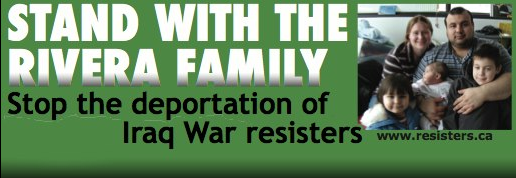
In recent news, the Harper government ordered U.S. Iraq war resister Kimberly Rivera, her husband Mario and their four young children deported to the United States. Kimberly served in Iraq in 2006, and sought refuge in Canada in 2007 after making the decision that she could no longer participate in the Iraq War. She was the first female US Iraq War resister to come to Canada. Kimberly and her family live in Toronto.

If deported, she faces harsh punishment. War resisters Robin Long and Clifford Cornell, two Iraq war resisters deported by the Harper government, were court-martialed and sentenced to 15 months and 12 months respectively for speaking out against the Iraq War.

Canadian support for American war resisters is widespread. We must redouble our efforts to make the Harper government listen.

Peace Alliance Winnipeg has sent a $300 donation to cover Kimberly Rivera’s legal costs. We have written to each Manitoba MP and we will be taking our message to the Winnipeg Take Canada Back demonstration on September 17th. Here are some things you can do:

1. Write, email, fax and or call your MP. If you wish, you can use or adapt the letter sent by Peace Alliance Winnipeg (below, at the end of this message) or you may wish to adapt the letter being used by the War Resisters Support Campaign.  To get their contact information, follow the links below:

(More MP contact information can be found here.)
2. Make a financial contribution to help with Kimberly Rivera’s legal expenses. You can make a donation online, here. To donate by cheque, make it payable to War Resisters Support Campaign and send to:

War Resisters Support Campaign
Box 23
427 Bloor Street West
Toronto, ON M5S 1X7
Canada

3. Write, email, phone or fax Minister of Citizenship, Immigration and Multiculturalism Jason Kenney and ask him to let Iraq War resister Kimberly Rivera and her family stay in Canada. You can use thisonline letter, or send your own message to:

325 East Block, House of Commons, Ottawa, ON K1A 0A6
Phone: 613-954-1064 Fax: 613-957.2688
Email: jason.kenney@parl.gc.ca, minister@cic.gc.ca

4. Join the Peace Alliance Winnipeg contingent at the Winnipeg Take Canada Back Demonstration on September 17th, 5:00 p.m., at the Manitoba Legislature. More information on this national demonstration, which coincides with the opening of Parliament, can be found here.

If Kimberly and her family are to be allowed to remain in Canada, we need to act now. Please share this message widely, and take action today.


LETTER SENT TO MANITOBA MPs FROM PEACE ALLIANCE WINNIPEG

September 13, 2012

Dear Member of Parliament for Manitoba

Re: Deportation of Kimberly Rivera , American Iraqi war resister

On behalf of the Peace Alliance Winnipeg I ask for your immediate attention and support on an urgent matter regarding the imminent deportation of Kimberly Rivera, a young American war resister, woman and mother. Her appeal to remain in Canada on humanitarian grounds has been denied by the Federal government and deportation is scheduled for as early as September 20, 2012.

Kimberly has sought refuge in Canada on moral grounds, motivated by her conscience, values, and political opposition to the American military action in Iraq. Many thousands of Canadians support her and view her decision and actions as a heroic matter of conscience.

On being forced to return to he US she will face two to five years of imprisonment made all the more harsh by her separation from her young children.

There is nothing to be gained from this inhumane decision and much will be lost. Kimberly losses her freedom and her ability to parent her children; her children lose precious time with their mother; the American military gains nothing but retribution and, as Canadians, we also lose.

This is a serious and symbolic issue for us a nation. If we fail to reverse this deportation decision, and all others like it, Canada loses a significant degree of independence in determining the value of individual conscience particularly as it concerns the matter of conscientious objection. The deportation of war resisters sends the message that Canada does not value those who refuse to fight in war. It further erodes our standing in the world as peace keepers and a middle power capable of being an honest broker on the world stage.

Most troubling we will have failed our long held national values of defending legitimate moral opposition, defending the right to conscience and protecting political refugees from certain prosecution. Our once highly held principle of humanitarian consideration for refugees will be irrevocably threatened along with our national identity as a compassionate and tolerant country.

This is a costly and grave matter for Kimberly and her family and for us as Canadians. It is erroneously being framed as a criminal matter. Deportation of Kimberly and others like her will have far reaching, long term destructive consequences for us all. The real crime is a moral one in allowing this deportation to proceed unchallenged.

In June 2008 and March 2009 Parliament passed resolutions calling for a halt to the deportations of war resisters and allowing them to stay in Canada as permanent residents. Please use your position and voice as a parliamentarian to immediately stop the deportation of Kimberly Rivera.

Glenn Michalchuk
Chair, Peace Alliance Winnipeg

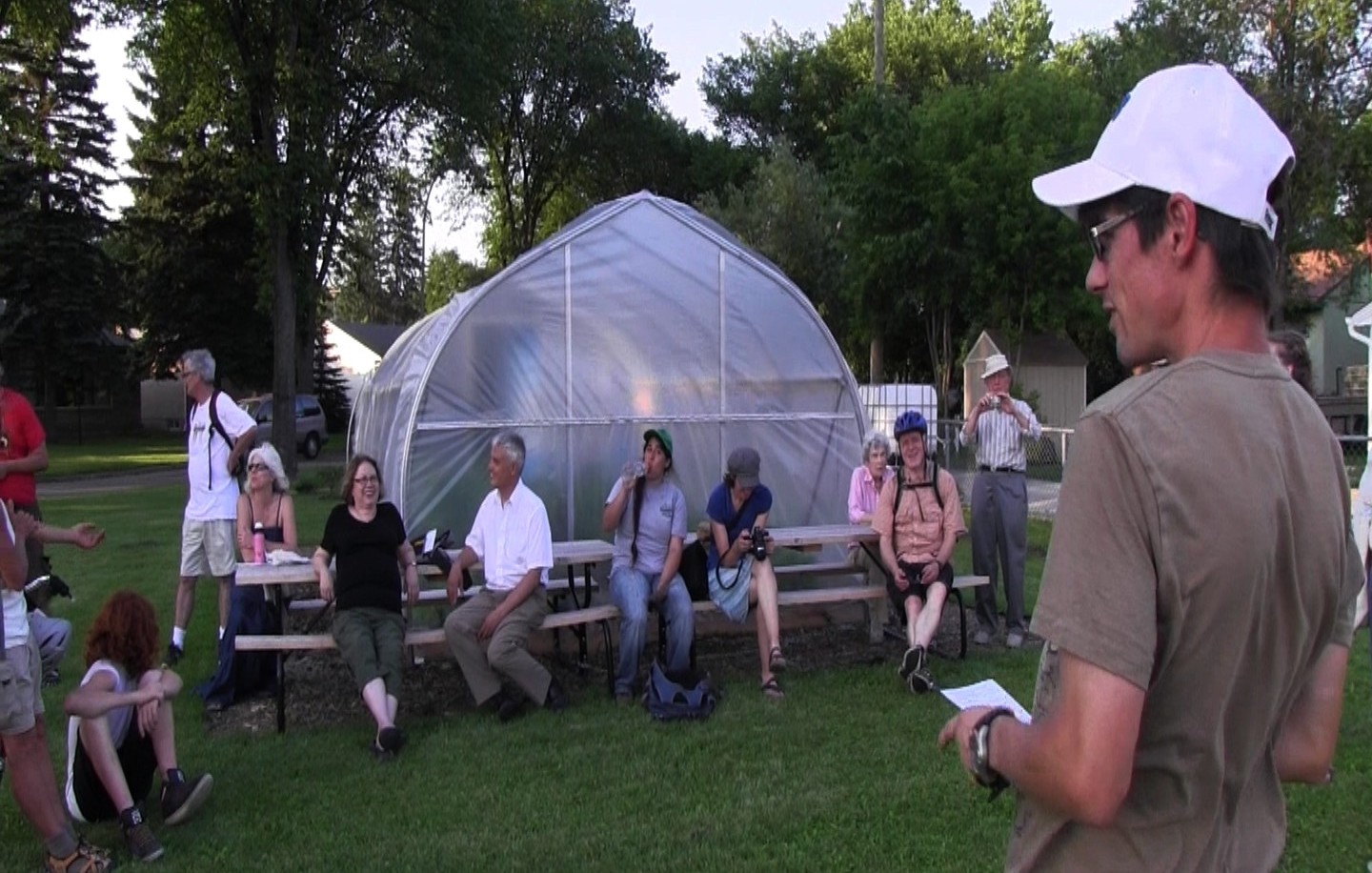
The Riverview Hoop House was one of the projects on display during a walking tour of urban agricultural projects organized by the Sustainable South Osborne Community Co-op in June in Winnipeg. Coordinator Scott Harrison explains how it works. Photo: Paul S. Graham

Where does your food come from? If you’re like most of us, your reach is truly global. Tomatoes from Mexico. Grapes from Chile. Oranges from Florida. Lettuce from California. And that steak on the barbecue? It may have started life on a Manitoba farm but it was probably fattened, slaughtered and processed in Saskatchewan, Alberta or the United States.

While some of our food is grown and processed locally, most of it travels several hundred to several thousand kilometres before it lands on our plates.

Our food doesn’t walk. Ocean going vessels, rail cars, and long haul truckers carry the bulk of it, with some luxury items travelling by air. This far-flung, complex transportation network enables us to enjoy an almost limitless variety of foods from around the world, regardless of the season.

This abundance is a relatively new phenomenon. While the peoples of the world have traded foodstuffs from one region to another throughout recorded history, it was only after the development of fossil fueled modes of transport that our globalized food system became possible.

That era will soon be coming to an end because the energy source that made it all possible is running out. As oil consumption continues to outpace oil discovery and production, energy prices will continue to rise. Because every aspect of our food system, from production, to processing and transportation depends on oil, the prices on our global menu will continue to grow, and they will grow beyond the reach of most citizens.

Simply put, our existing globalized food system is not sustainable. The sooner we begin to make the transition to a more rational system the better.

While governments appear to be largely unaware of this looming threat, small groups of citizens have recognized the problem and are beginning to look for solutions.

One of these is the Sustainable South Osborne Community Co-op, located in Winnipeg, MB. In June 2012, I joined a walking tour of projects the co-op has going in its neighbourhood.

Here is my video report.

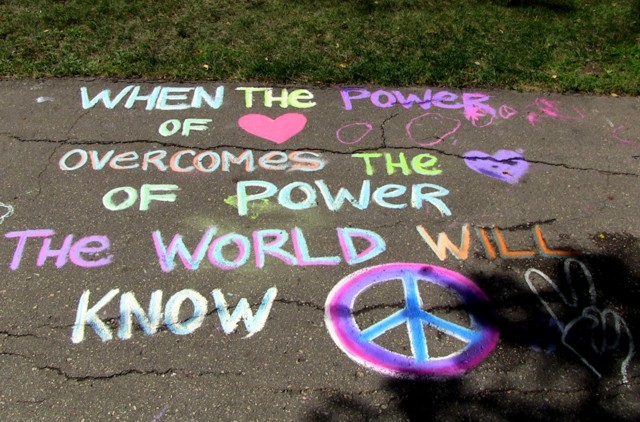
Aug. 25, 2012: One of the messages adorning the walkways of Vimy Ridge Park. Photo: Paul S. Graham

The underlying premise of CHALK 4 Peace might best be summed up in a statement attributed to Mahatma Gandhi in 1937: “There is no way to peace; peace is the way.”

CHALK 4 Peace is an annual event that has spread to hundreds of communities world-wide since its inception in 2003 in Arlington, Virginia. The objectives, according to CHALK 4 Peace  are:

  • To promote the arts by coordinating assemblies of young artists of all ages to draw their vision of peace in public and private spaces with sidewalk chalk as a scheduled worldwide event;
  • To advocate for peace in a non-partisan manner such that all people may share their visions and messages of peace without regard to their nationality, ethnicity, or political beliefs;
  •  To encourage relationships between municipalities and artists so that communities around the world become united in supporting the expression of peace.

Winnipeggers celebrated their 6th annual CHALK 4 Peace on Saturday, raising funds for War Child Canada, and bringing sidewalk art, music, and laughter to Vimy Ridge Park.

Performers included Ras Tamils, the Flaming Trolleys and Lindsey White & Mitch Dorge.

Kisa MacIsaac, one of the organizers of the Winnipeg event, explains how this coming together of arts, music and people contributes to a more peaceful world.

You can find find CHALK 4 Peace Winnipeg on Facebook.