Hassan Raza, his wife Sarfraz Kausar, and their children Rubab, 13, Mohsin, 12, Zain, 7, Ume Farve 6, Hassan, 4, and one-year-old Seema, took sanctuary in the Crescentwood-Ft. Rouge United Church in Winnipeg on Aug. 3, 2006 when they were threatened with deportation to their native Pakistan. The Shia-Sunni Muslim family fears they will face persecution if they are sent back. Given the sectarian strife between Shia and Sunni, this is a credible and reasonable fear.

The Razas wish to make Canada their home. The middle two children were born in the United States after the Razas left Pakistan in 1998 and sought asylum in the United States. They moved to Montreal in 2002 and came to Winnipeg in 2004 in search of better job opportunities and more affordable housing. The two youngest children are Canadians. It is only fair and compassionate that they be allowed to remain in Canada.

Many people in the Crescent-Ft. Rouge congregation (and others who are not involved in the church) have rallied to their side. Broader support is needed, and that is where you come in.

The family faces a deportation hearing in Winnipeg this Friday, Mar. 2 and is requesting letters of support from Canadians, urging the federal government to allow them to remain in Canada. I urge you to write an email indicating your support, and send it to the Raza family at raza@shaw.ca. Your letter will be presented along with many others at this hearing. Please do so without delay.

Much has been written about the Raza family and their struggle. A good source of information is at the Crescent-Ft. Rouge United Church web site.
The United Church, which has been supporting the family, advises letters be drafted with the following in mind:

  • maintain a polite and respectful tone always
  • ask the Minister of Citizenship & Immigration to make a compassionate intervention in the case of the Raza family to allow them to remain in Canada
  • ask the Minister of Public Safety to grant a “stay of removal” and allow them to leave sanctuary without fear of being apprehended
  • emphasize that there are six children – the two youngest (ages three and one) are Canadian-born citizens
  • note that the family has been in Canada for four years, the father, Hassan Raza was employed and has a job awaiting his freedom and that the children of school age have been in school
  • copy the letters to your own MP and to Prime Minister Stephen Harper at the House of Commons (you can get their contact information here).

In addition to sending a letter of support to the Raza family that can be presented at their hearing, letters to government ministers would be helpful as well.

Write to:

The Hon. Diane Finley,
Minister of Citizenship & Immigration,
House of Commons,
Ottawa, ON K1A 0A6 Phone 613-996-4974
Finley.D@parl.gc.ca

A copy may be sent to Ms Finlay’s Constituency Address: 70 Queensway West, Simcoe, ON, N3Y 2M6.

The Hon. Stockwell Day,
Minister of Public Safety,
House of Commons,
Ottawa, ON K1A 0A6 Phone 613-995-1702
Day.S@parl.gc.ca

A copy may be sent to Mr. Day’s Constituency Address: 202-301 Main Street, Penticton, BC V2A 5B7.

I’ve spent a bit of time with Hassan over the past few weeks, helping him with his English and I’ve met his family. They are good and gentle people. I like them. I’m pleased and proud that they want to live here. With our support, perhaps they can. Please take some time to write your letters today.

Anyone even remotely familiar with environmental issues finds it difficult these days to be optimistic about the future of civilization. Global climate change is now accepted, and the debate is not whether it is happening, but how bad it will be.

How bad will it be? The Intergovernmental Panel on Climate Change, in its most recent report, charts various scenarios. Leaving no doubt that the planet will continue to warm for centuries to come even if we stabilize greenhouse gas emissions at year 2000 levels, its worst case scenario suggests increased average temperatures (as much as 4 degrees Celsius) and higher sea levels (up to 69 centimeters) by the end of this century.

What this would mean in practical terms pretty much depends on where you live. While those of us who inhabit the frozen, mid-continental wastes of Manitoba might appreciate a bit of temperature relief this time of year, the implications of this kind of respite are serious enough that most thoughtful northerners would forego them.

The IPCC views the Hollywood’s nightmare scenario (in The Day After Tomorrow, the Gulf Stream shuts down, plunging the northern hemisphere into an Ice Age overnight) as unlikely. Neither is there any support for Al Gore’s predicted 6 meter increase in sea levels, however much he might secretly want Florida to disappear. That said, the impacts will be sustained and serious, especially for Asia, Africa and Latin America.

According to IPCC:

. . . all regions are likely to experience some adverse effects of climate change. . . Some regions are particularly vulnerable because of their physical exposure to climate change hazards and/or their limited adaptive capacity. Most less-developed regions are especially vulnerable because a larger share of their economies are in climate-sensitive sectors and their adaptive capacity is low due to low levels of human, financial, and natural resources, as well as limited institutional and technological capability. For example, small island states and low-lying coastal areas are particularly vulnerable to increases in sea level and storms, and most of them have limited capabilities for adaptation. Climate change impacts in polar regions are expected to be large and rapid, including reduction in sea-ice extent and thickness and degradation of permafrost. Adverse changes in seasonal river flows, floods and droughts, food security, fisheries, health effects, and loss of biodiversity are among the major regional vulnerabilities and concerns of Africa, Latin America, and Asia where adaptation opportunities are generally low. Even in regions with higher adaptive capacity, such as North America and Australia and New Zealand, there are vulnerable communities, such as indigenous peoples, and the possibility of adaptation of ecosystems is very limited. In Europe, vulnerability is significantly greater in the south and in the Arctic than elsewhere in the region.

The carefully measured language and the studiously academic tone of the IPCC report does not begin to convey the wide scale human suffering that will result from global warming.

Large numbers of people around the globe will either starve or be forced to move, retreating from floods and from droughts. Where will they move and how will they be received? Who will help and where will the necessary resources come from?

While the IPCC believes the impacts will be worst in the South, if anyone seriously believes that the more affluent North can or will escape, I have some soon to be flooded swampland in Florida they are welcome to purchase.

Perhaps it is this vision of the future that has scientist James Lovelock lamenting in the January 16, 2007 issue of The Independent that

. . . before this century is over billions of us will die and the few breeding pairs of people that survive will be in the Arctic where the climate remains tolerable.

Lovelock is a highly respected scientist, best known for putting forward the “Gaia Theory” – the notion that the earth is a self-regulating organism. In his January 16th article, Lovelock observes

We have given Gaia a fever and soon her condition will worsen to a state like a coma. She has been there before and recovered, but it took more than 100,000 years. We are responsible and will suffer the consequences: as the century progresses, the temperature will rise 8 degrees centigrade in temperate regions and 5 degrees in the tropics.”

Lovelock’s prognosis is considerably more pessimistic than that of the IPCC, but perhaps unfettered by the need to appear scientifically objective he is freer to call ‘em as he sees ‘em.

Both the IPCC’s worst case scenario and Lovelock’s warnings are premised on continued unchecked use of fossil fuels. But what if they are wrong? What if we run out?

Peak Oil

The idea that we will run out of oil in this century is gaining adherents worldwide. The theory that has come to be known as “Peak Oil” was proposed in 1956 by American geophysicist Marion Hubbert, who predicted that US oil reserves would peak around 1970 and that world reserves would peak sometime in the early part of the 21st century (about now, in case you hadn’t noticed). Most observers have concluded that Hubbert was bang on in predicting the US peak; there is considerable debate as to whether world oil reserves have peaked already or whether they will in the near future.

I’m not going to quibble over whether oil reserves peaked in 2005 or whether they will do so in 2020. The significance of the peak oil discussion can be summarized as follows:

  1. The world runs on oil. Our jobs, our food supplies, our technology, our economy are all, in one way or another, reliant on abundant supplies of relatively inexpensive petroleum.
  2. If half of all the oil in existence has been used up, and demand continues apace, remaining supplies will be consumed more quickly. Not only will they be used more rapidly, they will become increasingly more difficult and more expensive to recover.
  3. Worse yet, there is no substitute. All of our proven alternative energy technologies, including so called renewable energy technologies, rely on petroleum in one way or another. And none of the alternatives, with the exception of nuclear power, are nearly as productive as oil.
  4. When oil supplies become severely constrained, economic collapse will not be far behind. And this collapse will occur in the context of a world seriously stressed by global climate change.

Try and imagine a world without oil. We lived like that once upon a time. But there weren’t as many of us. And it appears there won’t be as many of us the next time around. (Gandhi was once asked by a journalist what he thought of western civilization. He is reported to have said he thought it would be a good idea.)

Trying to imagine civilization, western or otherwise, without oil is a daunting task. The good citizens of Portland, Oregon are going through that exercise in a big way. Displaying considerably more imagination than most governments, Portland’s City Council established a Peak Oil Task Force to consider the impact of constrained energy supplies on that community.

Their draft report is available online, and contains recommendations that should be considered by all urban centres. You know they are taking the problem seriously when their first recommendation is to “Reduce oil and natural gas consumption by 50 percent over the next 25 years.”

It wasn’t lost on me that measures appropriate to addressing petroleum shortages will also help mitigate global warming.

Reading through Portland’s task force report shines one small ray of optimistic light on an otherwise gloomy landscape. If the government of one major city is capable of responding in this way, perhaps others will be similarly capable and motivated.

Can you hear me, Stephen Harper?

Reframing the Left in Canada

Posted: February 13, 2007 in Uncategorized

A while back I posted a piece called Framing the Left, which focused on the theories of  George Lakoff of the Rockridge Institute concerning the effective communication of progressive values and ideas.

Murray Dobbin’s Feb. 6, 2007 article in The Tyee, How the Left Should Frame Issues, makes a good start at applying Lakoff’s ideas to Canadian federal politics. Well worth reading . . .

Yesterday Manitoba’s provincial government announced plans to rebate $2,000 to every citizen who buys a hybrid vehicle before Nov. 15, 2008. When I look at the gas guzzlers my tax dollars are going to support, I have to ask WHY???!!!

Here’s the list of vehicles that Manitoba will now subsidize and their respective fuel consumption estimates (miles per gallon) in parentheses (city/highway). Unless otherwise noted, fuel economy estimates come from the US Department of Energy/Environmental Protection Agency web site on fuel economy.

Trucks

SUVs

  • Ford – Escape Hybrid (36/31 FWD; 32/29 4WD)
  • Lexus – RX400H (32/27 2WD; 31/27 4WD)
  • Mercury – Mariner Hybrid (32/29)
  • Saturn – VUE Green Line (27/32)
  • Toyota – Highlander Hybrid (32/27 2WD; 31/27 4WD)

Cars

  • Honda – Accord Hybrid (28/35)
  • Honda – Civic Hybrid (49/51)
  • Honda – Insight (60/66)
  • Lexus – GS 450H (25/28)
  • Toyota – Camry Hybrid (40/38)
  • Toyota – Prius (60/51)

Now I drive an aging (1997) but still quite serviceable Mazda Protege which gets 25 mpg in the city and 33 mpg on the highway. Seats four; lots of room for groceries. I don’t drive it much, but when I do, it compares favourably with the brand new SUVs my government is subsidizing and beats the pants of those trucks.

This policy is wrong headed in the extreme. Not all hybrids are equal; nor are they equally worthy of support.

All this policy achieves is the public bankrolling of middle class luxuries — which may play well in a pre-election period, but does nothing about global climate change except perpetuate the myth that we can not only continue to have our climate destroying toys, but that the public should pay for them.

If hybrid vehicles are to be subsidized, at least be selective and support those products that have obviously raised the bar (such as Toyota’s Prius).

Better yet, spend more on improve public transportation systems and legislate fuel economy and emissions standards that challenge automakers to build green vehicles or get out of business.

Seventy women, members of COPE Local 343, have been on strike against the FirstOntario Credit Union in Hamilton, Ontario since October 20, 2006. The workers are striking because of management demands to roll back health, vacation and retirement benefits. Also at issue are job security provisions in the collective agreement.

More information from the union perspective is available here, where you will find a series of strike bulletins. What little information FirstOntario is providing, is available here, as far as I can discover from their web site.

As a life-long credit union member in Winnipeg, it breaks my heart to see supposedly co-operative institutions abusing their workers. COPE 343 deserves our support, not only because their demands are just, but because their bosses need to learn that credit unions should not do their business on the backs of their employees. (How ironic it is that FirstOntario grew out of credit unions set up in the 1930s and 1940s by trade union members who wanted a cooperative institution to provide financial services to working people!)

One way to show your solidarity with COPE 343 members, is to point your web browser to Labour Start. There you can send a clear message to the management of FirstOntario. In doing so, you will also be sending a supportive message to the members of COPE 343.

Close "Guantanamo North"

Posted: February 3, 2007 in Uncategorized

Mohammad Mahjoub, Mahmoud Jaballah and Hassan Almrei, inmates of Canada’s “Guantanamo North” are on hunger strike to protest their indefinite detention at Kingston’s Immigration Holding Centre. After two months without food or medical care, they are extremely weak and suffering from various medical problems.

According to rabble.ca, “Despite last week’s visit by Public Safety Minister Stockwell Day, who did not meet with the detainees, there has been no negotiation with the men, and no effort to end a critical situation that could turn deadly at any time.”

Their crime? No one, least of all the prisoners, knows. Under the Immigration and Refugee Protection Act, the Canadian Security Intelligence Service can initiate a process which leads to the arrest of permanent residents or refugees who have committed no crime, throw them in jail, and detain them indefinitely with the aim of deporting them, even in the face of potential torture and death. Neither they nor their lawyers are allowed to see the “information” upon which CSIS makes allegations against them.

Consequently, all have been imprisoned under a “security certificate,” Mahjoub, since 2000 and the others since 2001.

As the revelations surrounding the illegal deportation, imprisonment and torture of Canadian Maher Arar show, the shadowy, undemocratic processes of Canadian and American intelligence agencies violate human rights, rather than protect them. If there was ever a time to demand that the Canadian government respect human rights, it is now, and a good place to begin is to join with the hundreds of organizations and individuals who have demanded an end to the use of “security certificates” by the government of Canada.

How? You can begin by endorsing the following statement by sending an email to tasc@web.ca with your name, title, affiliation and address, saying: “I ENDORSE THE STATEMENT”


Statement Against Secret Trial Security Certificates

We, the undersigned, have grave concerns regarding the continued use of sections 9, 76-87 of the Immigration and Refugee Protection Act, which allow for the imprisonment in Canada of refugees and permanent residents under the authority of a “Security Certificate”.

We are particularly concerned that those detained under security certificates are:

  • Being imprisoned indefinitely on secret evidence, though no charges have been laid against them;
  • Tried in unfair trials where the evidence is not disclosed to the detainee or their lawyer;
  • Denied the right to appeal when the certificate is upheld in a process that uses the lowest standard of proof of any court in Canada;
  • Subject to deportation even when they face unfair imprisonment, torture or death.

We believe that the Security Certificate process is undemocratic and that it violates fundamental human rights, which the government of Canada has committed itself to through the Canadian Charter of Rights and Freedoms, the UN Universal Declaration of Human Rights, the UN Convention on Refugees, the International Covenant on Civil and Political Rights and the UN Convention on Torture. Accordingly, we demand that the Security Certificate process be abolished. For those currently imprisoned under security certificates, we demand:

  • That they be released immediately; or, if any case against them actually exists, that they be allowed to defend themselves in open, fair and independent trials with full disclosure of the case against them.
  • That they not be deported.

While you’re at it, write your MP. Better yet, insist on a meeting. The existence of “Guantanamo North” is a national disgrace, and the sooner we put an end to it, the better.

Resources

Labour in Love

Posted: January 27, 2007 in Uncategorized

Labour in Love.JPG

Labour in Love: the Mayworks Valentine Social

“Join us as we celebrate romantic unions — and unions in general!”

With music from singer-songwriter Adi Sara Kreindler & friends, Hugo Torres-Cereceda and Johnny Broadway.

Friday, February 9, 2007
Winnipeg Press Club (331 Smith St.)
Lower Level, Ramada Marlborough Hotel
Doors open @ 7 pm • Admission: $10

Proceeds support the Mayworks Arts Festival.

Tickets available at: Press Club • Winnipeg Labour Council Offices (502-Union Centre, 270 Broadway Ave.) • Workers Organizing Resource Centre (Mezzanine, 280 Smith St.) • or call Derek Black (256.9818) or Glenn Michalchuk (589.7840).

Download and post the Labour in Love Poster.

Winnipeg’s mayor, Sam Katz, has established something called an Economic Opportunity Commission to identify how the City can offset the approximately $62 million in business tax it collects every year.

In the words of the Mayor, “Unfortunately the business tax has long been identified as an impediment to growth. Fortunately, we’re going to eliminate it.”

This suggests to me that the Mayor has made up his mind. Axing the business tax has been a key plank for Katz in his last two elections. Regardless of the nature or quality of the EOC’s recommendations, he plans to deliver on this one. The EOC process is window dressing and will likely provide a platform for promoting other aspects of the Mayor’s pro-business agenda, such as privatization, contracting out, and reductions in services.

The EOC process has a veneer of democracy insofar as the public is invited to submit suggestions, in writing or online. But bear in mind that the discussion is about how businesses taxes should be eliminated, not if. And it is very much a one way process in that citizens are invited to submit recommendations, but there is no forum for citizens to see which recommendations have been submitted and who made them. Neither is there a way to debate them. This is unfortunate, because internet technology makes it easy to set up web forums that would facilitate the lively public debate that this issue deserves.

The makeup of the EOC is revealing. The members are all, in one way or another, strongly linked to the business community. Conspicuously absent are people who would bring alternative perspectives. There are no members associated with labour, or community development, aboriginal people, social services – and certainly no representatives of the workers who provide Winnipeg’s public services.

Also revealing are the links the EOC site provides for further information. In addition to links to various City sites and reports, there is a list of pro-business sites that clearly support the Mayor’s one-sided rightwing vision. As with the EOC membership, alternative visions are not present.

While the fix is in, the EOC process does provide at least a partial forum to debate critical issues underlying the future of Winnipeg. Although we can’t afford to limit our activities to making submissions that may never see the light of day, we shouldn’t ignore the opportunity to express our views.

Disclosure Time: I’m not a fan of our Mayor. And last year, I managed the electoral campaign of Marianne Cerilli, in which we put forward a positive, constructive vision for Winnipeg that remains relevant. I invite you to review these ideas here.

DANCE DOWN THA WALL 3!

Posted: January 17, 2007 in Uncategorized

Dance Down Tha Wall

The Canada-Palestine Support Network-Winnipeg (CanPalNet) presents:

DANCE DOWN THA WALL 3!
A fund raiser for the International Solidarity Movement, Winnipeg Local featuring Winnipeg’s funk & rap road map to dance floor justice and harmony, DJ Co-Op and Mama Cutsworth!

Saturday, February 3, 2007
Winnipeg Press Club
Lower Level, Ramada Marlborough Hotel
331 Smith Street
Winnipeg

Doors open at 8:30 pm
Admission: $10.00
Tickets are available at Mondragon Bookstore and Coffeehouse (91 Albert St.) and at the Winnipeg Press Club.

This social event is co-sponsored by the Uniter, CKUW 95.9 FM, Mondragon Bookstore and Coffeehouse, G7 Welcoming Committee and Peace Alliance Winnipeg. For more information, please contact CanPalNet at 942-1588 ext.1 or at 947-5093.

CanPalNet-Winnipeg is the local chapter of the International Solidarity Movement: a non-violent international organization working for peace in Palestine and an end to Israel’s longstanding and illicit occupation. (You might recall the ISM American member Rachel Corrie, who was crushed to death by an Israeli bulldozer while standing in front of a house set for demolition.)

The monies raised by CanPalNet-Winnipeg are used for educational seminars, panel discussions and other events, but the overwhelming majority of funds are used to dispatch volunteers to Palestine as witnesses to the occupation, and as workers in defense of ordinary Palestinians. They also hold an annual Canada-Palestine film festival, which so far has showcased over 20 films (feature length and documentary) on the conflict — films which rarely see the light of day in North America.

So, mark your calendar for February 3.

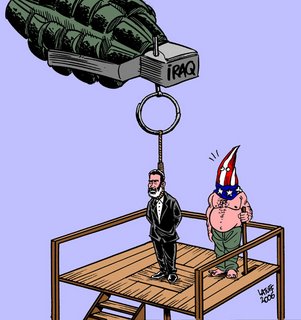
Saddam hangingAnd if any mischief follow, then thou shalt give life for life, eye for eye, tooth for tooth, hand for hand, foot for foot, burning for burning, wound for wound, stripe for stripe.
– Exodus 21:23

A day in the life of the average Iraqi has been reduced to identifying corpses, avoiding car bombs and attempting to keep track of which family members have been detained, which ones have been exiled and which ones have been abducted.
– riverbend, Baghdad Burning

Saddam Hussein didn’t have nearly enough body parts to compensate for the damage he did. Nor does George Bush.

It’s a pity, really, that George and Saddam will not have the opportunity to share what should be their just desserts: sharing a jail cell for the rest of their natural lives, with perhaps an opportunity for community service should either demonstrate he could be safely let out on the streets or display an aptitude for that kind of thing.

An eye for an eye makes the whole world blind.
– Mahatma Gandhi

‘Nuff said?