Today is the day the Canadian Peace Alliance has asked Canadians who oppose extending the stay of Canadian troops in Afghanistan to phone, fax, write, email their MPs, party leads, the PM, etc. If you haven’t, please get to it. More details at http://www.acp-cpa.ca/en/VirtualMarch.html.
Stuck for ideas? Just tell them how you feel. Here’s mine:
I am one of the overwhelming majority of Canadians who are opposed to any continuation of our military involvement in Afghanistan. This includes providing military training of any kind.
I am deeply disturbed at the appalling waste of human life (Canadian, NATO, Afghans on all sides). I feel morally compromised that my tax dollars are helping to pay for this carnage.
In my view, Canada’s involvement was wrong from the beginning. Despite the tiny fig leaf of legality afforded by the UN after the invasion, the invasion was a “crime of aggression” under international law; the ongoing occupation is a crime against humanity, committed to further the imperial designs of the United States and multinational corporate interests who have reaped the huge benefits of multi-billion dollar war spending. History will not look kindly on the Liberal and Conservative Party leaders who have brought us to this point.
Make no mistake, continuing to support this war and the hideously corrupt regime of Hamid Karzai under the guise of “training” fools no one.
Mr. Harper: you lied to the people about ending Canada’s military participation in 2011 and you lied when you said any extension would be subject to a debate in the House of Commons. You have developed a habit of hiding from Parliament when it suits your purpose and you will pay a huge price in the coming election.
Mr. Ignatieff: your complicity in defying the will of the Canadian people can only lead to the growing cynicism that Canadians feel when faced with politicians who will not listen to the people on important issues. It is astounding that you continue to squander opportunities to do the right thing and to lead Canada onto a principled, peaceful path. And you expect to become Prime Minister?
Mr. Duceppe: opposition to this war is stronger in Quebec than anywhere else in Canada. I hope you will act accordingly and oppose any further support for this madness.
Mr. Layton: I appreciate your opposition to the extension of this so-called “mission.” Remain strong and steadfast and be confident that the majority of Canadians support you when you call for the return of all Canadian troops. You may be the only national political leader who understands the need for peace, but, in this, you have millions of followers.
In summary, I insist that you bring ALL of our troops home from Afghanistan by July 2011, if not sooner.
In an interview, today, on Winnipeg’s CKUW-FM community radio station, peace and human rights activist George Galloway pledged to spend the proceeds of his lawsuit against the Canadian government to help fund the anti-war movement in this country.
Galloway was interviewed by Jonathan Wilson, co-host of CKUW’s People of Interest program which airs Monday, Tuesday and Wednesday at 8:00 a.m. at 95.9 on the FM dial. You can listen to the program on line, here. The Galloway segment of today’s program is available here .
In March 2009, Minister of Citizenship and Immigration Jason Kenney banned Galloway from entering Canada. The impact, according to Galloway, was severe.
“It may well have contributed to my first ever defeat in an election, in May of this year. My opponents ruthlessly pressed the case that I was a terrorist as officially defined by the government of friendly Canada – a country that most people tend to admire and love . . . It was threatening to my personal security because if I had been what Jason Kenney and his office were telling people I was, then there are lots of people around who are ready to physically harm if not eliminate such a person. It forced me to take all manner of personal security precautions.”
The October 31st Federal Court decision that over-turned the ban, has delighted Galloway. “I’m glad that the honourable judge proved what I had said all along, that Canada remains a country governed by laws rather than the whim of here today and gone tomorrow politicians. So I’m very glad to be back.”
“Well, it’s all very mysterious. That’s the first point. The Canadian taxpayer paid a pretty penny for this conference, even though they were entirely locked out of it. No media were permitted in it. We have no proper record of who was there. The attendance list even has not been published despite the taxpayer funding the whole thing. And it’s all very mysterious – what it’s all about. And when we’ll see its impact on Canadian public life. But it would be a fair inference that its impact will be malign and that the current assault on free expression on this issue in Canada is going to be intensified as a result of these protocols.
“I don’t think that this kind of secret conclave, coming up with – until now — secret protocols – is going to combat any antisemitism in Canada. As a matter of fact, it’s quite likely to generate greater feelings of enmity, which of course, I would deplore.
“Antisemitism exists. It is a racist phenomenon that has long existed in Christian countries for many, many centuries. Like all forms of racism it must be combated, and combated in the correct way which successfully, hopefully, one day, extinguishes it.
“But the answer to antisemitism is not to stop beating up the Jews and start beating up the Muslims. Instead, the answer is to conduct oneself in an unrelenting campaign against all forms of racism, bigotry and hatred – and that’s what I have done all of my life.
“Insofar as I’ve seen anything from this secret conclave, it attempts something unique in the world – to make Israel the collective Jew. And this, itself, is a racist and therefore antisemitic idea. Israel is not the collective Jew. There is no collective Jew.
“There are huge numbers of Jews who don’t want anything to do with Israel either from religious or secular, progressive standpoints. The population of Israel is not Jewish. There are at least 25 per cent of the population which is not Jewish and no one has the right to collectivize them as Jewish – to do what Lieberman is demanding they do themselves – to sign an oath effectively liquidating their place in the state as first class citizens.
“And of course there are well over two and a half million – in fact, getting on for three million Christians and Muslims living under illegal occupation within the de facto borders of Israel today. And they too cannot be collectivized as Jews by the whim of a secret conclave in Ottawa. So I think it’s all rather disturbing.
“But it raises what we used to call the $64,000 question, which is: Why is Canada doing this? Why has Canada become this monomaniacal supporter of the most extreme forms of support for Israel? Why has Canada allowed itself to become effectively an embassy for Netanyahu in the world?
“It’s certainly not in Canada’s interest. I don’t believe it’s in the interests of the Jews of the world. And I don’t even believe it’s in the interests of the State of Israel. And it goes without saying it’s certainly not in the interests of the region as a whole and peace in the world.”
Canada in Afghanistan
Galloway was asked about Canada’s role in Afghanistan now that the Harper government has announced troops will be staying until 2014 in a training capacity.
“Well I wondering when the people of Canada are going to ask how come these Afghans need so much training. That’s 10 years of training with no noticeable improvement in theatre. No one is training these Taliban and they seem to be doing remarkably well, so I’m wondering just how long you are going to keep on using your tax dollars and risk the blood of your sons in order to “train” the armed forces of a corrupt and discredited administration of Hamid Karzai.
“Second, I don’t think you should fool yourself that the Afghans resisting foreign occupation regard these soldiers as only trainers. In fact, any foreigner who is participating in the occupation of Afghanistan is, in fact, in a very life-threatening, endangered situation. And I pray that you don’t add to the very considerable death toll amongst Canadian soldiers that you already have, because I don’t believe that Hamid Karzai’s administration is worth another drop of Canadian blood, or anyone else’s blood for that matter.
“So I think it’s a very serious mistake. Again, it’s done for political reasons, to continue to provide cover for the war, so as not to add to the run on the credibility bank which is already underway in the world about this war – and I very much hope that Canada doesn’t pay a further price for this.”
George Galloway will be speaking in Winnipeg on Nov. 26, 2010. Click here for details. Details of the national tour are available here.
Three months before Canada announced it would remain in Afghanistan to train troops, the Afghan National Army announced “it reached the benchmark strength of 134,000 soldiers two months ahead of schedule.” (Big hat tip to Dr. Dawg and Prof. Amir Attaran) Another NATO document reports great strides in training and operational capability. With most, if not all of the heavy lifting in the training department accomplished, what will our Canadian troops have to do? It turns out, we’ve been buying Afghan real estate. Really expensive real estate.
According to the National Post, Foreign Affairs Canada has been on a real estate spending spree,with a “410% increase in its spending on real estate and capital works since Prime Minister Stephen Harper came to power.”
Afghan real estate has been a high priority. Last year, Foreign Affairs spent $24.5 million on real estate or renovations in Afghanistan; the year before, Afghan real estate cost us $23.6 million. According to the National Post,
“Much of the money is being spent on Canada’s chancery in Kabul. Public accounts reports show an estimated $18.5 million of the spending over the past two years is related to the chancery, including architectural work, construction-site development, mine clearing, a seismic upgrade and installation of an elevator. Another $14.3 million was spent on buying staff quarters and additional chancery spaces in Kabul. Canada paid Afghanistan’s Ministry of Foreign Affairs $11.7 million for land in Kabul. And $1.7 million went to Canada’s Defence Department to buy additional offices and accommodations in Kandahar in 2008-09.”
With investments like these, do you think they ever intend to leave?
On November 18, Call your MP and the Party Leaders and demand…. Don’t Extend It. End It.
The Conservative government, with the support of the Liberals are about to extend Canada’s war in Afghanistan. The Prime Minster says there is no need to debate the issue. Evidently he believes that keeping 1000 Canadian troops in Afghanistan, at a cost of $3 billion and against the will of 80 per cent of Canadians is an issue that needs no further discussion.
Stephen Harper is expected to announce the details of the extension of the Canadian deployment at the this week. He needs to hear from you!
Let the Prime Minister and the Party Leaders know that Canadians are against any extension of the war in Afghanistan and want the troops brought home now.
What can you do? 1- Join the virtual march on Ottawa this Thursday November 18. Phone, E-mail, fax and write your your MP and the Party leaders and call on them to end the war.
3- Write letters to the editor of your local newspaper. Please keep in mind that letters to the editor should be less than 200 words and must be accompanied by your contact information.
Points to consider in your letters and calls:
– Civilian and military casualties are at record levels in Afghanistan. Even with 150,000 troops, the resistance has a heavy presence in most of the country. There is no indication that this will get better with the new extension. In fact, all indicators point to a deteriorating situation that is not being helped with more troops.
– Women’s rights are still being eroded by the NATO backed government and the majority of reconstruction funds disappear into the pockets of Afghan officials and western development agencies.
– The government that Canada supports in Afghanistan is a corrupt warlord led government that hangs onto power through fraudulent “elections”.
– The extension of the war is expected to cost Canadians at least $3 billion according to Parliamentary Budget Officer Kevin Page.
– The notion that Canada can stay in a non-combat role is not true. If our soldiers are training Afghan troops they will still be in harm’s way.
Harper’s decision to continue Canada’s participation in the occupation of Afghanistan beyond 2011 is no surprise to anyone who has been paying attention. Ignatieff’s acquiescence is similarly unsurprising. Still, in light of previous statements, their hypocrisy is impressive. For example:
“We will not be undertaking any activities that require any kind of military presence, other than the odd guard guarding an embassy. We will not be undertaking any kind activity that requires a significant military force protection, so it will become a strictly civilian mission.”
–Stephen Harper quoted in National Post, January 6, 2010
“We’re bound by the parliamentary resolution. I’ve said clearly that our party’s position currently is that the military phase of the mission ends in 2011.”
–Michael Ignatieff quoted by Canadian Press, February 2009
“Mr. Speaker, as members of the House know, we made a pledge during the last election campaign to put international treaties and military engagements to a vote in this chamber.”
–Stephen Harper in the House of Commons, May 17, 2006
Tory-Liberal strategists and their apologists in the mainstream media are framing the issue in terms of training versus combat. By misrepresenting the character of the military mission they hope to defuse outrage over the promise not to commit Canada to “military engagements” without a Parliamentary vote.
Their refusal to debate the issue in the House of Commons deprives the NDP and BQ of an opportunity to challenge the government’s plans. It may also divert them from what should be the real issue, namely: “Should Canada have any involvement in Afghanistan?”
Most Canadians oppose continued military involvement in Afghanistan. A CBC-EKOS poll in April 2010 indicated that 60 per cent of Canadians opposed an extension of the military mission beyond 2011. A September 2010 Global News poll confirmed this view, with 61 per cent opining that “all Canadian troops need to come home.”
One has to ask what kind of democracy we have if the governing party and the principle opposition party can collude to flout the will of the majority of Canadians on issues as important as war and peace. Harper’s decision is one more indication of his lack of fitness to govern our country; Ignatieff’s complicity confirms his unsuitability to succeed Mr. Harper in the next election.
Where does this leave the NDP? A recent NDP statement is problematic:
“Harper waited until MPs left Ottawa and then engaged in a backroom deal with the Ignatieff Liberals to extend the military mission in Afghanistan. This is wrong,” said New Democrat Leader Jack Layton. “A majority of Canadians say they are against extending the military mission – Conservatives and Liberals must start listening to Canadians, not just to each other.”
“What New Democrats are saying is we need an increased focus on diplomacy, development and governance in Afghanistan, in order to build a lasting peace to this region,” said Layton. “Canada’s military has served with honour and done its fair share, now it’s time for Canada’s contribution to be through aid and diplomacy.”
Layton expresses his opposition to continued military action and his support for the peaceful aspirations of Canadians. This is positive.
However, his opportunistic genuflection to “Canada’s military” which “has served with honour and done its fair share” misleads Canadians about the shameful character of Canada’s involvement in America’s imperial war. The fact is, before the UN gave the occupation a fig-leaf of legality, the American-led invasion was a naked act of aggression, a crime against humanity, a war of aggression that had been on the drawing board well before Sept. 11, 2001. By supporting this war, Canada’s political leaders (Liberal and Conservative) are the moral equivalent of the Nazis we hanged at Nuremberg; our troops are their hired guns.
Layton’s commitment to ongoing aid for the the corrupt gang of drug lords and crooks that allegedly governs Afghanistan (aka, the Karzai government) reveals either a complete misreading of the war in Afghanistan (which is as much as anything else a civil war between ethnically defined contenders) or a preference for the kinder, gentler forms of imperialism that have characterized Canadian foreign policy in the past (also known as “peace keeping”).
The fact is, any Canadian involvement in Afghanistan that lends support to the Karzai government puts us on the side of America’s imperial project. Layton should know better.
Where does this leave the peace movement? I suppose we should be grateful for any kind of Parliamentary allies, however imperfect. That said, it seems unlikely that Parliament will extract us from this war or keep us out of future American imperial adventures.
“The holding of mass demonstrations and antiwar protests is not enough. What is required is the development of a broad and well organized grassroots antiwar network which challenges the structures of power and authority.
“What is required is a mass movement of people which forcefully challenges the legitimacy of war, a global people’s movement which criminalizes war.
“Antiwar protest does not question the legitimacy of those to whom the protest is addressed.
“Protest is accepted under Western style “democracy”, precisely because it accepts the established political order, while exerting pressure on political leaders to shift their policy stance.
“Protest serves the interests of the war criminals in high office, to whom the demands are directed.
“Ultimately what is at stake is the legitimacy of the political and military actors and the economic power structures, which control the formulation and direction of US foreign policy.”
While much of his article appears to be more directed at the American peace movement, these concerns need to be addressed by Canadian activists if we are to move beyond the limitations of Layton’s lame response.
Yves Engler has written a highly informative article on the deepening ties between Manitoba and Israel and the key role of the Canadian wing of the Jewish National Fund. Writes Engler:
“Manitoba’s ties to this openly racist institution are shocking, but also part of a decades-old pro-Israel policy of the NDP that must be challenged by real progressives.
“Shutting out Palestinian citizens of Israel, JNF lands can only be leased by Jews. A 1998 United Nations Committee on Economic, Social and Cultural Rights found that the JNF systematically discriminated against Palestinians in Israel. According to the UN report, JNF lands are “chartered to benefit Jews exclusively,” which has led to an “institutionalized form of discrimination.” In 2005, Israel’s high court came to similar conclusions. It found that the JNF, which owns 13 percent of the country’s land and has significant influence over most of the rest, systematically excluded Palestinian citizens from leasing its property.”
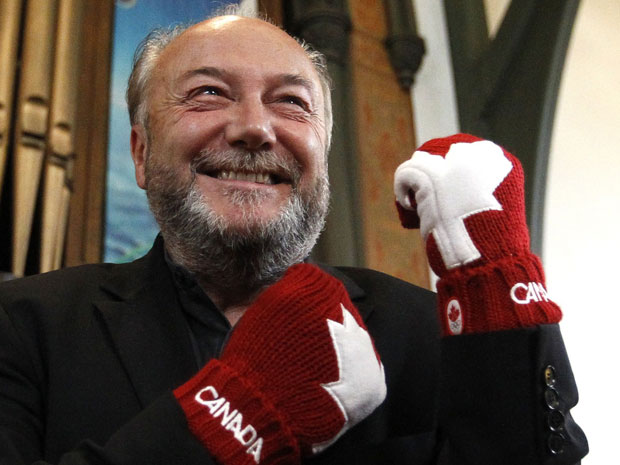
Galloway, quoted in the National Post, Oct. 4, 2010: “I was a boxer in my youth. Maybe Mr. Kenney would like to go five rounds with me.” Photo: Mike Cassese/Reuters
It’s official. The much anticipated, cross-Canada tour by George Galloway begins in Montreal Nov. 17. By the time it’s over, he’ll have visited 10 cities, bringing his message of free speech, free Afghanistan and free Palestine to thousands of Canadians. It’s a message Canadians need to hear, again and again, and we should be pleased that Galloway is demonstrably up to the challenge. Tour details are available here.
Freedom of speech in Canada is in danger, especially on the subject of Palestine. According to a recent statement by Independent Jewish Voices,
“The Harper government is sponsoring a conference of the ‘Inter-Parliamentary Coalition to Combat Anti-Semitism’ (ICCA) – the CPCCA’s international counterpart – in Ottawa on November 8 and 9. The CPCCA and ICCA have an agenda to attack free speech and to silence legitimate criticism of Israel by falsely conflating this with anti-Semitism.”
The IJV is hoping to mobilize opposition to this conference and what it represents, and deserves the support of every Canadian who treasures the right to speak our minds on any topic without fear of repression.
Another way of resisting attempts to restrict free speech is to promote and attend George Galloway’s speeches. Between now and the time he sets foot in Canada, we can confidently expect there will be attempts to discredit Galloway and distort his message. Our support for the tour will not only counter these reactionary diatribes; it will help raise funds for the local peace coalitions and Palestine solidarity campaigns across Canada that are sponsoring Galloway’s tour.
This, just in, from Independent Jewish voices . . .
A TIME TO SPEAK OUT: DAY OF ACTION TO DEFEND FREE SPEECH ON NOVEMBER 8
FREE SPEECH UNDER ATTACK
The Harper government is sponsoring a conference of the ‘Inter-Parliamentary Coalition to Combat Anti-Semitism’ (ICCA) – the CPCCA’s international counterpart – in Ottawa on November 8 and 9. The CPCCA and ICCA have an agenda to attack free speech and to silence legitimate criticism of Israel by falsely conflating this with anti-Semitism.
Independent Jewish Voices is deeply concerned about the threat to free speech and civil liberties posed by the Canadian Parliamentary Coalition to Combat Anti-Semitism’(CPCCA). It is legitimate and ethically necessary for Canadians of conscience to criticize Israeli human rights abuses and to support non-violent remedies.
A NEW MCCARTHYISM
The Harper government has already slashed funding to NGOs that dared to express support for Palestinian rights, brutally attacked and abused G20 demonstrators, barred British MP George Galloway from entering Canada because of his aid to the people of Gaza, and attacked CUPE, CUPW, and Israeli Apartheid Week activities. The list doesn’t end there.
The CPCCA, with Minister of Censorship and Deportation Jason Kenney as one of its driving forces, aims to entrench these attacks on free speech in the federal parliament.
The CPCCA held hearings this past year to try to paint a veneer of credibility on its transparent intention to attack free speech in Canada. It ignored many critical submissions, including those from Independent Jewish Voices. Even the CPCCA witnesses from Canadian universities and the police confirmed that there is no rise in anti-Semitism and called on the CPCCA to respect free speech.
The ICCA conference is intended to distract from this embarrassing result. At a cost of over $451,280 in federal funds, the ICCA conference is closed to the public and the media, and makes no pretence of unbiased research.
STAND UP, FIGHT BACK
1. Raise your voices for a day of action for free speech on Monday, November 8. Organize locally – get in touch with the nearest IJV chapter, human rights groups, free speech advocates and Palestine solidarity coalitions. Local events for the day of action could include press conferences, protests, teach-ins, or other creative ideas to build the movement to defend free speech. IJV will release a 10 minute video on Nov. 8, which will be posted on YouTube and the IJV web site. Feel free to use it in your events. Please let us know what actions you’ve taken: Contact Independent Jewish Voices at ijv@magma.ca.
2. Contact your MP and the federal party leaders and demand they reject any attempts to silence or criminalize legitimate criticism of Israel, and to stand up for the principle of free speech in Canada. www.webinfo.parl.gc.ca.
3. Contact university presidents and human rights offices in your city and ask them also to issue a statement affirming the right of students and faculty to free speech.
5. Send a photo to ijv@magma.ca of yourself holding an anti-CPCCA sign (perhaps with duct tape over your mouth) or a sign saying “I support free speech.” We will post it on line with a title “The is what Democracy looks like.”
6. Donate to IJV to help fund our campaign for free speech: Please send donations to IJV, P.O. Box 23088, Ottawa, Ontario K2A 4E2.
For more information, visit Independent Jewish Voices at www.ijvcanada.org.
In a stunning international rebuke Stephen Harper’s government lost its bid for a UN Security Council seat last week. The vote in New York was the world’s response to a Canadian foreign policy designed to please the most reactionary, shortsighted sectors of the Conservative Party’s base — evangelical Christian Zionists, extreme right-wing Jews, Islamophobes, the military-industrial-academic-complex, mining and oil executives and old cold-warriors.
Over the past four year Harper’s government has been offside with the world community on a whole host of issues. Canada was among a small number of countries that refused to recognize the human right to water or sign the UN Declaration on the Rights of Indigenous Peoples. On two occasions Ottawa blocked consensus at the Rotterdam Convention to place chrysotile asbestos, a known toxin, on its list of dangerous products and in November Finance Minister Jim Flaherty refused to even consider British PM Gordon Brown’s idea of a global tax on international financial transactions.
Close to the companies making huge profits on the Tar Sands, the Conservatives repeatedly sabotaged international climate negotiations. They angered many in the Commonwealth by blocking a resolution calling for a “binding commitment” on rich countries to reduce emissions and at a UN climate conference in Bangkok last year, many delegates from poorer countries left a negotiating session in protest after a Canadian suggestion to scrap the Kyoto Protocol as the basis of negotiations.
Israel’s best friend
The Conservatives extreme “Israel no matter what” position definitely hurt its chance on Tuesday. “It’s hard to find a country friendlier to Israel than Canada these days,” explained Israeli Foreign Minister, Avigdor Lieberman, who emigrated from Moldova when he was 20 but still feels fit to call for the expulsion of Palestinian citizens of Israel.
The Conservatives publicly endorsed Israel’s 2006 attack on Lebanon, voted against a host of UN resolutions supporting Palestinian rights and in February Ottawa delighted Israeli hawks by canceling $15 million in funding for the UN agency for Palestine Refugees (UNRWA). The money was transferred to Palestinian security reform.
For the past three years Canada has been heavily invested in training a Palestinian security force designed to oversee Israel’s occupation of the West Bank and “to ensure that the PA [Palestinian Authority] maintains control of the West Bank against Hamas,” as Canadian ambassador to Israel Jon Allen was quoted as saying by the Canadian Jewish News. According to deputy Foreign Affairs minister Peter Kent, Operation PROTEUS, Canada’s military training mission in the West Bank, is the country’s “second largest deployment after Afghanistan” and it receives “most of the money” from a five-year $300 million Canadian aid program to the Palestinians.
At the same time as Canadian “aid” strengthens the most compliant Palestinian political factions, the Conservatives have refused any criticism of Israel’s onslaught against the 1.5 million people living in Gaza. Canada was the only country at the UN Human Rights Council to vote against a January 2008 resolution that called for “urgent international action to put an immediate end to Israel’s siege of Gaza.”
Later in 2008 Israel unleashed a 22-day military assault on Gaza that left 1,400 Palestinians dead. In response many governments condemned the bombing and Venezuela broke off all diplomatic relations. Israel didn’t need to worry since Ottawa was prepared to help out. The Canadian embassy now represents Israel’s diplomatic interests in Caracas.
Threatening Iran
While Brazil and Turkey tried to dissipate hostility towards Iran, Harper used his pulpit as host of the G8 to pave the way for a possible U.S.-Israeli attack. A February 17 Toronto Star article was headlined: “Military action against Iran still on the table, Kent says.” The junior foreign minister explained that “it’s a matter of timing and it’s a matter of how long we can wait without taking more serious preemptive action.”
“Preemptive action” is a euphemism for a bombing campaign. Canadian naval vessels are already running provocative maneuvers off Iran’s coast and by stating that “an attack on Israel would be considered an attack on Canada,” Kent is trying to create the impression that Iran may attack Israel. But it is Israel that possesses nuclear weapons and threatens to bomb Iran, not the other way around.
While Ottawa considers Iran’s nuclear energy program a major threat, Israel’s atomic bombs have not provoked similar condemnation. The Harper government abstained on a number of near unanimous votes asking Israel to place its nuclear weapons program under International Atomic Energy Agency (IAEA) controls and in September Bloomberg cited Canada as one of three countries that opposed an IAEA probe of Israel’s nuclear facilities as part of an Arab led effort to create a nuclear-weapons-free Middle East.
Cold war throwback
Not content with taking on Iran, the military-minded Conservatives turned on Russia. Harper referred to Russia as “aggressive” and in a throwback to the Cold War, Defence Minister Peter MacKay added that Ottawa would respond to Russian flights in the Arctic by flying Canadian fighter jets near Russian airspace. Making sure that Moscow got the message, during a July 2007 visit to the Ukraine MacKay said Canada would help provide a “counterbalance” to Russia.
Haiti
Ottawa even prioritized the military over aid in the face of the incredible suffering caused by Haiti’s earthquake. Two thousand Canadian troops were deployed while several Heavy Urban Search Rescue Teams were readied but never sent. Foreign Affairs Minister Lawrence Cannon explained that the teams were not needed because “the government had opted to send Canadian Armed Forces instead.”
Overthrown in February 2004 by a joint U.S./France/Canada destabilization campaign, Haiti’s most popular political party, Fanmi Lavalas, has been barred from participating in elections. The Conservatives supported Fanmi Lavalas’ exclusion, congratulating Haiti’s puppet government for bringing “a period of stabilization” good for “investment and trade.” Ottawa backed up its words with deeds, adding tens of millions of dollars to a Haitian prison and police system that has been massively expanded and militarized since the 2004 coup.
Honduras
Ottawa gave its tacit support to the Honduran military’s removal of elected president Manuel Zelaya in June 2009. Mexico’s Notimex reported that Canada was the only country in the hemisphere that did not explicitly call for Zelaya’s return to power and Canadian officials repeatedly criticized Zelaya at the Organization of American States (OAS). The ousted government complained that Ottawa failed to suspend aid to Honduras, which is the largest recipient of Canadian assistance in Central America. Nor did Ottawa exclude the Honduran military from its Military Training Assistance Program.
The Harper government opposed Zelaya’s move to join the Hugo Chavez led Alba, the Bolivarian Alliance for the People of Our Americas, which is a response to North American capitalist domination of the region. Canada has actively supported the U.S.-led campaign against the government of Venezuela. In mid-2007 Harper toured South America “to show [the region] that Canada functions and that it can be a better model than Venezuela,” in the words of a high-level foreign affairs official. During the trip, Harper and his entourage made a number of comments critical of the Venezuelan government.
Colombia si. Venezuela no.
After meeting only members of the opposition during a trip to Venezuela in January, Peter Kent told the media that “democratic space within Venezuela has been shrinking and in this election year, Canada is very concerned about the rights of all Venezuelans to participate in the democratic process.”
Venezuela’s ambassador to the 34-country OAS, Roy Chaderton Matos, responded: “I am talking of a Canada governed by an ultra right that closed its Parliament for various months to (evade) an investigation over the violation of human rights — I am talking about torture and assassinations — by its soldiers in Afghanistan.”
Despite the move to the left among the majority of the region’s governments Harper moved closer to Latin America’s most right-wing state. Colombia’s terrible human rights record did not stop Harper from signing a free-trade agreement that even Washington couldn’t stomach.
The trade agreement as well as the Harper government’s shift of aid from Africa to Latin America was designed to support Canadian corporate interests and the region’s right-wing governments and movements. Barely discussed in the media, the main goal of the shift in aid was to stunt Latin America’s recent rejection of neoliberalism and U.S. dependence.
The Congo
One issue mentioned in a number of media reports about Canada’s loss last week had to do with the Congo. At the G8 in June the Conservatives pushed for an entire declaration to the final communiqué criticizing the Congo for attempting to gain a greater share of its vast mineral wealth. Months earlier Ottawa began to obstruct international efforts to reschedule the country’s foreign debt, which was mostly accrued during more than three decades of Joseph Mobuto’s dictatorship and the subsequent war.
Canadian officials “have a problem with what’s happened with a Canadian company,” Congolese Information Minister Lambert Mende said referring to the government’s move to revoke a mining concession that Vancouver-based First Quantum acquired under dubious circumstances during the 1998-2003 war. “The Canadian government wants to use the Paris Club [of debtor nations] in order to resolve a particular problem”, explained Mende. “This is unacceptable.”
The mining industry increasingly represents Canada abroad. Canadian miners operate more than 3,000 projects outside this country and many of these mines have displaced communities, destroyed ecosystems and resulted in violence. This doesn’t bother the Harper government, which is close to the most retrograde sectors of the mining industry. Last year they rejected a proposal – agreed to by the Mining Association of Canada under pressure from civil society groups — to make diplomatic and financial support for resource companies operating overseas contingent upon socially responsible conduct. Despite countless horror stories suggesting the contrary, the Conservatives claim that voluntary standards are the best way to improve Canadian mining companies’ social responsibility.
Afghanistan
Finally, the Conservatives have knowingly supported torture in Afghanistan and embraced an increasingly violent counterinsurgency war. Apparently, Canadian Joint Task Force 2 commandos regularly take part in nighttime assassination raids, which are highly unpopular with the Afghan population.
Losing the Security Council seat will hopefully cost the Conservatives some votes and temper their more extreme international positions. But, for those of us working to radically transform Canadian foreign policy the consequences of the loss may be much greater. There has probably never been a bigger blow to the carefully crafted image of Canada as a popular international do-gooder, a mythology that blinds so many Canadians to our country’s real role in the world.
Yves Engler is the author of The Black Book of Canadian Foreign Policy and Canada and Israel: Building Apartheid. He’ll be touring in Mid November to speak on “Why Canada lost its bid for a Security Council seat.” Anyone interested in organizing a talk please e-mail: yvesengler (at) hotmail.com.
To put it politely, I am deeply upset by your decision to deepen economic ties with the State of Israel. The ongoing violation of the basic human rights of the Palestinian people by the State of Israel has made Israel, deservedly, a pariah among nations. Because of this, individuals, organizations, companies and even governments are banding together in a nonviolent campaign of boycott, divestment and sanctions against Israel in the hope that Israel will recognize the rights of Palestinians and seriously work for peace.
Surely you are aware of the 1400 Palestinians (including 300 children and hundreds of civilians) who were killed during the 18-day invasion the Israelis called Operation Cast Lead. If not, please follow this link to a report by Amnesty International.
You must have heard of the widespread misery and deprivation that persists in Gaza because of the Israeli blockade. Possibly you are too busy to follow these matters in any depth, but I hope you will take the time to read the UN Human Rights Council report on the Israeli attack on the Gaza Freedom Flotilla, and the murders perpetrated against unarmed peace activists during that attack. These people were murdered because they were bringing humanitarian aid to the people of Gaza, people prevented by the blockade from rebuilding after the devastating Israeli invasion.
All too commonly in this country, affluent and ill-informed people are willing to turn a blind eye to injustice. The injustice against Palestinians began with their expulsion from their land in 1948. Systematically and relentlessly Israel has reduced the land available to Palestinians to a few small patches, hemmed in by Israeli soldiers, checkpoints and growing Israeli settlements. The situation of Palestinians is not unlike that of blacks in South Africa during the apartheid years. It is no accident that the term “Israeli apartheid” is heard more and more.
Is Manitoba in such desperate straights that our government sees a need to do business with such a repressive regime? What were you thinking?
Israel’s continued oppression of the Palestinian people is an affront to all who cherish human rights and social justice. Those who do business with such a regime are complicit in this ongoing horror show.
I expect better of my provincial government and I expect better from you.
Please cancel your upcoming trip to Israel and reverse your policy of economic and cultural cooperation with Israel until such time as it shows serious commitment to redressing the injustices it has committed against the Palestinian people.
Sincerely,
Paul Graham
Winnipeg
Dear Reader,
Please do your part to remind Mr. Selinger that it will not be acceptable to do business with Israel until it makes peace with Palestinians in Gaza and the West Bank and dismantles the ugly apartheid system it has set up.
Tell him Manitoba should be a part of the global boycott, divestment and sanctions for Palestine movement, rather than a partner in apartheid.




 Paul S. Graham