Archive for the ‘Winnipeg’ Category

Making war has been a human pursuit for thousands of years.

Playing at war, it would seem, is at least as old. This ancient Greek toy, a model of a war chariot, fashioned from clay, has survived the millennia to bear witness to our enduring attachment to violence and domination.

War requires warriors. Because killing is not something that comes naturally to most of us, a long period of preparation is usually needed. It begins, in childhood, with the toys we give to our children.

The design and marketing of war toys are anything but child’s play. According to an article in the New York Times, the US military and the American toy industry have a long history of working together. It’s a relationship where both parties benefit – toys are more realistic and often, toys have inspired weapons development. But there’s more. As the author observes:

“Because the newest generation of soldiers grew up playing with electronic toys and games, the symbiosis between them is nearly genetic. Today’s troops received their basic training as children.”

The popularity of violent video games inspired the US Army to develop its very own video game, which it provides free of charge from its web site. According to the late Gary Webb, an American investigative journalist of considerable renown,

America’s Army isn’t merely a game, recruiting device or a public-relations tool, though it is certainly all of those things. It’s also a military aptitude tester. And it was designed that way from the start.”

A growing body of evidence confirms that exposure to violent toys, games and media can increase aggressive behavior, desensitize people to violence, and contribute to an exaggerated fear of the world.

Dr. Darlene Hammell, of the University of British Columbia Faculty of Medicine explains:

“A close examination of the issue raises concerns that war toys teach children that:

  • war is a game, an exciting adventure.
  • killing is acceptable, even fun.
  • violence or the threat of violence is the only way to resolve conflicts.
  • the world is divided into “goodies” and “baddies” where the bad guys are devoid of human qualities and their destruction is desirable.”

For the past 10 years, Winnipeg’s Project Peacemakers has conducted an annual inspection of Winnipeg toy stores. The objective is to raise awareness about the levels of violence in children’s toys and games, and to call on retailers, government, and the wider community to take steps to limit this violence.

I tagged along with an inspection team, last month, as it looked at two of the eleven stores covered in this year’s survey and prepared this video report.

The envelope. please . . .

Here is how the stores performed in terms of providing peaceful, constructive playthings – as opposed to war toys.

Excellent: Children’s Museum
Commendable: A Child’s Place, Hans Christian Toys, Scholar’s Choice, Toad Hall
Acceptable: BJ’s Toy Store, Kit and Kabooble
Needs Improvement: Dollarama, Toys “R” Us, Zellers

Although a team visited a local Walmart, they were informed that Project Peacemakers would be unable to publicize its findings without first contacting Walmart’s public relations office. Project Peacemakers declined to rate the store, leaving you to draw your conclusions, if not about their toys, then about Walmart’s public relations savvy.

It oughtta be a crime

Under international law, most wars are crimes – though the likelihood of prosecution is low (unless you are on the losing side). War toys, however, remain perfectly legal in most places. Thankfully, there are exceptions. In 2009, Venezuela passed a “Law Prohibiting War Video Games and War Toys.” Prior to this, according to the Peace and Conflict Monitor, Sweden and Norway have “successful voluntary restriction” of war toy sales, Malta prohibits their import, Greece bans television advertising and Australia places some restrictions on imports. The Monitor says the European Parliament has recommended that its member states ban advertising of war toys and reduce their sale, though I could find no evidence that this has happened.

Merry Christmas, all.
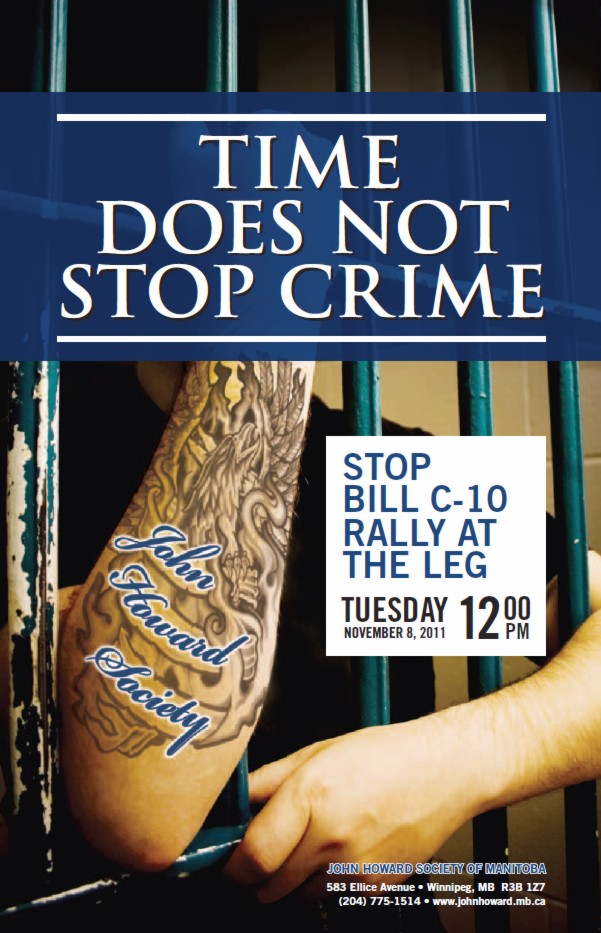

Nov. 8, 2011: 300 Winnipeggers demonstrated at the Manitoba Legislature and the Winnipeg Remand Centre to urge the Manitoba Government to join Quebec, Ontario and Newfoundland and Labrador in opposing the Harper government’s omnibus crime bill, misleadingly titled the Safe Streets and Communities Act (aka Bill C-10). Their key message, “time does not stop crime” rebutted the government’s contention that locking up more offenders for longer periods was an effective crime prevention technique.

As I noted in an earlier post, the John Howard Society of Manitoba estimates Canadians will pay $2 billion annually to cover the costs of the bill, which calls for mandatory minimum sentences for a wide range of crimes regardless of individual circumstances. While this will trigger a huge increase in the number of inmates and a prison construction boom, it will do nothing to address the root causes of crime, nor will it lead to the rehabilitation of offenders.

Speakers:

  • John Hutton, Executive Director, John Howard Society of Manitoba
  • Shaun Loney – Executive Director,  BUILD
  • Cora Morgan, Executive Director, Onashowewin
  • Tracy Booth, Executive Director, Elizabeth Fry Society of Manitoba
  • Jacquie Nicholson, Literacy Coordinator, John Howard Society of Manitoba
  • Alex Paterson, Occupy Winnipeg

The protest was sponsored by:

  • BUILD Winnipeg
  • Canadian Centre for Policy Alternatives
  • Canadian Federation of Students
  • Elizabeth Fry Society of Manitoba
  • Faculty of Social Work, University of Manitoba
  • Initiatives for Just Communities
  • Occupy Winnipeg
  • Ogijiita Pimatiswin Kinamatwin (OPK)
  • Mennonite Central Committee of Manitoba
  • School of Social Work, Université de Saint-Boniface
  • Social Planning Council of Winnipeg
  • Southern Chiefs Organization
  • William (Bill) VanderGraff, Law Enforcement Against Prohibition

For more information about C-10, contact the John Howard Society of Manitoba. And let your MP know what you think.


See also:

Nov. 8, 2011: Some of the 300 people who demonstrated in front of the Winnipeg Remand Centre in opposition to the Conservative Government's Omnibus Crime Bill, C-10. Photo: Paul Graham

The John Howard Society of Manitoba estimates Canadians will pay $2 billion annually to cover the costs of Stephen Harper’s omnibus crime bill. Bill C-10, which calls for mandatory minimum sentences for a wide range of crimes regardless of individual circumstances, will trigger a huge increase in the number of inmates and a requirement to build new prisons. It will do nothing to address the root causes of crime, nor will it lead to the rehabilitation of offenders.

Given the onerous cost, most of which will be borne by the provinces, it’s not surprising that the provincial governments of Quebec, Ontario and Newfoundland & Labrador have spoken out against the bill. In Winnipeg, the John Howard Society and 13 other agencies held a rally, Nov. 8, to tell the government of Manitoba to do likewise.

I recorded the event and will be producing a program for WCTV in the near future. But in the meantime, here’s a short interview with the executive director of the John Howard Society of Manitoba, John Hutton, in which he outlines some of the major problems with the legislation.


Against the wishes of most western farmers, and in defiance of laws that they are sworn to uphold, Stephen Harper and his Conservatives are poised to destroy the Canadian Wheat Board. In truly Orwellian fashion, the Tories describe this as “democracy,” all the while invoking closure on Parliamentary debate and refusing to hold the farmers’ plebiscite that is required by federal law before any such major change can be made to the status of the CWB.

The CWB has been a bone of contention in farm policy circles for decades. While a loud minority of western grain producers have been clamoring for an end to the CWB monopoly on wheat and barley exports, most farmers continue to support the Board, as evidenced by several CWB Board of Directors election results and a recent CWB-sponsored plebiscite. The reason for the Board’s enduring support is that it works for farmers, as opposed to private grain companies who exist to maximize profits for their shareholders.

Urban Canadians have yet to wake up to this issue, though this is starting to happen. The Council of Canadians is prominent in the coalition of organizations leading the fightback. What we city slickers need to get our heads around is that this is, first and foremost, a battle for democracy. It is a struggle against growing corporate control of our food and the relentless corporatization of agriculture that is destroying rural communities.

One one level, the issues are complex. You can get a crash course by watching the video I produced along with my WCTV colleague Ken Harasym. Follow that up with visits to the web sites listed below and you will be well on your way.

On another level, it is very simple: like us, farmers are part of the 99%. We gotta stick together. Occupy that, Stephen Harper!

Links

Despite its well established habit of electing social democratic governments, Winnipeg has claimed some dubious honors — “Murder Capital of Canada” and “Child Poverty Capital of Canada” to name two of the most disturbing. Even though we have had 11 years of NDP government to undo the damage of Gary Filmon’s Conservatives, both poverty and crime are well entrenched in Manitoba, especially in Winnipeg.

According to the 2011 Child and Family Poverty Report Card, issued by the Social Planning Council of Winnipeg:

  • 92,650 children in Manitoba live in families under the poverty threshold
  • 29,000 children in Manitoba live in families with annual incomes insufficient for meeting basic needs
  • 29,563 Manitoban children use food banks each month because their families cannot afford to purchase the necessary food they require
  • 59,734 Manitobans accessed Employment and Income Assistance
  • The richest 20% of Manitoban families have more total income than the poorest 60% of the population

The Council says these statistics have not changed significantly since 1989, the year the House of Commons pledged to end child poverty in Canada by the year 2000.

What is to be done? According to the Manitoba Green Party, 80 per cent of all expenditures on social assistance programs are consumed by government bureaucracy. They proposed, in the last provincial election, to replace welfare benefits with a Universal Basic Income benefit, payable to all Manitobans, that would ensure no one slipped below the poverty line. The idea has merit and I hope the Greens continue to explain and promote it.

Yet another group of Manitobans proposes a package of measures they call a “Justice Charter to End Poverty in Manitoba.” I’ve included it at the end of this piece.

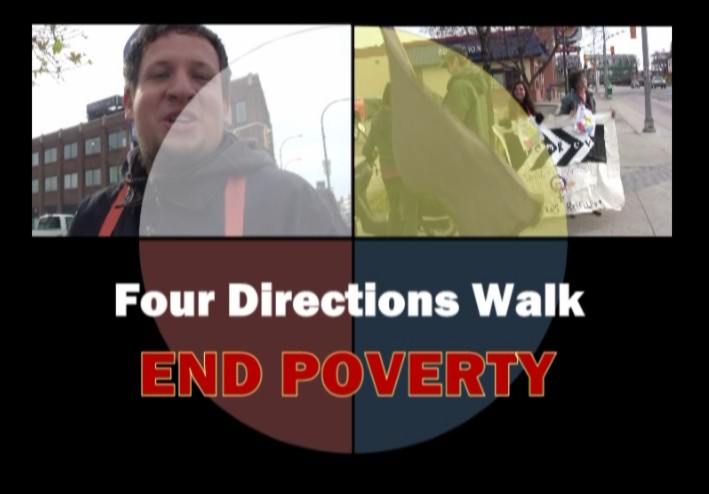
They also hold an annual event called the Four Directions Walk to End Poverty in which four contingents begin their walk on the outskirts of town and converge on the Manitoba Legislature. They held their fourth such walk on Saturday, Oct. 22. Naturally, I brought my video camera.


Justice Charter to End Poverty in Manitoba

We the people of Manitoba, seeing the growing gap between the wealthy and people in need, the working poor, and discriminated groups want to act in a timely manner to reverse the situation, to provide for people with needs and support the right for everyone to contribute to society to the best of their ability. To this end we make these demands and will work to make them a reality:

Housing must be a right and a comfort, not a constant crisis!

  • End subsidies to private landlords.
  • Establish stricter rent controls.
  • Enact a Tenant Bill of Rights.
  • Build and maintain public housing to the standard building code.
  • No utility cut-offs; establish a panel with legal power to require landlords to pay.

Universal health care for all, for every need!

  • Expand medicare into a comprehensive health care system focusing on prevention.
  • Extend medicare to cover all essential needs such as eye, drug, dental, ambulance and prosthetics.
  • Reduce pollution from mining and manufacturing, especially next to low income neighborhoods.


Jobs are a human right. Create good-paying jobs for all!

  • Create jobs through a massive investment in public housing, a public child care program, and conversion to a “green” economy.
  • Increase the minimum wage to $14 an hour.
  • Quality job creation by ensuring access to education, ending tuition fees, free student housing, education in Aboriginal and any other language where numbers warrant.
  • Access to better jobs – reduce the work week with no loss in pay, add paid vacation days and reduce the pension age for women to age 60.
  • End the Foreign Temporary Worker program, give these workers full labour rights and make them immigrants to Canada, if they so choose.

Provide for those in need!

  • Introduce a Guaranteed Liveable Income, above the poverty line and indexed to inflation.
  • Improve special needs benefits and introduce a fast appeals process with free advocacy services.
  • A public, high quality, free child care program employing well-paid early childhood development professionals.
  • Establish a hot breakfast program for children in schools.
  • For injured workers, establish a fast and free appeals process independent of the Workers Compensation Board. Provide free legal services and always respect the right to appeal.
  • Establish a Manitoba pension credit plan funded by payroll deductions, a surtax on corporate income to top up pensions above the poverty line and an inheritance wealth tax.
  • Establish a federally-chartered, publicly-owned bank that does not discriminate against people in poverty, is located in low-income areas, and provides free or nonprofit cheque cashing services and international fund transmittals.
  • Establish a province-wide, free and publicly-owned handi-transit service for people with disabilities.
  • Establish price controls for essential foods throughout Manitoba.

End racism, sexism and discrimination of all forms!

  • Support immediate settlement of Aboriginal land claims and emergency action to end housing, health care and education inequality.
  • Take steps to recognize Aboriginal nations on a new basis in Canada, including full national rights and equal nation to nation relations.
  • Introduce immediately affirmative action hiring with mandatory quotas for Aboriginal people, people of colour, women and people with disabilities in both the public and private sector.
  • Job pay equity for all workplaces.
  • Replace the present legal system of retribution and punishment with principles of restorative justice – restitution and reconciliation; include “ability to pay” as a consideration for sentencing people to jail for nonpayment of fines.
  • Ban discrimination based on social or mental health conditions in the Human Rights Code.
  • Introduce a Manitoba Bill of Rights based on the Universal Declaration of Human Rights (1948), adding protections against all forms of sexism.

Reform the democratic system

  • Establish proportional representation so that people will vote for what they want and so that every person’s vote will count.
  • Pay Legislators the average worker’s wage and benefits in Manitoba.

The Justice Charter is for discussion by all Manitobans. The annual Four Directions Walk is Winnipeg’s largest annual anti-poverty activity. It is organized to encourage discussion of the ideas in this Charter. We invite groups representing Aboriginal peoples, women, workers, youth and students, people of colour, people with disabilities, injured workers, the working poor, people living in poverty, people of all faiths and nonbelievers – all supportive groups:

  • To establish a Four Directions Walk in other Manitoba communities.
  • To discuss the Charter and send us your ideas.

Contact us if you would like to receive information on the annual Walk, held on a Saturday close to the International Day for the Eradication of Poverty (October 17).

Four Directions Walk Committee
Email: fourdirectionswalk@changetheworldmb.ca
Phone (204) 792-3371.

Oct. 15, 2011: Scenes from Occupy Winnipeg – and a reminder that what is now called Canada was occupied long before by the aboriginal peoples of this part of the world. It is time the descendants of the Europeans who took the land from the people who were here first do a much better job of sharing it with today’s First Nations.


Manitoba citizens will elect a new provincial government Oct. 4, 2011 and environmental issues will play an important role in determining which political party forms that government.

Where should Manitoba Hydro construct its planned Bipole 3 transmission line – or should it be built at all?

How should we save Lake Winnipeg from choking to death on toxic algae?

How best can Manitobans respond to rising energy costs and climate change?

These are only some of the issues that representatives of four political parties debated in this two-and-a-half hour public forum held Sept. 14., 2011 in Winnipeg. Naturally, I brought my video camera.


Moderator: Terry MacLeod, CBC Information Radio

Panelists:
– James Beddome, Green Party of Manitoba
– Paul Hesse: Liberal Party of Manitoba
– Jennifer Howard: New Democratic Party of Manitoba
– Heather Stephanson: Progressive Conservative Party of Manitoba

Sponsors:
Manitoba Eco-Network
Green Action Centre
Provincial Council of Women of Manitoba
Green Action Committee of the First Unitarian Universalist Church of Winnipeg

Every August 6, Winnipeggers commemorate the August 1945 atomic bombings of Hiroshima and Nagasaki with a Lanterns for Peace Ceremony. People come together to make and float their lanterns in a pond in the middle of the city to express their desire for a peaceful world and to show solidarity with countless others around the world who are doing something similar on that day.

The Cast

  • Glenn Morison – Project Peacemakers
  • Ismaila Alfa – CBC Radio
  • Doug Martindale – MLA, Burrows Constituency
  • Steve Plenert – Mennonite Central Committee
  • Jessica Nagamori – Manitoba Japanese Canadian Citizens’ Association
  • Terumi Kuwada – Manitoba Japanese Canadian Citizens’ Association
  • Haley Rempel – Flautist

Lanterns for Peace Sponsors

The Crew

On June 16, about 1,000 members of several Winnipeg unions rallied at the main post office in Winnipeg in solidarity with the Canadian Union of Postal Workers. The rally, one of many to be held across the country, was in response to federal government plans to legislate CUPW members back to work.

The union has been waging a rotating strike that started in Winnipeg on June 2 and then moved to other cities. Canada Post locked out the workers on June 14.

On June 20, the federal Conservative government tabled back-to-work legislation that will force the two sides to accept a form of binding arbitration called final offer selection. Under FOS, each side tables their final offer and the arbitrator picks one.

When governments force an end to strikes they undermine free collective bargaining. To put it another way,  they are trampling on our democratic rights. Some call this fascism; others feudalism. In any case, F-words, such as fightback, are entirely appropriate.

More information: Canadian Union of Postal Workers

“What if the Gulf could sue BP?” asks Maude Barlow, National Chairperson of the Council of Canadians. “What if the ocean around Japan could sue the owners of the nuclear facility? What if the Athabasca River could sue everybody? What if Lake Winnipeg could sue for the nitrates we dump into it everyday?”

On International Mother Earth Day, April 22, 2011, Barlow spoke to a packed hall in Winnipeg, Manitoba on the international campaign for the Rights of Nature and the need to retake the Commons from corporate predators. Her appearance was sponsored by the Council of Canadians (Winnipeg Chapter) and the Canadian Centre for Policy Alternatives (Manitoba Office).

This is an excerpt from her speech that I recorded at the Fort Garry Hotel.