Archive for the ‘Winnipeg’ Category

A poverty “shoe-down” at the Manitoba Legislature
uvs130104-001

Jan. 4, 2013: Demonstrators calling for an increase in rental rates for income assistance recipients, left dozens of pairs of shoes on the steps of the Manitoba Legislature. Photo: Paul S. Graham

Make Poverty History Manitoba rallied at the Manitoba Legislature on Friday to demand that the provincial government increase the rental allowance provided to recipients of provincial Employment and Income Assistance (EIA). Recalling the kindness of a Winnipeg Transit driver who gave a homeless man a pair of shoes, demonstrators left dozens of pairs of shoes on the steps of the Legislature to send the message that they no longer wish to depend on isolated, random acts of kindness.

EIA recipients are provided with a rental allowance that has increased only slightly over the past two decades. During that same period, rents have gone up by 60 to 70%.

According to Kirsten Bernas, Make Poverty History Manitoba is asking the Province to increase the rental allowance to 75% of median market rent, a move the provincial government estimates would cost approximately $18.5 million annually.

In this video report, Ms. Bernas explains why this increase is long overdue.

Poverty on the increase in Manitoba

According to the Social Planning Council of Winnipeg, “While the national poverty rate has remained relatively stable since 2006, the child poverty rate in Manitoba has been gradually increasing and remains 6.4 percentage points higher than the national average.” The SPCW reports that Manitoba had the second highest child poverty rate in Canada in 2012, with over 20% of our children (about 54,000) living below the poverty line as defined by Statistics Canada’s Low Income Measure After Taxes.

In Manitoba, the fastest growing banks are the food banks. Some statistics gleaned from the Winnipeg Harvest food bank web site tell the story:

  • Winnipeg Harvest provides emergency food assistance to nearly 64,000 people a month across Manitoba. Therefore, Winnipeg Harvest clients are Manitoba’s second-largest city. This figure is up more than 14% over the same period last year.
  • More than 47% of its clients are children. For each of the last two years, Manitoba is the #1 province for food bank use.
  • Winnipeg Harvest feeds more 30,000 children each month. Ten years ago, that number stood at 5,500 children.
  • Seniors and refugees have more than doubled in food bank use since 2010.
  • 1/3 of families experiencing hunger are dual wage-earner families, i.e, the working poor.
  • Winnipeg Harvest distributes food to more than 330 agencies throughout Manitoba
All Aboard

With great fanfare, the Manitoba government announced its ALL Aboard: Manitoba’s Poverty Reduction and Social Inclusion Strategy in 2009. In 2011, the The Poverty Reduction Strategy Act became law, committing the Province to include a poverty reduction strategy in its annual budget. In April, the Province released it’s four-year poverty reduction plan. While the strategy appears, upon first reading, to take a comprehensive approach to tackling poverty, two serious shortcomings are immediately evident:

  • The authors appear to believe that poverty rates in Manitoba are shrinking; they make the claim that the number of Manitobans living in poverty went down by 6,000 between 2000 and 2009. Research from the above-cited sources suggests that the opposite trend is more likely.
  • There are no concrete goals against which the government’s performance can be evaluated. Instead, we are given vague indicators against which progress will be measured.

A second reading of the strategy reveals it to be a glossy, feel-good kind of document which does little to instill confidence that the provincial government is seriously committed to poverty reduction. But don’t take my word for it; read it yourself.

Déjà vu all over again
Child Poverty in Manitoba and Canada

Source: Statistics Canada (2010). Income in Canada, CANSIM 202-0802 as cited in the Social Planning Council of Winnipeg’s “Child & Family Poverty 2012 Report Card.”

Manitoba’s child poverty rates have remained above the national rate since 1989 when Canada’s House of Commons passed a unanimous all-party resolution to eliminate child poverty by the year 2000. Canada’s national poverty rate remains pretty much where it was in 1990.

In 2009, the House passed another unanimous motion to “develop an immediate plan to eliminate poverty in Canada for all.” The Manitoba government seems to have bought into the legislative zeitgeist. However, unless there are some significant changes in their approach, nothing will change. The rich will get richer and the poor poorer — all of this occurring in the heartland of one of the wealthiest countries in the world.

A good place to start would be to acknowledge that poverty is growing and to act accordingly. This would include setting real goals and dedicating more resources to meet them. It would also mean backing away from its failed strategy of regular tax reductions so we have more resources to allocate to alleviating poverty. It would mean educating the public about the true nature of poverty and taking the risk that an honest dialogue would win over all but the most diehard reactionaries in the province.

Finally, for starters, why not increase the funds allocated to housing in the EIA budget, so that disabled, unemployed and other immiserated Manitobans don’t have to choose between paying the rent or putting food in their bellies?

Oct. 6, 2012: A passerby reads a leaflet distributed by Peace Alliance Winnipeg in Osborne Village. Photo: Paul S. Graham

Activists in at least 6 Canadian cities joined in the International Day of Action yesterday to carry the message “Don’t attack Iran” to our fellow citizens.

In Winnipeg, Peace Alliance Winnipeg held an information picket in the Osborne Village neighbourhood, distributing hundreds of leaflets that exposed the myths that are being spread by our various governments to justify sanctions and a future war against Iran.

At the conclusion of the demonstration, Peace Alliance Winnipeg chairperson, Glenn Michalchuk, spoke about the growing war danger and the implications for Canadians. Here is my video report.


Sept. 21, 2012: Actors Gord Tanner, Sara Constible and Tricia Cooper (l-r) in performance at International Peace Day at the Free Press Cafe in Winnipeg. The evening was sponsored by Project Peacemakers. Photo: Paul S. Graham

Yesterday was International Peace Day. It’s understandable if you missed it. Peace is a rare and beautiful thing in this war-torn world.

Winnipeg’s Project Peacemakers marked International Peace Day 2012 with skits and musical performances at the Free Press Cafe. Performing sketches written by Geoff Hughes and Diane Cooper, actors Tricia Cooper, Sara Constible and Gord Tanner provided a comedic response to the Harper Government’s military spending policies in general and its decision to spend $28 million celebrating the 200th anniversary of the War of 1812.

With skillfully performed covers of songs by Pink Floyd, John Lennon and the Weavers, Tom Penner and Jill Cooper closed out the evening with ballads beloved by peace activists everywhere.

International Peace Day was established by the United Nations in 1981 and first celebrated in September 1982. Since then it has been observed in countries around the world.

Project Peacemakers is a church-based organization that has been active in Winnipeg since 1983. It conducts educational forums, and publishes  educational materials on such issues as child soldiers, war-affected children, and violent video games and toys.

While I tend to be skeptical of international days of any kind, I’m glad I went. It was an enjoyable to be surrounded by people who care actively about world peace and the performances were great. Here is my video report.


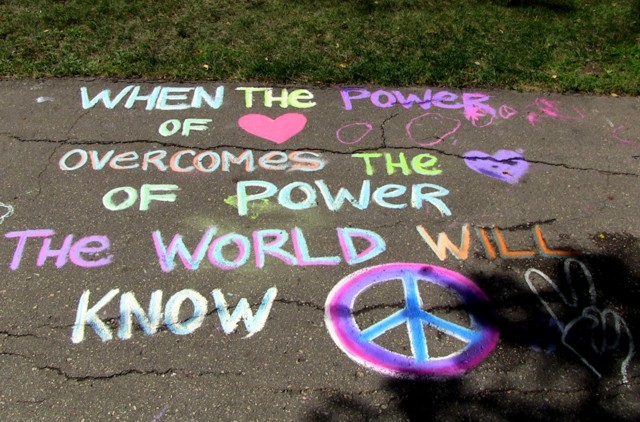
Aug. 25, 2012: One of the messages adorning the walkways of Vimy Ridge Park. Photo: Paul S. Graham

The underlying premise of CHALK 4 Peace might best be summed up in a statement attributed to Mahatma Gandhi in 1937: “There is no way to peace; peace is the way.”

CHALK 4 Peace is an annual event that has spread to hundreds of communities world-wide since its inception in 2003 in Arlington, Virginia. The objectives, according to CHALK 4 Peace  are:

  • To promote the arts by coordinating assemblies of young artists of all ages to draw their vision of peace in public and private spaces with sidewalk chalk as a scheduled worldwide event;
  • To advocate for peace in a non-partisan manner such that all people may share their visions and messages of peace without regard to their nationality, ethnicity, or political beliefs;
  •  To encourage relationships between municipalities and artists so that communities around the world become united in supporting the expression of peace.

Winnipeggers celebrated their 6th annual CHALK 4 Peace on Saturday, raising funds for War Child Canada, and bringing sidewalk art, music, and laughter to Vimy Ridge Park.

Performers included Ras Tamils, the Flaming Trolleys and Lindsey White & Mitch Dorge.

Kisa MacIsaac, one of the organizers of the Winnipeg event, explains how this coming together of arts, music and people contributes to a more peaceful world.

You can find find CHALK 4 Peace Winnipeg on Facebook.

Churchill MP Niki Ashton gave an impassioned speech at the July 11th Winnipeg rally for a national inquiry into missing and murdered aboriginal women. In addition to posting the video, I’m providing a transcript because it neatly sums up this ongoing tragedy and the Harper government’s decisions that have served only to make matters worse.


Winnipeg, July 11, 2012: Churchill MP Niki Ashton speaking at a rally in support of provincial and national inquiries into missing and murdered aboriginal woman in Canada. Photo: Paul S. Graham

Our message is clear. There is an epidemic of missing and murdered aboriginal women in Canada.

Let’s look at those statistics. Over 600 aboriginal women missing. One aboriginal woman is three-and-a-half times more likely to experience violence than a non-aboriginal woman. A young aboriginal woman is five times more likely to die from violence than a non-aboriginal woman in Canada.

But this isn’t about the statistics. It’s about the daughters, the sisters, the mothers, the grandmothers, the friends that have gone missing. It is about the broken families and the broken communities and the people that are grieving. And it is time to recognize that we need action. We need a national inquiry into missing and murdered aboriginal women.

International organizations have spoken out. Amnesty International — even the United Nations – are beginning to understand and have said they understand the magnitude of this issue.

But where is our federal government? Not only have they failed to recognize the magnitude of this tragedy, they have cut the programs that would help to be part of the solution — the loss of Sisters in Spirit, the cuts to the Native Women’s Association of Canada, the loss of the National Aboriginal Health Organization, the loss of the Women’s Health Network, the loss of the Aboriginal Healing Foundation, the loss of the First Nations Statistical Institute.

We need action and we need to find out what’s going on. We need an inquiry that will look into the underlying causes of why aboriginal women face so much violence.

The debilitating impact of a residential school legacy, crushing poverty, Third World living conditions on First Nations, overcrowding in housing, the lack of access to education and health care —

My message to Stephen Harper is: “Mr. Harper — if you’re not part of the solution, YOU are part of the problem.”

But in this darkness there is hope. There is hope that, with an inquiry and a call for action and a commitment to that action, we will be able to prevent this violence from continuing to take place. And more importantly, there will be an ability to bring justice to the memories of the women that have been missing, that have been murdered — to their families, to their communities.

So we are here and we are not asking. We are demanding that there be a national response to a national epidemic. We are demanding a national inquiry. And we will not rest until we hear from the federal government — until there is a national inquiry to finally put an end — so that no aboriginal woman — no woman — dies because she is an aboriginal woman — in a country as wealthy as Canada — in the year 2012 and beyond. Thank you. Meegwetch.


More: Video: Manitoba’s Grand Chiefs demand provincial, national & international inquiries into missing & murdered women


Winnipeg: July 11, 2012: Three of the several hundred demonstrators who marched through downtown Winnipeg demanding public inquiries into the the deaths and disappearances of 600 hundred indigenous women in Canada. Photo: Paul S. Graham

More than 600 indigenous women in Canada are believed to have gone missing or been murdered in recent years.  The slowness of governments to act and the lack of progress where governments have acted have spurred Manitoba’s aboriginal organizations to demand full-scale provincial and national inquiries.

The Assembly of Manitoba Chiefs, Manitoba Keewatinowi Okimakanak and the Southern Chiefs Organization have written to Prime Minister Stephen Harper, urging that he hold a national inquiry that would look at all aspects of the issue.

The Chiefs have sent a parallel request to Eric Robinson, Deputy Premier of Manitoba and Minister of Aboriginal and Northern Affairs. Both letters are available on the web site of the Assembly of Manitoba Chiefs.

So far, Manitoba’s and Canada’s governments have shown no interest in public inquiries. Manitoba’s Justice Minister, Andrew Swan, claims he does not support an inquiry because it could “get in the way of a criminal investigation” that led to the arrest of Shawn Cameron Lamb on charges of killing three aboriginal women in Winnipeg.

The Chiefs hope that will change if their efforts to have the United Nations become involved bear fruit. Says MKO Grand Chief David Harper, “The province will not inspect itself, Canada will not inspect itself . . . We’re going to the United Nations.”

The AMC, MKO and SCO held a rally in Winnipeg on July 11, 2012. Several hundred Winnipeggers marched from the Forks National Historic Site to the TD Centre near the corner of Portage and Main in support.

Here is some of the video I shot at this event. Featured in this video clip are Assembly of Manitoba Chiefs Grand Chief Derek Nepinak, respected community elder Mae Louise Campbell and David Harper, Grand Chief of Manitoba Keewatinowi Okimakanak.

In this clip, Winnipeg City Councillor Ross Eadie makes an impassioned plea for justice for Aboriginal People, declaring “We are all Treaty People!”


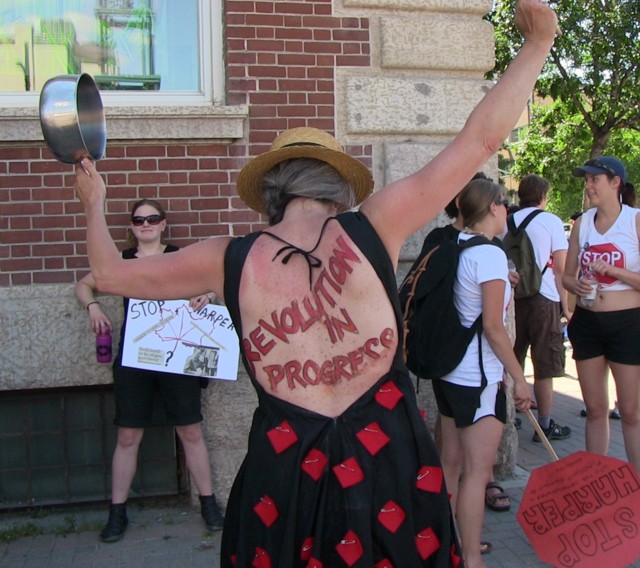
July 1, 2012: National Stop Harper Day in Winnipeg. Photo: Paul S. Graham

Traditionally a day of celebration, Canada Day 2012 became National Stop Harper Day for Canadians in 12 cities because of the regressive policies of the Harper government, most notably Bill C-38.

In Winnipeg, citizens held a Funeral for Canada in the Osborne Village neighbourhood, a display of activist art at the St. Norbert Arts Centre and a Vigil for Canada on the outskirts of The Forks National Historic Site.

Naturally, I brought my camcorder.


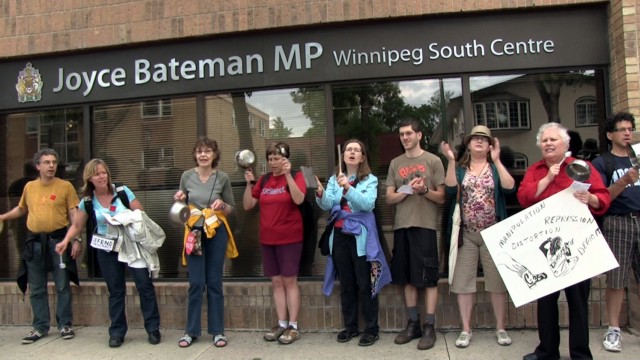
June 9, 2012: Citizens opposed to Bill C-38 pause for a moment outside of Conservative MP Joyce Bateman’s Winnipeg South Centre office before continuing to distribute literature in the constituency. Photo: Paul S. Graham

Stephen Harper’s Bill C-38 continues to generate controversy and opposition across Canada. In Winnipeg, a group of citizens have joined Lead Now’s “13 Heroes” campaign that is aimed at convincing enough Conservative MPs across the country to force the Prime Minister to back down on his budget implementation bill. The focus in Winnipeg is on Conservative MP Joyce Bateman (Winnipeg South Centre).

C-38 is an omnibus bill that combines budgetary spending and cuts with amendments to over 70 pieces of existing legislation. Among the bill’s lowlights, it

  • repeals the Canadian Environmental Assessment Act and introduces a weaker version
  • kills Canadian world-class science research centres, closing or selling the Experimental Lakes Area, The Cereal Research Centre at the University of Manitoba, marine & climate-monitoring programs
  • removes protection of endangered species and their habitat, when approving pipeline projects, by amending the Species at Risk Act and the Navigable Waters Protection Act
  • guts the Fisheries Act by removing provisions for habitat protection
  • repeals the Kyoto Protocol Implementation Act
  • eliminates the National Round Table on Environment and Economy
  • repeals the Fair Wages Act
  • reforms Old Age Security by raising the age of eligibility for the program
  • forces EI users to accept work that does not correspond to their training or customary salary

While Canadians and their MPs should debate the merits of these various measures, Harper will not allow this to happen. Because they have been stuffed into one Bill, these proposals will not get the individual attention they deserve. As you read this, the package is being rushed through one Parliamentary Committee — the Finance Committee. The Finance Committee is neither mandated nor equipped to assess the impacts of these wide-ranging amendments. Once again, Harper is showing his contempt for Canadians, for Parliament and for democracy itself.

Parliament may vote on Bill C-38 as soon as June 14th. The Opposition Parties are lined up to oppose the Bill, but with his majority, Harper will prevail unless we can convince some of his backbenchers to stop acting like sheep and listen to their constituents. Thirteen, to be precise. If thirteen Conservative MPs choose democracy, Harper can choose to back down or face an election.

On June 13, expect rallies outside of Conservative MPs offices. You can find out about the one nearest you here. If you live in Winnipeg, two events are planned:

Information picket in front of Joyce Bateman’s office (611 Corydon Avenue) from 4:00 to 6:00 p.m. Show up at three and you can help make picket signs.

Bill C-38 Dialogue Event, The University of Winnipeg, Room 2M70 (515 Portage Ave), from 7:00 to 9:00 pm

If you can’t make it, or abhor crowds, you can still remind Joyce Bateman that she has a choice. Contact her at

House of Commons
Ottawa, Ontario
K1A 0A6
Telephone:  613-992-9475
Fax:  613-992-9586
Email:  Joyce.Bateman@parl.gc.ca

or

102-611 Corydon Avenue
Winnipeg, Manitoba
R3L 0P3
Telephone: 204-983-1355
Fax: 204-984-3979

Finally, here’s a bit of video I recorded Saturday at Joyce Bateman’s office. But first, go to the kitchen and assemble your favorite noisemakers. Then play the video and chant:

“JOYCE HAS A CHOICE! LET HER HEAR YOUR VOICE!”


Winnipeg, March 11, 2012: Winnipeggers rally outside of Tory MP Joyce Bateman's office demanding the federal government allow a full inquiry into the federal election robocall scandal. Photo: Paul S. Graham

While Prime Minister Stephen Harper undoubtedly wishes this issue would disappear, Canadians marched in more than two dozen cities today, demanding a full inquiry into the federal election robocall scandal. In Winnipeg, over 100 rallied at the corner of Osborne Street and River Avenue where organizer Josh Brandon expressed the sense of outrage that many Canadians feel about the undermining of Canada’s electoral system. Speakers Kevin Lamoureux (Liberal MP for Winnipeg North) and Judy Wasylycia-Leis (former NDP MP for the same riding) urged them to support an NDP-sponsored bill that would grant Elections Canada greater powers to investigate electoral fraud, including the more than 30,000 complaints filed by Canadians about the last federal election.

At the conclusion of the speeches, the demonstrators marched to the Winnipeg South Centre office of Tory MP Joyce Bateman, to present her with a petition regarding concerns about robocalls that were made to voters in that riding. In the previous election Bateman narrowly defeated the Liberal incumbent, Anita Neville.

Here is my video report.


Winnipeg’s fabled North End, long known for its contributions to the arts, popular culture and radical politics, has always had a reputation for being a tough place to grow up. These days, however, crime, violence, gangs and poverty seem to be its defining characteristics, at least in the minds of folks who do not live there.

On January 15, 2012, the United Jewish People’s Order and the Association of United Ukrainian Canadians — organizations with deep, historic roots in north Winnipeg, held a public forum entitled “The North End – the Good and the Bad.” Their intent was to engage North Enders in a discussion of challenges they face and to highlight some of the forces for progress in the neighborhood.

Moderator: Roz Usiskin, United Jewish People’s Order

Panelists (in order of appearance):

– Sel Burrows, Point Douglas community activist
– Kevin Chief, MLA, Point Douglas and Minister of Children and Youth Opportunities
– Cindy Coker, executive director, SEED Winnipeg, Inc.
– Jim Silver, co-director, University of Winnipeg Urban and Inner-City Studies Program

It was an informative and useful discussion, as far as it went. I learned a lot. Cindy Coker and Jim Silver described some of the programs they and others are providing and the encouraging results that are emerging. Kevin Chief’s account of his election campaign showed that high levels of citizen engagement are manifesting in an area more known for political apathy. I particularly enjoyed Sel Burrows’ account of how the residents of the Point Douglas neighborhood banded together to reduce the local crime rate to levels comparable with those of much more affluent neighborhoods.

Michael Champagne challenges the audience to join with the young people of the North End who are "organizing ourselves to make a difference in our community." Photo: Paul S. Graham

That said, much was left unsaid, and I hope that UJPO and AUUC, in collaboration with other community-based organizations, offer future opportunities for discussion. Glaringly absent from this forum was any radical critique that would shine a light on the inadequacy of the social work approach to community development that seems so in vogue these days. Right at the end of the question period a young man named Michael Champagne stood up and challenged the audience to join with neighborhood youth who are self-organizing to reinvigorate their community. I hope that Mr. Champagne and others like him are on the podium the next time UJPO and AUUC hold a public forum.