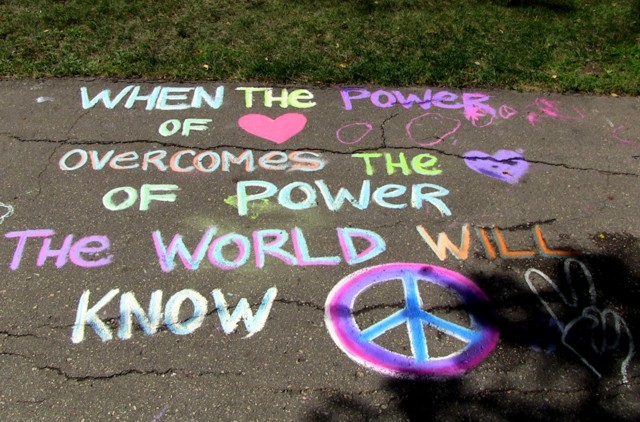
Aug. 25, 2012: One of the messages adorning the walkways of Vimy Ridge Park. Photo: Paul S. Graham
The underlying premise of CHALK 4 Peace might best be summed up in a statement attributed to Mahatma Gandhi in 1937: “There is no way to peace; peace is the way.”
CHALK 4 Peace is an annual event that has spread to hundreds of communities world-wide since its inception in 2003 in Arlington, Virginia. The objectives, according to CHALK 4 Peace are:
To promote the arts by coordinating assemblies of young artists of all ages to draw their vision of peace in public and private spaces with sidewalk chalk as a scheduled worldwide event;
To advocate for peace in a non-partisan manner such that all people may share their visions and messages of peace without regard to their nationality, ethnicity, or political beliefs;
To encourage relationships between municipalities and artists so that communities around the world become united in supporting the expression of peace.
Winnipeggers celebrated their 6th annual CHALK 4 Peace on Saturday, raising funds for War Child Canada, and bringing sidewalk art, music, and laughter to Vimy Ridge Park.
Kisa MacIsaac, one of the organizers of the Winnipeg event, explains how this coming together of arts, music and people contributes to a more peaceful world.
Canada’s Chief of Defence Staff Gen. Walt Natynczyk Photo: Jake Wright, The Canadian Press
This interview with Canada’s Chief of Defence Staff says more about the psychopathology of militarism than I would have believed could be found in a daily newspaper. Read along with me and ask yourself what kind of madness are we allowing to develop in this country.
My thoughts are in the right hand column. I’d be interested in hearing yours.
Canada’s top soldier says troops ready and eager for new overseas missions
CALGARY – When it comes to future missions for the Canadian Forces, Canada’s top soldier has to battle to keep his eager troops satisfied with staying out of major combat zones for now.
Our military exists, or should exist, to defend this country from aggressors while occasionally helping Torontonians dig out of blizzards and Manitobans fight floods. However, it seems that rather than guardians of national sovereignty and security we have a pack of blood thirsty attack dogs on a leash, restrained only by the herculean efforts of Chief of Defence Staff Gen. Walt Natynczyk.
Canada’s military presence in Afghanistan will come to an end once the current training mission concludes in 2014 and Chief of Defence Staff Gen. Walt Natynczyk acknowledges that’s a disappointment for many soldiers, sailors and air personnel.
If Natynczyk is correct in his assessment, we have allowed our military to become a haven for a large number of homicidal psychopaths. Is this what happens after a decade of war?
“We have some men and women who have had two, three and four tours and what they’re telling me is ‘Sir, we’ve got that bumper sticker. Can we go somewhere else now?’” Natynczyk said in an exclusive interview with The Canadian Press in Calgary.
These men and women need help. Failing that, they should never be allowed to own anything sharper than soup spoons.
“You also have the young sailors, soldiers, airmen and women who have just finished basic training and they want to go somewhere and in their minds it was going to be Afghanistan. So if not Afghanistan, where’s it going to be? They all want to serve.”
I like it when our troops are on hand to fight floods and forest fires. I’d prefer not paying taxes to help them make their bones overseas. If they are really that eager to kill people, our American cousins seem to have an insatiable appetite for cannon fodder.
But Natynczyk is unsure about what is in store for the Canadian Forces or even himself for that matter.
If you believe that, I have some prime muskeg, suitable for agriculture, that you won’t be able to resist.
He has been on the job for four years, which is past the normal tenure for someone in his position, and if he knows what is going to happen next, he isn’t providing any details.
“I’ll just keep on sprinting in this job until I’m told to get off the playing field and recognizing that I’m living in a pretty good time to be in the military,” he said.
Ah, so many people to kill, so little time!
“I never aspired to this job. I just serve. I serve Canadians and the country and look on every day as an opportunity to make a contribution.”
If you really want to serve, Walt, there’s a Starbuck’s near you that is always looking for talent.
Natynczyk said he is telling Canadian troops to keep their “kit packed up” because the world is an unpredictable place right now.
Iran? Syria? Northern BC, if the First Nations don’t allow Enbridge to build it’s Northern Gateway Pipeline?
“The world is turbulent right now and the fact is our allies want more of Canada, more of the men and women who wear Canadian uniforms,” he said.
Our allies want us to kill more brown people who have the misfortune to be in some proximity to undeveloped fossil fuels. We happen to be good at it, I guess.
“I’ve told them all to catch up on that training that lapsed while we had this high operational tempo between Afghanistan and the Olympics and Haiti and Libya, and let’s make sure we have all qualifications and training up to date so when we’re called upon we’re ready to go.”
We’re learning new ways to kill people every day.
The general said outside of Afghanistan, Canada has a number of other smaller missions underway including in the Middle East, Africa and the Caribbean.
Oh, and guess what! We’re opening up seven new military bases on foreign soil in Senegal, South Korea, Kenya, Singapore, Kuwait, Jamaica and Singapore.
Natynczyk said he is satisfied with the success of the Canadian mission to Afghanistan and pointed out that he flew into Kabul on a commercial airliner for the first time when he visited troops in the city last month.
Let’s see now . . . at great cost to ourselves and and a much greater cost to the Afghan people, we’ve helped a gang of drug lords maintain some control of a couple of urban centres which, when NATO leaves, will undoubtedly revert to Taliban control. The good news is, however, when the dust finally settles, commercial airlines will still fly into Kabul – just like they did before we invaded.
He said the departure of Canadian and U.S. troops will give the Afghan forces the little push that they need to succeed.
“It has helped the Afghans in a sense, taking ownership of their own security. One of the real challenges was the sense that NATO and our allies were going to stay there forever. (That) actually was not helpful in terms of their own culture and own atmosphere,” he said.
Natynczyk is a master of understatement.
Natynczyk is focusing much of his efforts now in making sure more attention is being paid to injured soldiers and their families, especially those suffering from the psychological effects of war.
Shattered bodies and broken minds are the inevitable outcomes of war. Why is Natynczyk so eager to get into another one?
“It’s almost easier to handle people with physical injuries, with physical wounds. People can see it. They can understand it, whether it be shrapnel, a broken leg, even these horrific amputations,” he said.
“It’s much more difficult in the mental injury, whether it be post traumatic stress, operational stress injury, traumatic brain injury because we’re just understanding the beginning of a process of understanding the complex nature of this.”
According to The Department of National Defence, 19 men and one woman died by suicide in the Canadian Forces in 2011, up from 12 in 2010. Since 1996, 187 soldiers have committed suicide. How many more suicides are we going to tolerate while the military is figuring out the “complex nature of this”?
Natynczyk said he talked about mental health on his last visit to Kabul, especially about overcoming the “stigma” of mental issues and making sure people come forward if they have a problem.
Lester B. Pearson has been dead for four decades, but his imagined legacy, that of international peacekeeper, remains one of the defining myths of the Canadian identity. Horrified by our murderous behavior in the occupation of Afghanistan and the bombings of Libya and the former Yugoslavia, the sainted memory of our 14th prime minister is resurrected by people who ought to know better to argue that war-making is not really a Canadian value, that we need to retake our traditional place in the global community as a progressive force for international co-operation, harmony and peace – that we must, again, assume the mantle of our revered Nobel Peace Prize laureate, Mike Pearson.
Yves Engler‘s sixth book, Lester Pearson’s Peacekeeping: The Truth May Hurt, was written to put an end to this nonsense. Canadian foreign policy continues to serve the interests of Canada’s corporate elite, and Pearson’s major contribution to this end was to shift Canadian allegiance from the declining British Empire to the emerging American one. With his peacekeeping fig leaf firmly in place, he backed some of the most murderous thugs of the 20th Century. As Noam Chomsky puts it in the preface to Engler’s book:
“Canada’s Nobel Peace Prize winner and eminent statesman, Lester Pearson was a major criminal, really extreme. He didn’t have the power to be like an American president, but if he had it, he would have been the same. He really tried.”
To encapsulate the book, Yves assembled a list of the “Top 10 things you don’t know about Canada’s most famous statesman, Lester B. Pearson.”
10. Asked in Parliament, he refused to call for Nelson Mandela’s release from prison.
9. He had Canada deliver weapons to the French to put down the Algerian and Vietnamese independence movements.
8. The Kennedy administration helped Pearson win his first minority government.
7. He incited individuals to destroy a peace group after it called for the outlawing of nuclear weapons.
6. Pearson backed the CIA coups in Iran and Guatemala.
5. He described the formation of NATO, not peacekeeping, as the “most important thing I participated in.”
4. Pearson threatened to quit as external affairs minister if Canada failed to deploy ground troops to Korea.
3. He agreed to have Canada’s representatives to the International Control Commission for Vietnam spy for the US and deliver their bombing threats to the North.
2. The world’s leading intellectual, Noam Chomsky, considers Lester Pearson a war criminal.
1. Stephen Harper’s foreign policy resembles that of Pearson more than any Liberal would ever admit.
UPDATE: You can watch a video report of Yves Engler’s March 15th Winnipeg presentation here.
Foreign policy analyst Yves Engler will be speaking in Winnipeg Thursday about his newest book, Lester Pearson’s Peacekeeping: The Truth May Hurt.
Date: Thursday, March 15, 2012 Time: 7:30 p.m. Location: Mondragon Bookstore and Coffee House, 91 Albert Street, Winnipeg Admission: Free. Donations will be requested to help defray expenses.
Written in the form of a submission to an imagined “Truth and Reconciliation” commission about Canada’s foreign policy past Lester Pearson’s Peacekeeping: The Truth May Hurtchallenges one of the most important Canadian foreign policy myths – that of Lester B. Pearson as peacekeeper.
Lester Pearson is one of Canada’s most important political figures. A Nobel Peace Prize laureate, he is considered a great peacekeeper and ‘honest broker.’ But in this critical examination of his work, Pearson is exposed as an ardent cold warrior who backed colonialism and apartheid in Africa, Zionism, coups in Guatemala, Iran and Brazil and the U.S. invasion of the Dominican Republic. A beneficiary of U.S. intervention in Canadian political affairs, he also provided important support to the U.S. in Vietnam and pushed to send troops to the American war in Korea.
Yves Engler has published five other books:
Stop Signs — Cars and Capitalism on the Road to Economic, Social and Ecological Decay (with Bianca Mugyenyi)
The Black Book of Canadian Foreign Policy (Shortlisted for the Mavis Gallant Prize for Non Fiction in the Quebec Writers’ Federation Literary Awards)
Playing Left Wing: From Rink Rat to Student Radical and (with Anthony Fenton)
Canada in Haiti: Waging War on The Poor Majority
Canada and Israel: Building Apartheid
His six books have been praised by Naomi Klein, Noam Chomsky, William Blum, Rick Salutin and many others.
Making war has been a human pursuit for thousands of years.
Playing at war, it would seem, is at least as old. This ancient Greek toy, a model of a war chariot, fashioned from clay, has survived the millennia to bear witness to our enduring attachment to violence and domination.
War requires warriors. Because killing is not something that comes naturally to most of us, a long period of preparation is usually needed. It begins, in childhood, with the toys we give to our children.
The design and marketing of war toys are anything but child’s play. According to an article in the New York Times, the US military and the American toy industry have a long history of working together. It’s a relationship where both parties benefit – toys are more realistic and often, toys have inspired weapons development. But there’s more. As the author observes:
“Because the newest generation of soldiers grew up playing with electronic toys and games, the symbiosis between them is nearly genetic. Today’s troops received their basic training as children.”
The popularity of violent video games inspired the US Army to develop its very own video game, which it provides free of charge from its web site. According to the late Gary Webb, an American investigative journalist of considerable renown,
“America’s Army isn’t merely a game, recruiting device or a public-relations tool, though it is certainly all of those things. It’s also a military aptitude tester. And it was designed that way from the start.”
A growing body of evidence confirms that exposure to violent toys, games and media can increase aggressive behavior, desensitize people to violence, and contribute to an exaggerated fear of the world.
Dr. Darlene Hammell, of the University of British Columbia Faculty of Medicine explains:
“A close examination of the issue raises concerns that war toys teach children that:
war is a game, an exciting adventure.
killing is acceptable, even fun.
violence or the threat of violence is the only way to resolve conflicts.
the world is divided into “goodies” and “baddies” where the bad guys are devoid of human qualities and their destruction is desirable.”
For the past 10 years, Winnipeg’s Project Peacemakers has conducted an annual inspection of Winnipeg toy stores. The objective is to raise awareness about the levels of violence in children’s toys and games, and to call on retailers, government, and the wider community to take steps to limit this violence.
I tagged along with an inspection team, last month, as it looked at two of the eleven stores covered in this year’s survey and prepared this video report.
The envelope. please . . .
Here is how the stores performed in terms of providing peaceful, constructive playthings – as opposed to war toys.
Excellent: Children’s Museum Commendable: A Child’s Place, Hans Christian Toys, Scholar’s Choice, Toad Hall Acceptable: BJ’s Toy Store, Kit and Kabooble Needs Improvement: Dollarama, Toys “R” Us, Zellers
Although a team visited a local Walmart, they were informed that Project Peacemakers would be unable to publicize its findings without first contacting Walmart’s public relations office. Project Peacemakers declined to rate the store, leaving you to draw your conclusions, if not about their toys, then about Walmart’s public relations savvy.
It oughtta be a crime
Under international law, most wars are crimes – though the likelihood of prosecution is low (unless you are on the losing side). War toys, however, remain perfectly legal in most places. Thankfully, there are exceptions. In 2009, Venezuela passed a “Law Prohibiting War Video Games and War Toys.” Prior to this, according to the Peace and Conflict Monitor, Sweden and Norway have “successful voluntary restriction” of war toy sales, Malta prohibits their import, Greece bans television advertising and Australia places some restrictions on imports. The Monitor says the European Parliament has recommended that its member states ban advertising of war toys and reduce their sale, though I could find no evidence that this has happened.
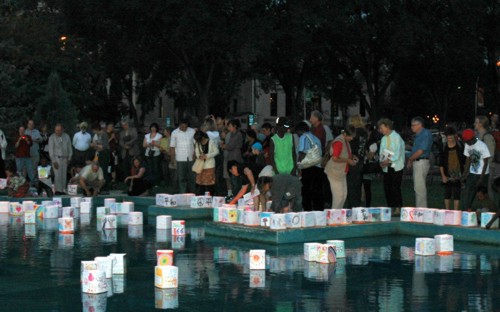
Every August 6, Winnipeggers commemorate the August 1945 atomic bombings of Hiroshima and Nagasaki with a Lanterns for Peace Ceremony. People come together to make and float their lanterns in a pond in the middle of the city to express their desire for a peaceful world and to show solidarity with countless others around the world who are doing something similar on that day.
The Cast
Glenn Morison – Project Peacemakers
Ismaila Alfa – CBC Radio
Doug Martindale – MLA, Burrows Constituency
Steve Plenert – Mennonite Central Committee
Jessica Nagamori – Manitoba Japanese Canadian Citizens’ Association
Terumi Kuwada – Manitoba Japanese Canadian Citizens’ Association
On Monday, August 6, 1945, at 8:15 a.m., the nuclear bomb “Little Boy” was dropped on Hiroshima, Japan by an American B-29 bomber, the Enola Gay. An estimated 130,000 people were killed.
On August 9, 1945, Nagasaki was the target of America’s second atomic bomb attack. At 11:02 a.m., the north of the city was destroyed and an estimated 70,000 people were killed by the bomb nicknamed “Fat Man.”
Over the years and decades that followed, thousands more died from a variety of radiation induced diseases. Even now, after more than six decades, many aftereffects persist, including leukemia, A-bomb cataracts, and cancers of thyroid, breast, lungs, salivary glands, birth defects, and disfiguring radiation burn scars.
The psychological damage arising from widespread chronic illness and the destruction of families and communities cannot be measured.
For many years, Winnipeggers have commemorated these tragedies and reaffirmed our commitment to peace and freedom from nuclear terror. We symbolize our commitment with a Lantern Ceremony.
Aug. 6, 2010: Winnipeggers gather at Memorial Park to launch their Lanterns for Peace. Photo: Paul S. Graham
Aug. 6, 2010: Lanterns reflect the individual aspirations of the artist. Photo: Paul S. Graham
August 6, 2010: Winnipeg Lanterns for Peace. Photo: Paul S. Graham
The Lantern Ceremony is part of an ancient Buddhist Ceremony (O-Bon), that commemorates the lives of deceased loved ones. For many years around the world, this ceremony has been used on Hiroshima Peace Day to honour and embrace the memory of those who died because of the attacks.
During these ceremonies, participants are invited to design a lantern that represents their thoughts and feelings regarding personal losses, global concerns of peace, nuclear disarmament and any other issue relevant to keeping our planet safe.
In addition to lanterns, we make origami peace cranes to commemorate the story of “Sadako and a Thousand Paper Cranes.”
Sadako Sasaki, a 10-year old girl, became sick with leukemia from the effects of the atomic bomb in post war Japan. She believed in an ancient tale that if you made 1000 paper cranes, you would be granted a wish. She wished for good health.
She died before she completed making the cranes and her classmates completed the task for her. Each year, thousands of paper cranes from all over the world adorn the statue of Sadako in the Hiroshima Peace Park in Hiroshima, Japan.
As important as it is to commemorate the horrible tragedies of August 6 and 9, 1945, more is required of us to prevent a recurrence of this disaster. Nine countries are known to possess nuclear weapons (United States, Russia, United Kingdom, France, China, India, Pakistan, North Korea and Israel). Together, they possess an estimated 8,000 active nuclear warheads and more than 22,000 in storage. The explosion (accidental or deliberate) of only one of these weapons would cause unthinkable suffering and destruction.
The nuclear threat is too serious to be ignored. We cannot rest until each of these nuclear weapons has been dismantled.
How you choose to work for a nuclear free world is up to you. There are numerous options. Here a few of the many Internet resources available to help you get involved.
Finally, the Canadian Peace Alliance is a good source of information on peace groups across Canada. The important thing is to become informed and involved.
The more we learn about the so-called humanitarian intervention in the skies above Libya, the less it looks like a war Canadians should support. Like the bogus humanitarian claims Tories and Liberals have used to support extending Canadian participation in the occupation of Afghanistan, the war against Libya has more to do with imperialism and any humanitarian benefit is simply “collateral.”
US Democratic Party Congressman Dennis Kucinich recently drew attention to the amazing similarity between the NATO invasion of Libya and a NATO war game entitled “Operation Southern Mistral 2011.”
“While war games are not uncommon, the similarities between ‘Southern Mistral’ and ‘Operation Odyssey Dawn’ highlight just how many unanswered questions remain regarding our own military planning for Libya.
The ‘Southern Mistral’ war games called for Great Britain-French air strikes against an unnamed dictator of a fictional country, “Southland.” The pretend attack was authorized by a pretend United Nations Security Council Resolution. The ‘Southern Mistral’ war games were set for March 21-25, 2011.
On March 19, 2011, the United States joined France and Great Britain in an air attack against Muammar Gaddafi’s Libya pursuant to UN Security Council Resolution 1973.
Scheduling a joint military exercise that ends up resembling real military action could be seen as remarkable planning by the French and British, but it also highlights questions regarding the United States’ role in planning for the war. We don’t know how long the attack on Libya has been in preparation, but Congress must find out. We don’t know who the rebels really represent and how they became armed, but Congress must find out. (Denis Kucinich, Kucinich: President Had Time to Consult with International Community, Not Congress? | Congressman Dennis J. Kucinich, Press Release, March 29, 2011)
Rep. Kucinich does not appear to have a Canadian counterpart who is questioning why we are involved, much less speaking out against it. Harper’s decision to send jet fighters to bomb Libya was supported unanimously by Canada’s MPs, some of whom one would expect to do their homework before being caught up in media-hyped war hysteria.
Did any of them stop to consider why we are doing nothing to stop the governments of Bahrain, Saudi Arabia, Yemen, Jordan, Qatar and Oman from murdering their citizens in large numbers? Did none of them find it odd that the uprising in Libya was armed and violent from the beginning — in stark contrast to the peaceful mass movements Canada has refused to defend? Isn’t it strange that we will rush to war against Gaddafi who, arguably is no better or no worse than any number of despots but we will not do a thing to restrain the routine brutality of the Israeli state against Palestinians?
The war in Libya is the pink elephant on the campaign trail that none of our politicians want to acknowledge. We have to change this.
Joshua Key is an American Iraq War veteran who sought refuge in Canada because of his war experiences. Author of “The Deserter’s Tale,” Joshua told the story of his recruitment into the U.S. Army, the war crimes he witnessed in Iraq and his subsequent flight to Canada to an audience at McNally Robinson Booksellers in Winnipeg on Jan. 17, 2011.
Like so many young people, Joshua joined the army to escape a life of poverty and support his family. The Army promised he would remain in the US and learn to build bridges, but the ink on his contract was barely dry when he learned he would be deployed to Iraq to blow them up. Basic training turned him into a killing machine, but the brutalities of war transformed him into a deserter, a refugee and a peace activist.
Joshua speaks with authority, simplicity, warmth and honesty. He may have been traumatized by what he has seen and done, but he has not lost his courage or his humanity. He and the many others who have said “no” to the American war machine deserve our admiration and need our support.
I’ve written about this before – the F-35 stealth fighter deal stinks to high heaven. Over priced and over sold, the stealthiest thing about this “defense contract” is the assault on Canadian taxpayers over the next several decades as we are robbed of $30 billion to bankroll the merchants of death.
This weapons system is designed for one thing only: fighting wars of aggression. We must send a clear message to Ottawa that we will no longer tolerate the use of our dollars to fuel the international war machine.
Above is a video I shot over the weekend in which Michael Bueckert of Project Peacemakers makes the case for tearing up Stephen Harper’s order for 65 of these death planes. Below is the text of his remarks, also published at the Peace Alliance Winnipeg News.
Call your MP today and tell him/her to shoot down this despicable deal without further delay.
The F-35 Stealth Fighter: A bad deal for Canada
By Michael Bueckert, Program Coordinator, Project Peacemakers
As you may know, this past July, the Conservative government announced what could be the single largest military procurement in Canada’s history when it declared its intention to buy 65 F-35 Lightning II aircraft (A.K.A. “Joint Strike Fighters”) to replace our aging fleet of CF-18s starting in 2016.
If you are familiar with this issue, then you are probably also aware of the narrow way in which the media has presented it.
On one side are the supportive arguments, provided by the Conservative government, military brass and the aerospace companies. When replacing our aging CF-18s, the F-35s are considered necessary for a number of reasons; namely, they provide interoperability with the U.S., they have the best, newest capabilities available, and the deal will create and support Canadian jobs. Additionally, by committing now we would secure the price at a low level.
And then there is the critical argument, provided by the main opposition parties: the deal is based on a sole-source contract, and without appropriate market competition we will inevitably be paying too much for the planes, and there may be better alternatives out there.
So the way it is framed, the debate is essentially one side saying that the F-35s are the best possible planes and this deal will support our army and industry, versus the other side saying that the deal is irresponsible and that we should have an open competition to get the best price.
This excludes the many important critiques being made by analysts in the peace community, primarily by the folks at Project Ploughshares, and by Steven Staples at the Rideau Institute. It is their work that I will draw from most in this presentation.
So let’s look at some of the main arguments put forward by proponents of the F-35 deal.
First of all, is the planes themselves. Proponents argue that these Fifth Generation fighter jets are top notch, with stealth and interoperability technology that makes them second to none.
As Defense Minister Peter McKay has said, “This aircraft is the best that we can provide our men and women in uniform, and this government is committed to giving them the very best.”
Without spending much time on this, what is it that the F-35 is designed to do?
Well, they are geared for aggressive military roles. According to the CBC, it is designed for tactical bombing and aerial warfare, equipped with a 25-millimeter gun, air-to-ground and air-to-air missiles, plus a variety of bombs. As Steven Staples puts it, the F-35 is “highly capable in air-to-air combat against other advanced fighters,” designed as “a first strike fighter-bomber intended for use in ‘shock and awe’ attacks.”
Well, I think that anyone who has read accounts of the American “shock-and-awe” bombing campaign of Iraq can appreciate how sickening it is just to imagine ourselves with that kind of capability.
But even without an appeal to moral sensibilities, even if we believe that in some cases the use of fighter planes is justifiable, and that national defence is a primary responsibility, we don’t have to look any further than the Government’s own 2008 “Canada First” defense strategy document to see that the purchase of these planes is inappropriate.
In that document, the government outlined the various threats that Canada could face in the future. According to Project Ploughshares, “you would be hard pressed to create a credible scenario from them where a stealth-enabled fighter jet is logically part of Canadian Forces’ response.”
This sentiment is reflected by Major General Leonard Johnson (retired), who argued in the Ottawa Citizen that apart from the incredulous prospect of war against an advanced enemy–Iran doesn’t count–it is “hard to see any useful military role” for the F-35.
And this argument–that there is no necessary role for the F-35 either domestically or internationally–is essentially accepted by F-35 proponents. Rather than point to how the planes could be used, they point to the unpredictable threats of an unknown future. We need the planes in order to keep our options open, and keep an aggressive militarism on the table.
The second main argument used by F-35 proponents is that by committing to these planes we are getting a good deal, and that it will provide and protect Canadian jobs. Conversely, rejecting the deal will waste taxpayers money and threaten billions of dollars in contracts for Canadian companies.
Well, to analyze these claims we need to look at the deal and the Joint Strike Fighter program in more detail.
Canada joined the Joint Strike Fighter program in 1997, under the Liberal government. The JSF program is a partnership of nine countries—the US, UK, Italy, Netherlands, Turkey, Norway, Denmark, Australia and Canada—to invest in the development, production and sustainment of three versions of a stealth, multi-role aircraft. Lockheed Martin won over Boeing in an early competition to develop the planes for the program. To date, Canada has invested 168 million U.S. dollars in the program, and is committed to spending an additional 551 million dollars between now and 2051 in production costs.
The planes are currently in the Production, Sustainment and Follow-on Development stage, and we are expected to start receiving them in 2016. What Canada did last summer is unusual, when it committed to buying 65 planes before they had even been completed, or tested.
The planes themselves, when we buy them, are said to total $9 Billion, with up to $7 Billion in maintenance costs over their lifespan. That would bring the total cost of the planes to $16 Billion, on top of the 711 million dollars in ongoing investment.
This sounds like a lot of money in itself, but even the $16 Billion is bound to be too low, for a number of reasons.
First, the program has been plagued by cost overruns, and estimates continue to grow. Project Ploughshares, using U.S.-based data, has estimated that the planes will come to a total cost of $30 Billion, which is about double what officials are saying. Further, because the planes are not completed and have not been tested, and there is simply no idea how much we will have to pay.
In testimony to the Canadian parliament, U.S. military critic Winslow Wheeler warned about the possibility of the planes being much more expensive than advertised. His testimony is worthy of being quoted at length:
“In this country, advocates cite various figures, all of them misleading. The gimmicks include excluding important parts of the airplane, such as the engine, excluding all development costs, using obsolete dollars that understate the contemporaneous cost, and – in your case – using American, not Canadian, dollars. There are other tricks that can be hard to unravel; I encourage you to thoroughly research any unit costs cited to you.
“Neither you nor I currently know, but it is certain that the costs being cited to you now are the ‘buy-in’ costs. Real costs, when your government negotiates an actual contract and as the program goes through its life cycle, are sure to be an unpleasant surprise to you.”
Moreover, the cost per plane is based on an estimated global market that is steadily decreasing. The more planes sold, the cheaper they will be, but many countries are starting to back down from their previous commitments. Project Ploughshares has reported on the fact that the sales projections quoted by proponents are now 10 years out of date; the 2001 projection was that 5,179 planes would be sold, and now it is more likely to be between 2 thousand and 3500. Using the old estimates are almost certainly intended to deceive, as they drastically reduce the expected price.
All this is to say that the 16 Billion dollar price tag is likely to be drastically inaccurate, and the supposedly good deal is not looking quite so good.
But what about the argument that this deal is good for supporting Canadian jobs? This is the most populist, and most common argument being put forward. (It should probably be noted that if the Government was committed to Keynesian economics, there are ways of supporting jobs that don’t involve manufacturing weapons. But let’s look at this anyway).
It is true that Canadian companies have benefited so far. Industry Canada notes that to date 350 million dollars in contracts have been awarded to 85 Canadian companies and research laboratories, which is more than Canadians have invested so far. Proponents say that up to $12 Billion is potentially available to Canadian companies in industrial benefits.
Some of those benefits are being realized right here in Winnipeg. A recent Winnipeg Free Press article highlighted Bristol Aerospace, noting its contracts to build horizontal tail components, and other parts for the F-35. According to the article, Bristol has committed about $100 million in capital spending to equip its Winnipeg plant, expects to ship 1 Billion dollars in parts, and had already shipped 35 million dollars worth of parts before we committed to purchasing the jets.
It is clear that Bristol, and the industry, have a lot of vested interest in this deal. Which is why its parent company, Magellan Aerospace Corporation, has come out with other companies to support the F-35 deal, citing outdated and exaggerated statistics.
However, while Canadian arms manufactures may have benefited so far, it is not at all certain that these privileges will continue. There are no guaranteed contracts built into the procurement deal. All we have is the opportunity to bid on them, and competition from industry in other countries is growing as they demand a fairer share in the distribution of contracts. Moreover, the figure of $12 Billion in potential industrial benefits is based on the outdated market projections I explained earlier, which assume an exaggerated number of planes will be manufactured.
Labour, for its part, has refused to passively accept these figures, but has refrained from speaking against the deal itself. Instead, the Canadian Auto Workers union has called for $16 Billion of guaranteed contracts to be included in the procurement deal, a demand that is certain to be ignored.
Now, what I have just done is to argue that the proposed financial benefits to Canada are not nearly as high as stated by officials and industry. The F-35s will cost much more than we think, and will give back fewer jobs than we expect. It is important to point out the misinformation that is provided on this issue, as proponents continue to sell the deal to Canadians. But the point is not simply that they are too expensive, as the Opposition parties claim. Yes, they are expensive, but we are not calling for cheaper fighter planes.
We should remember that the CF-18s, the planes which we are looking to replace, had been used to drop bombs on Iraq in 1991, and on Kosovo in 1999. Upgrading these planes–as suggested by Steven Staples–is not a peaceful alternative to the F-35s, although it would be cheaper. Similarly, buying unmanned drones to patrol the arctic–also suggested by Staples–does not get us much farther, because drones are easily incorporated into weapons systems.
Richard Sanders, of the Coalition to Oppose the Arms Trade, is disturbed about how analysts focus primarily on the relative cost of the F-35s, as if cheaper fighter planes will be more peaceful fighter planes. I tend to agree; we need to challenge not just these planes, but all fighter planes, all military spending. But we can start by working to ensure that we do not purchase the F-35, which would be a monumental waste of money towards immoral ends.
This article is the text of Michael Bueckert’s presentation to the Feb. 20, 2011 annual meeting of Peace Alliance Winnipeg.





 Paul S. Graham