
Speaking at a forum, Jan. 23, 2011, sponsored by Peace Alliance Winnipeg and Project Peacemakers, author/activist Yves Engler explores Stephen Harper’s foreign policy and how it cost Canada its bid, in 2010, for a seat on the United Nations Security Council.
Archive for the ‘Nibbling on The Empire’ Category
Video: How Canada lost its bid for a UN Security Council seat
Posted: March 9, 2011 in Nibbling on The Empire, WinnipegTags: Canada, imperialism
0
Sweden’s Sveriges Television has released a 57-minute documentary on the history of Wikileaks entitled WikiRebels. A must view for infomaniacs everywhere. The playlist for all 4 parts is here.
Why Canada lost its bid for a Security Council seat
Posted: October 18, 2010 in Guest Contributors, Nibbling on The EmpireTags: Canada, UN Security Council, Yves Engler
by Yves Engler
 In a stunning international rebuke Stephen Harper’s government lost its bid for a UN Security Council seat last week. The vote in New York was the world’s response to a Canadian foreign policy designed to please the most reactionary, shortsighted sectors of the Conservative Party’s base — evangelical Christian Zionists, extreme right-wing Jews, Islamophobes, the military-industrial-academic-complex, mining and oil executives and old cold-warriors.
Over the past four year Harper’s government has been offside with the world community on a whole host of issues. Canada was among a small number of countries that refused to recognize the human right to water or sign the UN Declaration on the Rights of Indigenous Peoples. On two occasions Ottawa blocked consensus at the Rotterdam Convention to place chrysotile asbestos, a known toxin, on its list of dangerous products and in November Finance Minister Jim Flaherty refused to even consider British PM Gordon Brown’s idea of a global tax on international financial transactions.
Close to the companies making huge profits on the Tar Sands, the Conservatives repeatedly sabotaged international climate negotiations. They angered many in the Commonwealth by blocking a resolution calling for a “binding commitment” on rich countries to reduce emissions and at a UN climate conference in Bangkok last year, many delegates from poorer countries left a negotiating session in protest after a Canadian suggestion to scrap the Kyoto Protocol as the basis of negotiations.
Israel’s best friend
The Conservatives extreme “Israel no matter what” position definitely hurt its chance on Tuesday. “It’s hard to find a country friendlier to Israel than Canada these days,” explained Israeli Foreign Minister, Avigdor Lieberman, who emigrated from Moldova when he was 20 but still feels fit to call for the expulsion of Palestinian citizens of Israel.
The Conservatives publicly endorsed Israel’s 2006 attack on Lebanon, voted against a host of UN resolutions supporting Palestinian rights and in February Ottawa delighted Israeli hawks by canceling $15 million in funding for the UN agency for Palestine Refugees (UNRWA). The money was transferred to Palestinian security reform.
For the past three years Canada has been heavily invested in training a Palestinian security force designed to oversee Israel’s occupation of the West Bank and “to ensure that the PA [Palestinian Authority] maintains control of the West Bank against Hamas,” as Canadian ambassador to Israel Jon Allen was quoted as saying by the Canadian Jewish News. According to deputy Foreign Affairs minister Peter Kent, Operation PROTEUS, Canada’s military training mission in the West Bank, is the country’s “second largest deployment after Afghanistan” and it receives “most of the money” from a five-year $300 million Canadian aid program to the Palestinians.
At the same time as Canadian “aid” strengthens the most compliant Palestinian political factions, the Conservatives have refused any criticism of Israel’s onslaught against the 1.5 million people living in Gaza. Canada was the only country at the UN Human Rights Council to vote against a January 2008 resolution that called for “urgent international action to put an immediate end to Israel’s siege of Gaza.”
Later in 2008 Israel unleashed a 22-day military assault on Gaza that left 1,400 Palestinians dead. In response many governments condemned the bombing and Venezuela broke off all diplomatic relations. Israel didn’t need to worry since Ottawa was prepared to help out. The Canadian embassy now represents Israel’s diplomatic interests in Caracas.
Threatening Iran
While Brazil and Turkey tried to dissipate hostility towards Iran, Harper used his pulpit as host of the G8 to pave the way for a possible U.S.-Israeli attack. A February 17 Toronto Star article was headlined: “Military action against Iran still on the table, Kent says.” The junior foreign minister explained that “it’s a matter of timing and it’s a matter of how long we can wait without taking more serious preemptive action.”
“Preemptive action” is a euphemism for a bombing campaign. Canadian naval vessels are already running provocative maneuvers off Iran’s coast and by stating that “an attack on Israel would be considered an attack on Canada,” Kent is trying to create the impression that Iran may attack Israel. But it is Israel that possesses nuclear weapons and threatens to bomb Iran, not the other way around.
While Ottawa considers Iran’s nuclear energy program a major threat, Israel’s atomic bombs have not provoked similar condemnation. The Harper government abstained on a number of near unanimous votes asking Israel to place its nuclear weapons program under International Atomic Energy Agency (IAEA) controls and in September Bloomberg cited Canada as one of three countries that opposed an IAEA probe of Israel’s nuclear facilities as part of an Arab led effort to create a nuclear-weapons-free Middle East.
Cold war throwback
Not content with taking on Iran, the military-minded Conservatives turned on Russia. Harper referred to Russia as “aggressive” and in a throwback to the Cold War, Defence Minister Peter MacKay added that Ottawa would respond to Russian flights in the Arctic by flying Canadian fighter jets near Russian airspace. Making sure that Moscow got the message, during a July 2007 visit to the Ukraine MacKay said Canada would help provide a “counterbalance” to Russia.
Haiti
Ottawa even prioritized the military over aid in the face of the incredible suffering caused by Haiti’s earthquake. Two thousand Canadian troops were deployed while several Heavy Urban Search Rescue Teams were readied but never sent. Foreign Affairs Minister Lawrence Cannon explained that the teams were not needed because “the government had opted to send Canadian Armed Forces instead.”
Overthrown in February 2004 by a joint U.S./France/Canada destabilization campaign, Haiti’s most popular political party, Fanmi Lavalas, has been barred from participating in elections. The Conservatives supported Fanmi Lavalas’ exclusion, congratulating Haiti’s puppet government for bringing “a period of stabilization” good for “investment and trade.” Ottawa backed up its words with deeds, adding tens of millions of dollars to a Haitian prison and police system that has been massively expanded and militarized since the 2004 coup.
Honduras
Ottawa gave its tacit support to the Honduran military’s removal of elected president Manuel Zelaya in June 2009. Mexico’s Notimex reported that Canada was the only country in the hemisphere that did not explicitly call for Zelaya’s return to power and Canadian officials repeatedly criticized Zelaya at the Organization of American States (OAS). The ousted government complained that Ottawa failed to suspend aid to Honduras, which is the largest recipient of Canadian assistance in Central America. Nor did Ottawa exclude the Honduran military from its Military Training Assistance Program.
The Harper government opposed Zelaya’s move to join the Hugo Chavez led Alba, the Bolivarian Alliance for the People of Our Americas, which is a response to North American capitalist domination of the region. Canada has actively supported the U.S.-led campaign against the government of Venezuela. In mid-2007 Harper toured South America “to show [the region] that Canada functions and that it can be a better model than Venezuela,” in the words of a high-level foreign affairs official. During the trip, Harper and his entourage made a number of comments critical of the Venezuelan government.
Colombia si. Venezuela no.
After meeting only members of the opposition during a trip to Venezuela in January, Peter Kent told the media that “democratic space within Venezuela has been shrinking and in this election year, Canada is very concerned about the rights of all Venezuelans to participate in the democratic process.”
Venezuela’s ambassador to the 34-country OAS, Roy Chaderton Matos, responded: “I am talking of a Canada governed by an ultra right that closed its Parliament for various months to (evade) an investigation over the violation of human rights — I am talking about torture and assassinations — by its soldiers in Afghanistan.”
Despite the move to the left among the majority of the region’s governments Harper moved closer to Latin America’s most right-wing state. Colombia’s terrible human rights record did not stop Harper from signing a free-trade agreement that even Washington couldn’t stomach.
The trade agreement as well as the Harper government’s shift of aid from Africa to Latin America was designed to support Canadian corporate interests and the region’s right-wing governments and movements. Barely discussed in the media, the main goal of the shift in aid was to stunt Latin America’s recent rejection of neoliberalism and U.S. dependence.
The Congo
One issue mentioned in a number of media reports about Canada’s loss last week had to do with the Congo. At the G8 in June the Conservatives pushed for an entire declaration to the final communiqué criticizing the Congo for attempting to gain a greater share of its vast mineral wealth. Months earlier Ottawa began to obstruct international efforts to reschedule the country’s foreign debt, which was mostly accrued during more than three decades of Joseph Mobuto’s dictatorship and the subsequent war.
Canadian officials “have a problem with what’s happened with a Canadian company,” Congolese Information Minister Lambert Mende said referring to the government’s move to revoke a mining concession that Vancouver-based First Quantum acquired under dubious circumstances during the 1998-2003 war. “The Canadian government wants to use the Paris Club [of debtor nations] in order to resolve a particular problem”, explained Mende. “This is unacceptable.”
The mining industry increasingly represents Canada abroad. Canadian miners operate more than 3,000 projects outside this country and many of these mines have displaced communities, destroyed ecosystems and resulted in violence. This doesn’t bother the Harper government, which is close to the most retrograde sectors of the mining industry. Last year they rejected a proposal – agreed to by the Mining Association of Canada under pressure from civil society groups — to make diplomatic and financial support for resource companies operating overseas contingent upon socially responsible conduct. Despite countless horror stories suggesting the contrary, the Conservatives claim that voluntary standards are the best way to improve Canadian mining companies’ social responsibility.
Afghanistan
Finally, the Conservatives have knowingly supported torture in Afghanistan and embraced an increasingly violent counterinsurgency war. Apparently, Canadian Joint Task Force 2 commandos regularly take part in nighttime assassination raids, which are highly unpopular with the Afghan population.
Losing the Security Council seat will hopefully cost the Conservatives some votes and temper their more extreme international positions. But, for those of us working to radically transform Canadian foreign policy the consequences of the loss may be much greater. There has probably never been a bigger blow to the carefully crafted image of Canada as a popular international do-gooder, a mythology that blinds so many Canadians to our country’s real role in the world.
Yves Engler is the author of The Black Book of Canadian Foreign Policy and Canada and Israel: Building Apartheid. He’ll be touring in Mid November to speak on “Why Canada lost its bid for a Security Council seat.” Anyone interested in organizing a talk please e-mail: yvesengler (at) hotmail.com.
See also: Video: How Canada lost its bid for a UN Security Council Seat, a presentation by Yves Engler in Winnipeg on Jan. 23, 2011.
Meditations on Martin Luther King Jr. Day
Posted: January 18, 2010 in Nibbling on The Empire, Peace, WarTags: Martin Luther King Jr
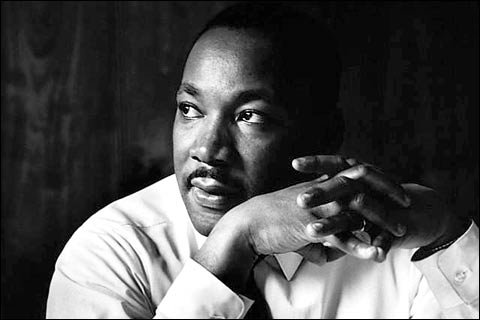
It’s Martin Luther King Day in the United States. It’s a big deal in the land of toxic derivatives; even the stock markets are closed in his memory.
Once harassed and stalked by the the FBI, King’s memory is now regularly and hypocritically invoked by those who stand on his shoulders.
Were King alive he would have just celebrated his 81st birthday. Had he survived the assassin’s bullet he would still be followed by spooks and menaced by that which he famously described as “the greatest purveyor of violence in the world today” — the U.S. government.
Speaking at Riverside Church in New York City on April 4, 1967, King exposed the hypocrisy of the U.S. government and called on it to end the war in Vietnam. His words sent shock waves through the land because he articulated a truth that millions of Americans had not been allowed to hear.
He shared with them his outrage at the subversion of democracy, the murder of men, women and children, the destruction of cultures and livelihoods and cruel irony that black and white Americans were being sent to kill and die together by a country that segregated them at home.
Martin Luther King exposed the Big Lie of American imperialism that day in New York City; exactly one year later, in Memphis, Tennessee, he would pay for his truth-telling with his life.
In reading his speech today I’m struck by the parallels between Vietnam (and America’s other wars in Laos and Cambodia) and the current day “war on terrorism” in Iraq, Afghanistan, Pakistan, and increasingly, in Yemen.
Read King’s speech for yourself; then re-read it and make a few substitutions:
- “terrorists” for “communists”
- “Al-Quaida” for “Viet Cong”
- “Afghanistan” for “Vietnam”
- “America” for “America”
Most of the actors have different names but the script is the same weary, blood-soaked, tear-stained tale.
The antidote remains the same, as well. King called upon his fellow Americans to oppose the war nonviolently, creatively and without letting up. But he acknowledged that anti-war protests were not enough. As King put it:
The war in Vietnam is but a symptom of a far deeper malady within the American spirit, and if we ignore this sobering reality we will find ourselves organizing clergy- and laymen-concerned committees for the next generation. They will be concerned about Guatemala and Peru. They will be concerned about Thailand and Cambodia. They will be concerned about Mozambique and South Africa. We will be marching for these and a dozen other names and attending rallies without end unless there is a significant and profound change in American life and policy.
King maintained that America needed make radical changes.
We must rapidly begin the shift from a “thing-oriented” society to a “person-oriented” society. When machines and computers, profit motives and property rights are considered more important than people, the giant triplets of racism, materialism, and militarism are incapable of being conquered.
Sounds like 2010, to me.
Sunday morning war crimes musings
Posted: April 5, 2009 in Nibbling on The Empire, WarTags: Condoleeza Rice, George W. Bush, war criminals
According to the RCMP:
“Crime against humanity”- means murder, extermination, enslavement, deportation, persecution or any other inhumane act that is committed against any civilian population or any identifiable group of persons that constitutes a contravention of customary or conventional international law or is criminal according to the general principles of law.
As long as war crimes and crimes against humanity are being committed, Canada will be vigilant to prevent those responsible from entering Canada and becoming or remaining citizens. We will be ready to commence criminal investigations and prosecute such persons found in Canada.
This is, of course, a complete crock. When George W. Bush visited Calgary last month, not only did the Mounties ignore their obligation to detain and charge him, but the government pulled out all the stops to protect this mass murderer.
While a Spanish court is preparing to prosecute Bush-era officials who developed the “legal” fig leaf for American forces to torture their captors, Calgary is preparing to welcome Condoleeza Rice in May.
Rice’s visit will attract at least as much outrage as Bush’s, and presumably as much police presence and state protection for a woman who, along with Bush et al, is culpable in the deaths of 1.3 million Iraqis, 60,000 Afghans, and countless other crimes against people around the world.
What are we to make of a government that would welcome these thugs into Canada while preventing the visit of British MP George Galloway who is demonstrably opposed to mass murder? OK, that is a rhetorical question.
Less rhetorically, what are we going to do about it?
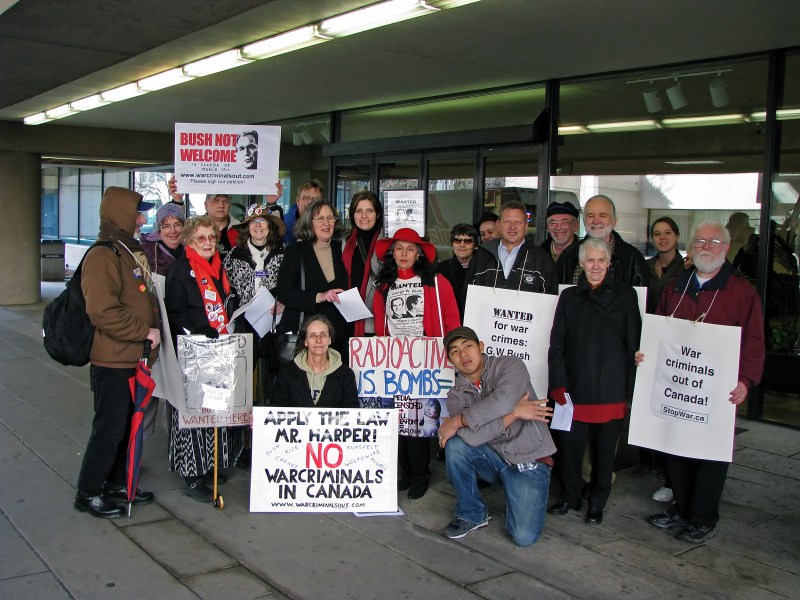
Some good folks in Maple Ridge, BC, also known as the Coalition of the Willing, are confronting their local MP on this issue. In an open letter, the Coalition calls upon MP Randy Kamp (Pitt Meadows-Maple Ridge-Mission) to resign and “sit as an independent (at least until your party reforms itself), so that you may begin representing the wishes of your constituents to Ottawa, and not Ottawa to us.” If Kamp does not meet their demand, the Coalition might run a candidate against him in the next election. Is Kamp worried? With a 51 percent majority in the last election and a 19 point lead over NDP candidate Mike Bocking, he doesn’t look too vulnerable. So, unless Mr. Kamp has a social conscience, I imagine he will ignore the Coalition of the Willing.
The Coalition says this issue is not one of Left versus Right, but Right versus Wrong. In Parliamentary terms, they may well be right. The NDP has been disconcertingly AWOL from this debate.
When Lawyers Against the War wrote to the RCMP, asking it to enforce Canada’s war crimes laws regarding George Bush, they sent copies to the leaders of the political parties. Jack Layton’s office replied:
On behalf of Mr. Layton, thank you for copying our office on the correspondence concerning former President George W. Bush`s March 17th visit to Canada. Please be advised that we will not be following-up on this matter.
Sincerely,
Office of Jack Layton, MP (Toronto-Danforth)
Leader, Canada’s New Democrats
Michael Byers, who carried the NDP banner to third place in Vancouver Centre last year. says that he supports a criminal investigation of Bush’s crimes, but he does not support calls for a Canadian prosecution at this time. He says he prefers to give the Obama administration the “first opportunity” to prosecute Bush. Yeah, right.
That seems to be as good as it gets with the NDP, so perhaps the Coalition is onto something — this is a case of “Right versus Wrong” and on this issue our Parliamentary Left is demonstrably wrong.
In fairness to the NDP, it opposes the war in Afghanistan, supports the repatriation of Omar Khadr, and would allow war resisters to remain in Canada. What are we to conclude from its unwillingness to engage when it has the opportunity to seek the prosecution of “The Decider” who made all of these crimes happen? That Jack Layton is a closet war criminal? Unlikely. That Jack Layton is trying to appear realistic and hence “Prime Ministerial”? Getting warmer, I think.
Could it be that war crimes in the 21st century are so commonplace, so banal, so depressingly quotidian that the NDP sees no benefit to associating itself with this issue? Now, if Bush had been responsible for increasing text messaging cost in Canada, we might see some action from the NDP.
What are we to do, beside writing the usual letters of outrage to our MPs (find yours here)? Well, we can start with or continue with that strategy. We can hook up with the Coalition of the Willing and Lawyers Against the War. We can be active in our local peace and human rights organizations.
The most important thing we can do is to refuse to lose our sense of outrage that abuses of human rights are committed, aided and abetted by our government. We can refuse to accept the fact that war criminals are allowed to travel the world with impunity. We can commit to taking every opportunity to expose these crimes and their perpetrators for what they are.
The Cadman Affair is not over
Posted: February 7, 2009 in Nibbling on The EmpireTags: Cadman Affair, Stephen Harper
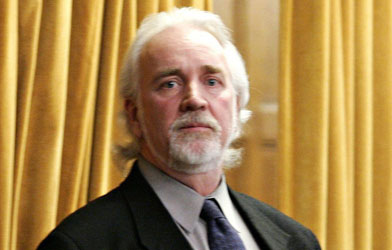
Chuck Cadman. Photo: CBC
Now that the Liberals and Conservatives have made kissy face over the Cadman Affair, it is time for the Mounties to investigate the possibility that the offer allegedly made by Tory officials to the late Chuck Cadman for his vote was a serious breach of the Criminal Code of Canada.
Tory representatives are alleged to have offered the terminally-ill MP a $1-million life insurance policy. According to the CBC, Stephen Harper has testified that he only authorized for Cadman to be approached with an offer of financial help for his election campaign if Cadman would vote against the Liberals, defeating the government, and then run for the Conservatives.
Am I the only one who thinks this sounds like a bribe? Here is what the Criminal Code of Canada has to say about offering financial incentives to an MP in return for a vote:
119. (1) Every one is guilty of an indictable offence and liable to imprisonment for a term not exceeding fourteen years who
(a) being the holder of a judicial office, or being a member of Parliament or of the legislature of a province, directly or indirectly, corruptly accepts, obtains, agrees to accept or attempts to obtain, for themselves or another person, any money, valuable consideration, office, place or employment in respect of anything done or omitted or to be done or omitted by them in their official capacity, or
(b) directly or indirectly, corruptly gives or offers to a person mentioned in paragraph (a), or to anyone for the benefit of that person, any money, valuable consideration, office, place or employment in respect of anything done or omitted or to be done or omitted by that person in their official capacity.
Here is what Prime Minister Harper was recorded saying in an interview with Tom Zytaruk, author of Like a Rock: The Chuck Cadman Story. You can listen to the Harper-Zytaruk interview here.
Zytaruk: “I mean, there was an insurance policy for a million dollars. Do you know anything about that?”
Harper: “I don’t know the details. I know that there were discussions, uh, this is not for publication?”
Zytaruk: “This (inaudible) for the book. Not for the newspaper. This is for the book.”
Harper: “Um, I don’t know the details. I can tell you that I had told the individuals, I mean, they wanted to do it. But I told them they were wasting their time. I said Chuck had made up his mind, he was going to vote with the Liberals and I knew why and I respected the decision. But they were just, they were convinced there was, there were financial issues. There may or may not have been, but I said that’s not, you know, I mean, I, that’s not going to change.”
Zytaruk: “You said (inaudible) beforehand and stuff? It wasn’t even a party guy, or maybe some friends, if it was people actually in the party?”
Harper: “No, no, they were legitimately representing the party. I said don’t press him. I mean, you have this theory that it’s, you know, financial insecurity and, you know, just, you know, if that’s what you’re saying, make that case but don’t press it. I don’t think, my view was, my view had been for two or three weeks preceding it, was that Chuck was not going to force an election. I just, we had all kinds of our guys were calling him, and trying to persuade him, I mean, but I just had concluded that’s where he stood and respected that.”
Zytaruk: “Thank you for that. And when (inaudible).”
Harper: “But the, uh, the offer to Chuck was that it was only to replace financial considerations he might lose due to an election.”
Zytaruk: “Oh, OK.”
Harper: “OK? That’s my understanding of what they were talking about.”
Zytaruk: “But, the thing is, though, you made it clear you weren’t big on the idea in the first place?”
Harper: “Well, I just thought Chuck had made up his mind, in my own view …”
Zytaruk: “Oh, okay. So, it’s not like, he’s like, (inaudible).”
Harper: “I talked to Chuck myself. I talked to (inaudible). You know, I talked to him, oh, two or three weeks before that, and then several weeks before that. I mean, you know, I kind of had a sense of where he was going.”
Zytaruk: “Well, thank you very much.”
I couldn’t find anything on the Liberal Party of Canada web site today that indicates they are planning to pursue this issue, now that the Tories have dropped their $3.5-million libel lawsuit against the Liberal party over statements published on the party’s website about the Cadman affair. Reportedly, lawyers on both sides have lowered the cone of silence as a part of the settlement.
So, it is up to us, and perhaps the Official Opposition parties that have declined to get into bed with Stephen Harper.
Here are some folks you can write:
Now that they have settled their lawsuit out of court, the Tories may hope this affair will go away. Let’s prove them wrong.

Illustration: Latuff
As George Carlin famously observed: “It’s called the American Dream because you have to be asleep to believe it.” Next Tuesday, most Americans who go to the polls will opt to remain asleep and vote for for some combination of the four candidates most likely to continue to dispense the imperial koolaid.
In Counterpunch, Alexander Cockburn and his colleagues have done a good job over the past many months of detailing and analysing the McCain-Palin and Obama-Biden campaigns. In summing things up today, Cockburn shows there is fundamentally no difference between the guy who would “bomb, bomb Iran” and the guy who would maintain a force in Iraq, escalate the war in Afghanistan, get tough with Iran and increase the size of the US military.
Cockburn’s comparison of McCain’s life to that of the fictional standard bearer of the British Empire, Harry Flashman, is hilarious.
His dismissal of Joe Biden is succinct: “In his single person is combined everything that is loathsome about the Democratic Party. He’s a phony through and through, serf of the credit companies and virtually incapable of opening his mouth without unleashing a falsehood, a plagiarism or an absurdity.”
Regarding Palin: “Though Sarah Palin has enough horse sense to attack Wall Street greed, it’s a brave and foolish soul who would argue that she will ever be ready to run the country . . .”
Writing in the New Statesman, May 29, journalist John Pilger outlines the political convergence of Obama and McCain and describes the eerie similarities between the campaigns of Obama and Bobby Kennedy.
Kennedy’s campaign is a model for Barack Obama. Like Obama, he was a senator with no achievements to his name. Like Obama, he raised the expectations of young people and minorities. Like Obama, he promised to end an unpopular war, not because he opposed the war’s conquest of other people’s land and resources, but because it was “unwinnable” . . .
In 1968, Robert Kennedy sought to rescue the party and his own ambitions from the threat of real change that came from an alliance of the civil rights campaign and the anti-war movement then commanding the streets of the main cities, and which Martin Luther King had drawn together until he was assassinated in April that year. Kennedy had supported the war in Vietnam and continued to support it in private, but this was skilfully suppressed as he competed against the maverick Eugene McCarthy, whose surprise win in the New Hampshire primary on an anti-war ticket had forced President Lyndon Johnson to abandon the idea of another term. Using the memory of his martyred brother, Kennedy assiduously exploited the electoral power of delusion among people hungry for politics that represented them, not the rich . . .
Like Kennedy, Obama may well “chart a new direction for America” in specious, media-honed language, but in reality he will secure, like every president, the best damned democracy money can buy . . .
There are those who would regard the election of Obama as positive simply because it would demonstrate that a majority of voters had turned the corner on race by electing a black man. As Colin Powell and Condoleeza Rice have amply demonstrated, being black does not confer immunity from that pathology called imperialism. It is as if the captain of the Titanic asked the passengers if they would prefer white deck chairs or black as they steamed unconsciously toward their icy nemisis.
If your main source of news is the mainstream media (including most political blogs, “progressive” or otherwise), you are unlikely to be aware of the campaigns of truly distinctive and healthy alternatives, such as Cynthia McKinney and Ralph Nader. Instead of spending next Tuesday night glued to the tube to watch “the best damned democracy money can buy” read about the candidates, black and white, who did offer Americans an antidote to Imperial Koolaid.


Illustration: Latuff
The New Neo-Con Reality
by Paul Craig Roberts, Counterpunch, Oct. 28, 2008
We’re an empire now, and when we act, we create our own reality. And while you’re studying that reality — judiciously, as you will — we’ll act again, creating other new realities, which you can study too, and that’s how things will sort out. We’re history’s actors . . . and you, all of you, will be left to just study what we do. –Bush White House aide explaining the New Reality
The New American Century lasted a decade. Financial crisis and defeated objectives in Iraq, Afghanistan, and Georgia brought the neoconservative project for American world hegemony crashing to a close in the autumn of 2008.
The neocons used September 11, 2001, as a “new Pearl Harbor” to give power precedence over law domestically and internationally. The executive branch no longer had to obey federal statutes, such as the Foreign Intelligence Surveillance Act or honor international treaties, such as the Geneva Conventions. An asserted “terrorist threat” to national security became the cloak which hid US imperial interests as the Bush Regime set about dismantling US civil liberties and the existing order of international law constructed by previous governments during the post-war era.
Perhaps the neoconservative project for world hegemony would have lasted a bit longer had the neocons possessed intellectual competence.
The Triumph of Ignorance
by George Monbiot. Published in the Guardian 28th October 2008
How was it allowed to happen? How did politics in the US come to be dominated by people who make a virtue out of ignorance? Was it charity that has permitted mankind’s closest living relative to spend two terms as president? How did Sarah Palin, Dan Quayle and other such gibbering numbskulls get to where they are? How could Republican rallies in 2008 be drowned out by screaming ignoramuses insisting that Barack Obama is a Muslim and a terrorist?
Like most people on this side of the Atlantic I have spent my adult life mystified by American politics. The US has the world’s best universities and attracts the world’s finest minds. It dominates discoveries in science and medicine. Its wealth and power depend on the application of knowledge. Yet, uniquely among the developed nations (with the possible exception of Australia), learning is a grave political disadvantage.
The absurdities of Empire
Posted: October 16, 2008 in Nibbling on The EmpireTags: militarism, Pentagon, United States
Well, our election’s over folks, so let’s get back to what’s really important – laughing at Americans.
Well, not all Americans. Not even red state Americans. Not even Obama and McCain, tripping over each other to be the most warlike. Not even Sarah Palin.
No, let’s just take a moment to chuckle at the fantasies of one sector of the military industrial complex that met in Washington for a couple of days last month to plan THE NEXT BIG THING – rocketing (literally) squads of fierce Marines wherever they are needed to strike down evil-doers within two hours of whatever evil-doing needs undoing.
Flash Gordon lives on in an idea that dates to the time Popular Mechanics was a popular magazine.
It boggles the mind. Here’s a gang that can’t win a war. Really, they can’t. They are getting their imperial backsides kicked in Afghanistan, even though they have bombed just about everything that can be bombed. They’ve lost Iraq, though it will be years before they admit it publically. All they are good for is pushing around the poorest of the poor, like Haiti, where they overthrew the first honest democratic politician Haitians had had in living memory.
And they are bankrupt. Wall Street is crumbling and the U.S. government can only operate because of the largesse of international lenders. Fidel Castro, bless him, recently found the perfect way to express the enormity of the US public debt, which he estimates to be $10, 266 trillion. (Maybe he meant S10.266 trillion. However, when you roll in all undfunded public liabilities, the number zooms to $59.1 trillion, but who is going to quibble over a few trillion here and there?) Says Castro:
A man working eight hours a day, without missing a second, and counting one hundred one-dollar bills per minute, during 300 days in the year, would need 710 billion years to count that amount of money.
And these space cadets want to build enormously expensive rocket ships to dispatch small squads of Marines through space to strike “terrorists.”
Sigh. Chuckle. Smirk.

Pentagon envisions spaceship troops
By Tom Vanden Brook, USA TODAY, Oct. 14, 2008
WASHINGTON — The Pentagon wants to rocket troops through space to hot spots anywhere on the globe within two hours, and planners spent two days last month discussing how to do it, military documents show.
Civilian and military officials held a two-day conference at the National Security Space Office to plan development of the Small Unit Space Transport and Insertion (SUSTAIN) program. The invitation to the conference called the notion of space troopers a “potential revolutionary step in getting combat power to any point in the world in a timeframe unachievable today.” Attendees included senior Army, Marine, Navy and Air Force officers.
So, Saddam’s dead. Feel better?
Posted: December 30, 2006 in 9/11, Nibbling on The Empire, Peace, War
And if any mischief follow, then thou shalt give life for life, eye for eye, tooth for tooth, hand for hand, foot for foot, burning for burning, wound for wound, stripe for stripe.
– Exodus 21:23
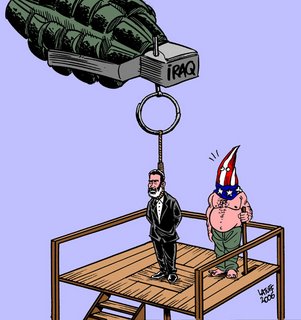
A day in the life of the average Iraqi has been reduced to identifying corpses, avoiding car bombs and attempting to keep track of which family members have been detained, which ones have been exiled and which ones have been abducted.
– riverbend, Baghdad Burning
Saddam Hussein didn’t have nearly enough body parts to compensate for the damage he did. Nor does George Bush.
It’s a pity, really, that George and Saddam will not have the opportunity to share what should be their just desserts: sharing a jail cell for the rest of their natural lives, with perhaps an opportunity for community service should either demonstrate he could be safely let out on the streets or display an aptitude for that kind of thing.
An eye for an eye makes the whole world blind.
– Mahatma Gandhi
‘Nuff said?
 Paul S. Graham