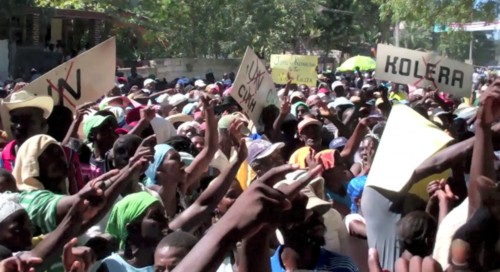
December 9, 2011: Angered by the UN-caused cholera epidemic that has claimed thousands, Haitians rallied at the UN Stabilization Mission in Haiti (MINUSTAH) Base at St. Marc. Photo: from a video produced by Nick Stratton, Bureau des Avocats Internationaux. Watch it at http://ijdh.org/archives/24340.
Two years after an earthquake killed 158,000, the majority of Haitians continue to battle against hunger, disease, homelessness and political repression. Half a million people remain in refugee camps and many thousands who have found other accommodations are living in buildings that have been designated as unsafe and requiring demolition or major repairs.
Clean water is unavailable to almost half the population and sanitation, in the form or latrines, is available to only 34%. It is a formula for disease, and the 2010 cholera outbreak, traced to the criminally negligent sewage disposal practices of UN troops, sickened nearly 500,000 people and killed more than 6,500 others.
With all of the aid money that has been pouring into Haiti, it would not be unreasonable to expect living conditions to be much better than they are. Journalist Kim Ives, a writer and editor of Haiti Liberté, who spoke on this topic last Thursday at the University of Manitoba, provided this summary:
$2.4 billion in bilateral relief aid (emergency aid) delivered to date
$4.5 billion was pledged for bilateral recovery in 2010, 2011 (plus $1 billion for debt relief). As of Dec, 2011, $2.4 billion of that was delivered.
Donors have dispersed an additional $560 million in recovery assistance.
An additional $3.1 billion for relief and recovery from NGOs and other private donors. (The largest share of that came from the Red Cross, which raised $1.4 billion; of that, only 50% has been spent. I wonder where the rest went?)
Cholera treatment funding of $172 million has been promised; $130 million has been disbursed.
Clearly something is wrong. Kim Ives summarized the obstacles to effective aid and reconstruction as follows:
A weak and under-funded national government, as a result of two centuries of foreign intervention and plunder
A large presence of international aid organizations and UN agencies, accountable, first and foremost, to their donors and home governments
A right-wing presidency brought to power through an exclusionary and fraudulent electoral process
A foreign police and military force (MINUSTAH) dating from the 2004 coup d’etat and whose purpose is to preserve the status quo
Gerry Caplan is a former CUSO field officer, author of The Betrayal of Africa, a weekly, online columnist for The Globe and Mail, a featured television political commentator and a veteran CCF-NDP war horse. He was also my boss at CUSO for a brief period in the late 70s, something he doesn’t remember – which may be all for the best :-).
Gerry was the keynote speaker at a dinner held in Winnipeg December 10, 2011 to mark the 50th anniversary of CUSO and the 63rd anniversary of the adoption of the Universal Declaration of Human Rights by the United Nations on Dec. 10, 1948.
The title of his talk was advertised as “When good people do bad things.” Fortunately for those present and for his reputation as a rabble rouser, the theme that emerged would be more appropriately described as “solidarity, not charity.”
This event was sponsored by the University of Winnipeg Global College, CUPE Manitoba, the Manitoba Council for International Co-operation and CUSO-VSO. It was held at the Union Centre in downtown Winnipeg. Here is my video report.
Friends of Canadian Broadcasting continues to raise the alarm over threats to our nation’s public broadcaster and well they should. While Heritage Minister James Moore promised in May to maintain and expand support for the CBC, Tory antipathy to the CBC is well known. Recent initiatives, such as the petition by Tory MP Rob Enders to end CBC funding cast doubt on the Tory pledge to support the CBC. (His surname says it all, eh?)
Because Harper is a notorious control freak, no Tory backbencher who wanted to keep getting nominated would post a petition of this sort without his blessing. This has to be taken seriously.
The Friends have taken a humorous approach in their current attempt to awaken Canadians to the Tory threat. I hope it works.
Under Harper’s majority government, we are beginning to see the unraveling of Canada.
Yesterday, they did something similar to western grain farmers when they effectively killed the Canadian Wheat Board without allowing grain producers their legally required right to a plebiscite on the question.
To complete the portrait of power drunk right wing ideologues, their response to falling crime rates is to build more prisons and jail more offenders for longer sentences in defiance of all the evidence that this approach has not worked anywhere it has been tried.
The next four years will be trying times for Canadians who do not want to see our society hideously disfigured. We will have to fight them every step of the way. Take a moment to see how you can begin this by supporting the Friends of Canadian Broadcasting.
The Attack on the Canadian Wheat Board: Seven Reasons Non-Farmers Should Care … and Act
Some of the 400 people who rallied in front of the CWB headquarters, Oct. 28, 2011. Photo: Paul S. Graham
On October 18th, Prime Minister Harper introduced legislation, Bill C-18, to dismantle the Canadian Wheat Board. The majority of farmers oppose the Prime Minister’s plan—farmers have repeatedly voted for a strong, effective CWB. Farmers are organizing and protesting. But to save our democratically controlled marketing agency, farm families need your help, and the help of the organizations with which you work.
The loss of the CWB will hurt every Canadian family. Here are seven reasons why non-farmer Canadian citizens should act to help protect the Wheat Board:
1. Privatization and Loss of Economic Control
Few sectors of the Canadian economy are 100% owned and controlled by Canadians. But one is: our multibillion-dollar western wheat and barley marketing system. If the Harper government destroys the CWB, it will turn over to transnational corporations (most of them foreign) a critical sector of our economy that is now owned and controlled by Canadian citizens. What C-18 takes away from farmers and other Canadians, it gives to grain giants such as Cargill.
2. Genetically Modified Food
In 2000, Monsanto moved to introduce genetically modified (GM) wheat. Farm organizations, environmental groups, and citizens’ organizations banded together to stop Monsanto and keep GM wheat out of Canadian fields and foods. United, we succeeded. The CWB was a crucial ally. Many people and organizations believe that had it not been for the work of the CWB, Canadians would now be eating food made from GM wheat. Lose the CWB and we may lose the fight to stop GM wheat.
3. Food Sovereignty
As an alternative to a globalized, long-distance, corporate-controlled food system, many Canadians are advocating Food Sovereignty, wherein farmers and all citizens collectively shape the food system we want for our families. The CWB is a good example of Food Sovereignty in action: a democratic agency controlled by food producers and citizens. By attacking the CWB, this government is pushing back hard against Food Sovereignty, serving notice that our future food system will be more far-flung, more corporate controlled. A government hostile to the CWB is hostile to Food Sovereignty.
4. National Sovereignty
Today, Canada has its own grain production, processing, handling, and transportation systems. Our Canadian Grain Commission sets and enforces quality standards—equal to the highest in the world. The Canadian Food Inspection Agency regulates new seed varieties, keeping harmful ones out and ensuring farmers have access to seeds that grow well in our climate.
Most of our grain flows “east-west”, hauled by Canadian National and Canadian Pacific railways and loaded onto ships at Canadian ports by Canadian workers. If we destroy the CWB, other parts of our Canadian grain system will be destroyed in turn. As the government empowers US-based grain transnationals, those corporations will chafe against Canadian regulations and push for the destruction of our Grain Commission, seed regulations, and the rest of our quality and regulatory systems. Destroying the CWB accelerates the Americanization of our grain and food systems.
Worse, the North American Free Trade Agreement (NAFTA), Chapter 11 gives US-based grain companies a veto over future attempts to rebuild our CWB. If we destroy it, we can’t get it back.
5. Your Economy
The CWB is the cornerstone of our Canadian wheat and barley marketing, handling, and transport systems. Those systems create jobs:
in Winnipeg where the CWB, the Grain Commission, the Canadian International Grains Institute, and other agencies are headquartered;
in Thunder Bay, Ontario; Churchill, Manitoba; Vancouver, B.C.; and Montreal, Quebec; where Canadian export grain is cleaned, blended, and loaded onto ships; and
across Canada as money is retained in this country and spent in rural and urban centres.
The CWB raises farmers’ revenues by $500+ million annually, money largely from foreign nations that is spent in urban and rural businesses across Canada. PriceWaterhouseCoopers calculated the CWB’s total benefit to the Canadian economy at more than $850 million annually. Without the CWB, citizens and communities across the nation will suffer financially.
6. Our Democracy
The vast majority of farmers want a strong, effective CWB. Farmers have reaffirmed that support in 10 votes—3 plebiscites and 7 sets of Directors Elections. Despite this, the Harper government is pushing forward to destroy the CWB. And it is doing so illegally.
Section 47.1 of the CWB Act requires that farmers must vote in favour of major changes to the CWB. The government is ignoring that law and refusing to hold a vote. Also, the government is ramming its legislation through parliament, using closure to limit debate, refusing to let the Agriculture Committee examine the bill, and instead setting up an ad hoc committee to review the bill, but limiting that committee to just 5 minutes per section. Prime Minister Harper has announced he will “walk over” the farmer majority that support the CWB, and he has called his drive to dismantle the CWB a “train barrelling down a Prairie track.” Our federal government is sneering at democracy, evading due process, and bending the law to the breaking point. If these antidemocratic tactics are not challenged, they will be repeated.
7. Farms and the Land
The CWB raises farmers’ prices and incomes. And the CWB provides equitable access to the market for all farmers, big or small. Losing the CWB will accelerate the loss of family farms. In so doing, it will concentrate farmland ownership in fewer and fewer hands. A blow to the CWB is a blow to family-farm agriculture, and the men and women who produce our food.
You can help protect our food supply, sovereignty, economy, and democracy
Time is short. We need to act fast. But action takes just 15 or 20 minutes. What is needed right now is for Canadians to write two short letters:
One to Prime Minister Harper, asking him to scrap Bill C-18, his destroy-the-CWB legislation, and to instead enact policies that foster Food Sovereignty and a strong Canadian nation and economy; and
One letter to Canadian Senators, asking them to resist pressure to fast-track Bill C-18, and to instead give careful and adequate consideration to this detailed and far-reaching legislation; to hold meetings of their Agriculture Committee; and to hear presentations from farmers, workers, businesspeople, and other Canadians who will be affected by this legislation.
Contact information for the Prime Minister
Hon. Stephen Harper
Prime Minister of Canada
80 Wellington Street
Ottawa, ON K1A 0A2
FAX: (613) 941-6900
Email: stephen.harper@parl.gc.ca
Contact information for Senators
Canadian Senators
c/o the Clerk of the Senate
Parliament Building
Ottawa, Ontario
I also think it would be worth it to contact your Member of Parliament. Here are some useful links and a video to round out your resource kit. Don’t delay.
Against the wishes of most western farmers, and in defiance of laws that they are sworn to uphold, Stephen Harper and his Conservatives are poised to destroy the Canadian Wheat Board. In truly Orwellian fashion, the Tories describe this as “democracy,” all the while invoking closure on Parliamentary debate and refusing to hold the farmers’ plebiscite that is required by federal law before any such major change can be made to the status of the CWB.
The CWB has been a bone of contention in farm policy circles for decades. While a loud minority of western grain producers have been clamoring for an end to the CWB monopoly on wheat and barley exports, most farmers continue to support the Board, as evidenced by several CWB Board of Directors election results and a recent CWB-sponsored plebiscite. The reason for the Board’s enduring support is that it works for farmers, as opposed to private grain companies who exist to maximize profits for their shareholders.
Urban Canadians have yet to wake up to this issue, though this is starting to happen. The Council of Canadians is prominent in the coalition of organizations leading the fightback. What we city slickers need to get our heads around is that this is, first and foremost, a battle for democracy. It is a struggle against growing corporate control of our food and the relentless corporatization of agriculture that is destroying rural communities.
One one level, the issues are complex. You can get a crash course by watching the video I produced along with my WCTV colleague Ken Harasym. Follow that up with visits to the web sites listed below and you will be well on your way.
On another level, it is very simple: like us, farmers are part of the 99%. We gotta stick together. Occupy that, Stephen Harper!
Cholera kills. Since the UN brought the disease to Haiti last year, 6,000 have died. Because this disease thrives in countries that lack potable water and sewage treatment infrastructure, it is unlikely to be eradicated soon in that country.
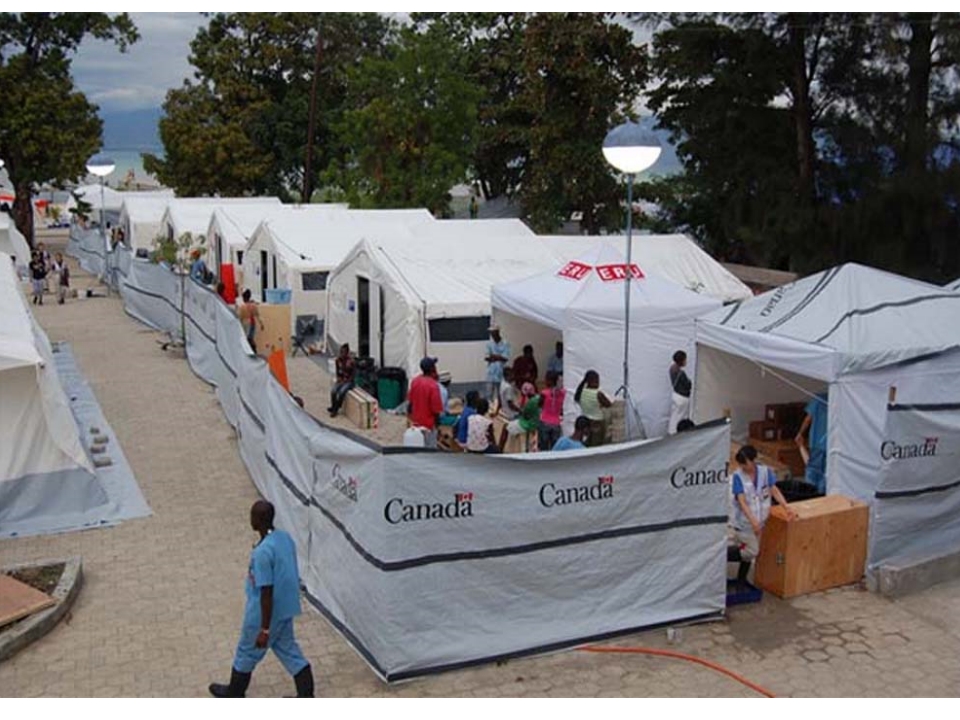
Cholera treatment facilities are likely to be an ongoing need in Haiti for some time to come. According to researchers at Harvard and University of California (San Francisco), the number of infections could rise to 779,000 this year. Sensibly, the Canadian Red Cross (CRC) did its part last November by setting up an 80-bed cholera treatment camp in Carrefour, and staffing it with 14 Canadian health and technical professionals, as well as local medical personnel.
However, with much fanfare, the Canadian Red Cross announced, in April 2011, that it was turning the operation over to the Haitian Red Cross. According to the CRC, cholera incidences had been reduced significantly. In the breathless, feel-good prose favoured by propagandists everywhere:
“That’s the real strength of the Red Cross,” explains Dave Batement, head of the Canadian Red Cross cholera treatment centre team. “We are training personnel from the Haitian Red Cross and giving them the tools they need to take over when we leave.”
Would that it were so . . .
In June, 2011, the Canada Haiti Action Network dispatched a small team to Haiti to gather information, gauge progress and learn how Canadians might express their solidarity. One of their objectives was to visit the cholera treatment camp in Carrefour.
This is what they went looking for.
This is what they found.
According to CHAN coordinator Roger Annis, the CRC didn’t transfer the centre; it closed it. “We met with Haitians there who told us the story,” says Annis, who added that the story was confirmed by staff at a nearby cholera treatment camp operated by Médecins Sans Frontières (MSF), who also told him of the increase in cholera cases after the CRC closed its camp.
Upon returning to Canada, Annis contacted the CRC for an explanation. Unwilling to be swayed by a few facts, the CRC spokesperson insisted that the camp was operating. Sigh . . . (insert your favourite expletives here).
Annis, and fellow delegation member Sandra Gessler, of the Winnipeg Haiti Solidarity Group, reported on their trip on September 26, 2011, in Winnipeg. As is my habit, I packed my video camera.
On August 3, 2011 – four days after being viciously assaulted in his Winnipeg apartment, Harvey Sanderson Junior died of his injuries. He was 27.
What made this crime especially shocking was that Harvey had brittle bone disease, a condition that confined him to a wheelchair.
Friends, neighbours and people who had never met him were saddened and horrified by Harvey’s murder.
And so, on August 12, they joined together with the Manitoba League of Persons with Disabilities to express their grief and their solidarity at a vigil for Harvey and all other persons with disabilities who are victims of violence.
The story does not end here. Within hours of Sanderson’s unconscious body being transported to the hospital, Winnipeg City Police arrested two suspects, Bobbi Melissa McKay and John Raven Ward, both 27, and charged them with aggravated assault and robbery. Following Sanderson’s death, police announced they were considering upgrading these charges.
The way in which a police spokesperson expressed this has raised red flags for local activists:
“Given the nature of the condition of the victim in this case, it’s something that has be looked at very carefully in consultation with the Crown’s office,” said Const. Rob Carver, spokesman for the Winnipeg Police Service.
The concern is that the Crown will prosecute McKay and Ward for aggravated assault, rather than murder, because of a misguided belief that Sanderson’s disability, rather than his beating, was the cause of his death. As Bonnie Bieganski said at the vigil:
“He was a healthy male with a disability. Yes, he had brittle bone disease but that disease does not require emergency brain surgery, the use of life support to sustain him nor induce a comatose state. Sanderson would be alive today if he had not been brutally beaten. The fact that the Crown will only upgrade the charges if it can be proven that it was the assault that killed Sanderson is an outrage.”
That Sanderson’s killing might be treated differently because of his disability is not an isolated or unrealistic concern. As we heard from several speakers at Harvey Sanderson’s vigil, vigilance is called for.
Today, Winnipeg activists responded to the actions of the Greek government to block the Tahrir and other vessels that make up Freedom Flotilla II from sailing for Gaza with an information picket in the city’s Osborne Village neighbourhood.
The Tahrir is the Canadian vessel in the Flotilla. As with all of the other boats and crews, the Tahrir is committed to peace and nonviolence. Its mission is to deliver humanitarian aid to the suffering people of Gaza and to pressure the Israeli government to end its illegal and oppressive blockade of Gaza.
Get informed and take action. These folks can provide both information and opportunities for action.
On June 3, 2011, when Brigette DePape, a 21-year old parliamentary page from Manitoba, pulled out a “Stop Harper” sign during the opening session of Canada’s 41st Parliament, she was escorted out of the room and quickly fired from her position.
Her solitary act of civil disobedience in resistance to the policies of the Harper government not only inspired an outpouring of support, but also called to mind another Manitoba woman, Nellie McClung. In 1912, McClung helped organize the Political Equality League and throughout the 1920s championed female suffrage and a host of measures to combat the social injustices of her time.
On June 18, 2011, a few of us took a trip over to the Manitoba Legislature to express our solidarity with Brigette DePape by bringing her message to the Nellie McClung Memorial located on the grounds of the same Legislature where Nellie won, for Canadian women, the right to vote.
Winnipeggers rallied in support of locked-out CUPW members in Winnipeg June 16, 2011. Photo: Paul S. Graham
This, just in, from Derek Blackadder at LabourStart. While it is addressed to trade unionists it should resonate with anyone who believes in democracy. The Conservative government’s decision to impose back-to-work legislation strikes at the heart of democracy; it is a form of forced labour, something expressly forbidden by the International Labour Organization of which Canada is a member.
If you think the Tories will stop with postal workers, think again. We must stop Harper here.
Please support the LabourStart campaign and tell Lisa Rait and Stephen Harper what they can do with their back-to-work legislation.
As trade unionists we understand that the right to free collective bargaining without interference from the state is fundamental to what we do.
When the state interferes on behalf of an employer our rights as workers are at stake.
‘Our’ newly-elected Conservative majority government is using the Post Office lockout as the first salvo in its war on trade unions in this country.
The legislation not only forces an end to free collective bargaining, it imposes wages that are less than those Canada Post had tabled.
It is virtually unprecedented for back-to-work legislation in Canada to impose terms and conditions of employment. (You can read the bill in PDF form here.)
Our CUPW e-campaign is within sight of the 10,000 messages mark.
The Minister of Labour is saying that she has thousands of messages demanding legislation to end the strike and to impose new conditions of employment on post office workers.
Help give the union the ability to say ‘we have tens of thousands of messages demanding free collective bargaining’.
Help build not only CUPW’s fightback, but the 4 year long fightback that has just started.
Join this campaign here and pass this link along to ALL your contacts!






 Paul S. Graham