Archive for the ‘Human Rights’ Category


On July 9, 2005 , Palestinian civil society put out the call for an international campaign of boycott, divestment and sanctions to compel the Israeli state to follow international law. Specifically, the signatories called on Israel to:

  1. End its occupation and colonization of all Arab lands occupied in June 1967 and dismantle the Wall;
  2. Recognize the fundamental rights of the Arab-Palestinian citizens of Israel to full equality; and
  3. Respect, protect and promote the rights of Palestinian refugees to return to their homes and properties as stipulated in UN Resolution 194.

The BDS campaign has been taken up by human rights activists around the world and there is some evidence that it is having an impact. For example, last month the Norwegian retail chain, VITA, announced it would stop all sales of products originating from settlements in occupied Palestine, including Ahava cosmetics. Also, last month, graduate students at Carleton University overwhelmingly voted in a referendum to call upon the university’s pension fund to divest from four companies that are complicit in the occupation of Palestine. The BDS campaign is being credited with the decision of the West London Waste Authority to exclude French multinational Veolia from a £485 million contract. Veolia helped build and is involved in operating a tram-line which links Jerusalem with illegal Israeli settlements in the Palestinian West Bank; it also takes waste from Israel and illegal  Israeli Settlements and dumps this on Palestinian land at the Tovlan landfill.

One measure of its effectiveness may be the passage of a law in the Israeli Knesset last year that facilitates attacks on supporters of BDS.  After all, if BDS were ineffective, there would be no reason to pass a law against it. According to the Jerusalem Post, the law “allows citizens to bring civil suits against persons and organizations that call for economic, cultural or academic boycotts against Israel, Israeli institutions or regions under Israeli control. It also prevents the government from doing business with companies that initiate or comply with such boycotts.”

“Can boycott, divestment and sanctions stop Israeli apartheid?” was the title of a forum held March 7, 2012 as part of Israeli Apartheid Week 2012 in Winnipeg. Featured speakers were Dalit Baum and Mostafa Henaway. Baum is an Israeli activist and co-founder of WhoProfits.org, a website that exposes corporate complicity in Israel’s subjugation of Palestinians. Henaway is a human rights activist who works with Tadamon! Montreal. Moderated by Lisa Stepnuk, the forum was sponsored by Students Against Israeli Apartheid and the Winnipeg Coalition Against Israeli Apartheid. As usual, I was there for Winnipeg Community TV to record the discussion.


Campaign to divest the Canada Pension Plan from complicity in Israeli Apartheid

The Ottawa-based Coalition to Oppose the Arms Trade has produced an invaluable resource that forms the first step in a campaign to compel the Canada Pension Plan to divest from companies that support Israeli apartheid. According to COAT’s co-ordinator, Richard Sanders,

“COAT’s research cites data from hundreds of sources to expose 64 corporations that have two things in common:

(1) they profit from links to Israeli government institutions, agencies and corporations that hide behind the euphemisms of “defence” and “homeland security,” and

(2) the Canada Pension Plan (CPP) held shares in these companies, with a market value of $1.4 billion in 2011.

You can learn more here.
As a part of Israeli Apartheid Week 2012 in Winnipeg, Paul Burrows and Cheryl-Anne Carr discussed the impact of colonialism on the indigenous peoples of Canada and Palestine. The similarities are disturbing and striking.

The event was sponsored by:

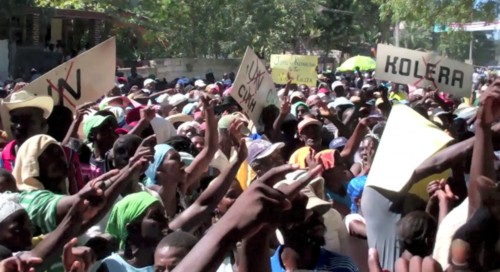
Decem­ber 9, 2011: Angered by the UN-caused cholera epidemic that has claimed thousands, Haitians rallied at the UN Sta­bi­liza­tion Mis­sion in Haiti (MINUSTAH) Base at St. Marc. Photo: from a video produced by Nick Strat­ton, Bureau des Avo­cats Inter­na­tionaux. Watch it at http://ijdh.org/archives/24340.

Two years after an earthquake killed 158,000, the majority of Haitians continue to battle against hunger, disease, homelessness and political repression. Half a million people remain in refugee camps and many thousands who have found other accommodations are living in buildings that have been designated as unsafe and requiring demolition or major repairs.

Clean water is unavailable to almost half the population and sanitation, in the form or latrines, is available to only 34%. It is a formula for disease, and the 2010 cholera outbreak, traced to the criminally negligent sewage disposal practices of UN troops, sick­ened nearly 500,000 peo­ple and killed more than 6,500 oth­ers.

With all of the aid money that has been pouring into Haiti, it would not be unreasonable to expect living conditions to be much better than they are. Journalist Kim Ives, a writer and editor of Haiti Liberté, who spoke on this topic last Thursday at the University of Manitoba, provided this summary:

  • $2.4 billion in bilateral relief aid (emergency aid) delivered to date
  • $4.5 billion was pledged for bilateral recovery in 2010, 2011 (plus $1 billion for debt relief). As of Dec, 2011, $2.4 billion of that was delivered.
  • Donors have dispersed an additional $560 million in recovery assistance.
  • An additional $3.1 billion for relief and recovery from NGOs and other private donors. (The largest share of that came from the Red Cross, which raised $1.4 billion; of that, only 50% has been spent. I wonder where the rest went?)
  • Cholera treatment funding of $172 million has been promised; $130 million has been disbursed.

Clearly something is wrong. Kim Ives summarized the obstacles to effective aid and reconstruction as follows:

  • A weak and under-funded national government,  as a result of two centuries of foreign intervention and plunder
  • A large presence of international aid organizations and UN agencies,  accountable, first and foremost, to their donors and home governments
  • A right-wing presidency brought to power through an exclusionary and fraudulent electoral process
  • A foreign police and military force (MINUSTAH) dating from the 2004 coup d’etat and whose purpose is to preserve the status quo

If you want to know more, watch my video report.


Resources

Canada Haiti Action Network
Winnipeg Haiti Solidarity Group
Institute for Justice and Democracy in Haiti
Haiti Liberté

Gerry Caplan is a former CUSO field officer, author of The Betrayal of Africa, a weekly, online columnist for The Globe and Mail, a featured television political commentator and a veteran CCF-NDP war horse. He was also my boss at CUSO for a brief period in the late 70s, something he doesn’t remember – which may be all for the best :-).

Gerry was the keynote speaker at a dinner held in Winnipeg December 10, 2011 to mark the 50th anniversary of CUSO and the 63rd anniversary of the adoption of the Universal Declaration of Human Rights by the United Nations on Dec. 10, 1948.

The title of his talk was advertised as “When good people do bad things.” Fortunately for those present and for his reputation as a rabble rouser, the theme that emerged would be more appropriately described as “solidarity, not charity.”

This event was sponsored by the University of Winnipeg Global College, CUPE Manitoba, the Manitoba Council for International Co-operation and CUSO-VSO. It was held at the Union Centre in downtown Winnipeg. Here is my video report.

An open letter to Canada’s Prime Minister, Members of Parliament, and Senators, from a broad and diverse coalition of 46 organizations representing millions of Canadians –

Support Canadian Food, Canadian Farmers, and the Canadian Wheat Board

Bill C-18, if passed, will destroy the Canadian Wheat Board (CWB).  Agriculture Minister Gerry Ritz has repeatedly stated that he will not recognize the plebiscite recently conducted by the CWB, in which results were clearly in favour of keeping the CWB as the sole marketing agent for prairie wheat and barley intended for human consumption.

The CWB was created by an Act of Parliament, and is run by a 15-member Board of Directors, ten of whom are elected by farmers.  The Wheat Board provides fair, equitable, reliable, and cost-effective services to farm families.  It provides stability in uncertain times, and is a foundation of Canada’s grain sector.

Ending the single desk authority of the CWB would throw western agriculture into turmoil and would transfer wealth created by Canadian farmers to big, private, often foreign-owned grain companies—money now returned to farmers, who spend it in their communities.  The Minneapolis Grain Exchange has already changed its rules to allow for speculation in futures contracts for Canadian wheat and barley—a move which will increase price volatility for purchasers without providing any benefit to farmers.

Canada’s political system is built on representative democracy.  This means that the law, not merely the person in power, is to be respected and followed.  The CWB Act is a law made by Parliament, and it requires a farmer vote before any substantive changes are made to the single desk authority.  Our current government is ignoring this law—refusing to hold the required vote—and moving to eliminate the requirement for a vote.  This is deeply concerning, as it strikes at the heart of our Canadian democracy.

We the undersigned:

  • Recognize the billions of dollars of economic value that the CWB creates each year—for farmers, rural communities, short line railroads, and the whole of Canada—as a result of its superior marketing ability, capacity to defend Canadian interests in trade disputes, and commitment to return to farmers all net proceeds from sales.
  • Are proud of the strong international reputation for quality and reliability that Canadian wheat and barley have earned—a direct result of the CWB and its companion institutions, the Canadian Grain Commission and Canadian International Grains Institute.
  • Deplore the government’s disregard for the outcome of the recent plebiscite in which 62% of farmers voted in favour of keeping the single desk for wheat and 51% supported keeping the single desk for barley.

We therefore call upon the Prime Ministers, MPs, and Senators to immediately stop undermining the single desk authority of the CWB.  We further insist that Parliament must comply with the Canadian Wheat Board Act, Section 47.1, which requires a binding plebiscite (vote) of farmers before any substantive change to the CWB’s single desk authority is initiated.

Signed:

  • Agriculture Workers Alliance
  • Bathurst Street United Church, Toronto
  • Big Carrot Natural Food Market
  • Biofreedom
  • Brandon University Students’ Union
  • Briarpatch Magazine
  • Canadian Auto Workers (CAW)
  • Canadian Labour Congress
  • Canadian Union of Postal Workers (CUPW)
  • Canadian Union of Public Employees (CUPE)
  • Canadian Wheat Board Alliance
  • CCNB Action (Conservation Council of New Brunswick)
  • Centre for Social Justice
  • Coalition On The Niagara Escarpment
  • Council of Canadians
  • Council of Canadians – Moose Jaw, Sask. Chapter
  • Council of Canadians – Prince Albert, Sask. Chapter
  • Council of Canadians – Winnipeg, Man. Chapter
  • CWA/SCA (Communications Workers Union) Canada
  • Food Action Committee of the Ecology Action Centre
  • Food Secure Canada
  • Friends of the Canadian Wheat Board
  • GE Watch Comox Valley
  • GRAIN
  • Grain Services Union (GSU)
  • Greenpeace Canada
  • Growing Food Security in Alberta
  • Health Sciences Association of Alberta
  • Inter Pares
  • International Brotherhood of Electrical Workers (IBEW) Local 529
  • Lardeau Valley Seed Savers
  • Les AmiEs de la Terre de Québec
  • LIFT (Low Income Families Together)
  • National Farmers Union
  • National Union of Public and General Employees (NUPGE)
  • New Brunswick Common Front for Social Justice
  • Ontario Public Interest Research Group (OPIRG) – Windsor
  • Organic Food Council of Manitoba (OFCM)
  • Oxfam Canada
  • Saskatchewan Federation of Labour (SFL)
  • Saskatchewan Union of Nurses (SUN)
  • Society for a GE Free BC
  • The Ark Farm, B&B, Vegetables, & Native Plants
  • Union paysanne
  • United Church of Canada
  • United Food and Commercial Workers (UFCW)

Stop the steamroller

Make your voice heard by sending a message to the PM and your MP at Stop the Steamroller.

Occupy Winnipeg took its opposition to Bill C-10, the so-called Safe Streets and Communities Act, to Winnipeg’s West End Library and then proceeded to occupy the constituency office of Manitoba’s Justice Minister, Andrew Swan for 24 hours.

Before doing so, an Occupy Winnipeg spokesperson read the November 17, 2011 statement of the Canadian Bar Association entitled “Ten Reasons to Oppose Bill C-10.” My alter ego, Red River Pete, captured some of the moments.

The Canadian Bar Association statement is available at its web site. Or you can read it below.


November 17, 2011

10 Reasons to Oppose Bill C-10

Bill C-10 is titled the Safe Streets and Communities Act — an ironic name, considering that Canada already has some of the safest streets and communities in the world and a declining crime rate. This bill will do nothing to improve that state of affairs, but, through its overreach and overreaction to imaginary problems, Bill C-10 could easily make it worse. It could eventually create the very problems it’s supposed to solve.

Bill C-10 will require new prisons; mandate incarceration for minor, non-violent offences; justify poor treatment of inmates and make their reintegration into society more difficult. Texas and California, among other jurisdictions, have already started down this road before changing course, realizing it cost too much and made their justice system worse. Canada is poised to repeat their mistake.

The Canadian Bar Association, representing over 37,000 lawyers across the country, has identified 10 reasons why the passage of Bill C-10 will be a mistake and a setback for Canada.

1. Ignoring reality. Decades of research and experience have shown what actually reduces crime: (a) addressing child poverty, (b) providing services for the mentally ill and those afflicted with FASD, (c) diverting young offenders from the adult justice system, and (d) rehabilitating prisoners, and helping them to reintegrate into society. Bill C-10 ignores these proven facts.

2. Rush job. Instead of receiving a thorough review, Bill C-10 is being rushed through Parliament purely to meet the “100-day passage” promise from the last election. Expert witnesses attempting to comment on over 150 pages of legislation in committee hearings are cut off mid-sentence after just five minutes.

3. Spin triumphs over substance.
The federal government has chosen to take a “marketing” approach to Bill C-10, rather than explaining the facts to Canadians. This campaign misrepresents the bill’s actual content and ensures that its public support is based heavily on inaccuracies.

4. No proper inspection. Contrary to government claims, some parts of Bill C-10 have received no previous study by Parliamentary committee. Other sections have been studied before and were changed — but, in Bill C-10, they’re back in their original form.

5. Wasted youth. More young Canadians will spend months in custodial centres before trial, thanks to Bill C-10. Experience has shown that at-risk youth learn or reinforce criminal behaviour in custodial centres; only when diverted to community options are they more likely to be reformed.

6. Punishments eclipse the crime. The slogan for one proposal was Ending House Arrest for Serious and Violent Criminals Act, but Bill C-10 will actually also eliminate conditional sentences for minor and property offenders and instead send those people to jail. Is roughly $100,000 per year to incarcerate someone unnecessarily a good use of taxpayers’ money?

7. Training predators. Bill C-10 would force judges to incarcerate people whose offences and circumstances clearly do not warrant time in custody. Prison officials will have more latitude to disregard prisoners’ human rights, bypassing the least restrictive means to discipline and control inmates. Almost every inmate will re-enter society someday. Do we want them to come out as neighbours, or as predators hardened by their prison experience?

8. Justice system overload. Longer and harsher sentences will increase the strains on a justice system already at the breaking point. Courts and Crown prosecutors’ offices are overwhelmed as is, legal aid plans are at the breaking point, and police forces don’t have the resources to do their jobs properly. Bill C-10 addresses none of these problems and will make them much worse.

9. Victimizing the most vulnerable. With mandatory minimums replacing conditional sentences, people in remote, rural and northern communities will be shipped far from their families to serve time. Canada’s Aboriginal people already represent up to 80% of inmates in institutions in the prairies, a national embarrassment that Bill C-10 will make worse.

10. How much money? With no reliable price tag for its recommendations, there is no way to responsibly decide the bill’s financial implications. What will Canadians sacrifice to pay for these initiatives? Will they be worth the cost?

Canadians deserve accurate information about Bill C-10, its costs and its effects. This bill will change our country’s entire approach to crime at every stage of the justice system. It represents a huge step backwards; rather than prioritizing public safety, it emphasizes retribution above all else. It’s an approach that will make us less safe, less secure, and ultimately, less Canadian.

© 2011 The Canadian Bar Association

Despite its well established habit of electing social democratic governments, Winnipeg has claimed some dubious honors — “Murder Capital of Canada” and “Child Poverty Capital of Canada” to name two of the most disturbing. Even though we have had 11 years of NDP government to undo the damage of Gary Filmon’s Conservatives, both poverty and crime are well entrenched in Manitoba, especially in Winnipeg.

According to the 2011 Child and Family Poverty Report Card, issued by the Social Planning Council of Winnipeg:

  • 92,650 children in Manitoba live in families under the poverty threshold
  • 29,000 children in Manitoba live in families with annual incomes insufficient for meeting basic needs
  • 29,563 Manitoban children use food banks each month because their families cannot afford to purchase the necessary food they require
  • 59,734 Manitobans accessed Employment and Income Assistance
  • The richest 20% of Manitoban families have more total income than the poorest 60% of the population

The Council says these statistics have not changed significantly since 1989, the year the House of Commons pledged to end child poverty in Canada by the year 2000.

What is to be done? According to the Manitoba Green Party, 80 per cent of all expenditures on social assistance programs are consumed by government bureaucracy. They proposed, in the last provincial election, to replace welfare benefits with a Universal Basic Income benefit, payable to all Manitobans, that would ensure no one slipped below the poverty line. The idea has merit and I hope the Greens continue to explain and promote it.

Yet another group of Manitobans proposes a package of measures they call a “Justice Charter to End Poverty in Manitoba.” I’ve included it at the end of this piece.

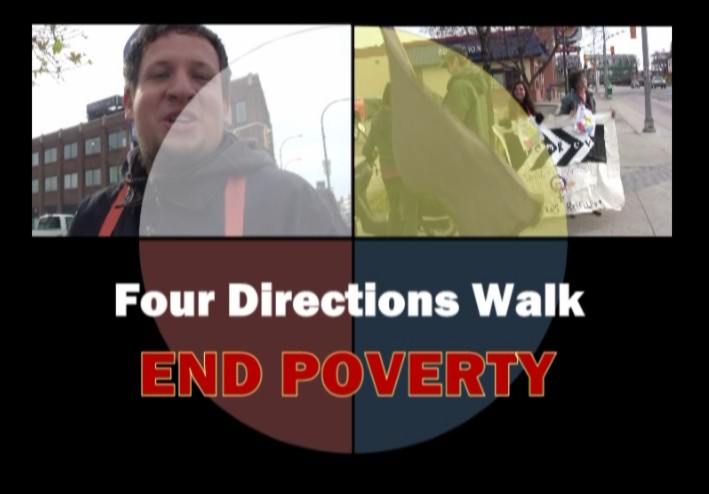
They also hold an annual event called the Four Directions Walk to End Poverty in which four contingents begin their walk on the outskirts of town and converge on the Manitoba Legislature. They held their fourth such walk on Saturday, Oct. 22. Naturally, I brought my video camera.


Justice Charter to End Poverty in Manitoba

We the people of Manitoba, seeing the growing gap between the wealthy and people in need, the working poor, and discriminated groups want to act in a timely manner to reverse the situation, to provide for people with needs and support the right for everyone to contribute to society to the best of their ability. To this end we make these demands and will work to make them a reality:

Housing must be a right and a comfort, not a constant crisis!

  • End subsidies to private landlords.
  • Establish stricter rent controls.
  • Enact a Tenant Bill of Rights.
  • Build and maintain public housing to the standard building code.
  • No utility cut-offs; establish a panel with legal power to require landlords to pay.

Universal health care for all, for every need!

  • Expand medicare into a comprehensive health care system focusing on prevention.
  • Extend medicare to cover all essential needs such as eye, drug, dental, ambulance and prosthetics.
  • Reduce pollution from mining and manufacturing, especially next to low income neighborhoods.


Jobs are a human right. Create good-paying jobs for all!

  • Create jobs through a massive investment in public housing, a public child care program, and conversion to a “green” economy.
  • Increase the minimum wage to $14 an hour.
  • Quality job creation by ensuring access to education, ending tuition fees, free student housing, education in Aboriginal and any other language where numbers warrant.
  • Access to better jobs – reduce the work week with no loss in pay, add paid vacation days and reduce the pension age for women to age 60.
  • End the Foreign Temporary Worker program, give these workers full labour rights and make them immigrants to Canada, if they so choose.

Provide for those in need!

  • Introduce a Guaranteed Liveable Income, above the poverty line and indexed to inflation.
  • Improve special needs benefits and introduce a fast appeals process with free advocacy services.
  • A public, high quality, free child care program employing well-paid early childhood development professionals.
  • Establish a hot breakfast program for children in schools.
  • For injured workers, establish a fast and free appeals process independent of the Workers Compensation Board. Provide free legal services and always respect the right to appeal.
  • Establish a Manitoba pension credit plan funded by payroll deductions, a surtax on corporate income to top up pensions above the poverty line and an inheritance wealth tax.
  • Establish a federally-chartered, publicly-owned bank that does not discriminate against people in poverty, is located in low-income areas, and provides free or nonprofit cheque cashing services and international fund transmittals.
  • Establish a province-wide, free and publicly-owned handi-transit service for people with disabilities.
  • Establish price controls for essential foods throughout Manitoba.

End racism, sexism and discrimination of all forms!

  • Support immediate settlement of Aboriginal land claims and emergency action to end housing, health care and education inequality.
  • Take steps to recognize Aboriginal nations on a new basis in Canada, including full national rights and equal nation to nation relations.
  • Introduce immediately affirmative action hiring with mandatory quotas for Aboriginal people, people of colour, women and people with disabilities in both the public and private sector.
  • Job pay equity for all workplaces.
  • Replace the present legal system of retribution and punishment with principles of restorative justice – restitution and reconciliation; include “ability to pay” as a consideration for sentencing people to jail for nonpayment of fines.
  • Ban discrimination based on social or mental health conditions in the Human Rights Code.
  • Introduce a Manitoba Bill of Rights based on the Universal Declaration of Human Rights (1948), adding protections against all forms of sexism.

Reform the democratic system

  • Establish proportional representation so that people will vote for what they want and so that every person’s vote will count.
  • Pay Legislators the average worker’s wage and benefits in Manitoba.

The Justice Charter is for discussion by all Manitobans. The annual Four Directions Walk is Winnipeg’s largest annual anti-poverty activity. It is organized to encourage discussion of the ideas in this Charter. We invite groups representing Aboriginal peoples, women, workers, youth and students, people of colour, people with disabilities, injured workers, the working poor, people living in poverty, people of all faiths and nonbelievers – all supportive groups:

  • To establish a Four Directions Walk in other Manitoba communities.
  • To discuss the Charter and send us your ideas.

Contact us if you would like to receive information on the annual Walk, held on a Saturday close to the International Day for the Eradication of Poverty (October 17).

Four Directions Walk Committee
Email: fourdirectionswalk@changetheworldmb.ca
Phone (204) 792-3371.

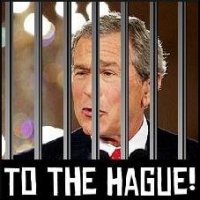
On Thursday, George W. Bush and former U.S. president Bill Clinton (himself an accomplished war criminal) will be attending the Surrey Regional Economic Summit at the Sheraton Vancouver Guildford Hotel. Here’s some information from the Canadian Peace Alliance on what you can do to support Bush’s arrest for war crimes.


» Report George W. Bush as a person likely to try to enter Canada contrary to section 35 of the Immigration and Refugee Protection Act.

The Canadian Border Service Agency runs a Border Watch Toll-free line. Their website advertises:
“If you have information about suspicious cross-border activity, please contact the Canada Border Services Agency Border Watch Toll-free Line at 1-888-502-9060.”

George Walker Bush, born July 6, 1945 is likely to try to cross the border into Canada on or about October 18 to 20th 2011 to attend an event in Surrey British Columbia.  Mr. Bush has admitted to authorizing and approving the widespread use of torture by the U.S. Armed Forces and the CIA.  There are reasonable grounds to believe that George W. Bush, as the President of the United States of America and Commander in Chief of the U.S. Armed Forces between 2001 and 2009, counselled, aided and abetted the commission of torture and other war crimes and crimes against humanity in Iraq, Afghanistan and other locations. Experts estimate that in Iraq alone, over a million innocent men, women and children have died as a consequence of the illegal U.S.-led war on Iraq authorized and directed by George W. Bush.

N.B. the website indicates that CBSA has discretion to provide a reward for information.
http://www.cbsa-asfc.gc.ca/security-securite/bwl-lsf-eng.html

For more information about the case to charge Bush as a war criminal please see: Lawyers Against the War

» October 20: Peaceful Rally to Protest George W Bush’s Surrey Visit

Thursday, October 20, 11:00 am
Join at the parking lot outside the Bay, Guildford Mall, SW corner of 152 St. & 104 Ave.
For info on this rally, please email stopwar@resist.ca
http://stopwarca.wordpress.com/

» Sign the Online petition to arrest George Bush:
www.amnesty.ca

»Torture victims plan to file charges when Bush enters Canada
www.stopwar.wordpress.com

» Lawyers press for Bush arrest, as #Occupy activists set to converge in Surrey
Vancouver Observer


You can follow the events on twitter: @StopWarCa and #OccupySurrey #ArrestBush

Sept. 30, 2011 - Award-winning Israeli journalist Amira Hass speaking at the University of Winnipeg on the need to end the Israeli occupation of Palestinian territories. Photo: Paul S. Graham

“Inhuman, immoral and unsustainable” are the words used by Amira Hass to describe what she terms “the State of Israel and the privileges it endows to Jews only, at the expense of Palestinians.”

Hass was at the University of Winnipeg Sept. 30, to provide a unique perspective on the Palestinian struggle, that of an Israeli Jew, a woman and a journalist for Haaretz, who has lived and worked in either Gaza or the West Bank for the past 17 years.

Hass was forceful in her denunciation of the conditions under which Palestinians live and uncompromising about the need to end the occupation and restore the rights of Palestinians in Israel and the occupied territories. What especially caught my attention, however, was her diplomatic yet unmistakable suggestion that activists outside of Israel take stock of their own societies and refrain from applying a double standard toward Israel.

“I’m fully aware that I’m speaking here mostly to the privileged. You are also a settler society that owes a large part of its affluence and comfortable life to the disenfranchisement of native peoples,” Hass said early in her presentation. She continued, “I also know that many who are engaged in the struggle for justice for Palestine are aware of it and probably some of you are part of the struggle to undo some of the damage that your communities, that your society, has inflicted on the First Nations.”

Hass returned briefly to this theme late in her presentation. While she expressed profound regret that she and other Israeli activists had not succeeded in convincing fellow citizens to end the suppression of Palestinians, she advised activists to get a sense of proportion.

“I would call for some sort of proportion. The calls about Israeli illegitimacy – I understand them – but I also want to understand why Israel is more illegitimate as a settler society – why is it more illegitimate than Canada. . . . let’s not treat Israel as the only evil in the world.”

If you look at the map Hass used in her presentation (click for a larger view) it would seem that the Israelis have borrowed the Canadian playbook – force the aboriginal peoples onto isolated parcels of land, compel them to live in poverty and control every aspect of their existence until they lose the will to resist. The main difference in this regard is that we’ve been doing this to “our” native peoples for a much longer time.

My take-away from Amira Hass’s presentation: stand up for Palestinian rights, but remember your responsibility for stand up for aboriginal rights in Canada.

Please share this video widely, especially with those who have imbibed deeply at the well of Israeli propaganda. For them, it could be an eye-opener.

On August 3, 2011 – four days after being viciously assaulted in his Winnipeg apartment, Harvey Sanderson Junior died of his injuries. He was 27.

What made this crime especially shocking was that Harvey had brittle bone disease, a condition that confined him to a wheelchair.

Friends, neighbours and people who had never met him were saddened and horrified by Harvey’s murder.

And so, on August 12, they joined together with the Manitoba League of Persons with Disabilities to express their grief and their solidarity at a vigil for Harvey and all other persons with disabilities who are victims of violence.

The story does not end here. Within hours of Sanderson’s unconscious body being transported to the hospital, Winnipeg City Police arrested two suspects, Bobbi Melissa McKay and John Raven Ward, both 27, and charged them with aggravated assault and robbery. Following Sanderson’s death, police announced they were considering upgrading these charges.

The way in which a police spokesperson expressed this has raised red flags for local activists:

“Given the nature of the condition of the victim in this case, it’s something that has be looked at very carefully in consultation with the Crown’s office,” said Const. Rob Carver, spokesman for the Winnipeg Police Service.

The concern is that the Crown will prosecute McKay and Ward for aggravated assault, rather than murder, because of a misguided belief that Sanderson’s disability, rather than his beating, was the cause of his death. As Bonnie Bieganski said at the vigil:

“He was a healthy male with a disability. Yes, he had brittle bone disease but that disease does not require emergency brain surgery, the use of life support to sustain him nor induce a comatose state. Sanderson would be alive today if he had not been brutally beaten. The fact that the Crown will only upgrade the charges if it can be proven that it was the assault that killed Sanderson is an outrage.”

That Sanderson’s killing might be treated differently because of his disability is not an isolated or unrealistic concern. As we heard from several speakers at Harvey Sanderson’s vigil, vigilance is called for.