Miguel Enríquez was a physician and a founder of the Chilean Movimiento de Izquierda Revolucionaria – MIR (Movement of the Revolutionary Left). He was General Secretary of the MIR between 1967 and his death, on October 5, 1974, in a gunfight with agents of Chile’s secret police, the Dirección de Inteligencia Nacional, a Gestapo-like tool of the Pinochet dictatorship that tortured and murdered opponents of that vicious regime with impunity.
On October 5, 2024, members of Winnipeg’s Chilean-Canadian community celebrated his life and work. A half-century has passed, but the hopes and dreams for a better world live on. As Canadian singer-songwriter Nancy White sang about Víctor Jara, another famous Chilean murdered by Pinochet’s thugs, “they killed the man but they couldn’t kill the song!”
Professor Michael Lynk, who teaches law at the University of Western Ontario, served as the United Nations “Special Rapporteur for the human rights situation in the Palestinian Territories occupied since 1967” from 2016 to 2022. He spoke in Winnipeg on October 18, 2024, about the occupation of Palestinian territory by the State of Israel, why this has been judged illegal under international law and why Israel stands accused of the crimes of genocide and apartheid.
Professor Lynk’s appearance was co-sponsored by Canadian Muslims for Palestine, Peace Alliance Winnipeg, Independent Jewish Voices Winnipeg, Canadian Palestinian Association of Manitoba, University of Manitoba Muslim Students’ Association, Diversity for Palestine and Faculty for Palestine.
On August 6, 1945 the United States dropped an atomic bomb on Hiroshima, Japan. On August 9th, the Americans dropped another atomic bomb, this time on Nagasaki. The immediate combined death toll of the two raids was about 200,000. Over the decades that followed, many more thousands would suffer and perish from radiation induced illnesses.
Winnipeg is one of more than 8400 cities that belong to Mayors for Peace, an organization devoted to nuclear disarmament. Annually, in early August, Winnipeggers gather to affirm their commitment to peace and freedom from nuclear terror with a Lanterns for Peace Ceremony.
In this video, co-authors Yves Engler and Owen Schalk discuss their most recent book, one which reveals Canada’s foreign policy to be profoundly antidemocratic and in service to imperial and corporate interests. In their book, Schalk and Engler describe and analyze Canada’s role in the overthrow of twenty democratically elected governments between 1953 and the present day.
Yves Engler is a Montréal-based activist and author who has published 12 books and is a columnist for Canadian Dimension. In recent years Yves has sought to mobilize activists to confront politicians through peaceful, direct action. He has interrupted about two dozen speeches/press conferences by the prime minister, ministers and opposition party leaders to question their militarism, anti-Palestinian positions, climate policies, imperialism in Haiti and efforts to topple Venezuela’s government.
Owen Schalk is a writer from rural Manitoba. In addition to co-authoring Canada’s Long Fight Against Democracy, he is a columnist for Canadian Dimension magazine and the author of Canada in Afghanistan: A story of military, diplomatic, political and media failure, 2003-2023. He is currently working on his third book, which details Canada’s role in the 2011 NATO war on Libya.
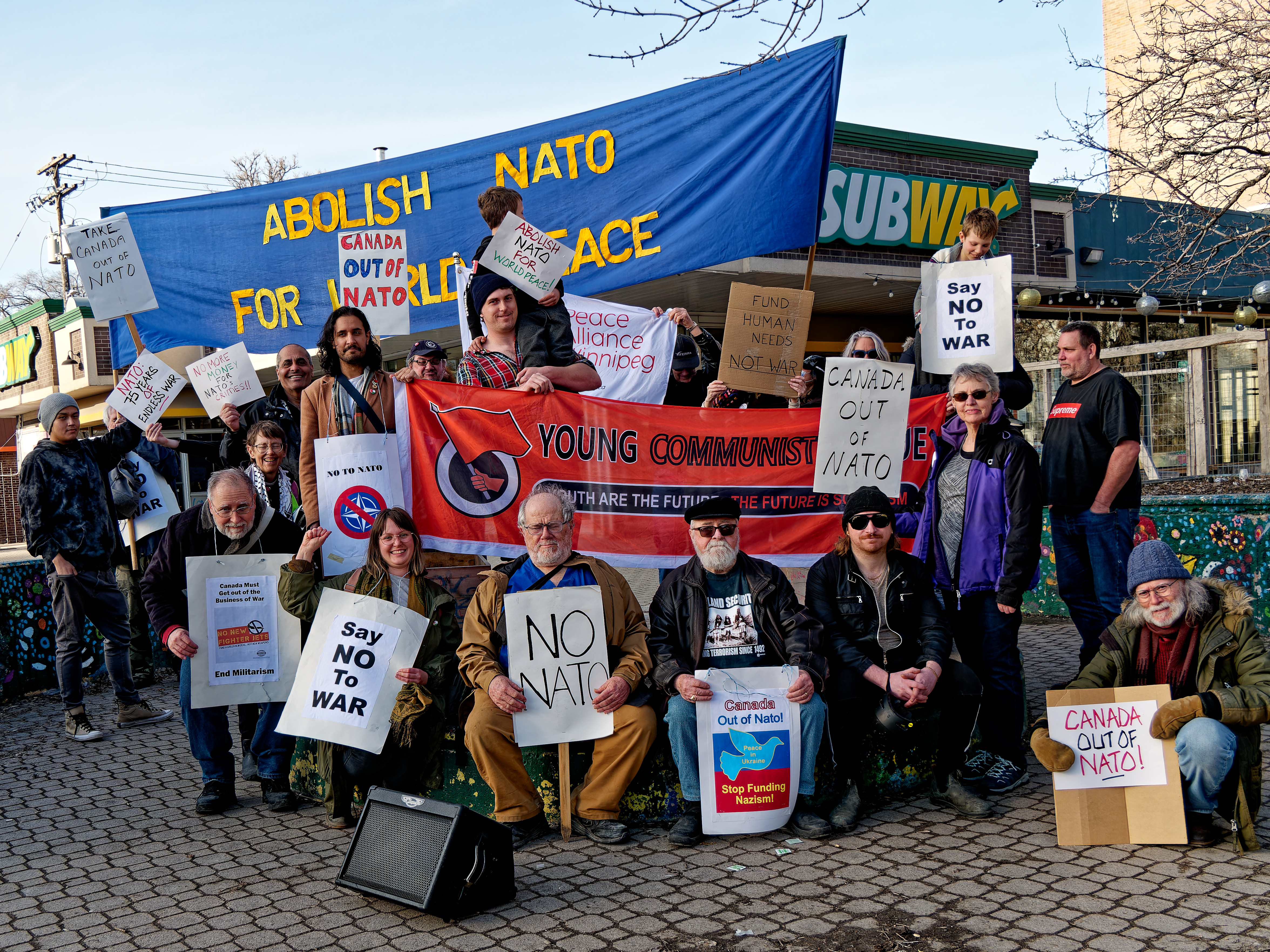
Winnipeg, April 4, 2024: Members of Peace Alliance Winnipeg marked the 75th anniversary of the founding of the North Atlantic Treaty Organization (NATO) with an information picket in the Osborne Villlage neighbourhood of Winnipeg. Following is the text of the statement they distributed.
Canada Must Get Out of NATO It’s High Time and Long Overdue!
The Biden Administration and the heads-of states of other Western powers, including Canada, are preparing to mark the 75th anniversary of the formation of the North Atlantic Treaty Organization (NATO). It will be a gala affair, with much fanfare and chest-thumping among the economic and political elites. But NATO’s continued existence is nothing to celebrate; rather, it is a time for a sober reappraisal of the dangerous role of this political-military alliance, and of Canada’s membership within it.
Neither the parties in the Canadian parliament nor the mainstream corporate media are prepared to seriously examine, much less question, our NATO status. And yet it is precisely our NATO membership – and the ‘obligations’ that entails – which is the mechanism driving increased military spending and preparations for more aggression and war.
Peace activists and organizations in Quebec and across the rest of Canada, together with allies in the labour and people’s movements, need to move this festering issue to the front burner, and intensify grassroots efforts across the country to demand Canada’s withdrawal from NATO and call for the dissolution of this dangerous military pact as a whole.
NATO was formed on April 4, 1949, with Canada as one of its founding members. This aggressive alliance was ostensibly created to preserve peace and stability, and to “safeguard the freedoms of its peoples”, based on the “principles of democracy” and “the rule of law”. Its primary raison-d’être however was to prepare for war against the former Soviet Union, which it considered an existential threat to ‘Western values’, the capitalist order and the maintenance of U.S. hegemony around the world.
Ever since its founding in April 1949, NATO has served as the vehicle to spur the arms race in the name of ‘peace through strength’. In that very same year, the Truman Administration in the United States secretly developed “Operation Dropshot’ to launch a devastating nuclear ‘first-strike’ against the former Soviet Union. Throughout the ‘cold war’ years, the U.S. and its NATO allies always maintained an overwhelming military superiority over the USSR and the Warsaw Pact – a fact that they cynically concealed from public view at the time, but now readily admit.
But NATO did not dissolve when, in the early 1990s, the USSR was dismantled and broken up (along with the Warsaw Treaty). Instead, it seized the opportunity to launch a massive expansion program into Eastern Europe, right up to the borders of the Russian Federation. In February 1990, US Secretary of State James Baker promised that NATO would not expand eastward following the reunification of Germany. His famous phrase “not one inch” was followed by a relentless NATO expansion program.
U.S. imperialist wars, taken under the mantle of NATO, have included the 78-day aerial bombardment of Yugoslavia in 1999, the invasion and occupation of Afghanistan in October 2001, and the toppling of the Kaddafi government in Libya in 2011, to name only a few examples.
At its core, NATO is the muscle enforcing class domination on behalf of Western monopolies and banks, and reflects the colonialist, supremacist policies of its ruling elites. Through its ‘Partnership’ program, NATO is extending its tentacles far beyond the North Atlantic. And it is now openly preparing to launch an Asian variant of NATO, extending its sphere of operations to the Far East to tighten the encirclement of the People’s Republic of China. In today’s world, NATO has become the primary obstacle to peace and stability. Its policies of confrontation are global in scope. Take the war in Ukraine, for example. In the early days of that horrendous conflict, Washington dispatched its NATO puppet, former UK Prime Minister Boris Johnson to Kyiv on April 9, 2022 to block a potential peace treaty between Ukraine and the Russian Federation. The proposed treaty would have seen the Russian Federation withdraw its troops in exchange for Ukrainian neutrality but NATO insisted on trying to bring Ukraine into the alliance. The results of NATO meddling have been catastrophic for Ukraine with hundreds of thousands killed and injured.
The USA is aggressively pursuing a similar approach in south-east Asia. With support from Canada and other NATO powers, the U.S. empire is trying to provoke a confrontation with China over the province of Taiwan. This provocation includes “academic exchanges” with Taiwanese military personnel being trained at NATO’s Defence College in Rome and training its fighter pilots in the United States, selling weapons to the island province dating from 1979, stationing U.S. troops and regular navy war ships and aircraft passing through the Taiwan Strait. Clearly such actions promote instability in the region and can certainly lead to another war.
NATO promotes instability, aggression and war around the world. On behalf of U.S. imperialism, it threatens, intimidates and uses military might to plunder any country or region in service of its economic and geopolitical interests. It is a monster driving a new round of militarization, bringing humanity to the precipice of nuclear annihilation. It must be dismantled, and Canada must free itselffrom its shackles and move towards a foreign policy of peace and disarmament, based on the UN Charter and international law. Canada’s membership in NATO comes with an incredibly high price-tag. It chains our country to an aggressive, militaristic alliance dominated by the United States, and makes it virtually impossible to deviate from foreign policy decisions made in Washington DC. For instance, NATO’s nuclear “first-use” policy is routinely trotted out as an excuse why Canada (and other NATO countries) must refuse to sign the UN Treaty on the Prohibition of Nuclear Weapons (TPNW). Canada’s NATO commitment also drains massive amounts of budget resources away from desperately needed social programs such as health, education, housing and environmental protection. NATO demands member countries commit 2% of their annual GDP to war and aggression, euphemistically referred to as “defence spending”. Currently Canada wastes $35 billion on war preparations, but with Canada’s $2.9 trillion GDP, that means $58 billion annually must be diverted away from social programs and services like education, healthcare, affordable housing and environmental protection.
The Canadian Peace Congress and the Mouvement Québécois pour la Paix are organizing a country-wide campaign to get Canada out of NATO (as well as NORAD and the ‘Five Eyes’ spy network). This will include organizing public protest actions on Saturday, April 6, 2024 in as many cities and localities as possible. We are also producing leaflets and posters denouncing NATO, educational activities to expose the true nature of this criminal organization, and other initiatives. We appeal to our local Peace Councils and affiliated members, and to other anti-war, labour, women’s and youth organizations to support and join these anti-NATO actions, and to help promote cooperation in building a stronger, more effective peace movement across Canada.
Canada Out of NATO! No to war, Yes to Peace!
Winnipeg, April 4, 2024: Members of Peace Alliance Winnipeg marked the 75th anniversary of the founding of the North Atlantic Treaty Organization (NATO) with an information picket in the Osborne Villlage neighbourhood of Winnipeg. Photos and video by Paul S. Graham
Winnipeg, March 24, 2024: Members of the Manitoba-Cuba Solidarity Committee rallied to show support for the Cuban people in their six-decade struggle to end the United States economic blockade of their country. Following is the text of a statement the Committee distributed at the rally.
BIDEN, END THE CRIMINAL U.S. BLOCKADE OF CUBA!! TAKE CUBA OFF THE STATE SPONSORS OF TERRORISM LIST!! LET CUBA LIVE!!
Statement of Manitoba-Cuba Solidarity Committee for the Rally Against the Blockade, March 24, 2024
Protests in Santiago de Cuba last Sunday – people worried about the serious shortages of food, electricity and other basic necessities – have been used by the U.S. and enemies of Cuba to stir up calls once again for regime change in Cuba. The international media has called them ‘anti-government’ protests. A U.S. Department of State official posted “The United States stands with the Cuban people as they exercise their rights to assemble peacefully. The Cuban government will not be able to meet the needs of its people until it embraces democracy and the rule of law and respects the rights of Cuban citizens.”
This statement is a blatant threat and the height of hypocrisy! It is the U. S. blockade of Cuba, now in its 62nd year, and Trump’s addition of Cuba to the list of State Sponsors of Terrorism in 2021, one week before his term as President ended, that have caused and exacerbated the economic crisis in Cuba which has led to the serious shortages of necessities around the country.
An infamous U.S. declassified 1960 document (one year after the victory of the Cuban Revolution) written by Lester Mallory, Deputy Assistant Secretary of State for Inter-American Affairs concludes that “the only foreseeable means of alienating internal support is through disenchantment and disaffection based on economic dissatisfaction and hardship.” It adds . . . “every possible means should be undertaken promptly to weaken the economic life of Cuba”. The ‘every possible means’ over the years have included bombings, military interventions, sabotage, assassination attempts in addition to the provisions of the Blockade. The financial damage to the Cuban economy has added up to more than 1 trillion U.S. dollars. Had Cuba not been subjected to the Blockade for 62 years, its ability to develop the economy and meet ALL the needs of the Cuban people would have led the way in the world to showing what a socialist economy could accomplish.
In spite of all the efforts, the Cuban people are strong and determined. They will survive this latest attempt as they have overcome all the attempts from the U.S. over the past decades to bring Cuba back into its fold, to become once again a playground for the rich, a colony with materials and labour to exploit.
Cuba will defend socialism and its right to independence, sovereignty and self-determination.
Cuba has so many friends all around the world! The solidarity movement in Canada and in the heartland of imperialism is strong and will not falter. It is our role to continue supporting Cuba in its defense of humanity, on its path to determining its own society and future.
President Biden, you have just over 7 months left in this term. Do something positive and . . .
TAKE CUBA OFF THE SSOT LIST! END THE BLOCKADE OF CUBA! LET CUBA LIVE!
“Gaza – Stories of Grief, Resilience and Hope” was hosted by the Canadian Palestinian Association of Manitoba and Independent Jewish Voices Winnipeg at the Canadian Museum for Human Rights in Winnipeg on March 16, 2024. As the title suggests, members of the Palestinian diaspora in Winnipeg share the impact this war has had on them and their family members and friends in Gaza.
PAUL GRAHAM:Owen Schalk is a writer of short stories, novels, political analyses, and essays on film and literature. He is a columnist at Canadian Dimension, and has written for Alborada, Monthly Review, Protean Magazine, and many other publications. His most recent book is entitled Canada in Afghanistan: A story of military, diplomatic, political and media failure, 2003-2023. It’s published this year by Lorimer and available online in paperback and e-book formats and at better bookstores across Canada. Owen’s book and what it says about Canadian foreign policy more generally is the topic of our discussion today.
Owen, and I’d like to begin by telling you how much I enjoyed reading your book. It’s well written and comprehensive. You provide an historical context for Canada’s involvement in America’s so-called War on Terror and it’s a context that most Canadians are not aware of and you bring to light many facts about Canada’s actions that thoughtful Canadians would find disturbing. So welcome. I’m really glad to talk to you.
OWEN SCHALK: Yeah, likewise. Thank you for the invite and thanks for that introduction.
PAUL GRAHAM: Let’s begin by talking about the scope of Canada’s involvement in the invasion and occupation of Afghanistan that began in 2003. What specifically did we do? Why did we do it, and what impact did our actions have in Afghanistan and for that matter, on Canada.
OWEN SCHALK: Yeah so in the book, I divide the military mission itself into four sections, and each section is represented by a major Canadian operation in Afghanistan. So I go through Operation Apollo – that’s from 2001 to 2003, then Operation Athena, Phase One, Athena Phase Two and then ending with Operation Attention. That brings us to 2014 and the withdrawal, and each of these operations had different tactics and aims, but taken together, they paint a picture of Canadian involvement that’s very wide-ranging. I mean, by the end, this mission cost us at least $18.5 billions. It involved ground, naval and air troops, special forces operations, psychological operations, development initiatives, domestic propaganda and more. These operations were embedded in a geopolitical context that saw Canada work with the US and work with NATO in Washington’s pursuit of a certain regional and global order.
So just running very briefly through these four operations that I used to structure the book, we begin with Operation Apollo which was Canada’s contribution to Operation Enduring Freedom – the actual invasion of Afghanistan. And that involved about 7000 Canadian troops working hand in glove with U.S. forces, and it ultimately involved almost every single part of the Department of National Defence. It was very, very comprehensive mission. And that that brings us to 2003, where we inaugurate the first phase of Operation Athena, which is based in Kabul.
And Athena Phase One is meant to support the goals of the ISAF in the capital. That’s the International Security Assistance Force and provide security for the new authorities as they organize elections for Parliament and President.
And so CIDA sets up offices during this time. The Canadian ambassador is welcomed back in a splashy ceremony. Thousands of Canadian soldiers are deployed to help set up this new this new constitution, the new elections, all of which, of course, excludes the Taliban and does not empower the true democrats in the country or those fighting for gender equality or economic equality. It’s designed to empower the Northern Alliance, which is this alliance of Northern warlords and militias, Tajiks, Uzbeks and Hazaras, who are for a lot of reasons opposed to the Taliban, which is Pashtun organization.
And Athena, in this phase involved police patrols, Canadian planners becoming tight with the new President, Hamid Karzai, influencing the new government’s economic policies toward a neoliberal orientation.
And it must be said, too, that the elections that Canada provided security for here were not exactly “free and fair” – to use the term that’s bandied about a lot today. The warlords were never disarmed, despite the population wanting that, knowing that intimidation would follow if they were not. There were reports of multiple voting and of course, foreign money, like US money, flowing to the winning presidential candidate, Hamid Karzai.
And that brings us to 2005, with the second phase of Athena, in which Canadian forces moved to Kandahar with the provincial reconstruction team.
And that’s really Canada most significant investment in the war. Once Karzai is entrenched in the capital, the Canadian forces relieve the US military from Kandahar, and they bring in what’s called a 3D approach, the defence development and diplomacy, but practically that means that the defence, the military component really, really dominates, and Canadian actions in Kandahar could be very heavy-handed, and they sowed a lot of distrust amongst the Afghan people there. It was really in Kandahar, where you see, like the big military operations – Operation Mountain Thrust, Operation Medusa. The development programs really get going with schools, health, education, the Dahla Dam, polio eradication: you know, very well advertised initiatives that were, in the end not successful if they were ever meant to be, but they did serve one important purpose, which was obscuring the fact that Canada was involved in this counterinsurgency war and not, as it was branded, a humanitarian peacekeeping mission. And that goes until 2011, when Canadian troops moved back to Kabul with Operation Attention, which is mainly a training mission that lasts to 2014 and then they withdraw.
So why did we do it? Why were we there from 2001 to 2014? And what impact did these actions have? I would say the reasons we were there have been very obscured by media censorship, on the one hand, and also propaganda. The military journalist David Pugliese says that this was the most extensive propaganda campaign designed to convince the Canadian public about the need for this war since World War Two and it was massive in scale. And the narrative that was forwarded at that time was that we were there to support human rights, to plant the seed of democracy and gender equality and the Real geopolitical interests, things like regional investment, the arms industry, the geopolitics: all of these things were not included in this narrative.
And what was the impact? I mean, all the major development initiatives failed. The Dahla Dam was never repaired, polio wasn’t eradicated. Canadian built schools often had few or no students. There were in some areas of the country for sure, life got easier for women, but Canada’s promotion of gender equality conflicted with the views of a lot of people Canada was supporting in the Karzai government. Like in 2009, Hamid Karzai endorsed a law legalizing rape within marriage and banning women from leaving their home without their husband’s permission. And this was Canada’s guy.
So, I guess to sum up this question, Canada dedicated a lot of resources to the occupation, but they did so out of material self-interest, the material self-interest of the state and they did not achieve much for the people of Afghanistan.
PAUL GRAHAM: When most Canadians think about Afghanistan, if in fact they think about it at all, they do tend to remember the military operations, the losses of life, of Canadians. Perhaps they even think about the many Afghan citizens who died in that conflict. But Canada’s role and you alluded to this a few minutes ago, was much broader than strictly a military one. They were participants in government in a fairly significant way. I wonder if you could talk a b it about that.
OWEN SCHALK: Yeah, of course. So, other than the military role, I think the most important aspect to consider is the economic one.
So at the time of the mission we were in that end of history moment as it was called after the Cold War, when Western leaders were telling the world that free enterprise and Western style democracy were the future. These models would inevitably spread, and that this was the end of any ideological conflict over economics. It would only be over culture from now on.
So the economic model that Canada supported in Afghanistan and around the world was a free market model, very neoliberal that reduced the power of the state and increased the power of foreign actors and international investors, including Canadian investors.
So I mentioned that during Athena Phase One, Canadian officials became very involved in the Afghan Government’s economic policy. There was actually a team of Canadian forces personnel called the Strategic Advisory Team – Afghanistan, the SAT-A, who were installed at the highest levels of the Afghan Government to advise on economic policy.
And they even helped write the Afghan national development strategy, which affirmed that privatization and the free market would be the guiding principles of the new Afghan economy.
So Canadian officers, they advised the economics team, they advised electoral officers, the president himself and the SATA was highly influential, like out of all proportion to their size. As part of this new economic model imposed on Afghanistan, we saw a lot of Canadian companies invest and secure lucrative, lucrative contracts.
In the country we saw mining companies pour in, engineering firms, consultants and more.
We can also say more about the development side of things – like the these aid initiatives that were so well publicized and celebrated. In reality, they were mainly photogenic, not concerned with the actual development of the Afghan economy. And at the same time that we had these development initiatives furthering a certain narrative about the mission, we also had Canadian companies coming in and they were the ones who were doing well off of this occupation. It wasn’t the Afghan people themselves, by and large.
So yeah, the military component was the most visible. It was the most talked about, but the economic dimension and foreign aid – those are also useful lenses through which to examine the mission and to understand the actual mechanisms by which it operated.
PAUL GRAHAM: Canadians have gone to war in faraway lands many, many times since Confederation, either as part of the British Armed Forces or as allies of American empires throughout the 20th century. And despite that, most Canadians tend to view our role of the world to be that of peacekeepers. In your book, you talk quite a lot about the gap between the myth of Canadian foreign policy and the reality. I wonder if you can expand on that a bit.
OWEN SCHALK: Yeah. So the myth of Canadian foreign policy is something I think all listeners will be familiar with. It’s the myth of Canadian generosity in international affairs, the idea that Canada’s sole interest around the globe is promoting democracy and human rights. And this myth has helped to craft a national brand for Canada this benevolent brand I think you could reasonably call it Canadian exceptionalism.
But in the book I attempt a deep history of how this brand emerged, going back to 1945, when Canada really started to spread its influence around the globe. And then I also look at 1947 and the Gray Lecture of Louis St. Laurent, where he kind of founded this idea that Canadian foreign policy is first and foremost concerned with moral questions, not economic ones.
And this this discourse of morality still infuses conversations around Canadian foreign policy, and it certainly did during the war in Afghanistan as well. But throughout Canadian history, there’s always been another thread that gets neglected if we accept that moral framing. And that’s the material thread, the economic thread, the question of what the Canadian state’s actual material self-interest might be around the globe.
So, I argue in the book that it’s always been about access to markets and access to resources. Going back to the post World War 2 moment and to Canada’s first foreign aid program, which is called the Colombo Plan, we see it there too. The explicit goal of the Colombo Plan, which was centred around Southeast Asia, was to fight communism and to encourage those post colonial nations to adopt pro capitalist reforms rather than socialist or Communist ones.
And Keith Spicer, this longtime government insider, he said that the primary motivation behind this aid plan was to stop these countries from replicating the Chinese revolution of 1949, which was a revolution that deprived Western nations of access to China’s resources on the West’s terms.
So that’s the reality of Canadian foreign policy, I would argue. Canada, like other nations, is motivated by economic self-interest and as a capitalist state, that means that Canada’s interests are capitalist interests: the spread of open markets, the ability of Canadian companies to invest on favorable terms to extract enough profit to make those investments worthwhile.
And frankly, I think it should be common sense that Canada has these selfish motives in its engagement with the world.
And yeah, we can go back to more recent wars that Canada participated in with Korea, Vietnam. That was mainly through arms production, not so much boots on the ground. The former Yugoslavia. There’s always a self-interest there. Material and economic self-interest. The fight against communism or, you know, the arms industry interests, the promotion of Western Power. It’s always there.
But self-interest runs counter to those myths of Canadian history, so it’s usually ignored in mainstream discussions of our foreign policy, including with Afghanistan.
PAUL GRAHAM: Can we dive a little bit deeper on some of these economic and commercial interests, particularly as they pertain to Afghanistan. Are there companies or industries that benefited in particular from that particular war?
OWEN SCHALK: I mean, yeah, totally. So we could talk about like the mining companies, there’s the major mining concession, the Hajigak mining concession in Afghanistan, which was the largest iron mine in the country and supposedly one of the largest untapped iron ore deposits in Asia.
And after the invasion, a Canadian company got part of that. There were, you know, many other companies, financial companies that were advising the Afghan government on their policy. There were engineering firms that benefited from contracts including SNC Lavalin and then arms companies, of course, in Canada that I detail in the book. These economic and commercial interests were very real and they were there for anyone to see.
And really, you could you could pick any area of the world, and if you do your research, you’ll see how Canadian corporate interests play a huge role there in shaping our government’s foreign policy. It could be the Caribbean, Latin America, Africa, Asia.
And absolutely the same was true of the Afghanistan mission.
And once you accept that that’s the logic that governs our states decision making, it becomes clear why Canada would involve itself in this war and to the extent that it did. You know, much like the Colombo plan, the war in Afghanistan and the War on Terror more broadly, as it was called, was about spreading a certain economic model around the world for the benefit of Canadian companies, and it goes without saying that these companies are deeply entwined with the state, with the major political party.
And undoubtedly that influences Canada’s international positions as well. But yeah, you could look at all these different sectors. I mainly focus on mining in my work outside of this book.
But I was able to find many examples of Canadian companies in various industries profiting from this invasion of this occupation.
PAUL GRAHAM: Former Prime Minister Jean Chretien had a particular interest in Afghanistan, did he not?
OWEN SCHALK: Yes. Jean Chretien flew multiple times to Turkmenistan to meet with the Turkmen President, President Niyazov, and he was there accompanied by Canadian oil companies.
And the Turkmen oil, was it played a huge role in the Afghanistan invasion and the geopolitics around it. You know, it was in US interests, Western interests generally, to see a pipeline of Turkmen oil flow through Afghanistan and into Pakistan and India. This was the TAPI pipeline.
And Chretien took an interest in that after he left the Premiership and yeah, he flew to Turkmenistan. He met with Niyazov, he was with these companies and yeah, Canada was very aware of this pipeline plan. They backed it in numerous meetings. The Defence Minister, Peter Mackay, said that Canada would defend the pipeline from Taliban attacks if needed. So yeah, absolutely oil. Another another key sector here.
PAUL GRAHAM: So, the shooting has stopped. The United States finally withdrew. The Taliban have regained control of the country, and presumably peace has come to Afghanistan, but the misery continues. Can you talk about how Canada and the United States and perhaps other countries continue to make life difficult for the Afghan people?
OWEN SCHALK: Yeah. So, in in early 2022, after the US had withdrawn from Afghanistan, the Biden administration chose to seize the new Afghan government’s central bank reserves, which were valued at a total of $7 billion, which is in a huge amount for any country, but especially in underdeveloped country like Afghanistan. And the situation worsened immediately, to the point that 95% of Afghans are not getting enough to eat. And meanwhile, Biden ignored calls to return that money to Afghanistan, leaving international charities and organizations trying to pick up the slack and bring the Afghan people some much needed assistance.
And Canada is implicated in this as well. And in a really shameful way. So while the Afghan people were struggling to eat, you know, also last year there were reports of hospitals filling up, soaring child malnutrition, people selling organs on the black market to survive. While all this was going on, the Canadian government policy was actually blocking aid from being allowed into Afghanistan.
And in August last year, World Vision had to cancel a shipment of food that would have fed almost 2000 Afghan children because of a federal law that bans Canadians from doing business with the Taliban, and that extends to aid in Ottawa’s mind.
There were reports of Canadian officials warning aid groups not to pay drivers to deliver food around Afghanistan, because that might give taxes to the Taliban, and this was as these groups were telling Western governments that they had warehouses full of food sitting inside Afghanistan that they couldn’t deliver because they might be penalized for it.
In the situation now, I haven’t been following it as closely. I know that earlier this year that Trudeau government said that they were going to reform these laws to allow an aid loophole. I haven’t seen much follow-up reporting on that. I was contacted earlier this year by a woman from Whistler who said that she donated to a charity that builds playgrounds in Afghanistan.
She had spoken with the people who run it. She was confident that they would be able to work there.
So it’s possible that Canadian government is loosening some restrictions a little bit.
But as for the situation improving anytime soon, I’m not hopeful. I mean, basically the entire population has been pushed into poverty and precarity, and it seems like the Western powers are keen on keeping Afghanistan frozen in that crisis. I don’t know if it’s indifference or if it’s vindictiveness over losing the war, but it’s hard for me to see that situation improving in the near future.
PAUL GRAHAM: Well, I guess geopolitically what one of the one of the reasons – and you go into this in the book – one of the reasons for the American invasion and the occupation had to do with controlling that part of the world and controlling energy resources – the transit of natural gas and oil, and depriving Russia and China of influence over the area. Is it possible that this continues to be part of the motivation for making life difficult for the Afghans?
OWEN SCHALK: Absolutely, that’s possible. I know that China has expressed interest in investing more in Afghanistan. You know, as part of this BRI [Belt and Road Initiative] project – to try to bring Afghanistan into that which would certainly bring more money into the country, [and] potentially alleviate some of the suffering there.
But yeah, I mean you mentioned kind of the geopolitics of this invasion and that that was a huge part of it. There’s a big concern in the US government at this time about any other country ascending to the point that it could rival US power. And in that region, Central Asia, South Asia, the main concerns were Russia and China rivaling US interests there, and Iran more of a regional power, but a lot of concern about Iran, especially because they were forwarding this plan of building a pipeline to Pakistan and India.
And of course, as I mentioned before, the US and Canada, they wanted Turkmen gas to go to Pakistan and India because Turkmenistan is a lot more friendly to the West than Iran is and they wanted to keep Pakistan and India friendly to the West because of this larger geopolitical game that I alluded to between the US and China and Russia. A lot of geopolitics involved here. And Afghanistan. Yeah, it has won its war against its occupiers, but it remains ensnared in this global game.
I don’t see the situation improving a whole lot anytime soon.
PAUL GRAHAM: You’ve co-authored another book that’s going to be coming out in 2024 with Yves Engler. Can you tell us a little bit more about that?
OWEN SCHALK: Yeah. So that book is called Canada’s long fight against democracy, published by Baraka Books. It’ll be out in February of next year. And that book is a history of military coups that Canada has supported. I believe it’s from 1951 to the present, and we found over 20 coups or coup attempts that Canada has either passively or actively supported. And there are also examples of Canada disregarding internationally monitored elections that don’t serve the state’s geopolitical interests. We have a chapter on the 2006 elections in Gaza, which obviously is very relevant to this moment.
And there are many examples that illustrate the capitalist and the pro corporate logic that determines Canada’s foreign policy decisions. One of the clearest to me is one of the actually the least known, which was a coup in the 1950s in Colombia that brought General Rojas Pinilla to power. Lester B Pearson was a big ally of Rojas Pinilla because he was saying, oh, he’s gonna buy Canadian fighter jets, so we should recognize him. He didn’t care what he was gonna do with those fighter jets. He just said, oh, this guy was a military dictator who came to power in a coup. We like him because he’s gonna help Canadian companies.
And we found evidence of this again and again. Guatemala, Congo, Chile, Uganda, Russia, Bolivia. Venezuela – so many examples and so much data that backs up our argument about the nature of Canadian foreign policy.
And I think it complements my Afghanistan book well too. You know, these are both books that have as a goal kind of the demystification of Canadian foreign policy, an effort to squint through the fog of nationalism and propaganda and censorship to glimpse the real inner workings of the state.
And Yves is one of the best people to read on Canadian foreign policy. I still can’t really believe that I wrote a book with him, but I think anyone who enjoyed my book on Afghanistan, they’ll get a lot out of this book too.
PAUL GRAHAM: Well, I could hardly wait until it comes out and maybe we can have you and Yves on.
So, you are a keen observer of Canadian foreign policy. In your view, what should we expect from the Trudeau government between now and the coming election?
OWEN SCHALK: More of the same, I would guess. I mean, watching events in Gaza right now has been truly sickening and disheartening to me to see the conduct of the Trudeau government there – supporting this genocide that we’re all watching unfold.
There’s another event of relevance going on right now that also kind of exposes how Trudeau views the world, and that’s happening in Panama. It’s not very well known, but in Panama right now, there’s a wide range of social movements rising up against a Canadian mine owned by First Quantum Minerals.
And that mine has been a focal point of social tension for years, and Ottawa has always backed the company against this range of protesters coming out to demand greater equality and more economic security for the country’s people and Trudeau has said nothing.
So I wouldn’t expect too much of a change. I think we might see – and I may be wrong – we might see a drift toward a less warlike stance in Ukraine, but if that happens, that will be a byproduct of the US losing interest in prolonging that war. I mean, there’s a recent article on I think NBC about how the US is urging Zelensky to maybe start considering peace negotiations or a compromise of some kind. But that’s of course in the context of what’s going on in the Middle East. So we might see a change there, but I could be wrong. Overall, I think the character of his foreign policy will remain the same as it has throughout Canadian history – that very pro corporate, self interested stance.
PAUL GRAHAM: Any final thoughts about your book or anything else?
OWEN SCHALK: I just encourage everyone to keep reading about Canadian history, about foreign affairs and Canada’s role in the world. There are many scholars who work hard to demystify this national brand around Canada and to get to the heart of foreign policy.
And I hope everyone keeps reading and I hope that my book can contribute in some small way to that growing catalog of really critical work on our foreign policy decisions.
PAUL GRAHAM: Well, thanks very much, Owen. Listeners, who want to find out where to purchase this book can go online to Amazon or to Indigo books or for a more complete list can go to Lorimer books at https://formaclorimerbooks.ca/product/canada-in-afghanistan.
And I guess we’re going to be continuing our conversation later on this week at McNally Robinson booksellers in Winnipeg, and I’m looking very looking forward to that very much. (November 10, 2023 at 7:00 pm)
OWEN SCHALK: Absolutely. Me too. And thanks again for the invite, Paul.
On September 11, 1973, Popular Unity Government of Salvador Allende was overthrown in a violent coup d’état carried out by the Chilean military with the backing of the government of the United States. The coup leader, General Augusto Pinochet, implemented a bloody campaign of torture, imprisonment and murder. Thousands were killed; thousands more imprisoned; perhaps 200 thousand more were forced into exile. Several hundred found a safe haven in Winnipeg, Canada.
These political exiles, along with friends and supporters in Winnipeg, came together at the Franco-Manitoban Cultural Centre on September 11, 2023 to remember those dark, terrifying days from half a century ago and to honour the many brave men and women who resisted Pinochet’s tyranny. Here is the video I recorded of this commemoration.
Winnipeg, August 9, 2023 — Winnipeggers held a Lanterns for Peace Ceremony to mark the 78th anniversary of the atomic bombings of Hiroshima and Nagasaki. These ceremonies are conducted each year to help keep alive the memory of these attacks so that current generations understand we must never allow nuclear weapons to be used again.
This year, our focus is on the need for Canada to sign the UN Treaty on the Prohibition of Nuclear Weapons, adopted by the UN July 7, 2017. Winnipeg is now one of 19 Canadian cities to support the treaty. Thus far, 92 countries have signed the treaty; Canada’s federal government refuses to support it.
Winnipeg Lanterns for Peace 2023 was sponsored by Peace Alliance Winnipeg, the Japanese Cultural Association of Manitoba, and the Winnipeg Monthly Meeting of the Religious Society of Friends (Quakers)



 Paul S. Graham